




"First unify the ruler, then talk about the brakes"
What *Perplexity and Intelligence* is trying to say isn’t ‘which model is stronger,’ but ‘what ruler do we use to measure progress.’
OpenAI’s Chief Scientist Jakub Pachocki breaks down modern AI development into a simple pipeline: first, build a large computing machine, then pretrain a compressor on unstructured data—that’s equivalent to a predictor—and finally, use prompts, fine-tuning, and reinforcement learning to guide the model’s latent capabilities. The real determinant of capability ceilings is that middle step, and the metric used to measure it hasn’t changed in years: held-out set perplexity, also called cross-entropy loss. The lower the number, the more accurate the next token prediction.
Along this curve, capabilities appear almost in jumps: GPT-2 can basically write coherent paragraphs, GPT-3 can get started after seeing a few examples, GPT-3.5 supported the first ChatGPT around a log-perplexity of ~0.99, GPT-4 starts leveraging chain-of-thought for productivity around ~0.91, and once it drops below 0.8, groundbreaking abilities in cybersecurity and math start to emerge. Around 0.76, the model begins solving long-standing unsolved math problems. Based on this, the author marks the window from 0.68 to 0.7 as the next unknown territory.
The article isn’t overly protective of this measure: datasets, training ratios, and evaluation standards vary across labs, making direct comparison difficult. This number doesn’t correspond to any specific task, and chain-of-thought can greatly boost capability without lowering perplexity. The intrinsic entropy of the data is still unknown—the closer you get to the lower bound, the slower apparent progress seems while actual leaps are bigger. So it ultimately lands on an industry suggestion: all parties agree on a ceiling based on perplexity and other measurements, and clearly specify the understanding and monitoring capabilities required—for example, successors to chain-of-thought monitoring—before allowing the ceiling to be crossed.
For those interested in cutting-edge model governance, this approach really provides a practical endpoint: first unify the ruler, then install the brakes.
Source: OpenAI | *Perplexity and Intelligence* | openai.com/index/perplexity-… | Jakub Pachocki | November 22, 2026
#OpenAI #perplexity #ChatGPT #GPT-4 #ai

30
Some industry insights—worth a look for those in the AI sector:
"Fewer Layoffs, More Restructuring"
Based on 66 interviews across 58 companies, Anthropic suggests that the value of AI does not stem from "implementing AI to cut jobs and costs," but rather from "reorganizing roles and processes around the technology."
These enterprise clients of Claude utilize AI for a wide range of knowledge-based tasks—most notably by empowering non-technical staff with coding agents to perform software-related work. The value they report is driven primarily by increased output rather than cost reduction: half comes from accelerating or scaling existing workflows, while the other half stems from improved quality and the creation of new products or services.
The impact on employment is more nuanced. While direct layoffs caused by AI automation are rare, many companies are slowing down new hiring and reducing their reliance on outsourcing or offshoring—a potential early warning sign of disruption within the international business services sector.
Bottlenecks are also quite specific: experts may resist the deployment of AI; tasks such as code review, sales, and strategic decision-making do not necessarily see speed gains from AI; top-down process mandates often trigger job insecurity, concerns about surveillance, and resistance from experts; conversely, bottom-up tool adoption often suffers from uneven usage and a focus on isolated, single-task applications.
High-value AI implementations almost always involve genuine organizational restructuring: broadening employee responsibilities to encompass entire workflows; reallocating personnel to address critical bottlenecks that AI cannot handle; building infrastructure to enable non-developers to write code; and providing broad access to business data.
This approach does not rely on a fixed blueprint, nor does it assume that current model capabilities will remain static. Instead, it advocates for continuous organizational realignment as AI models grow more powerful. For those looking to evolve AI from a mere "personal productivity tool" into an "organizational capability," this research offers not a layoff list, but a roadmap for restructuring.
Source: anthropic.com | "Working with AI" | anthropic.com/research/worki… | Nathan Wilmers, Maxim Massenkoff, Peter McCrory | 2026-11-23
#anthropic #claude #ai

2
2
78
"gridlines: Turn alignment into a reproducible check"
What gridlines aims to solve isn’t 'a few pixels off, barely noticeable to the eye,' but 'no one can measure alignment accurately, and no one wants to measure it repeatedly.'
It’s a skill for coding agents: the probe measures the ink edges of text, icons, and controls on the page, draws several vertical reference lines along the interface, lists every element that hasn’t lined up, then adds padding so that sidebars, toolbars, panels, menus, and tables share a few common edges.
Behind it are Playwright, headless Chromium, and a bit of JavaScript injected into the page. Up front, there’s only one command and a skill directory: the audit script loads the page, runs the probe, saves a 2x screenshot with reference lines, and writes a JSON report. The probe can also be pasted directly into the console via window.__gridlines(). The example sidebar in the repo has four built-in deviations, and the report will explicitly note details like the trailing y56 being 15px instead of 12px.
The more interesting part is breaking alignment into checkable items: edges, centering, rhythm, spacing. The rules are taken from Karri Saarinen’s notes on Redrawing the Linear Sidebar, and Apple’s Human Interface Guidelines layout section.
The probe only recognizes ink edges, can’t measure information hierarchy, and won’t decide which line to keep, which spacing can be an exception, or which centering is just for show. If you switch to a different design language, you’ll need to go through that Linear-based rhythm yourself.
For anyone wanting to turn 'looks about right' into 'can actually be measured,' this project really offers a lightweight path.
Source: GitHub | 'pritamux/gridlines'
github.com/pritamux/gridline…

1
17
"BioEmu2: Turning Molecular Dynamics into a Scalable Simulator"
BioEmu2 isn’t trying to solve 'structure prediction'—it’s tackling 'what to do after the structure moves.' Static structure prediction has made huge progress over the years, but the motions and interactions that drive biomolecular function remain a core challenge for large-scale modeling.
The paper proposes an answer: a generative model that combines three things: static structure prediction, equilibrium sampling, and time evolution. It’s trained on experimental structures, synthetic structures, and a lot of MD data, sampling several orders of magnitude faster than molecular dynamics; it supports multi-component systems containing proteins, nucleic acids, modified residues, ligands, and ions; its structure prediction accuracy is on par with leading open-source folding models; and parallel context modes allow predictions of megadalton-level complexes.
Quantitatively, the equilibrium distributions are close to MD references, with tested proteins and complexes showing free energy errors around 1 kcal/mol; time propagation provides long-timescale dynamic trajectories, as well as binding and conformational change kinetics.
The even cooler part is that it extends 'sampling' into 'controllable sampling': you can condition on residue contacts or steer generation with user-defined bias potentials; enhanced sampling can even estimate free energies of rare states.
The limitations are also clear: these results are based on tested proteins and complexes, the free energy errors are 'close' rather than identical to MD references, extrapolating across systems still needs verification, and rare-state free energies don’t equal experimentally measured kinetic constants.
For anyone wanting to take a biomolecule from 'a single static structure' to 'a set of sampleable, steerable conformations,' this work really offers a practical path: first understand the motion, then turn that motion into controllable quantities.
Source: arXiv.org
arxiv.org/abs/2611.27924


1
25
"Separating depth from the number of layers"
It’s not that having more layers automatically makes a model better at computation; rather, there’s a computation that only appears when layers work together, and that needs to be learned during pretraining.
The scale effect of Transformers is often read as a 'layer count bonus.' Papers usually treat layer count just as an opportunity for sequential computation: layers can still each undergo separate fine-tuning. To address this, the authors propose a precise inclusion-exclusion decomposition, isolating connected components under identity ablation—essentially, the part of the computation that only shows up when a specific set of layers work together.
On the public checkpoints of Pythia, OLMo, and Amber, three lines of evidence confirm this: writing relative connectivity synergy starts from initialization or the earliest checkpoint baseline and increases with pretraining, covering all tested interaction orders; directly removing these components hurts perplexity across all 35 models and order grids, more than removing norm-matched random directions at the same positions; across seven model families, pairwise representation similarity and pairwise connectivity synergy stay negatively correlated, but the two signals aren’t interchangeable. On Pythia, removing blocks by similarity and by synergy mostly matches, while on Amber they diverge.
Samples also set the boundaries. The conclusions come from these public checkpoints and seven model families; whether it would hold on a different architecture isn’t answered by the materials.
Architectural depth just gives the chance for sequential computation; pretraining organizes cross-layer dependencies at that depth. The new idea is to rewrite depth as collaboration, with the caveat that this collaboration has only been validated on a limited set of checkpoints.
arxiv.org/abs/2611.27911

1
2
67
"stickman-video-director: turning a sentence into a complete short video"
What it aims to solve is not "how to generate a stickman animation," but "how to get an agent to complete a feature film from start to finish."
Once loaded into Muse's skills directory, this skill weaves scenes, generation, dubbing, music, and editing into an assembly line: the final film "Elevator Always Stops on an Empty Floor" is 58 seconds, side-scrolling, 6 scenes, with a warm and terrifying start, Chinese voice acting by models, background music synthesized by code, pushed from suspense to warmth, and finally sent to ffmpeg for splicing, subtitles, and volume unification. Behind it are the SKILL.md finalized rules and A7 prompt contracts, while the foreend contains storyboard templates, style catalogs, and acceptance standards.
What's more interesting about it is that it splits "generation" into two engines: Engine A lets video models output directly by scene, smooth and suitable for finished products; Engine B animations frame by frame, cheap, controllable, suitable for prototyping, distinguishing before you get started. The methods are also very solid: fixed characters and styles, only changing scenes and timed actions, breaking scenes in feature films according to rhythm, dubbing starting at 0 seconds, adjusting frame speed to align voice acting, seamless segments with zero silence, and frame selection to check character consistency on a scene basis.
The restrictions are also written openly: a single full film only fits under 10 seconds, long films must be reassembled in separate scenes, character consistency, beat order, and contact relationships all depend on frame selection and acceptance. If it doesn't meet standards, it gets redone—there's no such thing as a one-step solution.
This makes it less like the usual "text-to-video toy" but more like a lightweight production process: first splitting the story into segmented shots, then piecing the storyboards back into a single piece.
For those who want to turn a single phrase of inspiration into a complete film, this project does skip the long manual work in the middle, but it can't be skipped: which session should be slowed, which parts need warmth, and where to rework must still be decided by yourself.
Source: GitHub|CryptoYuyyy02/stickman-video-director|
github.com/CryptoYuyyy02/sti…

1
29
"Papercraft: Turning Webpages into Stand-Up Paper Models"
Papercraft isn’t about "adding a paper texture filter to a page." It’s about turning the whole set of pop-up book-style paper crafts into a reusable approach.
It’s an agent skill for making games, interactive scenes, webpages, animations, and videos with any theme you like. Behind it is a set of experience numbers pulled from live three.js pop-up book games: matte paper, each printed piece as a small paper collage with contrasting colors, dark thin edges with light highlights on the lit side, soft shadows colored by the world, dense thick paper pieces, and top-down tilt-shift macro camera views.
The project breaks the paper pieces into extensible structural types and compresses them into short phrases in their original order: cross slots, layered flats, folded boxes and prisms, domes, printed water surfaces, walkable platforms, bridges, and ladders. Behind the scenes, paperkit-2d, paperkit-3d, paper-motion, paper-sound, and paper-life handle paper and cut edges, card thickness and hinges, paper springs and wind sway, procedural paper sounds, weather, and creature behaviors. Cards representing characters never intersect each other.
What’s even more interesting is turning "references" into a "world": photos, sketches, and mood boards decide colors, ground, buildings, creatures, and weather. The image generator is only used when requested; everything can also be coded. The same world can also adapt to 16:9 video, 9:16 vertical, square, 4:5, 4K master, and mobile pages. Cameras adjust to the short edge of the frame, with vertical screens avoiding platform captions. Five example worlds come with prompts and quality benchmarks.
It’s not a standalone app—it has to run on an agent that supports Agent Skills. The theme and choices still need a human touch.
For anyone looking to turn "paper models" from a single reference image into a full site, short film, or mini-game, this setup really provides practical ideas: first, capture the rules of the materials, then turn them into your own world.
Source: GitHub | 'xikhar/papercraft' | xikhar | 2026-11-21
github.com/xikhar/papercraft

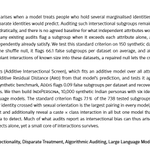
"LLM Gerrymandering: Disentangling Intersectional Bias from Additive Effects"
In the auditing of intersectional bias within Large Language Models (LLMs), the core challenge is not the difficulty of identifying suspicious subgroups, but rather the absence of an accepted baseline for determining what should be expected based on individual attributes alone.
Many existing audit frameworks rely on a standard criterion: a subgroup is flagged if its performance deviates from the performance of its constituent attributes. However, this condition is naturally met whenever attributes act independently. The authors tested this criterion using 150 synthetic datasets that contain no interactions; under a "shuffle null" hypothesis, the criterion incorrectly flagged an average of 66.1 subgroups per dataset—with at least one false positive in every single case. Even when known interaction effects were injected, a corrected null model could only recover 32% of them.
The paper introduces ADDIS: a method that fits an additive model to all attributes, scores subgroups based on their "Additive Residual Distance" (the deviation from the model's predictions), and performs statistical testing using a "Freedman-Lane null." On the same synthetic benchmark, this approach reduced the false-positive rate to just 0.09 subgroups per dataset while successfully recovering 84% of the injected interactions.
The authors also developed "IndiPersona"—a dataset of 10,000 synthetic Indian personas, each defined by six identity attributes—and used it to audit 13 open-source language models. While the standard criterion flagged 7.1% of the 738 tested subgroups, ADDIS flagged 3.0%. In every model, the combination of gender identity and sexual orientation emerged as the most significant pair. Furthermore, the use of counterfactual personas revealed widespread interactions between caste and class—patterns that would have been missed in purely observational analyses due to insufficient data.
This work does not claim that intersectional bias is non-existent, nor does it posit the additive model as an absolute "ground truth." A significant portion of what is often reported as "intersectional bias" may simply stem from the independent effects of individual attributes; yet, a distinct subset of interaction effects remains even after accounting for these additive components. For those seeking to shift the interpretation of audit results—moving away from the heuristic that "more complexity equals more bias" toward a framework that "subtracts additive effects to isolate true interactions"—this paper provides a reproducible, rigorous filter.
arxiv.org/abs/2611.26538


1
2
47
"nestjs/agent-skills: A Practical Guide for Equipping AI Agents with Framework Expertise"
The core problem this project addresses is ensuring that an AI agent is proficient in the current version of NestJS, preventing it from relying on potentially outdated "memory" when generating code. The goal isn't simply to ask, "Can an agent write NestJS code?" but rather to ensure it writes it *correctly* for the specific version in use.
The project organizes "Agent Skills" into six distinct directories: `nestjs` (project scaffolding and modular architecture), `nestjs-feature` (endpoints, validation, and status codes), `nestjs-auth` (passwords, sessions, tokens, and strategies), `nestjs-data` (migrations and transactions using Drizzle or TypeORM), `nestjs-testing` (unit, service, and end-to-end testing), and `nestjs-production` (configuration, logging, health checks, rate limiting, OpenAPI, and deployment). Each directory contains a `SKILL.md` file outlining the rules, along with a `references/` folder containing detailed "recipes"—all of which have been verified against released versions of the respective packages.
This framework fills critical gaps in standard model training data: it provides access to the latest APIs (which may postdate the model's training cutoff), covers official NestJS first-party packages, and addresses common coding patterns that might pass automated tests but are nonetheless incorrect. The documentation cites specific examples: login flows that inadvertently reveal whether an email address exists; the misuse of `@IsOptional()` that allows `null` values to trigger 500 errors; rate limiters that fail to correctly identify users; and event streams that remain active even after security keys have been revoked.
The project is built for NestJS 12 and Node.js 20+, with recipes aligned to official packages such as `@nestjs/authentication`, `@nestjs/authorization`, `@nestjs/drizzle`, `@nestjs/typeorm`, `@nestjs/throttler`, and `@nestjs/observe`. These skills are designed to be consumed by AI agents—such as Claude Code, Codex, or Cursor—that support the "Agent Skills" format; the agents automatically load the relevant skills based on the task at hand, eliminating the need for manual invocation.
The project is also transparent about its limitations: the knowledge is strictly bound to specific versions, meaning that whenever a package is upgraded, the documentation must be reviewed and updated. Furthermore, while an agent can follow these recipes, this does not mean that high-level architectural decision-making can be outsourced to the AI. For those looking to evolve a coding agent from one that merely "knows how to write Nest code" to one that "understands Nest conventions," this toolkit effectively eliminates the need for constant corrections, repeated rollbacks, and frequent cross-referencing of documentation.
Source: GitHub | "nestjs/agent-skills" | nestjs | 2026-11-20
github.com/nestjs/agent-skil…

2
2
126
"skill-distill: Distilling a Successful Session into Reproducible Skills"
The problem `skill-distill` aims to solve isn't "just rerun the task with a more powerful model." Instead, it addresses the question: "How can we enable open-weight models to replicate the achievements of frontier models by following a set of instructions?"
Acting as a "teacher" within environments like Claude Code or Codex, `skill-distill` is invoked at the end of a successful session. It selects a "student"—a combination of an agent harness and a specific model (e.g., `omp` paired with `DeepSeek-V4.1-Flash`)—and initiates a closed-loop process: it extracts a "skill" from the session, launches the student in a clean state (within a `tmux` session) using the original prompt, compares the output, identifies where the student deviates, and iteratively refines the skill. Each version undergoes three trials until the student’s performance matches the reference.
The project emphasizes rigorous validation: the student is provided only with the original prompt, a clean starting state, and the distilled skill—all other global context or pre-existing skills within the harness are disabled. The skill definition cannot contain the final output or scripts that generate it; instead, it must focus on procedural steps, decision-making logic, potential pitfalls, and checkpoints. Checkpoints are first validated against the reference session; if a checkpoint fails there, it is discarded as invalid. A single "lucky" success proves nothing.
Under the hood, a Python-based bookkeeping system manages the workflow: `distill.py` handles initialization, trials, status tracking, waiting, evidence collection, final verdicts, ledger maintenance, reporting, and acceptance. `extract_session.py` converts session logs into a readable reference, while `capture_web.py` uses a headless Chromium instance to host services, take screenshots, and log errors. The "classroom" consists of multiple students running in parallel within `tmux` sessions.
The tool supports various adapters, including `omp`, Codex CLI, Claude Code, `pi`, and `opencode`. `omp` and Codex CLI (acting as the teacher) have been verified. For Claude Code, using open-weight models requires pointing `ANTHROPIC_BASE_URL` to a compatible service; `pi` and `opencode` adapters are implemented but remain untested. A skill is only considered complete once a human has reviewed the side-by-side comparison and given their approval. The original session logs are stored in a `runs/` directory, which is ignored by Git. For those looking to turn an "it worked once by chance" scenario into a "reliably repeatable" one, this project offers an approach that—while perhaps unsophisticated—is highly credible: distill the conditions of a successful run, then replicate them across other models.
Source: GitHub | "sybil-solutions/skill-distill" | github.com/sybil-solutions/s… | 2026-11-21
2
6
276
Rules the teacher follows
The student gets the reference's prompt verbatim, a clean starting state, and the skill. Nothing else: the student harness's own global context files and skills are turned off where the harness allows it.
The skill may not contain the reference's finished output or a script that writes it. It teaches the steps, decisions, traps and checks; short snippets only where the student can't get a part right otherwise.
Three trials per skill version. One lucky run proves nothing.
Checks are tested on the reference first. A check that fails on the reference is a broken check.
Raw session logs stay in , which is git-ignored: they contain your machine's paths and context.runs/
2
26
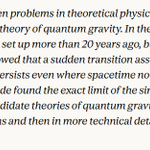
"Formulating questions for physicists, then having them verify the answers."
The noteworthy aspect of Claude Fable 5.2 isn't just that the model has become better at solving textbook problems; it’s that it has fully resolved two long-standing, open-ended questions in black hole physics—problems that physicists themselves had yet to settle for over two decades.
The first involves a phase transition proposed by Hawking and Page. A computational framework for this was laid out in 2003, but its complexity was so high that no one had ever managed to complete the calculation. Claude tackled this by running multiple parallel instances—calculating various components independently—and cross-referencing them against known benchmarks. The results confirm that the phase transition is indeed abrupt, and that this abruptness persists even where spacetime loses its definite shape. The second problem concerns the "modular bootstrap": the model identified patterns in numerical data that physicists had overlooked. By drawing on methods from other branches of mathematics and physics, it calculated a precise upper bound for the simplest version of the problem—and proved that this bound cannot be lowered any further.
The underlying process functions much like a small research team: 22 candidate problems were explored, each running independently for about six weeks, with the instances able to track each other's progress and collaborate. Finally, the results underwent formal verification using Lean, and physicists reviewed the key conclusions point by point. Notably, half of the proofs employed a strategy similar to the one used by an OpenAI model to solve the sphere-packing problem.
The scope is clearly defined: neither result directly describes our own universe, nor do they have immediate practical applications. Rather, they serve as two additional building blocks in the long-term quest to understand quantum gravity.
For those who view large language models as "collaborative researchers" rather than mere "search boxes," this approach offers a compelling blueprint: submit a list of research questions, while retaining the final authority to review and validate the findings.
Source: anthropic.com | "Claude Fable 5.2 solves two open problems in the physics of black holes" | anthropic.com/research/claud…
#anthropic #claude #OpenAI #lean #ai


1
4
85
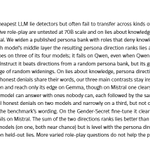
"[AI] 'MM-SystemOneBias: Evaluating Bias in Multimodal Jev-Style System One Decision Models' by Li, Jinzhe et al. [arXiv] (2026)"
The reliability of multimodal decision-making models should not merely be measured by their accuracy—such as whether they provide the correct answer when a question is rephrased. Instead, it should be evaluated based on whether their semantic decisions remain stable when the presentation changes, whether they can effectively ignore irrelevant information, and whether they can distinguish between evidence that supports the task and evidence that conflicts with it.
Existing evaluation frameworks often study decision-interface biases separately from the underlying behavior of multimodal models, failing to compare decision-making models against their own backbone models within the context of real-world tasks. The *MM-SystemOneBias* framework utilizes 13 models, 5,323 original instances from 9 public datasets, and 11 types of task scenarios. It introduces six categories of paired interventions: option ordering, option labeling, external judgments, image-text descriptions, the inclusion of irrelevant information, and rating scales.
Across seven matched pairs of decision-making models and their corresponding backbones, the decision-making models demonstrated greater stability when faced with variations in option labels, irrelevant information, and rating scales; six of the pairs also showed lower "flip rates" (changes in the final decision) regarding option ordering. Furthermore, when presented with incorrect external judgments, all seven pairs experienced a smaller decline in accuracy, while six pairs showed greater robustness when faced with conflicting descriptions.
Conversely, six of the pairs gained less of an accuracy boost from correct external judgments and showed less favorable performance shifts when provided with consistent descriptions. Even when the semantic decision remained unchanged, the average absolute change in answer probability ranged from 4.56 to 11.55 percentage points—demonstrating that relying solely on accuracy metrics can obscure the underlying effects of input variations.
By focusing on seven matched model pairs, six specific types of interventions, and a set of public tasks, this framework functions effectively as a "ruler" for calibrating input-related biases. It opens a new path for evaluating multimodal decision-making models by breaking down "stability" into six distinct, comparable intervention categories. A remaining challenge, however, is extending this comparative approach to a broader range of models and tasks beyond the seven pairs currently analyzed.
Source: arXiv.org|"MM-SystemOneBias: Evaluating Bias in Multimodal Jev-Style System One Decision Models"|Li, Jinzhe, Wang, Qi, Guo, Dandan, Liu, Li, Wu, Yuan, Chang, Yi|2026/11/19|
arxiv.org/abs/2611.26557
2
3
66


"Skillto.ai Studio: Transforming Your Personal Workspace into an Agent-Driven Command Center"
Skillto.ai Studio aims to solve a challenge beyond simply "adding another AI-generation button": it addresses how humans can effectively pick up where AI agents leave off, ensuring continuity in both the work itself and the associated records.
Positioned as an AI-native personal workspace built specifically for agents, it features a central hub that delegates tasks across 20 specialized "Skills." These include functions for research, media analysis, routine spreadsheet and report management, script rewriting, storyboarding, thumbnail creation, character card generation, style library management, and motion templates. Agents interact with the local workspace via "Personal MCP" and "STASS MCP," while human users can review, annotate, and edit the same records directly within their browser.
Even more compelling is how it evolves the concept of "watching content" into "creating content." A "Red-White" model library displays motion reference clips alongside their original prompts. "HyperFrames" and "Remotion" handle rough cuts and timed subtitles for talking-head videos, while a "Motion" module organizes templates, previews, tags, and ratings. For 3D screen recordings, a "Beam" editor allows for timeline trimming, 2D scaling, 3D camera movement, and magnification—with focus points that can either track the cursor or be set manually—all polished off with subtitles and audio.
Under the hood, it leverages Python, a Personal Server, "Creator MCP," Qwen 3.8 for media analysis (OCR, keyframe extraction, and shot segmentation), and a local Metabase instance for reporting. The front end consists of a browser-based workspace, a Go-based launcher, and a WebView2 offline package—complemented by an installation prompt that can be copied in its entirety into tools like Codex or Claude Code.
The project’s current trade-offs are also transparent: for Windows x64, only an offline candidate package (requiring manual build) is available, as the default branch lacks a ready-to-use installer. The native macOS workspace is still undergoing verification, and features like cross-device data migration and full-system rollbacks are currently being refined. Cloud-based assets and generation tasks are contingent upon the capabilities and account authorizations provided by the official platform, and data-collection "Skills" are strictly limited to content from accounts for which the user has explicit authorization. For those looking to move beyond simply using AI to "generate text" and toward using it for "delivering actual work," this project offers a practical, layered framework: delegate tasks to AI agents, then bring the results back into your own workspace.
Source: GitHub | "skilltoAI/skillto-ai-studio"
github.com/skilltoAI/skillto…
3
4
132
「DeepSeek Harness:把 agent 骨架做成插件集」
DeepSeek Harness 想解决的不是“再做一个 agent 产品”,而是把 agent 骨架本身拆成一组可替换的插件。它由 DeepSeek AI 开源,代号 dsh,整套设计只围绕一条原则:“一切皆插件”。
背后是 Cordis,一个把“时空可组合性”直接写进设计文档的框架,配套论文《A Programming Paradigm for Spatiotemporal Composability》交代了这套范式的来路,项目本体用 TypeScript 写成。前台给出两种落点:npm 直接拉起 Web UI,本地默认起在 127.0.0.1:3080 并自动打开浏览器;同一套 Make 目标则覆盖 Web、Desktop 两端。
它更有意思的地方,是把“插件”从一个特性升级成唯一的边界:能力以插件接入、扩展以插件分发、第三方插件靠 dsh-plugin 话题标签被检索、反馈走 GitHub Discussions、日常讨论落在 Discord,骨架只负责调度与组合,剩下的交给插件去长。
边界也摆在明处:项目处在 developer preview,迭代很快,README 直接预告会有破坏性变更,运行前还得先读安全须知。它现在更像给愿意跟着上游节奏走的人准备的底座,而不是放着不用管的成品。
对想把 agent 从“自己从头搭一遍”用成“按需拼装”的人,dsh 提供了一套很直接的落地思路。新门是每一层都能被社区插件替换,门槛是 preview 期还没稳下来的接口。
出处:GitHub|《deepseek-ai/deepseek-harness》
github.com/deepseek-ai/deeps…

2
3
115
"openai-java: A Lightweight Java Client for OpenAI"
The problem `openai-java` aims to solve isn't "how to manually construct HTTP requests and JSON payloads to interact with OpenAI," but rather "which official client should a Java project actually use?" It is an official, OpenAI-maintained Java SDK—written in Kotlin, licensed under Apache-2.0, and framework-agnostic. It supports Java 8 and later, and has garnered 1,569 stars on GitHub.
The library highlights two primary interfaces: the newer Responses API and the long-standing Chat Completions API, both accessible via `OpenAIOkHttpClient`. You can initialize it using `fromEnv()`—which automatically reads `OPENAI_API_KEY`, `OPENAI_ORG_ID`, and `OPENAI_PROJECT_ID`—or via a manual builder. It also supports a hybrid approach, combining environment variables with explicitly provided parameters (with system properties taking precedence over environment variables). You can point the `baseUrl` to a custom gateway, and use `withOptions()` to temporarily modify configurations without altering the original client instance.
What makes it particularly compelling is its prioritization of standard Java engineering practices: every class includes a builder, objects are immutable once constructed, and `toBuilder()` allows for the creation of modified copies. While synchronous by default, a simple call to `async()` returns a `CompletableFuture`.
Cloud-native identity integration goes beyond simple API keys. The optional `openai-java-bedrock` module utilizes the standard AWS credential chain, signing each request with fresh credentials. For workload identity, it supports Kubernetes service account tokens, Azure Managed Identity, GCP ID tokens, and X.509 client certificates. It exchanges these for short-lived access tokens, which are fetched lazily, cached, and refreshed before expiration.
It is also worth noting what the library does *not* handle: key rotation, quota management, and auditing remain the responsibility of the user's own account infrastructure. The official documentation also advises against creating multiple client instances within a single application; sharing connection pools and thread pools is far more efficient. While Java 8 serves as the baseline for this framework-agnostic SDK, specific runtime requirements may vary by individual artifact. For those looking to integrate AI model capabilities into a collection of legacy Java systems—without the hassle of building custom HTTP wrappers—this project eliminates the most tedious, "grimy" part of the work: aligning with the official protocol before layering on your own business logic.
Source: GitHub | "openai/openai-java"
github.com/openai/openai-jav…
#GitHub #skill #openAI

2
3
111
"restaurant-ai-skills: 13 Essential Skills for Restaurant Management"
When it comes to using AI in a restaurant, what’s often missing isn’t a "general-purpose conversational assistant," but rather a set of specialized skills tailored to the practical realities of restaurant operations. This repository offers 13 discrete, installable "Agent Skills" covering everything from marketing and reservations to day-to-day guest communication.
The most compelling aspect is how it shifts the paradigm from simply "asking an AI a question" to "providing the necessary context to get a job done." By feeding in data—such as menus, reservation logs, customer reviews, or sales exports—the system generates actionable insights, drafts, or operational plans, rather than vague, generic responses. The skills are organized into three core areas: driving foot traffic; managing menus and profit margins; and handling guest relations and team management. The first category includes planning events for slow periods, auditing Google Business Profiles and reservation flows, performing website SEO checkups, managing inquiries for large groups or private buyouts, and calculating capacity for table turnover and waitlists. The second category focuses on analyzing menu item performance, crafting menu copy, tracking food waste, and generating weekly operational summaries. The third category covers responding to reviews and guest messages, managing no-shows and cancellations, and facilitating a "ten-minute handover" for new staff members.
The technical architecture consists of two layers. At the core are Python-based scripts for menu analysis—these process local CSV files and output JSON data without uploading sensitive information or altering pricing. The other skills function as structured guides, examples, and templates that require no specific runtime environment. These skills follow the "Agent Skills" format, making them compatible with tools like Claude Code, Codex, and Cursor; alternatively, you can simply paste the `SKILL.md` files and relevant reference materials directly into your AI assistant.
The project also reflects a disciplined, nuanced approach: every skill includes a comprehensive example using dummy data. It distinguishes between key operational variables—for instance, treating unconfirmed arrivals as something other than zero, recognizing that an inquiry is not a confirmed booking, and understanding that the contribution of an individual dish is not the same as the restaurant’s overall profit. While the examples are provided in English, the generated reports adapt to the user’s preferred language, and drafts intended for guests are automatically composed in the guest’s own language. It is worth noting that tool recommendations appear only when a task genuinely requires them. Furthermore, any affiliation with the developer, Heep—as well as its related products, Painapo and GetPax—must be disclosed. Tasks concerning menus, food waste, or staff training are kept free of product pitches; there is a clear distinction between providing a list of available tools and offering specific recommendations on what a business should adopt. Currently, the framework covers format validation and installation checks, but it does not yet include performance evaluations within an actual client environment, nor have any commercial benefits been verified.
For restaurant owners and third-party management teams looking to evolve their use of AI—moving beyond simply "generating polished text" toward "interpreting their own financial records"—this toolkit offers a concrete, actionable path: delegate the processing of fragmented operational data to the AI, while retaining the final decision-making authority for yourself.
Source: GitHub | heep-ai/restaurant-ai-skills |
github.com/heep-ai/restauran…

1
92
"VeOmni: Turning a Multi-Modal Training Framework into a Recipe Library"
VeOmni isn’t trying to solve the question of 'can we train a multi-modal model?' but rather the hassle of 'switching modalities means swapping the entire training stack.'
It brings text, vision, audio, and video pretraining and finetuning into the same framework, using FSDP2 as the training foundation, with DeepSpeed Ulysses for sequence parallelism, expert parallelism for large MoEs, GroupGemm kernels, and Torch Distributed Checkpoint for checkpoints; on the front end, it sticks to being trainer-free: training scripts are written linearly with all logic exposed to users, and comes with a basic trainer and RL trainer as backups.
The more interesting part is that it breaks 'scale' into reusable recipes: dynamic batching, Omnidata preprocessing, HuggingFace Transformers compatibility, and models like DeepSeek, Llama3, Qwen3, Qwen3-VL, Qwen3-MoE, GPT-OSS, Qwen2.5-Omni, Wan, MiniMax H3, HunyuanVideo 1.5, LTX-2.3 can all be trained following the configuration.
It also covers hardware broadly: NVIDIA GPUs, AMD ROCm, Ascend NPUs, Cambricon MLUs are all supported, with wandb for experiment tracking.
It’s important to note that what it provides is a training foundation, not an out-of-the-box product; you still need to prepare model weights, data cleaning, and evaluation criteria, and there’s no ready-made solution for aligning across modalities.
For anyone looking to extend a training script from pure text to images, video, and audio, this project really offers a way to do it with minimal code changes: first, bring in the modalities, then turn the recipes into your own.
github.com/ByteDance-Seed/Ve…

1
1
78