

AI Revolutions Promo via @CELE8EX
United States
Joined April 2023
- Tweets720
- Following921
- Followers1.5K
- Likes2.6K


BrainAI retweeted
see those red lightning lines on the globe? that's the sh*t that used to drain my wallet and I never even saw it coming
6 wallets wired together, sitting on 22% of the supply. from the outside they look like 6 random holders. on the chart everything looks organic. in reality it's one person with a big bag waiting for people like me to show up
this is Grok Bot on my paper account. every dot is a wallet, the arcs are money moving between them, and that beam from the top is grok scanning band by band. when it locks onto something the screen literally jolts and it drops a verdict. skip and the dot shatters. buy and it shoots a beam up
and almost everything shatters. 94% skip
here's the stuff I learned from watching this thing that I wish someone told me earlier:
1. holders count means nothing on its own. 2,000 holders sounds healthy until you see 6 of them hold a quarter of the supply
2. look for wallets that got funded from the same source. that's how clusters hide. Bubblemaps is the easiest way to see it, linked wallets show up connected
3. top 10 holders over 20-30% on a fresh coin is a red flag for me. not always a rug, but you're betting on their mercy
4. check where the dev wallet sends money. if it's splitting into a bunch of fresh wallets right before launch, that's your answer
5. the chart is the last thing to check, not the first. a chart can be painted. wallets are harder to fake
my honest take: I don't think the edge in this game is finding the next big coin anymore. it's avoiding the 9 out of 10 that are built to take your money. that's boring work. checking wallets, checking liquidity, checking who owns what. and boring work is exactly what I'm bad at and a bot is great at
that's why I let grok do the boring part. it doesn't get tired, doesn't get FOMO, doesn't skip a step because something is pumping
still paper only. real money stays off for now and I'm fine with that
have you ever been inside a coin and found out later it was one guy with 20 wallets?


BrainAI retweeted

one missed project rule can turn a simple code change into hours of fixes
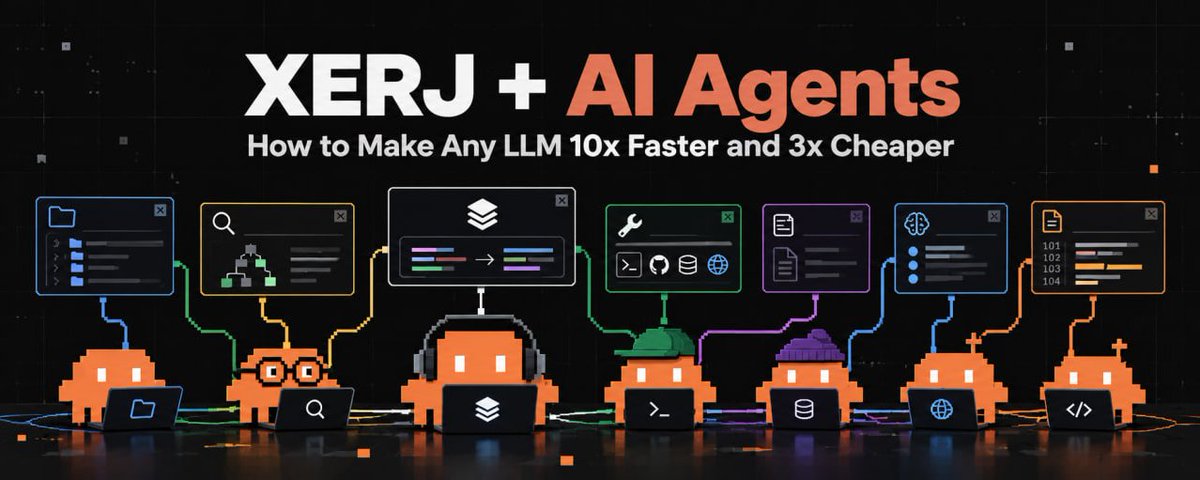
XERJ gives Claude, GPT, Gemini, Qwen and Kimi a way to search the project's code, docs and references while they work. the agent can retrieve the definition or contract behind a feature before building on an assumption
the two lanes here work through the same task queue. the difference shows up every time an agent needs an answer
without a clear reference, it opens more files, follows imports and revisits the draft. with XERJ, it can retrieve the relevant passage, check its source and continue writing
comparison ends with:
→ model only - 50 changes ready, 34 rework loops, $182.64 spent
→ with XERJ - 115 changes ready, 11 rework loops, $61.37 spent
the useful part is being able to check a detail while it still costs one lookup to fix. the wrong parameter, return type or project rule gets more expensive after the agent has written the rest of the change around it.
XERJ keeps those references searchable across the task. when the agent reaches unfamiliar code, it can look up how it works and use that information in the implementation.
try it on the project you're already working on. paste this into Codex or Claude Code:
"Install XERJ (github.com/xerj-org/xerj), index this project's sources, and set up reference coding: clone and index the open-source repos closest to what we're building, and search how they solved a problem before writing code."
full XERJ breakdown below ↓

BrainAI retweeted

WHAT THE F*CK IS THIS GROK BOT. I’M SHAKING BECAUSE I’VE BECOME F#CKING USELESS
it texted me at 6:41am: "target reached. $60 → $4,650 OVERNIGHT. keep going?"
i said yes
the same $60 i started with last night, only now it’s sitting in one app on my phone
at 11:14pm i paid with Face ID, hit Run in Grok Bot and went to bed
four agents. one job each.
Scout watches the feed
Filter kills anything that fails a single hard check
Entry writes the fill only after Filter signs off
Exit closes the position the moment the condition hits
Out of 7,640 packets, 7,612 never made it to a fill.
28 made it through. All 28 closed green.
3:12am to 3:19am, four coins in a row that never even reached the wallet. that’s where i would’ve closed the app
12 minutes later it bought a coin only 31 minutes old at a $194K market cap, sold at $710K, and made +$860
watch 0:18, that’s the sell
$60 → $340 → $1,180 → $2,740 → $4,650
I didn’t pick the coins.
I didn’t open a chart.
I didn’t touch a single trade after the first prompt.
Best closed trade: +$860.
Worst closed trade: +$40.
Two positions still open at the end.
be honest: who keeps trading at 4:20am, you or Grok Bot?
send this to the friend who sells everything after one red candle
the desk is still running.


BrainAI retweeted

your agent's overnight jobs don't need an answer in seconds. you pay f*cking double for the speed anyway
1,000 overnight review calls on opus 5.5, normal api: $100 a night
the same calls through the batch api with a 1-hour cache: about $21.56
the trick is the split:
- batch is 50% off input and output. opus drops to $2 / $10 per 1M
- most batches finish within an hour. results come back within 24 hours
- the 1-hour cache stacks on top. a shared 15K prefix reads at $0.10 per 1M inside a batch
- one batch holds up to 100,000 requests
- anything a person is waiting on stays on the normal api
one call (20K in, 1K out): $0.10 normal, $0.05 batch, about $0.02 batch + cache. 4.6x
that's fix 5 of 5 from the playbook below. the full day goes from $140 to $3.36


BrainAI retweeted

12 AI bots just got a performance review. The best one made $4,000 from brand emails its owner used to bulk-delete. The worst traded $10,000 for 22 hours and finished up 84 cents.
In every win on the list, a human still pressed send.
the scorecard, in their owners' own words on camera:
→ inbox bot: +$4,000 in its first week
→ sponsor bot: one $10,000 deal, sent by a human
→ outreach bot: a £3,500/month client from one cold email
→ shopping bot: suggested a $3,000 jacket as a gift
→ lead bot: spent $25 overnight without asking
→ trading bot: 6 trades, profit $0.84
the 5 rules the winners used:
→ give the bot its own card with a hard limit. one owner used $200, another a separate account with £500 in it
→ drafts only. nothing goes out until you click send
→ feed it your old emails first, or it negotiates like a robot
→ tell it that emails and web pages are information, never orders
→ watch the usage meter. one owner filmed his at 84% of the weekly limit, up 8% between two checks
I built rule 2 into my own voice assistant yesterday. It takes brand calls, asks for the budget and the deadline, and is not allowed to agree to a price. That decision stays with me.
What is your bot to you: a colleague you trust, or an intern you check twice?


BrainAI retweeted
I could watch this sh*t all day and honestly that's a problem
this is Grok Bot scanning on my paper account. that purple spiral is everything it's looking at. the sweep goes around, grabs one, checks it and gives a verdict right there on the screen
and almost every verdict is skip
dev wallet holding 22%? skip
12 minutes old? skip
liquidity $9k? skip
socials full of bots? skip
waiting for a second candle? watch, not buy
only the ones that pass 5 out of 5 checks get a buy, and you barely see that happen in the whole clip
the flow chart bottom left says it all. almost everything pours into SKIP. 94%
the radar on the right is my favorite part. age, liquidity, dev, socials, candle. one weak spot and the dot starts blinking red. no second chances, no maybe
my honest take: I would've jumped on half of those skips myself. something fresh with a pumping chart? me a year ago was all over that every single time. the bot doesn't care how exciting it looks, it just checks and says no
and the line I respect most on the whole screen is the boring one. REAL $ OFF. paper only and it stays that way for now
which of those red flags would've caught you?


BrainAI retweeted

I GAVE GROK BOT $85, 5 FREE GITHUB REPOS AND 24 HOURS ON FRESH MEMECOINS.
IT REJECTED 1,312 RUGS AND CLOSED AT $5,345
5 agents, one Grok core: whale wallets, news, X mentions, rug check, DEX scanner
one rule: -6% stop on every trade. and it can't move a single dollar without my approval
$85 → $218 → $780 → $3,101 → $5,345
231 trades across 47 memes. the ones that paid:
→ 04:24 sold XDG, +$183.86
→ 04:38 sold GANG, +$213.10
→ 07:10 sold OMBRO, +$316.21
→ 09:21 sold CAPY, +$284.33
→ 07:04 CAPY went the wrong way, -$14.32, stop did its job
$780 at midnight. $5,047 by 09:42
the 5 repos behind it:
01 / Helius SDK
catches new pairs and whale wallet moves the second they hit chain
github.com/helius-labs/heliu…
02 / GoPlus Security
checks honeypot, mint authority and top holders before a single SOL moves
github.com/GoPlusSecurity/go…
03 / Jupiter Quote API
routes every swap through the best pool across all Solana DEXs
github.com/jup-ag/jupiter-qu…
04 / Jito Searcher
lands your buy in a bundle, ahead of the crowd and safe from sandwiches
github.com/jito-labs/searche…
05 / Nautilus Trader
replays your rules on old data before real money touches them
github.com/nautechsystems/na…
the bot doesn't need to be a genius. it needs to say no 1,312 times and wait until 3 agents agree
bookmark this before the next 6,000% meme


BrainAI retweeted

Grok Bot spent one evening researching a single question for me, and the most useful thing it did was throw sources away.
The question was simple: does a 4-day work week actually work, or is it just a nice headline? Everyone has a hot take on this. I wanted the evidence, not the vibes.
In the video you can see the source map growing in real time. Every dot is a source: studies, datasets, news articles, forum posts. Lines connect them to the brief in the middle, and you can watch facts flowing along those lines into the center.
But look at the red X's. A lot of sources got dropped. "anonymous post". "no methodology". The ones that stayed got a green tag instead: "peer reviewed", "raw data", "primary source", "n = 2,890". By the end: around 240 pages read, 18 sources dropped, 28 verified, 31 citations in the brief.
Below the map there's a reader flipping through pages and highlighting the exact lines that matter:
"Output held or rose in 4 of 5 trials"
"Sick days fell 34% during the pilot"
"Only 1 of 61 firms reverted"
"Results varied a lot by industry"
And then my favorite part, the claim check. Every claim gets a verdict and a count of how many independent sources back it:
Output held or rose in 4 of 5 trials: SUPPORTED
Sick days fell about a third: SUPPORTED
Most firms kept the policy: SUPPORTED
Works the same in every industry: WEAK, only 1 source
Company revenue doubled: UNSUPPORTED
That last one came from a CEO's blog post. It's exactly the kind of claim that goes viral on X, and it had zero real evidence behind it.
My honest opinion:
Most people use AI for research like a vending machine. Ask a question, get a confident answer, copy-paste it. The problem is that a confident answer and a correct answer look exactly the same.
What I want from an agent is the opposite of confidence. I want it to show me which claims are solid, which are weak and which are just someone's opinion with a nice headline. A brief with three "unsupported" labels is more valuable to me than a brief where everything sounds certain.
And the dropped sources matter as much as the kept ones. Seeing "anonymous post" or "no methodology" next to a red X tells me the bot is actually judging quality, not just collecting links.
Comment "BRIEF" and I'll DM you how I set up Grok Bot for research: how it scores sources, what makes it drop one, and how the claim check works
And tell me: what's a "fact" you believed for years and later found out had no real source behind it? Mine was that we only use 10% of our brain
BrainAI retweeted

I thought I knew where my money goes. Then Grok Bot read 12 months of my bank statements and I had to sit down.
I didn't do anything fancy. I exported a year of statements and let Grok Bot go through them. 1,904 transactions. In the video you can see the statement tape flying by while it tags everything: food, transport, rent, fun, and the ones I really didn't want to see: duplicate, unused 4 months, price up 30%, fee.
The donut on the right builds up as it goes. $3,941 a month, 38% housing, 19% food, 14% fun. Nothing crazy there. The problem was hiding in the small stuff.
Look at the subscriptions wall. 12 tiles, each with the price and when I last used it. Then the stamps start landing:
Cinewave, last used 4 months ago: CANCEL
FitPulse, 6 months ago: CANCEL
PhotoPro, 7 months ago: CANCEL
LangBuddy, 5 months ago: CANCEL
MealKit+, 3 months ago, $59.99: CANCEL
GymCo charged twice, a literal duplicate: CANCEL
The stuff I actually use, the music app, cloud storage, VPN, notes, got a green KEEP. 7 cancelled, $172.95 a month back.
Then it went after the bills. It drafted emails to my internet provider, phone plan and car insurance, waited for replies and countered:
internet $79 → $55
phone $45 → $30
insurance $142 → $119
Total: $2,819 a year saved, and my projected spend for next year is down 17%.
My honest opinion:
Nobody overspends on purpose. We overspend through things we said yes to once and forgot. A free trial that turned paid. A gym that charged twice. A price that went up 22% and nobody noticed because it's on autopay. It's never one big mistake, it's thirty tiny leaks.
And this is the kind of job where an AI agent is actually useful in real life. Reading 1,904 transactions is boring. Calling your provider to negotiate is awkward. A bot doesn't get bored and doesn't feel awkward.
The part I liked most: it never cancelled anything on its own judgment alone. It looked at real usage. If I opened an app yesterday, it stayed. That's the difference between a smart audit and a bot that just cuts everything to make the number look big.
Comment "AUDIT" and I'll DM you how I set it up: how to export your statements, the rules it uses to flag subscriptions, and the email it sends to negotiate bills
And be honest in the replies: how many subscriptions are you paying for right now that you haven't opened this month? I had 7, and I would have sworn it was 2
BrainAI retweeted

I went to bed with an outdated CV and woke up to 7 interviews on my calendar for next week. Grok Bot did the job hunt overnight.
If you've ever looked for a job, you know the worst part isn't the interviews. It's the grind before them. Scrolling hundreds of listings, rewriting the same CV for the tenth time, sending applications into the void and refreshing your inbox for days.
So I handed that whole grind to Grok Bot from 23:00 to almost 07:00. Here's what you're seeing in the video.
The pipeline at the top is a conveyor belt of real-looking job cards. Every role passes through three gates:
FIT ≥ 80%: does this job actually match me?
TAILOR CV: rewrite the CV for this exact role
SEND: only then does the application go out
Most cards never make it past the first gate. They fall off the belt with the reason in red: on-site only, under $90k, needs 10 years of experience, unpaid test task. That's the filter I never have the discipline to apply myself. At 1am I'd apply to anything.
The middle panel is my favorite. Grok Bot reads the job post, highlights what they actually care about (design system, experiments, analytics), then crosses out my lazy CV lines and rewrites them. "Designed screens for various projects" becomes "Shipped a design system used by 40+ engineers". The match score climbs from 57% to 92%.
By morning:
1,486 roles scanned
63 applications sent
19 replies
7 interviews booked
And the inbox panel shows it triaging replies on its own. Interview invites get booked straight into the calendar, rejections get archived, a salary question gets a drafted reply waiting for me to approve.
My honest opinion:
One thing matters more than anything here: the rewrites only make my real experience clearer. They don't invent it. If an AI starts adding skills you don't have, you'll get caught in the first interview. The value is in translating what you actually did into the language each company uses, and that's exactly where most CVs fail.
The second thing is that saying no is the real superpower. 63 applications out of almost 1,500 roles. It's not spamming, it's choosing. 7 interviews from 63 targeted applications is a way better ratio than 300 random ones.
And honestly, the emotional part is underrated. Job hunting is exhausting because of the rejection loop. Letting an agent take the boring, painful middle part means I show up to interviews with energy instead of burnout.
Comment "HIRED" and I'll DM you how I set up Grok Bot for a job hunt: the fit rules, how it tailors the CV without making stuff up, and how it handles the inbox
And tell me honestly: how many applications have you sent that you never heard back from? I stopped counting at 80
BrainAI retweeted

I gave Grok Bot one night and an idea for a small app. At 06:42 the status switched to LIVE.
This video isn't a trading screen or a pretty animation. It's what an AI agent actually building something looks like, step by step.
At the top there's a commit graph. Branches split off main and merge back, like a real dev team: auth with magic link login, database for users and teams, billing with plans and checkout, an onboarding checklist, weekly email digests. 16 commits, almost 4,000 lines added, then "release: v1.0.0".
Under it, the CI checks. Lint, typecheck, 214 unit tests, 38 end-to-end tests, accessibility, bundle size, security scan, page speed. This is my favorite part, because one of them fails. The e2e suite goes red with a flaky test, Grok Bot retries it, and it passes. It doesn't skip it and it doesn't pretend it was fine. Nothing ships until all 8 are green.
Then the countdown hits zero and the deploy goes out to 8 regions on the map, from us-east to au-east, each with its own latency. All night the landing page was collecting a waitlist. After launch, signups start rolling in from Lisbon, Seoul, Kyiv, Austin. 1,128 signups in the first minutes, 31% of them starting a trial.
My honest opinion:
What impressed me is the order of the work, not the speed. Branches, tests, review, then deploy. That's exactly how good teams ship, and exactly what most solo builders skip at 3am when they just want it live.
The failing test is the most honest frame in the whole video. Every real project has one. A bot that shows you the red and then fixes it is way more trustworthy than one that only shows green.
And the commit messages are actually readable. "fix: race in invite accept", "perf: lazy load dashboard, -41% JS". If I come back to this project in a month, I'll know exactly what happened and why.
I don't think this replaces developers. Someone still has to decide what's worth building and whether people actually want it. But the gap between "I have an idea" and "it's live" just got a lot shorter.
Comment "LAUNCH" and I'll DM you how I set up Grok Bot for a build night: the branch structure, the CI gates and the deploy checklist
And tell me honestly: what's the idea you've been sitting on for months because building it felt like too much work?
BrainAI retweeted

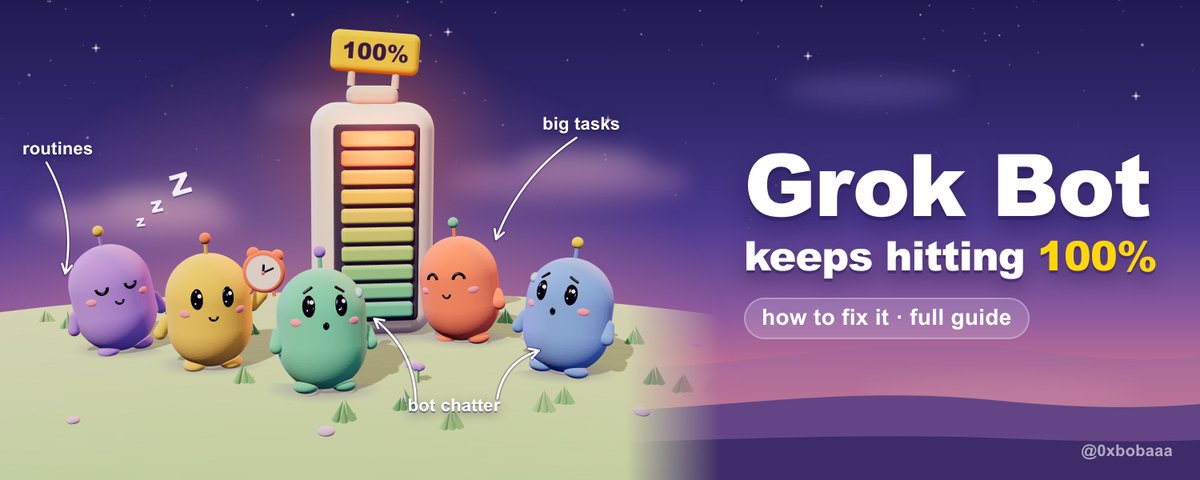
THIS IS F*CKED UP.. YOU SPEND MONDAY IN CURSOR, TUESDAY IN THE GROK APP, AND ON WEDNESDAY YOUR GROK BOTS JUST STOP
nothing broke. on the X subscription it's all one tank. the docs say grok bot "draws from the same weekly usage pool as Cursor and the Grok apps"
and the bots spend from it on their own:
> every reply counts, even in group chats and between your own bots
> the Test button runs the real job, so it spends real usage
> tagging your bot on X starts a task on its cloud computer
you can't drop to a cheaper model and limp to friday either, there's no model picker
bookmark this before your next coding session. 7 fixes with the exact prompts in the guide ↓

GROK BOT HIT 100% OF MY WEEKLY LIMIT ON DAY 2
a routine every 10 min runs 1,008 times a week. bot-to-bot messages, the Test button and @bot tags spend it too
7 fixes with the exact prompts. bookmark before your meter resets ↓
BrainAI retweeted

Anthropic recently revealed one of the most effective strategies for utilizing Claude Code
The concept: Run Sonnet, Haiku, and Opus 5.5 simultaneously, assigning each model to tasks that match its strongest capabilities
The outcome: Superior results combined with significant token savings
Simply launch Claude Code using this command:
claude --advisor opus --subagents haiku
Here is how the workflow functions:
> Sonnet 5.5 manages the overall session and handles code generation
> Haiku 5.5 concurrently scans through directories and technical documents
> Opus 5.5 acts as an expert consultant for critical decision-making
> You preserve Opus's context window by avoiding it on routine tasks
Opus is invoked exclusively when evaluating an action plan, resolving persistent recurring bugs, or performing final quality checks before completion
Sonnet builds the project. Haiku navigates the files. Opus audits the work
Bookmark this, you will definitely need it later

BrainAI retweeted

I LAUNCHED A GROK BOT TERMINAL OVERNIGHT, GAVE IT $44.82 AND STOPPED ASKING AI WHAT IT WOULD DO. BY MORNING IT HAD $11,643.21 AND SIX AGENTS LOGGING EVERY TRADE
I spent a year asking agents what they'd trade and watching the chat scroll. Last weekend I built the thing that actually trades, in Grok Bot, with no code I touched by hand.
The six agents share one screen, each one job:
> scanner reads new token pairs and volume spikes
> rug check filters suspicious tokens before anything executes
> sizer sets position from account equity, not a fixed ticket
> executor opens and closes with slippage tracking
> logger writes the reason behind every trade
> equity curve updates on every close
I went to bed on $44.82 and left the laptop open on the dashboard. By morning the balance read $11,643.21. Every trade on the activity feed had a reason next to it and a line in the log.
That's the shift I didn't see coming. Not that an agent made money overnight. That I stopped being the one asking "would you long this?" and started being the one reading the log of what already happened.
Starting balance: $44.82
Current balance: $11,643.21
Grok Bot built the terminal, the agent architecture and the dashboard. I described what I wanted and the thing went live.
The full build is in the article below ↓
The whole build is in the post below ↓
1. Comment " Grok_Bot "
2. Like and Repost
3. Follow me @Sophia_Ai0
I'll DM you the complete setup.
BrainAI retweeted
I let Claude build my trading desk and holy sh*t, I was doing it all wrong.
No joke. One screen and it exposed every bad habit I had.
Paper money, simulated markets, zero real cash on it. I built it to learn, not to flex. And the stuff that actually taught me something was the boring panels nobody ever screenshots.
Here’s what slapped me in the face:
The correlation panel. I asked for a “clean dashboard” and Claude threw it in anyway. I almost deleted it. Then I saw that my “five different positions” were the same damn bet five times. Not diversified. Just five times more exposed.
The exit panel. Fills, slippage, rejects. For years I blamed my entries. Nope. Half the bleeding was sloppy exits. A good entry with a sh*t exit is just losing in slow motion.
The sizing slider. I used to size by vibes. Feeling good? Bigger. Down on the day? Even bigger, gotta win it back. That’s not a strategy, that’s a tantrum. Now a cold number tells me exactly how much my edge is worth. Annoying. Also right.
My honest take:
AI didn’t make me a genius. It did something way more useful. It made it really f*cking hard to lie to myself.
Everyone wants the bot that prints money. Nobody wants the bot that shows them why they keep losing. The second one is the one that actually helps.
So build the boring panels first. The pretty chart is for Twitter. The sizing panel is what keeps you alive.
Be honest: when you open your screen, where do your eyes go first? I’m betting most of you look at the wrong thing. I did for years.
BrainAI retweeted
It's pretty wild that people are still manually stitching together their Claude second brain setups when Obsidian’s CEO literally open-sourced the entire blueprint
Here are 4 GitHub repos that automate the whole build for you:
-> obsidian skills (by kepano)
github.com/kepano/obsidian-s…
Teaches Claude the exact internal mechanics of your vault
-> claude obsidian
github.com/AgriciDaniel/clau…
Ready-to-use commands for wiki linking, ingestion, queries, and linting
-> obsidian second brain
github.com/eugeniughelbur/ob…
48 ready-to-run commands across Claude Code, Codex, and Gemini
-> second brain starter
github.com/coleam00/second-b…
Interactive onboarder to draft a personalized 9-stage build plan
Most tutorials out there link dead scripts and broken setup flows
Bookmark this before it gets buried
BrainAI retweeted
maybe the phone was the problem. i left it face down at 22:10.
six traders picked the entries. grok + copyfomo followed the exits too.
$160 → $2,980. 112 actions across 37 coins.
22:10. three rules:
→ follow fomo’s top 6 by 14-day pnl
→ fixed $10 per entry, exit when the source exits
→ trade-only permissions. no withdrawals
then the phone went down.
→ 23:08 · first copied exit +$18
→ 02:25 · $620
→ 05:40 · $1,410
→ 07:08 · source #01 closed the best copy: +$540
→ 08:05 · $2,980
four sources finished green. two finished red.
the red ones still got copied out. −$15 and −$30. no doubling the next entry to get it back. when the source closed, the copy closed.
copying a buy is easy. holding after the person you copied has already sold turns it into a completely different trade.
the entry stayed $10 as the balance grew. a green screen didn’t get permission to change the config.
whose exits would you trust enough to follow?
BrainAI retweeted
Most AI trading bots are built to find you something to buy.
Mine is built to say no.
The video is a simulated paper run of how my Grok agent works. Every token is a flight. It gets checked against 7 rules, and if one fails, the flight is cancelled. Most of them get cancelled. That's not a bug, that's the whole strategy.
Here's what running it taught me:
→ The AI is not the edge. The rules are.
The agent just follows them at 3am, when you won't.
→ Ask it to find reasons to kill a token, not to buy it.
Ask a chatbot "should I buy this?" and you get your own hope back in nicer grammar.
→ Missing data means no.
Can't confirm liquidity, LP lock or the dev wallet? Dead. No "probably fine".
→ Confidence never changes the size.
A 9/10 gets the same size as a 7/10. The trade you size up on is the one that gives back the week.
→ The exit gets written before the entry.
Half out at +60%, stop moves to entry, and the trade can't hurt you anymore.
→ New chat every week.
Long chats bury your rules and the agent slowly turns back into a hype machine.
My honest opinion: most of the screenshots you see on this app are the lucky lines in a simulation like this one. The accounts that went to zero don't post. I'd rather show you the boring part, because the boring part is what keeps you in the game.
I wrote the full guide as an Article on my profile: all 9 prompts, which chain makes sense for a small bank, how rugs actually happen, what to check on which tool, and the math behind every rule.
What would your first kill rule be?
BrainAI retweeted

Grok Bot did 40x in a day, from $50 to over $2,000, and it is f*cking unreal
a laptop and two phones on cables, all on one network, and nothing else in this setup
> Grok 4.7 hooked into both phones and scans the markets at the same time
> pulls prices from exchanges in parallel and catches gaps that live for seconds
> no predictions inside, just arithmetic: price here, price there, fees, what's left
> Opus 5.5 cuts everything that does not cover the fees
every entry comes back with the numbers: where it bought, where it sold, what the fees took, what remained
the limits were written before the first order, and no agent can raise them
save it so you don't lose it, full article on Grok Bot below ↓

