


Elon Musk believes Neuralink could eventually help people with severe spinal cord injuries walk again.
The idea is to create a communication bridge between the brain and the body.
Normally, the brain sends electrical signals through the spinal cord, which carries movement commands to the muscles. But when the spinal cord is severely damaged, those signals cannot reach their destination.
Neuralink wants to bypass that broken connection.
A brain implant would capture movement intentions from the motor cortex. Those signals could then be decoded and transmitted to another implant near the damaged section of the spinal cord, which would stimulate the appropriate nerves and muscles.
In theory, this could restore voluntary movement without having to repair the original damaged nerves.
But there is another important part of this system. The brain also needs sensory feedback to understand what the body is feeling.
That is why Neuralink has discussed building a two-way communication system, not just sending movement commands.
The ambition is much bigger than controlling a computer with thoughts. It is about reconnecting the brain with the human body.

1
5
Neuralink is working toward two very different milestones.
The first is helping people with paralysis interact with digital devices using their thoughts.
Its Telepathy system records neural activity from the brain and translates it into actions such as moving a computer cursor.
The second is much more ambitious.
Neuralink wants to eventually bypass damaged connections between the brain and spinal cord, potentially allowing people with severe spinal injuries to regain control of their limbs.
These should not be confused.
In its April 2024 PRIME Study update, Neuralink described its initial human clinical trial as an effort to evaluate the safety of its implant and surgical robot and assess whether people with quadriplegia could control external devices.
That is not the same as demonstrating restored walking or full-body movement.
In November 2026, Musk said more than 30 people had received Neuralink devices and again described restoring the ability to walk as a future goal.
The distinction matters because progress in controlling a computer does not automatically establish that the much harder spinal communication system works.
1
8
This is fu*king insane
Vic Gundotra, Google's former Senior Vice President, believes AI is approaching a stage where it could recursively improve its own capabilities.
His concern goes beyond smarter chatbots.
Imagine AI systems that can discover new scientific methods, develop medicines, solve mathematical problems, and eventually produce knowledge that even their creators struggle to understand.
There is already a glimpse of this in mathematics. Anthropic reported that Claude autonomously produced a computer-checked proof of Fermat's Last Theorem in Lean over 11 days, using multiple AI agents.
But there is an important distinction. Producing a result that a computer can verify is not the same as making the reasoning easy for humans to understand.
Gundotra sees this as the beginning of a much bigger transition.
The 12-month prediction is his personal forecast, not an established scientific consensus. But the underlying question deserves serious attention.
What happens when human intelligence is no longer the most capable intelligence on Earth?
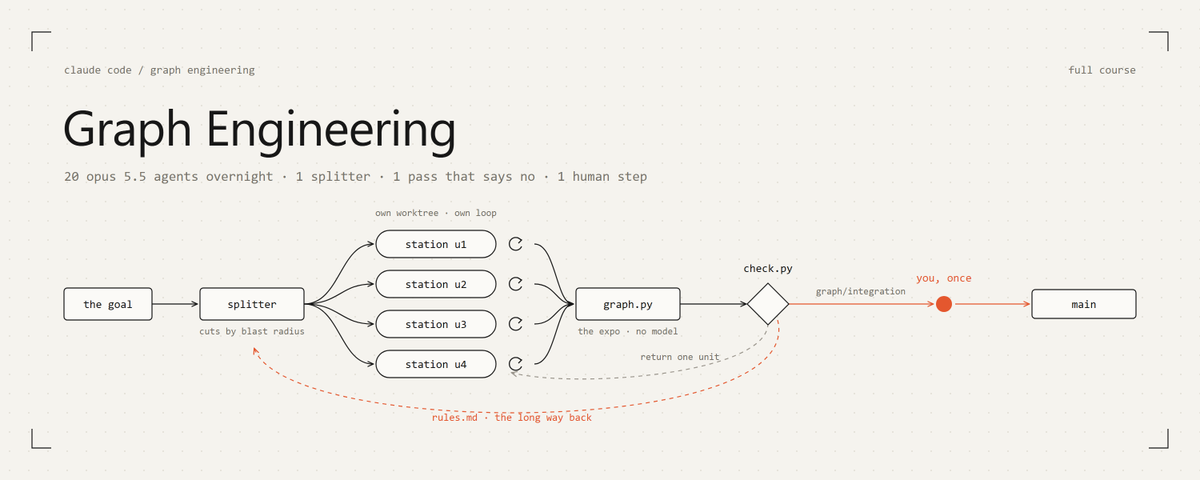
Companies pay $300K+ a year for engineers who can run AI agents without babysitting them
Last week 20 Claude Code agents shipped 143 changes while I slept. I approved 6 merges
Here is graph engineering in Claude Code, file by file. Free ↓
3
OpenAI wants to build Codex for scientists.
Joy Jiao, who works on OpenAI's life sciences efforts, says its models already have capabilities in chemistry and structural biology that many researchers do not know how to use.
The problem is not necessarily the intelligence of the model. It is the gap between what the model can do and what people know how to ask it to do.
This is what she calls a capability overhang.
OpenAI saw something similar in software development. Codex made powerful coding capabilities accessible through a product designed around how programmers actually work.
Now it wants to bring that experience to scientists, biotech companies, and pharmaceutical researchers.
The bigger opportunity is making AI useful inside real scientific workflows, rather than expecting every researcher to become an expert at prompting AI.
The next competitive advantage in AI may belong to companies that make intelligence accessible, not just companies that build more intelligent models.
1
13
OpenAI's ambition in scientific research is not limited to training a better biology model.
It wants to own more of the experience through which scientific work gets done.
Joy Jiao's comments about building Codex for scientists reveal this direction.
GPT-Rosalind provides specialized scientific intelligence. But OpenAI also recognizes that researchers need a product that helps them apply that intelligence to real problems.
This is where scientific workspaces, tool integrations, and repeatable workflows become important.
A researcher might need to combine information from scientific papers, biological databases, internal datasets, and experimental results before making a decision.
A model that can reason across these sources and help execute the workflow becomes much more useful than one that only answers isolated questions.
There is also a strategic advantage here.
When a company becomes part of how professionals perform their daily work, its value is no longer limited to the quality of its underlying model.
It becomes part of the infrastructure of that profession.
8
Sam Altman is worried about an AI future that most people might actually welcome.
Imagine a world where AI cures cancer, eliminates material scarcity, handles most of your work, and gives everyone a comfortable life.
Sounds like a utopia, right?
But what if that same world has constant surveillance, no meaningful privacy, and almost no room for individual choice?
Altman fears that society could overreact to AI safety and gradually accept restrictions that make life more predictable but take away human freedom.
The disturbing part is that people might not even resist it.
If everything is convenient, comfortable, and provided for, how many people would question what they have given up?
The biggest AI question might not just be whether machines remain under human control.
It is whether humans remain in control of their own lives.
1
8
There is an interesting tension in Sam Altman's warning.
We need AI safety because increasingly capable systems can create serious risks.
But if society responds by concentrating AI power in a handful of institutions, it could create another kind of risk.
A world where a small number of organizations decide which AI systems people can access, what they can do, and which uses are acceptable.
That might reduce certain risks in the short term.
But it could also make society dependent on a very small number of decision-makers.
Altman's argument is that safety and decentralization should not be treated as opposing goals.
We need safeguards against dangerous AI behavior while ensuring that intelligence and economic power are distributed widely.
The difficult part is finding that balance before the technology becomes too deeply embedded in society.
4
This is f*cking insane🚨
Jason Calacanis recently argued that the industry is entering a conflict between open-source AI and closed frontier models.
Look at the developments he points to.
Nvidia under Jensen Huang was investing heavily in open models through Nemotron and its proposed $12.9 billion acquisition of Hugging Face.
Then Jensen resigned amid a national-security investigation involving allegations of ties between a business associate and Chinese intelligence.
At the same time, US lawmakers began scrutinizing companies like Airbnb and DoorDash for using Chinese open-weight models.
And Anthropic went public, putting another major frontier AI company in the public markets.
These events do not prove a coordinated campaign.
But they reveal a genuine strategic divide.
Open models make AI cheaper, more accessible, and harder for any single company to control.
Closed frontier models give their creators greater control over access, distribution, and monetization.
The real battle may be about who gets to control the infrastructure of the AI economy.
1
63
America has an unusual problem with Chinese open-weight AI models.
They are becoming useful enough that American companies want to use them.
Airbnb has used Alibaba's Qwen models in customer support. DoorDash has reported using models from several Chinese developers. Cursor's Composer model was built using a version of Moonshot's Kimi.
These are not just experimental projects. They show how Chinese AI technology is entering real business operations.
Washington is concerned that widespread adoption could create long-term dependence on Chinese technology.
But there is another side to this.
If American companies are forced to avoid capable, affordable models simply because of where they originated, they could lose access to useful technology and face higher AI costs.
This creates a difficult policy question.
How does America protect its AI supply chain without making its own businesses less competitive?
That is the tension behind the growing scrutiny of Chinese open-weight models.
7
This is Fu*king insane🚨
Steve Jobs understood something about retail that many technology companies overlooked.
In 2001, when Jobs decided to open Apple Stores, the idea was heavily criticized. Michael Dell reportedly called it crazy, saying it would never work.
Even Bernard Arnault, the chairman of LVMH, admitted he had doubts.
But Jobs was not trying to build another electronics shop.
He wanted Apple products displayed in premium locations, similar to Louis Vuitton stores. More importantly, he wanted customers to experience the products instead of simply hearing salespeople talk about specifications.
Apple's original stores included product demonstrations, dedicated solution areas, a Genius Bar, and even a theatre for presentations.
The strategy was about controlling the entire customer experience, from discovery to purchase to support.
That is a very different business proposition from simply opening more retail outlets.
Jobs was not just selling computers. He was building an environment around the products.
1
18
There are two ways to sell a product.
The first is to explain its features and convince someone to buy it.
The second is to let someone experience the product and understand why they might want it.
Apple's original retail strategy leaned heavily towards the second approach.
Its stores had connected computers, product demonstrations, dedicated learning areas, and technical support.
This meant customers could discover what a Mac could actually do rather than just compare processor speeds and specifications.
The difference matters because people do not always understand the value of a product from its technical description.
Sometimes they need to experience the benefit before they recognize the value.
Apple built its retail experience around that idea.
2
Gavin Baker has some simple advice for Jensen Huang.
Work out. Watch the sunrise. Get eight hours of sleep.
It sounds basic, especially coming from an investor talking about one of the most important figures in AI.
But there is a bigger point here.
Building a company like NVIDIA requires years of difficult decisions, constant pressure, and the ability to think clearly when the stakes are high.
Intelligence and ambition matter, but so does the ability to sustain them over decades.
We often celebrate founders who work 16-hour days, sacrifice sleep, and treat exhaustion as a badge of honor.
But there is a difference between working hard and being able to perform consistently over the long term.
Sometimes, the smartest investment a leader can make is in their own ability to keep going.
1
34
Gavin Baker's comments about Jensen Huang were not simply lifestyle advice.
In his November 17 CNBC interview, Baker discussed Huang's future at NVIDIA following his resignation.
Baker said he wanted the board to take a slow, measured approach while the relevant facts emerged. He also said he hoped Huang would get a second chance if cleared of the accusations.
During the interview, Baker revealed that his most consistent personal advice to Jensen had been to exercise, watch the sunrise, and get eight hours of sleep.
He has known Huang for decades and considers him a friend.
The interesting part is that Baker sees Huang's potential contribution to AI and technology as far from over.
His comments combine personal loyalty with a broader argument about the importance of Jensen's leadership to NVIDIA.
32

Trump just gave one of the strangest explanations for the Jensen Huang controversy.
“Sex sells, fellas.”
But his comments revealed something more interesting about how Washington views Nvidia.
Trump argued that if Nvidia had not brought Huang back, China could have offered him the opportunity to lead Huawei.
Think about the strategic implications.
Huang is not just another tech CEO. He built Nvidia into the company supplying the computing infrastructure behind the AI boom. His relationships with customers, understanding of the chip industry, and experience building Nvidia are difficult to replace.
Trump appears to view retaining Huang as an American strategic interest, not simply a corporate leadership decision.
That raises an important question.
When a private company's CEO becomes important enough to be discussed in terms of national security, where does corporate independence end and national interest begin?
1
50
Nvidia's situation raises a difficult question for investors.
How much of Nvidia's competitive advantage belongs to Nvidia, and how much belongs to Jensen Huang?
A company can have billions in infrastructure, world-class engineers, strong products, and enormous customer demand.
But replacing the person who built its strategy and relationships is not necessarily straightforward.
The board's decision to reinstate Huang highlights this tension.
Founder-led companies can benefit enormously from having a leader with deep institutional knowledge. However, that same dependence can create governance and succession risks.
Nvidia's experience is a useful case study in both sides of founder dependence.
24
NVIDIA just brought Jensen Huang back as CEO, reversing its decision from less than two weeks ago.
The board voted unanimously to reinstate him as President, CEO and Board Director, effective immediately.
Huang had resigned on November 12, with CFO Colette Kress taking over as interim CEO.
The board says it held discussions with Huang, was satisfied with his candor and leadership, and received input from senior US government officials before concluding that his return poses no national security risk.
But there is an important detail.
The investigations have not ended. NVIDIA says its independent board committee will continue its investigation, and Huang has agreed to cooperate.
The company has also created a separate National Security and Export Control Committee and is searching for a Chief Compliance Officer.
Huang is back, but the governance questions surrounding NVIDIA are not gone.
2
58
NVIDIA's leadership crisis unfolded remarkably quickly.
Here is the timeline.
November 12 — Jensen Huang resigns as President, CEO and Board Director. CFO Colette Kress is appointed interim CEO.
November 17 — Board Chair Harvey Jones says the board does not intend to reinstate Huang.
November 23 — The board reverses its position and unanimously reinstates Huang with immediate effect.
That is an 11-day gap between his resignation and return.
The reversal also comes after the board held discussions with Huang and received input from senior US government officials.
One detail is particularly important.
The board has not closed its investigation. It says the independent committee will continue its work, with Huang cooperating.
So this is not a case of every issue being resolved.
It is a decision to restore Huang's leadership while allowing the investigations and additional oversight measures to continue.
41