

L'avenir est ce que nous allons faire. 🧰 Senior Economist @OECD. 🎓 Board @lavoceinfo, @scuolapolitiche & Labor Chair @PSEinfo. ⚠️ Opinions mine.
Paris, Europe
Joined January 2013
- Tweets15.9K
- Following1.9K
- Followers5.2K
- Likes17.5K






Pinned Tweet
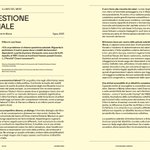
📢 Venerdì 21 marzo esce un piccolo libro su un grande tema, la questione salariale italiana.
📉 Con @mania_roberto abbiamo provato a capire come mai i redditi da lavoro in Italia siano fermi dagli anni Novanta e come si inverte la rotta.
📖 In pre-ordine in libreria e online.

Sono trent’anni che i redditi dei lavoratori italiani non crescono. Un’anomalia assoluta tra le economie avanzate.
Perché è accaduto? E come se ne esce?
In libreria dal 21/3, “La questione salariale” di @AGarnero e @mania_roberto è disponibile online, qui: tinyurl.com/LaQuestioneSalar…

ALT Il libro "La questione salariale" di Andrea Garnero e Roberto Mania (Egea, 2025)
Good to see @CompBureau calling for stronger action on non-compete clauses across Canada. They draw extensively on OECD evidence on how #noncompetes can reduce labour mobility, innovation and wage growth. Proud to see our work helping inform the policy debate.
@DanAndrewsEco

In an open letter, Interim Commissioner Jeanne Pratt is urging provinces and territories to foster more competitive labour markets by limiting the use of non-compete agreements: canada.ca/en/competition-bur…

ALT A person signing a document while another person points at a specific part on the document. Text in image: We’re urging provinces and territories to limit widespread use of non-competes
Andrea Garnero retweeted

In an open letter, Interim Commissioner Jeanne Pratt is urging provinces and territories to foster more competitive labour markets by limiting the use of non-compete agreements: canada.ca/en/competition-bur…
ALT A person signing a document while another person points at a specific part on the document. Text in image: We’re urging provinces and territories to limit widespread use of non-competes
Andrea Garnero retweeted

Company wage policy in a low-wage labour market
Giulia Giupponi @giulia_giupponi @Unibocconi, Stephen Machin @s_machin_ @LSEnews @LSEEcon
ow.ly/xvZb5101Yvz

Andrea Garnero retweeted

New Substack post with @soumitrashukla9. Work has never been just about the income earned sans effort costs, as typical in economic models. Key aspects of people’s identity, their meaning, and sense of agency are all wrapped up with what they do for a living.
There has been a lot of conversation lately about how technological change, particularly AI, may disrupt this relationship, from Ezra Klein's column on his own mathematician father’s grapplings with losing meaning in mathematics, to Francis Fukuyama's post on AI, agency, and recognition. In this piece we take a historical perspective on how technological transformation has disrupted identity and meaning by affecting jobs, and how workers and society responded to these changes.
Much of the debate around AI and jobs has centered on wages and material consequences, but losing one's work is also intertwined with how people view their place in society. Most people know about the Luddites—skilled weavers and knitters—who protested the devaluation of their mastery. What’s less known is that the Luddites were actually experts in using the machines as well, and that their protests prompted prominent economists like David Ricardo to rethink the role of automation in society, and later inspired the Arts and Crafts movement. A century later, when recorded sound displaced 20,000 cinema musicians, their campaign against "canned music" and two-year recording ban pressured labels into funding live performance.
Soumitra and I have been working on versions of this essay for months. He led the piece, and we’re both really excited to get it out there.
Link to the post here: aleximas.substack.com/p/tech…


The most revealing part of this conversation between Jon Stewart and Jacob Coxon wasn't Coxon's warning about A.I. doom, but his description of A.I. utopia, and Stewart's incredulous response. I wrote about it — and Francis Fukuyama's "Last Man," and A.I. easily solving the problems that bedeviled my father's field of mathematics for decades — here: nytimes.com/2026/10/18/opini…

Andrea Garnero retweeted

🇮🇹 The employment and output puzzle finally makes more sense
And so, after countless revisions, here we are with the so called Italian "employment and output puzzle". The figure shows the latest vintage of each series, and the picture has changed once again. This time, however, it finally makes considerably more economic sense.
First, since 2019, hours worked and real GDP have grown at essentially the same pace, whereas previous vintages implied negative hourly productivity growth, something that never made much sense to me.
Second, hours worked per employee are now higher than in 2019, consistent with the substantial increase in permanent employment and the sharp decline in temporary contracts.
Third, over the past three to four years, employment and output have grown at essentially identical rates, finally resolving the question we have been hearing for the past three years. How can employment keep increasing while GDP barely grows? Never made sense to me!
What remains puzzling is the productivity boom of 2021 and 2022, as well as the timing of the very weak GDP growth observed since 2022, particularly given the scale of the fiscal stimulus.
I see two possible explanations. Either output was overestimated in 2021 and 2022, and I remain skeptical about some of the deflators used at the time, or output has continued to be substantially underestimated since 2022.
At this point, I would probably lean toward the first explanation, because the overall picture since 2019 finally looks consistent with that of an economy that remains fundamentally incapable of generating productivity growth, but has nevertheless expanded considerably through higher employment and more hours worked. But again, I'm really not sure here, so it could well be the latter.
A glass half full, or perhaps only one third full, if you prefer.
In any case, the puzzle is still there, but at least several pieces finally seem to fit together.
End. Peace. 🕊️

Andrea Garnero retweeted

How do non-compete clauses affect worker mobility in #Canada?
New @OECD evidence finds they are widespread and increasingly used, while no-poaching and wage-fixing agreements can also restrict labour market competition.
🔗 Read the paper: brnw.ch/21x6qoM

Andrea Garnero retweeted
🇮🇹 Le continue revisioni al rialzo del PIL hanno cambiato il quadro macroeconomico e ridimensionando il famoso puzzle occupati/PIL. Ma perché gli errori vanno quasi sempre nella stessa direzione?
Ne scrivo su @lavoceinfo. Grazie per l'ospitalità.
lavoce.info/archives/114295/…

Andrea Garnero retweeted

Great thread. Loss of a skilled job isn’t just loss of income - it can be loss of craft, meaning, a sense of self.

🧵1/10 Given the recent reactions of mathematicians over rapid advances in AI, I think it is important to remember that technological change has historically been a very personal event for people.
Over the history of technological progress, looms have fallen silent, switchboards have gone dark, and factory lines have shrunk bringing with them a human crisis of identity and what it means to be a master of one's craft.

Today, UK PM Burnham announced his intention to limit the use of non-compete clauses.
To know how prevalent these clauses are, which workers they cover, and what they entail, see the country note 👉oecd.org/en/publications/non…
@OECDeconomy @OECD_Social

Burnham set to launch crackdown on non-compete clauses ft.trib.al/Gs7qtiV

Andrea Garnero retweeted

In 2025 just five companies (Amazon, Alphabet, Meta, Microsoft and Oracle) were responsible for 37 percent of the global capex of the top 100 U.S.-listed nonfinancial companies.
The last time investment was that concentrated was the early 1970s, when AT&T reigned supreme.

Andrea Garnero retweeted
Do non-competes come at a productivity cost?
New @OECD evidence links higher use of non-compete clauses to weaker labour reallocation and slower knowledge diffusion, with potential consequences for #productivity growth.
🔗 Read the paper: brnw.ch/21x6gap

Andrea Garnero retweeted

Première note "policy paper" du LIFT. Pourquoi l'IA ne rend pas (encore) la France plus productive. Ecrit avec @BunelSimon et accessible sur le site du labo
heclift.github.io/website/fi…
Les Français utilisent l'IA générative à titre individuel au moins autant que les autres Européens, mais leurs entreprises l'intègrent moins : seules 18 % l'utilisent, contre 26 % en Allemagne, et l'intégration reste superficielle, concentrée sur le développement de produits plutôt que sur les fonctions transversales

New @EU_Social-@OECD_Social brief on EU #automotive. Three highlights:
- China's role in supply chains went from nothing to 3%.
- 80% of workers report marked change but 1/3 does not receive training.
- Job loss means a cut of 57% in earnings. Six years on, still down by 25% .


Andrea Garnero retweeted

How should long-term employment contracts be regulated? We show that optimal regulation prices the use of non-competes, tying stronger non-competes to higher wages. This limits inefficient worker lock-in and raises pay at better matches.
econometricsociety.org/publi…

Andrea Garnero retweeted

Can the arts business model survive AI? Perhaps the best guide is to look at how the arts survived past tech revolutions
Take music—internet piracy and then streaming killed the lucrative CD market, but musicians mostly saved their jobs by focusing much more on live concerts

Super interesting and nth example of the difference between hype and reality

New from @Stripe Economics: the SaaSpocalypse was a massive market sell-off earlier this year, but how did actual SaaS firms fare?
We built the Stripe SaaS Index to find out: a metric of payments to non-AI SaaS firms.
Turns out revenues *accelerated*. /1 stripeeconomics.com/p/the-sa…

Andrea Garnero retweeted

New from @Stripe Economics: the SaaSpocalypse was a massive market sell-off earlier this year, but how did actual SaaS firms fare?
We built the Stripe SaaS Index to find out: a metric of payments to non-AI SaaS firms.
Turns out revenues *accelerated*. /1 stripeeconomics.com/p/the-sa…
Andrea Garnero retweeted

Q1: How do you write down a model that delivers 15% AI-driven GDP growth in 2030 like the folks at the Anthropic Institute?
A1: It's easy and you can do it in a way any well-trained econ undergrad understands: take a standard Solow model, stick in a task-based production function, calibrate in seemingly innocuous way ➡️ done!
See the supplement to the essay with @alexolegimas benjaminmoll.com/task_based_…
(The Anthropic model is, of course, fancier with many more bells and whistles but the basic logic – AI removes labor as a bottleneck on growth – is the same.)
Q2: Does this mean that 15% growth is a reasonable prediction?
A2: No. Just because you can write down such a model doesn't mean you should. Just because it's possible in theory, doesn't mean it will actually happen in practice !
Instead you're making a number of assumptions that are unlikely to hold: aleximas.substack.com/p/will…


Anthropic’s Economics team is sharing a new model of how AI might affect economic growth, jobs, wages, and more by 2030.
Explore the scenarios, tell us what you think will happen, and see how your answers compare to more than 10,000 Americans. anthropic.com/institute/econ…

Andrea Garnero retweeted
New essay on @alexolegimas's blog:
Will AI Soon Deliver Double-Digit Growth?
Probably not. Here is why.
aleximas.substack.com/p/will…
1. We outline the economics behind oft-discussed predictions that AI will soon deliver double-digit GDP growth in advanced economies. We list the assumptions that need to all hold in order for double-digit growth to happen and explain why we think they won’t.
2. To be clear: we are extremely bullish on AI and think the capabilities explosion predicted by technologists is already happening (e.g. yesterday's Navier-Stokes news!). But predictions of GDP growth in the 2030s of 15%, 30% or even 100% per year are off the mark. What we take issue with is the timeline. To paraphrase Milton Friedman's dictum on monetary policy, AI will affect GDP growth with "long and variable lags."
3. Start with some growth rate arithmetic. It is often much more useful to first think in levels rather than growth rates. Ask yourself: how much richer will we be in, say, 15 years? If you think twice as rich, that implies 4.7% annual growth, which would already be massive. Ten times as rich requires 16.6% per year; it would also imply that we are 100 times as rich 30 years from now! Asked in levels, we bet that most people would come up with much lower growth rates.
4. It's important to be clear: there is absolutely nothing in standard growth theory that constrains growth rates to be in the single digits. In fact, it's pretty easy to write down theoretical models that deliver explosive double-digit growth. We show this by writing down a standard textbook growth model of the type we routinely teach our undergrads (a souped-up Solow model), plug in some seemingly innocuous parameter values, and get AI-driven double-digit growth by the mid-2030s benjaminmoll.com/task_based_…. The basic logic is that, by replacing labor with capital, automation alleviates / eliminates diminishing returns and removes labor as a bottleneck on growth. Fancier models, in which AI also automates R&D, deliver even wilder numbers.
5. But just because something is possible in theory doesn't mean it will happen in practice. The explosion rests on five assumptions, and each is unlikely to hold within the next 10-15 years. These assumptions are:
Assumption 1: Fast, economy-wide automation, with machines doing two thirds of all tasks by 2035. Historically, automation has proceeded at about 2% of tasks per year. Most work is physical, not cognitive. And politics will slow things down.
Assumption 2: People keep spending on whatever gets automated. They don't. As things get cheap, their share of spending falls, as it did for agriculture and manufacturing. Messy jobs, relational goods and scarce physical inputs like energy, chips and land become the new bottlenecks.
Assumption 3: Someone buys the new output and firms invest to produce it. Automation shifts income from workers to capital owners, who spend a smaller share so demand may not keep up with supply.
Assumption 4: No AI-driven cyber incidents destroying economic value. AI can also destroy output, and every incident slows deployment and investment.
Assumption 5: Explosive technology growth because AI automates R&D. The wildest scenarios in which the economy doubles each year all rest on this feedback loop. There is no evidence for it so far.
Why do many people who are closest to the technology (and who have been consistently right about the capabilities explosion) consistently predict double-digit growth? Our best guess: they extrapolate from their own sector to the rest of the economy. This reminds me of the 2022 German gas debate: industry insiders were right about their own firms and very wrong about the economy as a whole.
Our bottom line: a much more likely outcome is a large increase in the level of GDP spread over a decade or two, which is what 4-5% growth is.
If you remain unconvinced and still believe in double-digit growth, we are still looking for counterparties for our bet benjaminmoll.com/growth_bet/ 😃
