







Pinned Tweet
AEye has announced that Apollo™ lidar was selected by @LunarOutpostInc for integration on its Pegasus Lunar Terrain Vehicle, designed to transport Artemis astronauts across the Moon’s South Pole.
The multi-million-dollar engagement marks AEye’s entry into space mobility. Apollo’s rugged, compact, software-defined design will support terrain perception, obstacle detection, and autonomous navigation in the lunar environment.
Read more: aeye.ai/press-releases/aeyes…
Pegasus Lunar Terrain Vehicle image courtesy of Lunar Outpost.
$LIDR #AEye #Apollo #LunarOutpost #SpaceMobility

Counter-UAS requires layered sensing.
Small, maneuverable drones can be hard for radar alone to distinguish from birds or environmental movement. High-resolution 3D lidar perception can add spatial context to radar, cameras, AI, and other sensing inputs.
Read more: loom.ly/d2NLgWE
$LIDR #AEye #CounterUAS #DefenseTech

Thank you @adamsarhan for having Matt Fisch on Smart Money Circle! It was great to talk about AEye's role in Physical AI, how lidar is helping machines interact with the world around them, and some of the lessons Matt has learned throughout his career about leadership and innovation.
Watch the full interview here: youtube.com/watch?v=Q7jtolrC…
$LIDR #smartmoneycircle #lidar #physicalAI

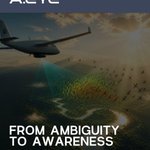
Detecting a drone is one challenge. Detecting a small, autonomous drone at long range, without relying on a radio signal, is another.
As counter-UAS threats evolve, both range and resolution are becoming increasingly important. AEye's STRATOS™ lidar is designed to bring ultra-long-range 3D perception to demanding applications like these.
In our latest blog, we explore the detection challenges posed by increasingly autonomous drones and why multi-sensor approaches matter.
Read more: aeye.ai/blog/when-drones-go-…
$LIDR #AEye #STRATOS #CounterUAS #PhysicalAI
Did you hear? Apollo™ was validated on NVIDIA DRIVE AGX Thor™, positioning AEye as a sensor partner in the NVIDIA DRIVE Hyperion ecosystem.
The milestone strengthens sensor-to-compute interoperability for next-gen automotive and Physical AI platforms and gives OEMs and Tier 1s a pre-qualified lidar option for programs built on NVIDIA DRIVE.
More: loom.ly/t0tnsPM
$LIDR #AEye #Apollo #NVIDIA #DRIVEAGXThor #PhysicalAI

How do you prove lidar can handle the Moon?
On the Big Biz Show, AEye CEO Matt Fisch shares how we tested Apollo™ lidar for the extreme conditions of the lunar environment and what it takes to bring high-performance perception beyond Earth.
Watch the full interview: youtube.com/watch?v=bQ-XzjWl…
Thank you @loft100studios Studios for having us!
$LIDR #Lidar #SpaceMobility #PhysicalAI #AutonomousSystems
Defense is becoming a Physical AI problem.
As UGVs, UAVs, robotic reconnaissance platforms, and intelligent perimeter systems take on more missions, they need to continuously perceive, interpret, and respond to changing physical environments.
See how software-defined lidar can help: loom.ly/d2NLgWE
$LIDR #AEye #DefenseTech #PhysicalAI #LiDAR #Autonomy

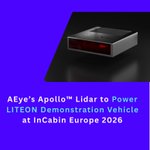
At InCabin Europe 2026, AEye’s Apollo™ lidar is being featured in a LITEON demonstration vehicle showcasing how camera and lidar data can work together to provide a more complete understanding of the world around a vehicle. Read the announcement here: aeye.ai/press-releases/aeyes…
$LIDR #AEye #lidar #ADAS


AEye and Swiftstrike AI are collaborating to develop and integrate STRATOS™ ultra-long-range lidar into Swiftstrike’s counter-UAS systems, with the goal of enabling earlier, more reliable detection of small drone threats.
Read more: loom.ly/p2W_2_4
$LIDR #AEye #LIDR #STRATOS #CounterUAS


From roadways to the lunar surface, Physical AI depends on the same foundational capability: accurate, real-time perception of the physical world.
With Apollo™ selected for @LunarOutpostInc’s Pegasus Lunar Terrain Vehicle, AEye is bringing software-defined lidar into space mobility.
Pegasus Lunar Terrain Vehicle images courtesy of Lunar Outpost.
#AEye #Apollo #PhysicalAI #Lidar #SpaceMobility

For a lunar vehicle, perception must support more than one task.
Apollo™ on Pegasus will help enable:
- Terrain perception
- Obstacle detection
- Autonomous navigation
Together, these capabilities help vehicles understand and traverse challenging terrain in real time.
Learn more: loom.ly/H3DlZdo
Pegasus Lunar Terrain Vehicle images courtesy of @LunarOutpostInc.
#AEye #Apollo #Lidar #SpaceMobility #PhysicalAI

AEye has entered space mobility with Apollo™ selected for @LunarOutpostInc ’s Pegasus Lunar Terrain Vehicle.
But what makes perception so critical on the Moon?
Our latest blog explores the sensing challenges of the lunar South Pole—and why software-defined lidar matters.
Read: loom.ly/H3DlZdo
#AEye #Apollo #PhysicalAI #Lidar #SpaceMobility

Why was Apollo™ selected for @LunarOutpostInc’s Pegasus Lunar Terrain Vehicle?
Three reasons: rugged solid-state design, software-defined adaptability and a compact form factor built for missions where every gram and every decision matters.
3. Compact form factor
Lunar vehicles face strict mass and volume constraints. Apollo delivers long-range perception capability without competing for the limited space and weight budget the mission requires.
On Pegasus, Apollo will support terrain perception, obstacle detection and autonomous navigation—helping crews and mission operators traverse challenging lunar terrain.
Learn more about this exciting collaboration at aeye.ai
#AEye #Apollo #LunarOutpost #Lidar #SpaceMobility

Apollo™ is expanding into elite sports analytics through AEye’s agreement with Alive3D.
Apollo’s software-defined architecture supports 3D spatial visualization, precise measurement, and advanced data analytics—while allowing scan patterns, range, and resolution to be configured for the application in software.
More: loom.ly/t0tnsPM
$LIDR #AEye #Apollo #SportsAnalytics
