

Making ways to know... / Zero conotation to follows, likes or retweets
San Diego
Joined April 2010
- Tweets2.6K
- Following7.5K
- Followers865
- Likes6.1K






Pinned Tweet
need 50x people with 3K capital for SDAI-guild for rackspace rental an AI server build timeshare / or capital angels out there? I got the network side and rackspace angle

✅ yes, competitive ecosystem please

Intel is making AI accelerator cards.
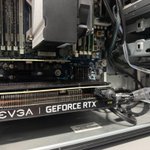
Intel’s GPU D270 (Crescent Island) is a PCIe 5.0 card built for inference. It is more or less a variant of a graphics card, engineered for AI.
It uses 32 Xe cores. Each one mixes ordinary vector engines with specialized matrix engines called XMX.
Memory is LPDDR5X. Intel’s card has about 160 GB. It can go up to 480 GB.
I am curious about the price tag.

cool!

A chip-scale optical gyroscope measures rotation as slow as 37 degrees per hour—nearly 2,000 times more sensitive than an earlier silicon nitride gyroscope. @opticalsociety phys.org/news/2026-10-chip-s…

niche opp
any company with a blackbox custom app created by a previous employee
ai will ingest it, maintain it and optinize it for your org changing beeds going forward


Greg Focaccio retweeted

A visceral visualization of what AI can do relative to humans.
xitter.cf/Math_files/status/2110…

we're all excited about reverse engineering but maybe soon the cost of just forward engineering it will make the need to reverse engineer software obsolete?


software having a moment too

Chamath thinks AI could completely change how we value software companies.
@chamath believes we're reaching a point where the intellectual property behind traditional software could become practically worthless and his reasoning makes sense. Recently, a developer reportedly used AI to recreate alternatives to several of $ADBE popular products and released the software as open source. These are products that took years, billions of dollars, and thousands of engineers to develop. Now we're seeing individual developers use AI to build competing alternatives at a fraction of the cost.Of course, recreating an application doesn't necessarily mean it can match the original in quality, reliability, or features but I think the bigger implication is what happens to the software industry if AI continues improving at this pace.
For decades, software companies have been able to charge premium subscription prices because building competing products was expensive, complicated, and required large engineering teams but what happens when AI agents can build similar applications in days or weeks instead of years? Suddenly, charging businesses hundreds or thousands of dollars for software becomes much harder to justify when they can potentially build customized alternatives themselves.
Chamath also talks about something called headless software, which basically means AI agents can interact directly with applications without requiring humans to navigate their interfaces.Technologies like MCP make it easier for agents to connect to different software tools, access information, and complete tasks automatically. Think about $CRM. Instead of employees spending hours navigating dashboards, updating customer records, and generating reports, AI agents could eventually handle much of that work automatically. And if businesses can accomplish the same tasks with cheaper software and fewer paid licenses, that creates a HUGE problem for the traditional software subscription model.
Now, I don't necessarily agree with Chamath that software IP has suddenly become worthless. companies still have proprietary data, customer relationships, security requirements, and deeply integrated systems that aren't easy to replace but I do think AI could put enormous pressure on software pricing, especially for companies selling products that can be easily replicated. But, if millions of businesses eventually start building their own applications and deploying AI agents to perform tasks that previously required humans, the amount of computing power required could increase significantly.
Every AI agent still needs inference compute to operate, and that means more demand for GPUs, memory, networking equipment, data centers, and electricity. So while AI could potentially disrupt parts of the traditional software industry, it could also accelerate spending on the infrastructure powering these applications. And this is exactly why I continue to remain bullish on the broader AI infrastructure buildout over the next several years.bBullish on the AI infrastructure side of this shift. If you want to see how I’m investing around the companies powering this next wave of software and agents, check out my full Milk Road Pro portfolio below.
link.milkroad.com/d8cj6v
phys and hardware def having its moment

NVIDIA and @Cisco introduce pluggable optics to scale AI factories.
USFP is the first module to support 400Gb/s per lane, delivering 4x the bandwidth density of today's optics. AI builders can connect more compute to the same switch — no extra network tiers, less power per bit moved.
Learn more: nvda.ws/4B6Ch7e

ALT NVIDIA and Cisco Introduce New Pluggable Optics Form Factor to Scale AI Factories
Greg Focaccio retweeted

Today we are announcing our biggest bet yet on our own silicon.
Starting next calendar year, we will scale our Maia family to multi-gigawatt deployments, making it the primary inference system for our own product and services.
And we’re introducing Maia 300, which delivers 40% more tokens per watt compared to leading GPU-based systems.
We are already deploying Maia 200 across the US, Europe, and Australia, delivering up to 1.7x more tokens per watt across experiences in Teams and Copilot.
Our goal is to build on the full-stack efficiency gains we’ve already seen, while continuing to bring the latest innovations from across the ecosystem into our fleet.


