

Brief glimpses into fights, and fighters, of the 20th century; the great, the near great, the very good, the journeymen, the opponents and much more.
Joined April 2025
- Tweets12K
- Following321
- Followers719
- Likes11.5K


youtu.be/gBJPY_A7GjU
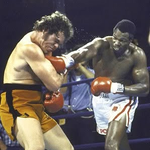
On the undercard of Holmes-Cobb, on October 26, 1982 at the Houston Astrodome, Greg Page TKOs James 'Quick' Tillis in the 8th-round for the USBA Heavyweight title.
From the AP:
"Greg Page got up from a 2nd round knockdown to floor James 'Quick' Tillis in the 8th round and keep the USBA heavyweight title Friday night at the Astrodome. Tillis dropped Page with a left and right to the jaw late in the 2nd round and drew a warning from referee Mark Tessman when he hit Page while Page was still on the floor. Page struggled up at eight and lasted the round. Tillis, 216, seemed to hold an edge after the 6th round. Then in the 7th, Page, 238 3/4, began to find the range with his right hand and rocked Tillis on seven occasions. A right and left almost put Tillis down near the end of the round. In the 8th round, Page sent Tillis reeling around the ring with four overhand rights to the head, then after hitting him with a left, he slammed home another right that dropped Tillis in a heap. The time was 43 seconds of the 8th round."
In the 13th defense of his WBC Heavyweight Championship, Larry Holmes takes target practice on Randall "Tex" Cobb for 15 rounds at the Houston Astrodome on October 26, 1982.
The scorecards; 149-136, 150-135, 150-135, didn't nearly reflect the level of mismatch this fight was.
Before the start of the 13th round, Howard Cosell, who called the fight for ABC-TV, said, "This is as brutal a mismatch as I think I've ever seen."
Cosell was so disgusted by the fight that he quit covering boxing. "The Cobb fight did it for me," he later said. "I don't want to be a party to the sleaziness."
When told that his fight with Holmes drove Cosell out of boxing Cobb, the quintessential cut-up boxing character, said:
"If I eliminate heart disease, if I walk on water, if I come up with a cure for crippled kids, I can't image a greater gift to mankind. That is my greatest accomplishment."
This was Holmes first fight after the Cooney fight.

Former WBA Light Heavyweight Champion Victor Galindez with Antonio Lizeviche, center, on October 26, 1980, before the start of the race that both men would die in.
After retiring from boxing, Galindez decided to pursue a career as a race car driver.
His first race was Argentina's Turismo Carretera on October 26, 1980.
Galindez's car broke down near the end of the first lap.
As he and his co-driver, Nito Lizeviche, were walking back to the pits, a car driven by Marcial Feijoo went out of control, spun off the track and slammed into them.
Galindez and Lizeviche were killed instantly. Feijoo, whose car was demolished, was seriously hurt and taken to a hospital. His co-driver, Juan Buesolo, was treated for shock.
Victor Galindez was just 31 when he died.

WBC Super Bantamweight Champion Wilfredo Gomez celebrates his 5th round TKO of Nicky Perez, on October 26, 1979, at Madison Square Garden.
By the time he was done with the Junior Featherweights, Gómez had established a division record of 17 title defenses (in two reigns atop the division), and a world record of the most defenses in a row won by knockout, all of his defenses finishing before the established distance limit.
Gomez will make two more defenses before moving up to Featherweight to challenge WBC Champion Salvador Sanchez in August of 1981.


In a matchup of two young and undefeated welterweights on October 26, 1978, Thomas Hearns (12-0 in white trunks) KO's Pedro Rojas (13-0 coming in) in the 1st round at Olympia Stadium in Detroit.
Rojas, out of Venezuela, whose amateur Record was 95-9 with 75 KO's, along with winning 2 Gold Medals at the Afro-Latino Games and a Bronze at the Centro-American Games, would retire after this bout.

WBA Junior Welterweight Champion Antonio Cervantes, "Kid Pambele", KO's challenger Shinichi Kadota in the 8th round, on October 26, 1974, at the Nihon University Auditorium in Tokyo, Japan, knocking the gutsy challenger down 8 times in the fight.
Kadota, 38-10-1 as a pro with 25 KO's, had wins over Chango Carmona, and had split a pair of fights with Guts Ishimatsu coming into this bout.
This was the 9th title defense of Cervantes' first reign as champ at 140 lbs. He'd lose the title to Wilfred Benitez in March of 1976.
----------------------------------------------------------
On January 31, 1964, Antonio Cervantes Reyes entered the boxing ring as a professional for the first time, beating Juan Martinez by decision in 6-rounds. His first 32 bouts as a professional were in Colombia, and he won 27, lost 4 and drew in one of them.
Realizing his pupil needed publicity outside Colombia, trainer Carmelo Prada then moved with Cervantes to Venezuela, where, on November 25th of 1968, he knocked out Orlando Ruiz in the first round for his first fight abroad. He followed that win with a ten rounds decision over Nestor Rojas only three days later.
On December 23rd of that year, he suffered his first knockout defeat when Cruz Marcano, a fringe contender of the time, beat him in 4-rounds in Caracas.
He won five and lost two in 1969, splitting his fights between Colombia and Venezuela, and losing a ten-round decision to Antonio Gomez, a former world champion.
He won two more in 1970, then he and Prada moved, this time to Los Angeles. In California, he began by beating Jose Rodriguez by a KO in the first round in San Jose, and on December 17, he beat Rodolfo "Gato" Gonzalez by KO in 8-rounds. After this and a 1971 win over Argentine Enrique Jana, Cervantes was ranked as a light welterweight by the WBA. On December 11th of that year, he had his first world title shot, against the great Nicolino Locche, in Buenos Aires. Cervantes would lose a 15-round decision.
After winning three fights in 1972, Cervantes, who had by then returned to Colombia, had another world title try: Alfonso Frazer, who had dethroned Locche of the world title, gave Cervantes a chance on October 28th in Panama City. Cervantes knocked Frazer out in ten rounds and became the world light welterweight champion for the first time.
Cervantes immediately became a national hero in Colombia, and many enterprises made him their spokesman in the coffee producing country, most notably Sanyo, whose name the popular champion advertised on his clothing and fight trunks.
Cervantes made nine title defenses in his first reign, including a 10th round TKO of Locche in their rematch after his corner stopped the fight due to a cut over his left eye, a KO in five of Frazer, also in a rematch, a 15-round split decision win over Josue Marquez in Puerto Rico (in the first world title bout ever held at Roberto Clemente Coliseum) and a 15-round decision over future Lightweight champion Esteban De Jesus. But on March 6th of 1976, in San Juan, he lost a 15-round decision and his world title to 17-year-old Puerto Rican Wilfred Benitez, who with that became boxing's youngest champion ever.
Cervantes won five more fights in a row, including a win over Saoul Mamby, before fighting for the world title again. After Benitez had left the light welterweight belt vacant, Cervantes regained it on June 25th of 1977, with a 5-round KO of Carlos Maria Gimenez, again in Venezuela.
His second reign as world champion took him to such places as Thailand, Botswana and South Korea, among others. He retained the title six times, beating the likes of Adrian Marrero and Miguel Montilla (twice).
By this time, there was much talk about a superfight with World Lightweight Champion Roberto Duran, who was coming up in weight. Duran decided to challenge Sugar Ray Leonard instead, however, and Cervantes-Duran never materialized.
Cervantes would drop Pryor in the 1st round of their title fight but the incredibly resilient "Hawk" would rebound to take the title via 4th round KO.
Cervantes, who'd hung up the gloves after this loss, would come out of retirement due to financial problems and went on boxing until 1983, winning four fights and dropping his last one, a ten-round decision loss to Danny Sanchez on December 9th of 1983, in Miami.
His final record would stand at 67-12-1 (37 KO's).


WBA Light Heavyweight Champion Vicente Rondon (dark trunks) TKO's Gomeo Brennan (84-19-7 coming in) in the 13th round, on October 26, 1971, at the Convention Center in Miami Beach.
The bout, Rondon's second title defense, was stopped in between the 13th and 14th rounds due to excessive swelling from Brennan.
Gomeo Brennan started his boxing career in January of 1956 and didn't step away from the ring until April of 1972.
Fighting out of the Fifth Street Gym in Miami Beach, he was trained by Angelo Dundee and managed by Chris Dundee.
During his long career, he fought 110 fights, losing only 21. In his first year as a fighter, he fought 18 times.
Born in the Bahamas in 1939, he fought as a welterweight all the way up through the light-heavyweight division, at one time winning the middleweight championship of the British Empire.
Some of the fighters he defeated included Wallace "Bud" Smith, Art Hernandez, Charlie Cotton, Eddie Owens, Jerry Evans, Mickey Crawford and Carl Hubbard.
1971 was an outstanding year for Vicente Rondon with a number of title defenses. He became the first and only fighter to stop Gomeo Brennan and many began to feel that Rondon could and would defeat Bob Foster if or when they met.
In 1972, however, Rondon would lose to Foster in two rounds.
Later that year he lost, at heavyweight, to Earnie Shavers, Ron Lyle and Jose Manuel Urtain.
Rondon did better in 1973 as he started to trim down in weight. He looked highly skilled and impressive by scoring a 10 round decision over undefeated prospect Oliver Wright in Miami Beach. Shortly after that he stopped heavyweight Mike "Jim" Boswell in 4 rounds.
An attempt to regain the light heavyweight title, saw him drop a decision to top ranked Len Hutchins, and then he suffered a 9th round technical knockout loss to John Conteh.
In 1974, Rondon weighing 188 pounds went back to the heavyweight division, where he would be largely unsuccesful. He was unable to get off the stool for round three in his fight with Rodney Bobick at Miami Beach, Florida. In his next fight he was knocked out in 2 rounds by former world heavyweight title contender Joe "King" Roman.
Sadly, after his career ended, Rondon suffered severe depression, leading to his being confined to a Venezuelan mental hospital after his ring career had ended.
Further depressed over the death of his mother, Vicente Paul Rondon, died forgotten and broke in poverty in Santa Ana de Carapita, a slum of Caracas. He was only 54.


On the undercard to Ali-Quarry I, on October 26, 1970 in Atlanta, Eddie "Bossman" Jones (left) TKO's Willis Earls in the 7th round.
One thing we do here at 20th Century Boxing: Icons, Memories & More is to remember not just the greats but the almost greats, the could have been greats and the not so greats.
Where Eddie Jones or Willis Earls fall in those categories, I'm not so sure, but they both certainly deserve to be remembered by any true boxing fan.
Eddie "Bossman" Jones was considered a slick boxer-puncher. He finished his career at 29-16-3 (12 KO wins) and was skilled enough to have decision wins over Henry Hank, Tom Bethea, Jimmy Dupree and Andy Kendall.
Jones had one title shot in his career, losing a 15-round UD to WBA Light Heavyweight Champion Vicente Rondon in Venezuela, in August of 1971.
"We don't think very highly of the Venezuelan. Bob Foster would knock out Rondon." was the opinion of Jones trainer, Eddie Futch, following that bout.
Eddie Jones would later work as a sparring partner for Heavyweight Champion George Foreman as he prepared for "The Rumble in the Jungle" against Muhammad Ali in 1974.
Willis Earls was a hard-punching club-fighter, a journeyman who, after a rather unsuccessful first 9-years of his ring career, finally found himself and streaked to an impressive winning streak and a top 10 world ranking.
Earls, out of Austin, Texas, turned pro in 1960 and until July 29th of 1969, had compiled a rather dismal record of 4-10-1.
However, a closer look at his opponents, showed that the inexperienced Earls was grossly overmatched early in his career. He was defeated by the likes of heavyweights Sonny Liston, Jerry Quarry, and Dave Zyglewicz.
One thing Willis Earls was noted for was his punching power. He reportedly had Liston on the canvas in the 1st round before being knocked out in two rounds all though I couldn't find a news account of the bout to confirm that.
On December 1st of 1969, Earls moved down to light heavyweight (he had been weighing in in the low 180's for his heavyweight bouts) and launched a comeback.
In eight short months, Earls went undefeated in 9 straight fights, which included upset knockouts over Joe Burns and Paul Patin. Earls even held world-rated 175 pounder Eddie Jones to a draw in June of 1970. Earls earned a #10 world ranking and fought the #1-rated Jimmy Dupree for the right to challenge world champion Bob Foster.
Earls' bubble was burst and he was knocked out in the 1st round.
His career took a nose dive after the loss, and he ended his career with consecutive knockout losses to Eddie Jones, Terry Daniels, Elmo "Tex" Henderson, and Brian Kelly finishing his career at 12-14-2 with 8 KO wins.

In his first fight in 43 months, former Heavyweight Champion Muhammad Ali stops #1 ranked (by The Ring magazine, ranked #3 by the WBA) Jerry Quarry after three rounds, on October 26, 1970, at the Municipal Auditorium in Atlanta.
Ali's fight against Quarry was his first since he knocked out Zora Folley in seven rounds on March 22, 1967.
His layoff was due to his refusal to be drafted into the United States Army and subsequent legal battles. "It is the light of my consciousness as a Muslim minister and my own personal convictions that I take my stand in rejecting the call to be inducted in the armed services," Ali stated after refusing induction on April 28, 1967. "I have searched my conscience and I find I cannot be true to my belief in my religion by accepting such a call."
He was convicted of draft evasion on June 20, 1967.
Ali was sentenced to five years in prison and fined $10,000, the maximum penalty for the offense. He remained free on a $5,000 bond while he appealed his conviction.
Ali was also stripped of the World Heavyweight Championship by the New York State Athletic Commission and the World Boxing Association, systematically denied a boxing license in every state and stripped of his passport.
With help from Georgia State Senator Leroy Johnson, Ali was able to get a boxing license in Georgia.
On September 2nd of 1970, he boxed an eight-round exhibition at Morehouse College in Atlanta. that was the first time Ali had boxed in public since a six-round exhibition in Detroit, Michigan, on June 13, 1967.
A fight between Ali and Quarry was arranged for October 26th at the Auditorium in Atlanta. Contracts were signed in New York City on September 10th. The bout was promoted by House of Sports, Inc., headed by Senator Johnson, and by Sports Action Inc., headed by Harold Conrad.
"People think now that the Supreme Court decision is what allowed Ali to fight, but that didn't come until later," Conrad told author Thomas Hauser for his book "Muhammad Ali: His Life and Times." "All it took was politics and money and three years of trying until we worked things out in Georgia."
As for the fight, Mark Kram of Sports illustrated wrote:
With a cracking right hand, the speed of which seemed hardly impaired since he last fought, Ali cut Quarry over the left eye in the middle of the third round, a wound which would require 11 deep sutures and would not allow the Californian to come out for the fourth round. "It was not a butt," Quarry said before being stitched up, "and I don't want anybody saying that it was. It was a right hand." Referee Tony Perez did not stop the fight. It was Quarry's chief cornerman Teddy Bentham who did so, and with reason. Quarry, puzzled by Ali's unorthodox style and unwilling to commit himself, was unable to launch an effective attack. About all he could do was counter with winging left hooks, most of which missed or were brushed off, although he did land one solid punch—a right hand to the body in the second round. "If he didn't get cut," said Ali, "I think it might have gone 10 rounds." Indeed, Quarry seemed to be gaining confidence until the blood began streaming down his face. . . . In one sense the fight was indecisive, simply because of our uncertainty that Ali could go any distance. The quick appraisal that can be made—and that only because we have not seen him for so long—is that he does not seem to be pulling his head back as quickly as he used to. A much maligned move in his early days, this is one of the most vital aspects of his defense. Quarry did reach him on occasion, but was never in proper balance to be effective. Excepting this flaw, all else about Ali seemed to be intact—the rocking jab, the beautiful combinations and his general ring intelligence.


Muhammad Ali weighs in at 213.5 lbs for his first fight in 43 months, on October 26, 1970, against Jerry Quarry at the Municipal Auditorium in Atlanta, Georgia.


Amercian George Foreman wins Gold in Mexico City, on October 26, 1968, as the referee stops his Heavyweight Final bout with Lithuanian Jonas Cepulis, representing the Soviet Union, in the 2nd round.
Cepulis had TKO'd his first three opponents.
An American heavyweight (Tyrell Biggs was a Super Heavyweight) would not win another Gold Medal until Henry Tillman in 1984, followed by Ray Mercer in 1988, two decades after Joe Frazier and Foreman won back-to-back Gold for the USA at heavyweight.
Correct me if I'm wrong please, but an American heavyweight has not won Gold since Mercer.
