




🚀 Kubernetes Helm — the cheat sheet every DevOps engineer needs!
Managing Kubernetes deployments manually can get messy. Helm makes it easier to package, configure, version, and deploy applications using reusable Charts.
Here's what every Kubernetes engineer should know 👇
🔹 Charts & Releases
🔹 "Chart.yaml" vs "values.yaml"
🔹 Helm templates
🔹 Essential Helm commands
🔹 Install, upgrade & rollback
🔹 Managing dev, staging & prod environments
💡 Pro tip: Master "helm upgrade" and "helm rollback" before managing production deployments.
Save this cheat sheet for your next Kubernetes project! 🔖
#Kubernetes #Helm #DevOps #SRE #CloudNative

Tech retweeted
🛠️ Every DevOps Engineer and SRE should know Vim.
When you're debugging a production issue over SSH, editing a config on a remote server, or troubleshooting a Kubernetes pod, Vim can save you valuable time.
You won't always have VS Code available. Sometimes, all you have is a terminal. ⚡
Bookmark this Vim cheat sheet to master the essentials:
✅ Navigate files like a pro
✅ Edit configs without leaving the terminal
✅ Search logs and replace text quickly
✅ Work efficiently on remote servers
Pro tip: Master dd, /pattern, :%s/old/new/g, and :wq first.
Small skills. Faster debugging. Better incident response.
♻️ Repost this to help another DevOps engineer or SRE!
#DevOps #SRE #Linux #Vim #Kubernetes
🚀 API DESIGN CONCEPTS EVERY BACKEND DEVELOPER SHOULD KNOW
Building APIs is easy. Designing reliable, scalable APIs is the real skill.
Here's your checklist 👇
1. REST principles & resource-oriented design
2. HTTP methods: GET, POST, PUT, PATCH, DELETE
3. Safe methods & idempotency
4. HTTP status codes & error handling
5. Headers, cookies & content negotiation
6. Path params vs query params vs request bodies
7. Pagination: Offset vs Cursor-based
8. Filtering, sorting & searching
9. API versioning & backward compatibility
10. OpenAPI / Swagger documentation
11. Request validation & error contracts
12. Rate limiting, throttling & quotas
13. Timeouts, retries & request cancellation
14. Idempotency keys for payments & orders
15. ETags & HTTP caching
16. CORS & preflight requests
17. Webhooks, signatures & duplicate delivery
18. REST vs gRPC vs GraphQL
19. WebSockets vs Server-Sent Events
20. API Gateways & BFF
💡 Great APIs don't just work.
They handle failures, prevent duplicate operations, protect resources, and evolve without breaking clients.
🔖 Bookmark this for your next backend project!
#BackendDevelopment #SystemDesign #APIDesign
🚀 CoreDNS in Kubernetes — explained visually!
Ever wondered how a Pod finds another Service without hardcoding its IP address?
Meet CoreDNS. 👇
🔹 Provides DNS-based service discovery
🔹 Resolves Kubernetes Service names to ClusterIPs
🔹 Runs as a Deployment in kube-system
🔹 Uses plugins like kubernetes, forward, and cache
🔹 Forwards external DNS queries to upstream servers
💡 Example: web.default.svc.cluster.local
Kubernetes DNS makes service-to-service communication simpler, more reliable, and easier to scale.
🔥 If you're learning Kubernetes, don't skip DNS. It's a fundamental part of cluster networking.
🔖 Save this for your next Kubernetes revision!
#Kubernetes #DevOps #CloudNative #PlatformEngineering

☸️ Kubernetes Service Networking — explained visually!
Why do we need Services when every Pod already has an IP?
Because Pods are ephemeral. Their IPs can change, but your applications still need a reliable way to communicate.
Here's what every DevOps engineer should know 👇
🔹 ClusterIP — Internal cluster communication
🔹 NodePort — Exposes a Service through node ports
🔹 LoadBalancer — Exposes a Service externally using a load balancer
🔹 ExternalName — Maps a Service to an external DNS name
🔥 Remember:
Services provide stable endpoints, use label selectors to discover Pods, and distribute traffic across eligible backends.
Master this concept, and Kubernetes networking becomes much easier to understand.
🔖 Save this for your next Kubernetes revision!
#Kubernetes #DevOps #CloudNative #PlatformEngineering

☸️ Kubernetes Gateway API — the modern way to manage traffic.
Ingress worked well, but modern applications need more flexible traffic management.
Meet Gateway API 👇
→ GatewayClass defines the controller
→ Gateway handles traffic entry points
→ HTTPRoute defines routing rules
→ Supports advanced traffic management
→ Enables role-based configuration
🔥 Learning Kubernetes? Understanding Gateway API is becoming increasingly important for DevOps and Platform Engineers.
Save this visual for your next Kubernetes revision. 🔖
#Kubernetes #DevOps #PlatformEngineering #CloudNative

🚨 Kubernetes news every DevOps engineer should know.
Ingress NGINX has been retired.
❌ No more bug fixes
❌ No security patches
❌ No new releases
Your existing deployments won't suddenly stop working, but continuing without a migration plan is risky.
What should you do? 👇
→ Evaluate Kubernetes Gateway API
→ Consider a maintained Ingress controller
→ Audit your existing configurations and plan your migration
⚠️ Important: This retirement applies to the community ingress-nginx project, not every NGINX-based ingress controller.
Infrastructure changes. Your skills should evolve with it.
Official announcement 👇
kubernetes.io/blog/2025/11/1…
#Kubernetes #DevOps #PlatformEngineering
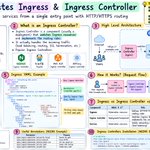
☸️ Kubernetes Ingress vs Ingress Controller — explained visually.
How do you expose multiple services through a single entry point?
Here’s the key:
→ Ingress defines the routing rules.
→ Ingress Controller implements those rules.
→ Services route traffic to the right Pods.
→ TLS enables secure HTTPS traffic.
→ Host-based & path-based routing keep everything organized.
Example:
/ → Frontend
/api → Backend
/admin → Admin Service
⚠️ Remember: Creating an Ingress resource alone isn't
enough. You need an Ingress Controller to process its rules.
Save this for your next Kubernetes revision. 🔖
#Kubernetes #DevOps #CloudNative

Tech retweeted
Kubernetes Pod Networking — explained visually.
Every Pod gets its own IP.
Pods can communicate across nodes.
Services provide stable access to changing Pods.
CNI plugins connect the cluster network.
Understand these 4 concepts, and Kubernetes networking starts making sense.
Save this for your next K8s revision. 🔖
#Kubernetes #DevOps #CloudNative
Tech retweeted
Payment succeeded. Shipping failed.
The customer has paid, stock is reserved, but delivery cannot be arranged.
How do you recover when each service has its own database?
This is where the SAGA pattern helps.
WHAT IS A SAGA?
A SAGA breaks one business operation into a sequence of local transactions.
Each service completes its own work and commits changes to its own database. If the workflow cannot finish, compensating actions address the effects of earlier successful steps.
Let’s use an online checkout.
THE SUCCESSFUL FLOW
1. Order service creates a PENDING order.
2. Inventory service reserves the product.
3. Payment service processes the payment.
4. Shipping service books delivery.
5. Order service marks the order CONFIRMED.
These are separate commits across services.
WHAT IF SHIPPING REJECTS THE BOOKING?
The payment and stock reservation have already succeeded.
For this workflow, recovery could be:
1. Refund the payment.
2. Release the reserved stock.
3. Mark the order CANCELLED.
These recovery operations are called compensating actions.
COMPENSATION ≠ DATABASE ROLLBACK
A refund is a new transaction. It does not erase the original payment.
Similarly, releasing stock is a new inventory operation.
Compensation follows business rules to reach a valid outcome. It does not necessarily restore every detail of the original state.
HOW ARE THE STEPS COORDINATED?
There are two common approaches:
• Choreography: Services react to events. Inventory publishes StockReserved, Payment responds, then Shipping responds to PaymentCompleted. There is no central coordinator. Simple flows can work well, but larger workflows become harder to trace.
• Orchestration: A coordinator requests each step, tracks outcomes, and directs recovery. The workflow is easier to follow, but the coordinator must reliably persist its progress.
WHAT MAKES A SAGA RELIABLE?
• Idempotency: Repeated commands must not cause duplicate charges or refunds.
• Durable state: A restart must not lose completed steps or pending recovery.
• Reliable messaging: A committed change must not silently lose the event that advances the workflow.
• Safe retries: A timeout does not prove an operation failed. Check the outcome before repeating a payment.
• Recovery handling: Compensation can fail too. Record progress, retry safely, and alert when recovery stalls.
SAGA allows intermediate states—such as payment completed while shipping is pending. It aims for eventual consistency and does not provide built-in global isolation.
Would you choose choreography or orchestration for this checkout—and why?
#SystemDesign #Microservices
Tech retweeted
Top 10 System Design Interview Questions
1. Design a URL Shortener (Bitly)
2. Design WhatsApp / Chat App
3. Design Instagram / News Feed
4. Design a Distributed Rate Limiter
5. Design Uber / Ola
6. Design YouTube / Video Streaming
7. Design an E-commerce Order System
8. Design a Notification Service
9. Design Dropbox / Google Drive
10. Design a Distributed Job Scheduler


🏷️ Bonus: Custom Aliases
Users want memorable codes:
Generated: sho.rt/A7k9Ps
Custom: sho.rt/java-blog ✨
Must be:
✓ Unique
✓ Validated (only safe chars)
✓ No conflicts with /admin, /api, /health
✓ Abuse-protected
Which strategy to pick?
🚀 MVP / Low scale → Sequential + Base62
💪 Medium scale → Random Base62
🔥 High scale / Global → Snowflake + Base62
Thread summary:
- Sequential = simple but predictable
- Random = secure but retry overhead
- Snowflake = distributed but complex
Choose based on scale!
End of the thread 🧵
Thanks!