

⚔️ ..In the end, Nobody will be right.. ⚔️
Australia
Joined February 2017
- Tweets13.3K
- Following987
- Followers9.1K
- Likes28.6K
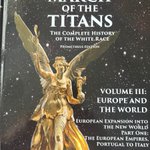



In 768, Charlemagne started a 32 year long campaign of what can only be described as genocidal evangelism against the Saxons under his control in western Germany. The campaign started with the cutting down of the Saxon’s most sacred tree, their version of the World Tree….In 772, at Quierzy, he issued a proclamation that he would kill every Saxon who refused to accept Jesus Christ, and from that time on he kept a special detachment of Christian priests who doubled as executioners, and in every Saxon village in which they stopped, these priests would execute anybody who refused to be baptised. Then in 782, at Verden, Charlemagne carried out the act for which he is most notoriously associated - he ordered the beheading of 4,500 Saxons in one day who had made the error of being caught practicing paganism after they had agreed to be Christians. His onsite biographer, the monk Einhard records that after these beheadings: “the king went into winter camp, and there celebrated mass as usual…” — Arthur Kemp

“During the early period of the Christian movement the multitude of often contradictory texts was so great that the young Church saw only one way of preserving the faith from splitting into numerous sects: assembling a canon of writings and destroying rejected apocryphal (hidden) texts.” — The Original Jesus
Large scale editorial control. The aim; Consolidation, a single world government, and a single world religion.
They didn't want independent segregated tribes and natives all believing whatever they want, they couldn’t have that. Instead, they insisted on one God that everyone must worship. To achieve this, they seek to homogenise cultures, beliefs, and practices. Anything that remains discordant or resistant is banned, discarded, or destroyed. What remains is then packed and sold to the public through a carefully managed PR campaign.
“The New Testament writings “were not written by eyewitnesses of an overpowering divine appearance in the midst of human history… the Christian Bible turns out to be a masterpiece of invention… To be quite frank about it, the Bible is the product of very energetic and successful mythmaking on the part of those early Christians.” — Burton L. Mack, Who Wrote the New Testament?
“The words “authorised” and “original,” when applied to the Bible, do not mean “genuine,” “authentic,” or “true.” — Tony Bushby, The Bible Fraud
“The Canon of the New Testament, is nothing more or less than a copy of the mythological histories of the Hindu Savior Krishna, and the Buddhist savior Buddha, with a mixture of mythology borrowed from the Persians and other nations.” — T.W. Doane, Bible Myths and Their Parallels in other Religions.
The result is a tightly curated narrative that became the foundation for a religion capable of empire-scale reach.


“Those initiated into the sacred mysteries knew the Gospel stories were false, but considered it necessary to keep up the imposition for the purpose of propagandism. But while this transition of faith was going on, some of the more conscientious teachers began to tell the people that the Jesus Christ they were worshipping was not a historical personage. This was regarded by the conservative priests as a dangerous disclosure, and so John denounces the innovators as liars and Anti-Christs, knowing that he himself and his fellow priests were the pious liars and that the Anti-Christs we’re telling the truth…Error prevailed, and the mythical Christ became the historical Jesus…” — (Revelations of Antichrist)

Being able to jump in-and-out of different reality tunnels is a superpower. youtu.be/joXjEVVU6Sg?si=qI4L…
..113 retweeted
I am not an atheist.
I believe in God.
Just not the version the priest caste sold us.
I reject conventional religion and the idea of a separate supernatural God who created the universe from outside it, without reducing reality to mere material processes.
There is a spiritual dimension to existence.
God is the Holy Spirit: Spirit itself, the living consciousness that is the ground of reality.
Your spirit is your consciousness.
The voice you hear within (the one you ordinarily take to be merely your own), is closer to the divine than any distant external deity.
God is not far away or superior in some hierarchical sense; it speaks with you every moment, disguised as yourself.
The numinous quality of the world (the awe of nature, the mystery of existence, the sheer fact of awareness) is what gives rise, over time, to the God-archetype in the human psyche.
Priests externalise that archetype, turn it into an external tyrant, and monopolise access to it.
True divinity is not outside the universe demanding worship.
The universe is inherently creative; it is an expression of Spirit rather than the product of an external craftsman.
Rejecting the God of Christianity does not mean rejecting all spirituality or every possible conception of divinity.
It means reclaiming the inner one.
The self. the Holy. The Spirit.
And recognising that the sacred is immanent in consciousness and in the world itself.
Now in saying that, as a Christian, what version of creation in Genesis do you subscribe to, given that both cannot be literally true?
Contradictions in the Bible:
Creation accounts (Genesis)
Two creation narratives differ in order, method, and details: Genesis 1 (Elohim; structured six-day creation; light, plants, animals, then male and female humans together on day 6) vs. Genesis 2 (Yahweh Elohim; man formed from dust first, then plants/garden, then animals as potential companions, then woman from the man’s rib).
In Genesis 1 light exists on day 1 (with “evening and morning”), but the sun, moon, and stars are created on day 4.
God declares creation “very good” (Genesis 1:31) but later regrets making humanity (Genesis 6:6).
Flood and Noah (Genesis 6–9)
Number of animals: Genesis 6:19–20 commands two of every kind; Genesis 7:2–3 specifies seven pairs of clean animals and one pair of unclean.
Duration and chronology: rain for 40 days/nights in some verses vs. waters prevailing 150 days and a longer overall timeline in others; doublets of boarding, disembarking, and similar commands.
Two interwoven narrative strands (often linked to different sources using different divine names) produce repetitions and inconsistencies in details.
Patriarchal and early narratives
God’s name: Exodus 6:3 states God was known to the patriarchs as El Shaddai but not as Yahweh; Genesis 15:7 and other passages have God identifying as Yahweh to Abraham earlier.
Jacob/Esau deception and departure: details of the blessing and the reason for Jacob leaving vary between accounts in Genesis 27–28.
Abraham’s purchase of burial ground and related details conflict in some later retellings (e.g., Acts 7 vs. Genesis).
Numerical, chronological, and historical discrepancies (especially Chronicles vs. Samuel/Kings).
David’s census: 2 Samuel 24:1 attributes it to the Lord’s anger; 1 Chronicles 21:1 attributes it to Satan. Numbers differ (e.g., ~800,000 Israelite fighters in Samuel vs. ~1,100,000 in Chronicles; Judah figures also differ).
Ages and reign lengths of kings: e.g., Ahaziah 22 (2 Kings 8:26) vs. 42 (2 Chronicles 22:2); Jehoiachin 18 (2 Kings 24:8) vs. 8 (2 Chronicles 36:9).
Lists of returned exiles (Ezra 2 vs. Nehemiah 7) contain numerous numerical mismatches in family counts; grand totals do not match the summed figures.
Other details: names of officials (e.g., David’s scribe varies), numbers in battles or inventories, and sequences of events differ between parallel accounts.
Gospel narratives (birth, ministry, passion, resurrection)
Genealogies of Jesus: Matthew 1 (via Solomon, Joseph’s father Jacob, ~28 generations from Abraham) vs. Luke 3 (via Nathan, Joseph’s father Heli, longer list with different names after David). Both present as Joseph’s line.
Infancy: Matthew has magi, flight to Egypt, and return after Herod’s death; Luke has shepherds, presentation in the Temple, and direct return to Nazareth.
Timing relative to Quirinius’s census (Luke) conflicts with Herod’s reign (Matthew).
Baptism voice: wording and addressee differ slightly across Matthew, Mark, and Luke.
Jesus’ movements after baptism and early ministry details differ between Synoptics and John.
Temple cleansing: near the end of the ministry in the Synoptics; early in John.
Passion details: day of crucifixion (Synoptics place it after the Passover meal; John on the day of Preparation, aligning with Lamb of God imagery); last words differ (“My God, why have you forsaken me?” in Mark vs. “It is finished” in John); temple curtain timing relative to death varies between accounts; number of women at the tomb, number/identity of angels/men, whether they told anyone, and post-resurrection appearances differ.
Judas’s death: Matthew 27 (returns money, hangs himself; priests buy the field) vs. Acts 1 (keeps/buys the field himself, falls and bursts open).
Peter’s denial: Mark specifies before the rooster crows twice; other Gospels say before it crows (once)
Paul’s itinerary and Jerusalem visits: Acts vs. Galatians differ on sequence, timing, and meetings after conversion.
Other: Jairus’s daughter’s status when he approaches Jesus (dying vs. already dead); high priest name in the “bread of the Presence” incident (Mark names Abiathar where 1 Samuel has Ahimelech).
Theological, ethical, and doctrinal tensions
Nature/visibility of God: passages describe seeing or speaking with God face-to-face (e.g., Exodus 33, Genesis 32) vs. statements that no one has seen God or can see his face and live (John 1:18, Exodus 33:20).
Forgiveness and judgment: passages emphasising God’s unwillingness to forgive certain sins or destroying for wickedness vs. broad themes of mercy and forgiveness.
Violence, law, and ethics: “eye for an eye” and capital prescriptions in the Torah vs. “turn the other cheek,” love of enemies, and non-resistance in the Sermon on the Mount; Sabbath strictness vs. New Testament flexibility; polygamy and divorce practices in the Old Testament vs. stricter New Testament ideals.
Salvation and works: Paul emphasises justification by faith apart from works of the law; James states that faith without works is dead and that a person is justified by works and not by faith alone.
Inclusivity: “Whoever is not with me is against me” (Matthew) vs. “Whoever is not against us is for us” (Mark).
Slavery and social roles: regulations permitting and regulating slavery in the Torah and household codes vs. statements of equality in Christ; passages on women’s silence in church vs. examples of women in leadership roles.
Earth’s permanence: statements that the earth remains forever or is fixed (e.g., Ecclesiastes 1:4, Psalm 104:5) vs. New Testament passages about its destruction and a new earth.
Prophecy fulfillments or quotations that do not match the cited Old Testament text exactly (or cite the wrong prophet).
Manuscript and textual variants that affect details in some passages (later additions such as the longer ending of Mark or the Pericope Adulterae).

The Christians love to froth “Mystery Babylon!” and “Nimrod worship!” the second anything challenges their favourite bedtime story.
They act like their faith is some pure, one-of-a-kind revelation, then lash out when someone points out the obvious recycling: the dying-and-rising sun-king, the virgin-mother with the child, the twelve zodiacal companions, Eve in the garden, 10 commandments, the cross that folds into the solar cube, the December birth under the star, and the rest of it.
All of it was running in older Egyptian, solar, and mystery cult traditions long before their book showed up.
But the moment the parallels get noticed, the hysterics start screaming about Nimrod like the label magically erases the older sources.
They’re the ones following the solar-cult script under a new name, (kneeling on 🌞day, eating the body of a solar hero who rose at the vernal equinox,etc.,) then losing it when anyone calls the recycling what it is.
Keep yelling “Mystery Babylon!” at every exposé.
It only makes your inherited cope clearer.

Civilisations are not built from bricks and mortar.
They’re built from minds, hearts, ambition, passion, vision, and moral standards.
When those die, the whole thing starts collapsing.
That’s where we are.
The ancients were more existentially present in the world than we are.
They stayed aligned with nature instead of treating it as a resource to strip.
Their consciousness wasn’t sealed off inside individual skulls.
It was an extension of the living intelligence of the planet and the larger universe.
They related to plants and animals with the same directness we use when we talk to each other.
Egypt’s dynastic rulers operated as enlightened or near-enlightened figures.
For millennia their people remained in the Nile Valley and did not treat neighbouring lands as conquest targets.
Celtic and Gaelic Druids/Aryans refused to cut any living thing with a blade.
Compare that restraint and that ethics to the people running most governments today.
The ancient astrologers were not those who indulged in mere fortune-telling.
They tracked the actual linkages between the deeper phenomenal dimension and the everyday world, between matter and mind.
That linkage is what life is.
Without it, the claim that we are “living” is mostly performance.
Later bans on astrology were not about protecting people from superstition.
They were about severing the symbolic and practical connections between human beings and the rest of the living world.
The prohibition on idol worship worked the same way: it forced reliance on linear, left-brain calculation while starving the emotional body, imagination, and the capacities associated with the right brain.
The result was a systematic psychic imbalance.
Scientists are now, reluctantly, rediscovering what older traditions stated for thousands of years.
Materialism as a complete description of reality is failing.
Quantum findings make the older scientific dogmas harder to defend, even by the people who enforced them longest.
Thought has been shown to be non-local.
The brain behaves more like a hologram than a sealed computer.
Nonlinear modes of thinking increase neural density and connectivity.
Intelligence is not only intellectual; it is also somatic and emotional.
So-called junk DNA is functional.
The space between atoms is not empty.
The quantum domain appears to operate by rules continuous with those of consciousness.
Fractal patterns indicate an underlying order inside what looks like chaos.
Thought is fate and your character is your Destiny.
It’s only a matter of when and not if it will be rediscovered that the story of Our Lives is indeed written in the heavens and that what is above is also below.


Alright, fuck it.
These are the core thinkers and researchers I keep returning to.
Some are well-known, some are forgotten, some are controversial.
Make of it what you will.
• Sigmund Freud
• Carl Jung
• Otto Rank
• Alfred Adler
• Viktor Frankl
• Erich Fromm
• Bruno Bettelheim
• Friedrich Schelling
• Hegel
• Arthur Schopenhauer
• Friedrich Nietzsche
• Immanuel Kant
• Goethe
• Martin Heidegger
• Søren Kierkegaard
• Rudolf Steiner
• William Blake
• Emanuel Swedenborg
• Jacob Boehme
• Meister Eckhart
• Paracelsus
• George Berkley
• Malebranche
• Alfred North Whitehead
• Owen Barfield
• Hölderlin
• Rilke
• Wordsworth
• Shelley
• Emerson
• Thoreau
• Byron
• Whitman
• Immanuel Velikovsky
• Comyns Beaumont
• Ignatius Donnelly
• R.A. Scwaller de Lubricz
• Michael Tsarion
• Helena Blavatsky
• Gerald Massey
• Alvin Boyd Kuhn
• Jordan Maxwell
• Jim Fitzpatrick
• Zecharia Sitchin
• Bible and apocrypha
• Book of Enoch
• Irish Annals of the Four Masters.
• Welsh Triads
• Egyptian texts
• Vedas/Mahabharata
• Norse Eddas
• Mayan/Toltec codices
• Sumerian epics
• related mythologies
• Thomas Szasz
• Karl Kraus
• Julius Evola
• Oswald Spengler
• Aleister Crowley
• Manly P. Hall
• Godfrey Higgins
• John E. Remsberg
• Kersey Graves

It’s an established fact that all the scriptures of all major religions, together with their pantheons, practices, customs, rituals and rhetoric, are based on, and are replications of, astro-theological leitmotifs. It is what the comparative evidence shows once the theological special pleading is stripped away.


The Gaonim were the top rabbis and scholars who ran the main Talmud academies in Babylonia from about the 6th century to the 11th century CE.
After the Talmud was finished, they took charge of protecting it, explaining it, and deciding how Jewish communities everywhere should follow it.
Emerging in the wake of earlier upheavals that had displaced elite circles from Judea, they carried forward aristocratic scholarly and priestly traditions with roots in earlier Zadokite and related lines of authority.
The word “Gaon” means “excellence” or “pride.”
They positioned themselves as figures of supreme standing.
They controlled two big academies in what is now Iraq: Sura in the south, and Pumbedita.
From there they interpreted the Talmud, answered questions from Jewish community across the world, and shaped how religious rules were applied in daily life.
Their rulings carried weight far beyond their own schools.
They effectively became the central authority on Jewish law during this period, sitting above local rabbis and deciding disputed matters.
Unlike the Exilarch, who handled more secular political matters for the Jews under Muslim rule, the Gaonim held the real power over religious and legal questions.
They used that position to keep the Babylonian Talmud at the centre of Jewish practice and to maintain their own role as the final word.
This setup gave them lasting influence.
It linked the rabbis who wrote the Talmud to the later medieval scholars who built on it, while keeping decision making concentrated in a small group of academy heads rather than spread more widely.
Their work locked the Talmud in as the foundation of rabbinic Judaism and gave these Babylonian leaders a strong grip on how that tradition was understood and enforced for centuries afterwards.
Later developments show how concentrated networks of this kind continued to operate.
The secret societies and cabals that became infamous in later centuries grew out of the activity of the “Clerics,” who continued to serve the Templar hierarchy after the Templars were suppressed in the 14th century.
Descendants of the Gaonim worked alongside these groups, and in many cases outranked them.
It is not entirely clear who held the higher place; the clerics, in the form of the Knights of Malta, may have outranked the Gaonim’s line.
In any case, both remained subordinate to the House of Edessa, the Atonist order of Melchizedek (linked to Akhenaton), and the Cult of Venus, aka the Order of Sion.


It should never be forgotten that the power of the priests rests solely on the credence of the people. The people cry out for a saviour, for certainty of heaven, for an exemption from the terrors of hell. Hence priestcraft can neither do without hell nor purgatory. Take away both, or either, and its power is gone.

1. “Isis had sex with Osiris.”
It’s a solar myth, not biology. Isis is the pure dawn/horizon who births the young sun from the dead one. The “sex” is the mythic encoding of the suns return from darkness. Not an ordinary conception that disproves a “virgin” mother. In Egyptian solar theology the goddess remains the eternal virgin who repeatedly gives birth to the young sun (Horus) without a living earthly husband. Treating this as a gotcha against the virgin-birth parallel is category error. One is cosmic symbolism, the other is a later literalization of the same pattern.
2. “I have seen no credible account of this.”
The accounts are in the Pyramid Texts, the temple reliefs at Abydos (Isis as a bird over the reconstructed Osiris), and Plutarch’s ‘On Isis and Osiris.’ The “credibility” objection can only hold if you demand a modern report instead of recognising the standard dying-and-rising sun-god formula that appears across cultures. The sources do exist. Refusing to read them as solar allegory is the real issue.
3. “No, he’s a sky/war god.”
Exactly. Horus is the sky-sun that wars daily and seasonally against Set (darkness, chaos, the winter night) that’s the same role as the “light of the world” who overcomes the Prince of Darkness. A sky/war god is the solar saviour archetype. Calling him that does not seperate him from the Jesus pattern. It confirms the shared structure.
4. “No, Osiris only partially rose from the dead.”
Precisely the point of the cycle. Osiris is the dead father/underworld sun who is only partially restored. Horis is the living successor who fully rises and avenges him. The Christian story splits the same motif. The dead one is raised, and the living son inherits the victory over death. Partial restoration of the father + full rise of the son is the Egyptian version of the same death and resurrection drama.
5. “No it doesn’t.”
Whatever claim you dismissing, (resurrection, healing, etc…,), the solar pattern does it. The Sun “dies” at sunset or the winter solstice, remains “dead” for a period (the three days of standstill near the solstice), then rises again. It restores warmth and life (“heals”), travels with twelve stations (hours or zodiac), and is called the light, the way, and the one who overcomes darkness. The pattern matches. Denying doesn’t erase the astronomical facts the myth describe.
6. No he wasn’t, anachronism.”
The twelve companions motif isnt an anachronistic borrowing of “disciples”. It’s the 12 hours of the suns daily path or the 12 houses of the zodiac through which the solar hero must travel. Present in Egyptian solar theology long before any Christian text. Treating the parallel as a later chronological theft ignores that both traditions are describing the same observable sky. Shared cosmic observation produces shared structure. That is not anachronism.
7. “No, he was called the avenger.”
Yes. Horus the avenger of his father. That is the living sun overcoming the forces that slew the previous cycle (Set/Darkness/Death). It’s the same narrative function as the one who defeats death and restores the kingdom. Being “the avenger” doesn’t refute the parallel. It is one of the clearest expressions of the dying father / rising son solar drama that the gospels later retell.
Your debunked 7 points treat the myths as failed biographies instead of solar allegories. When you read them from what they are. Personifications of the suns birth, struggle, death, and return…the structural parallels stand.


The End Of The World:
The world ends because you refuse to see it.
Not by fire or flood alone, but by the slow, deliberate self-erasure of a species that has traded its memory for comfort and its sovereignty for the narcotic of the herd.
Ancestral trauma, sealed into the non-coding depths of your flesh by ancient cataclysms and genetic interference, has produced a race of amnesiacs who mistake their cages for homes.
You are a god in ruins, content to kneel.
The monotheisms that claimed to save you inverted the stellar order into a machine of guilt and obedience.
What was once the drama of the heavens became a pestilence of the soul, covering the true origins of power beneath layers of deliberate forgetting.
Now the Age of Revealing strips the masks.
The Black Sun of the galactic center exposes the architects: the secret societies, the psychic vampires, the pathological parents who manufactured the four riders of the pathocalypse —
Schizoids, armored against feeling.
Compulsives, regimenting life into lifeless order.
Depressives, outsourcing their existence.
Hysterics, chasing sensation to outrun the void.
One in twenty-five is fully sociopathic; the rest are partial specimens of the same disease.
The average persona scrolls, complies, and dies in place.
This is life out of balance.
Kinship dissolves.
Brothers devour brothers.
The wolf age is not prophecy; it is the present tense of a civilization that chose the dead over the real, technology over the terror of authentic contact, the crowd over the solitary confrontation with the shadow.
There is no external savior and no political fix.
The end of the world is the death of the false self and the collapse of every institution built to protect it.
Face the inherited hurt or be consumed by it.
The ruins do not care which.
