

Picking stocks for 60years 10Baggers. GE Finance. IB MD. OODA Loop. Med Tech, Moat, Energy, Grid, Super Cycles, BUY during liminal to transition period
Newburgh, NY
Joined August 2015
- Tweets4.1K
- Following2.5K
- Followers843
- Likes428






William F. Nicklin retweeted

EU gas storage levels falls below 70%, lowest for this time of year. 5-year average is 88% full 🇪🇺 ⚠️
🚢 LNG imports ~10% below 2025 levels. Hormuz flows still partially disrupted
🇳🇴 And gas fields in Norway, Europe’s top pipeline supplier, suffer outage

William F. Nicklin retweeted

Reuters - Warm Asian winter could ease Europe's LNG squeeze Europe's gas prices have hit multi-year highs as traders fret over low storage levels. But unusually warm weather forecasts across Asia may offer some relief this winter, as less demand for heating in the Far East may free up LNG supplies for Europe. reuters.com/commentary/reute…


William F. Nicklin retweeted

Le prix du gaz 📈+7% aujourd'hui en 🇫🇷 pour certains résidentiels.
Comme les stockages (en particulier 🇩🇪) ne sont pas assez pleins, les prix spot vont continuer 📈 tout l'hiver pour attirer les cargaisons de GNL dont 🇪🇺 aura besoin🥶🥶

William F. Nicklin retweeted

Whooshka... holy smokes... 🥃 #coaltwitter #TTF #JKM #LNG #Rott #NEWC $WHC.AX $YAL.AX $SMR.AX $TER.AX $BTU $TGA.L $GLEN $COAL


Europe’s need for extra LNG this winter will divert cargoes away from Asia. With no spare capacity, Asian buyers will turn to thermal coal for power generation (substantially cheaper), increasing demand for NEWC & pushing its price higher. #coaltwitter #TTF #JKM #LNG #Rott #NEWC $WHC.AX $YAL.AX $SMR.AX $TER.AX $BTU $TGA.L $GLEN $COAL

William F. Nicklin retweeted

European natural gas prices keep rising, but the spread between Asian JKM and European TTF is widening too
That means the bidding war between Europe and Asia has started. As I’ve been saying for a while:this is when the rise in TTF really starts to accelerate.Europe, buckle up.


William F. Nicklin retweeted

Europe's benchmark TTF gas price rose 2.1% to as much as $107.40/MWh on Monday, its highest since 2022, after a 7% weekly gain. EU storage is only 74.62% full vs a ~86% five-year average with Qatar LNG cut off. #NaturalGas #LNG #TTF #Europe
oilprice.com/Latest-Energy-N…

William F. Nicklin retweeted
As feared.. 7months later TTF has tripled & European gas storage is still at the lowest level on record (dating back 15yrs) at this time of year in Oct/Nov.. WINTER IS COMING 🥶 ❄️ ⛄️ #coaltwitter #TTF #JKM #LNG #Rott #NEWC $WHC.AX $YAL.AX $SMR.AX $TER.AX $BTU $TGA.L $GLEN $COAL

Another thing I'll be keeping a very close eye on is European #gas storage which is heading towards its lowest level in 15 years.. this is eerily similar to the 2022 playbook & with prolonged supply disruptions &/or a cold snap, it could get very ugly fast.. #coaltwitter #OOTT $YAL.AX $WHC.AX $NHC.AX $TER.AX $CNR $BTU $WDS.AX $STO.AX


William F. Nicklin retweeted

TypeSafe AI's Diogo Almeida on why Jev is called Jev, and what cheap intelligence finally changes about software:
"It's wild that AI is so cool and software has been unchanged in 10 years... The most we can do is add a little chatbot in the side sometimes that can take actions, but not all actions."
"TypeSafe is making AI for software. We want to make AI powerful, not just for humans in the loop, but to actually build real software."
"It's about the laziness to spend 10 hours to do the five-minute task instantly and to never have to do it again. It should be an ROI decision for people who automate stuff. I would just like it to be automatable."
"I think that people will just make new kinds of work, hence the Jev in Jevons. New kinds of work once that stuff is doable."
"As we have lots of intelligence at lots of different cost and speed trade-offs, the super systems-y types will be making trade-offs. Jev's gonna be 1000x too smart for them. They just want an approximate guess to optimistically route here and there."
Martin Casado: "The good news is we get to rebuild systems again. We have a new primitive. It's kind of a new way of thinking about doing software."
@CompleteSkeptic @typesafeai @bhorowitz @martin_casado

launched a model
accidentally served trillions of tokens a day
29.4% of the fortune 500 showed up
raised a really big series A from @a16z
it's been 3 weeks
we would like to sleep now
William F. Nicklin retweeted

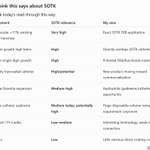
$SOTK is quietly evolving from a niche ultrasonic-coating specialist into a higher-value production systems company — with improving operating leverage, a strong balance sheet, and growing evidence that its R&D-to-production model is working.

William F. Nicklin retweeted

SpaceX CFO Bret Johnsen has announced that the company has signed another AI compute deal that will generate $1.11 billion of revenue per month ($13.3 billion per year), starting on Dec 1, 2026.
"Earlier this month, we closed another hosting deal. By the end of this year, with annualizing our December number, we're on track to hit $100 billion of ARR."
(via Goldman Sachs Communacopia and Technology Conference)

William F. Nicklin retweeted

OIL
Shanghai crude futures above Brent Crude for the first time since May.
China's buyer strike has been the most important reason oil prices have remained subdued during the Iran War.
It seems China is buying again now...

William F. Nicklin retweeted
Remember: the EU’s economy was larger than the US’s in 2011. Thanks to its self-defeating ‘green’ and GDPR policies (and U.S. tech dominance) the US economy is now 44% larger than Europe’s. Europe needs to wake up. 🇺🇸 🇪🇺

William F. Nicklin retweeted

Knowing how/why something works is really important.
Most people come to realize this the hard way…
…when that something, stops working.
William F. Nicklin retweeted

Nobody alive has ever experienced an El Niño event this strong.
By this fall, we are tracking a system that easily eclipses the historic events of 2015 and 1997. On its own, this El Niño could make 2027 extraordinarily hotter than normal for most of the planet—and by a massive margin.
We measure El Niño by the peak water temperature anomaly in a specific area of the equatorial Pacific. This year, the heat isn't just baking the surface; it is deeply rooted in the ocean.
Top 4 El Niños Ever Observed:
1. 1877-1878: +2.8°C (Estimated reconstructed ONI index; contributed to global famine)
2. 2015-2016: +2.6°C
3. 1997-1998: +2.4°C
4. 1982-1983: +2.3°C
The Late 2026 Projection:
Consensus models are currently averaging a +3.0°C to +3.4°C index by November and December, with extreme outliers approaching +4.0°C. If these averages hold, this system will blow every historical event out of the water.
The strongest El Niño on record likely occurred about 150 years ago in 1877, just after the end of a regional cool period known as the "Little Ice Age" and before human carbon emissions began rapidly impacted warming the planet. That event shows just how destructive these cycles can be even without the added heat trapped in today's atmosphere.
While that historical context gives us a baseline, the immediate focus is what this means for us locally as we head into winter.
I will dive deeper into the Florida forecast once summer winds down, but historically, similar years have produced multiple significant winter tornado outbreaks. For example, the winters of 1982, 1997, and 2015 all produced EF3 tornadoes (133-165 MPH)—including the deadly "Night of the Tornadoes" that devastated parts of Central Florida in February 1998.
Looking at the broader picture, this system will trigger distinct weather extremes across the globe—to name just a few impacts:
The Pacific Ocean: A dramatically higher number of hurricanes for the rest of the year.
Florida and the Southern U.S.: Potentially one of the wettest winters on record.
Europe: Extreme amounts of localized, heavy rain.
Long story short, different parts of the globe experience major El Niño impacts at different times. This is a globally significant, strengthening weather event that will have clear, undeniable consequences later this year and throughout 2027.

William F. Nicklin retweeted
Los mercados financieros han empezado a descontar el impacto de El Niño
Un interesante artículo publicado esta semana en el Financial Times explica cómo un fondo de cobertura está captando capital para un vehículo creado específicamente para beneficiarse del fenómeno de El Niño de este año, y por qué los bancos de todo el sector ya están publicando informes para sus clientes sobre sus posibles repercusiones en los mercados.
☕ Los precios del café y el cacao se han disparado ante la previsión de daños en las cosechas de África occidental y Brasil.
🌾 El trigo de Australia y el arroz de la India se enfrentan a graves amenazas, ya que las precipitaciones del monzón indio se sitúan más de un 10 % por debajo de la media.
🚢 Los precios de las subastas para transitar por el Canal de Panamá han alcanzado máximos históricos. La preocupación por el descenso del nivel del agua recuerda a la grave sequía de 2023-2024.
⚡ La minería del cobre podría sufrir interrupciones por la sequía en Zambia y las inundaciones en Chile, ya que un mismo fenómeno genera riesgos opuestos en distintos lugares.
🍬 Los analistas siguen de cerca el posible impacto sobre la producción de azúcar de la India.
La Organización Meteorológica Mundial afirma que no existen pruebas de que el cambio climático esté aumentando la frecuencia de los episodios extremos de El Niño. Sin embargo, está claro que el calentamiento global agrava las consecuencias de cada episodio: al incremento habitual de entre 0,1 y 0,2 °C provocado por El Niño se suma un calentamiento ya peligroso de 1,4 °C. Además, una atmósfera más cálida contiene más humedad, lo que favorece lluvias más intensas en las zonas donde El Niño ya provoca precipitaciones.
La cifra más preocupante no tiene que ver con los mercados. El Programa Mundial de Alimentos advierte de que este episodio podría empujar al menos a 49 millones de personas más a una situación de inseguridad alimentaria. Es un recordatorio de que las consecuencias más graves recaen sobre quienes tienen menos capacidad para afrontarlas. Y sus efectos no desaparecen rápidamente: un estudio publicado en Science en 2023 concluyó que los grandes episodios de El Niño reducen el crecimiento de los países afectados durante años.
Precisamente por eso es tan importante el tiempo de antelación de las previsiones que la OMM ofrece desde primavera. Los mercados ya están tomando posiciones ante este episodio, meses antes de que alcance su punto álgido. La cuestión es si esa misma capacidad de anticipación llegará a los pequeños agricultores, los responsables de la seguridad alimentaria y las comunidades vulnerables con la misma urgencia con la que llega a los fondos de cobertura. 🛰️
📰 Fuente: Financial Times, «How will El Niño hit the world economy?» (Moral Money, 12 de agosto de 2026).

William F. Nicklin retweeted

WHEAT
Wheat is now trading 1 standard deviation below its long-term trend, close to its usual bottom level of at -1.5σ.
$WEAT


William F. Nicklin retweeted

Taleb: "standard deviation is not how much something moves on average."
ask anyone - even statisticians, even government agencies - and that's exactly the wrong definition you'll get back.
what they're describing is mean absolute deviation. real standard deviation squares the moves first - which quietly hands almost all the weight to the rare extremes.
his demo: 1,000,000 numbers, all zero except one. mean deviation ≈ 2. standard deviation ≈ 1,000. same data, a 500× gap.
~10 min, free. why the risk metric everyone trusts falls apart on fat tails ↓

Taleb: the worst single-day loss in market history was "a small setback."
Nvidia shed $589B in a day on the DeepSeek scare - the biggest one-day wipeout ever.
his take: that's noise. the stock was up an order of magnitude. giving back 17% means nothing.
the real lesson - the whole AI trade leaned on one chip, one story. and people only notice the falls, never the rises.
"Something goes from 1 to 10, goes back to 9, people freak out."
"now it's no longer flawless. You have a small little chip on the glass."
"Google came out of nowhere and displaced Alta Vista."
~4 min, Taleb on why the crash is "the beginning," not the bottom ↓