







something's shifting in $BTC land and you need to pay attention.
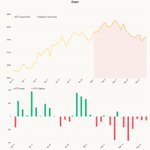
market is basically frozen rn. nobody buying, nobody selling.
volume just dropped into the bottom 12th percentile of all-time. whales are in full wait-and-see mode. not a good sign when the big hands go quiet.
and there's this one level you need to tattoo on your brain: $76,088
think of it as the line between bull and bear. BTC is literally hovering right above it, twitching. if that breaks, the whole narrative flips.
ETF flows? yeah about that...
$2.26B pulled in 2 weeks. BlackRock alone yanked $1B last week.
we spent months saying "institutions are coming" and now... institutions are leaving
but here's the thing this isn't a crash signal. it's a warning shot.
no panic in the streets yet. market's just tired and confused. running on fumes.
my take? no aggressive longs rn. not even close.
sit on your hands. watch $76K like a hawk. if it breaks → step aside. if it holds AND volume comes back → then we talk.
until then, patience is the alpha.

31
24
2,498
Over the last 30 days, whales accumulated 270,000 BTC.
This is the biggest accumulation wave we’ve seen since 2013. So nothing like this has happened in 13 years.
To put that into perspective: 270,000 BTC is roughly $20B right now.
There are people who quietly accumulated that in 30 days. These aren’t people panicking. It’s the exact opposite, people saying “I’m buying no matter what the price is.”
And there’s this too: BTC reserves on exchanges are now at their lowest level since December 2017.
That matters a lot because falling exchange reserves = people are pulling BTC off exchanges and moving it into cold wallets = they’re not looking to sell.
So we’re getting two signals at the same time:
➝ big money is buying
➝ and the people buying aren’t putting it back on exchanges
Historically, what does that combo usually mean? Supply gets tighter, demand goes up. Classic economics 101.
That said, whales aren’t always right, and timing can still be misleading.
But ignoring this data doesn’t seem very smart either.

14
17
3,273
BlackRock, Morgan Stanley, Goldman Sachs, all of them are piling into Bitcoin ETFs at the same time.
BlackRock alone put in $292M in a single day.
Morgan Stanley pulled in $103M in just 6 trading days, grew fast enough to pass WisdomTree, and now Goldman Sachs has filed its own ETF with the SEC too.
So yeah, we’ve been hearing “institutions are coming” for years.
Now they’re here.
And then there’s the RWA side, which honestly feels even bigger to me.
J.P. Morgan called it “the next big step” and says it’s planning to launch an institutional digital wallet backed by $BTC, $ETH, and $SOL in the second half of the year.
Tokenized real-world assets, real estate, bonds, commodities, have already passed $27B.
This isn’t just a narrative shift, it’s an infrastructure shift.
And infrastructure shifts don’t really go backwards.

12
15
3,095
Looking at the market last week, people were genuinely scared.
The Fear & Greed Index was at 43, so still in the fear zone.
But this week it moved up to 52. That means we’re not really in fear anymore, but not in greed either, just right in the middle. Neutral. That’s the effect of $BTC breaking back above $76K.
So people are starting to breathe a bit again. Slowly shifting into that “maybe this drop is over” mood.
It’s still way too early for altcoin season. The Altcoin Season Index is at 34 right now. What does that mean?
If it was above 75, we’d say “altcoin season has started.” Last month it was 44, now it’s 34, so it actually pulled back even more. The high this year was 78, and we’re still far from that.
So what does that mean in practice?
Right now the winner in this market is BTC. Everyone is buying $BTC, institutions are buying BTC, ETFs are buying BTC.
Altcoins still haven’t been invited to this party. So no, we’re not really in the “this altcoin will do 10x” phase yet, at least not for now.
And there’s this too: AHR999 at 0.325 is saying $BTC is still in the cheap zone.
The Rainbow Chart says “Fire Sale.” So onchain signals are basically saying buy, but the market still doesn’t fully believe it yet.
Being bullish on $BTC makes sense here. For altcoins, patience still matters. Before altcoin season can really start, $BTC needs to sit on solid ground first.

34
29
2,450
Bitcoin developers have a serious proposal back in focus today.
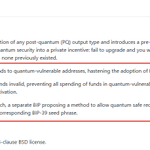
It’s called BIP-361. The draft exists in the Bitcoin BIPs repo as “Post Quantum Migration and Legacy Signature Sunset.”
And the topic is this: quantum computers.
Quantum computers could theoretically break today’s cryptography.
Bitcoin right now relies on ECDSA, and BIP-361 is built around the idea that older signature setups eventually need a sunset once post-quantum outputs exist.
If a strong enough quantum computer shows up, coins sitting in older Bitcoin address types could theoretically be stolen.
So BIP-361 is basically saying: “Let’s deal with this before we get there.”
They’d make old addresses unusable over time.
Meaning 5 years after activation, any BTC still sitting in old-style wallets would be frozen. You wouldn’t be able to send it. You wouldn’t be able to spend it.
The draft describes a phased migration, with legacy signatures eventually becoming invalid after that window.
“So what happens to the 1 million BTC in Satoshi’s wallet?”
Yeah, that would get frozen too.
Those coins have never been touched, never been moved.
If BIP-361 ever passes, they could become inaccessible forever. It’s still just a proposal, of course.
Nothing in Bitcoin gets through without broad community support.
But it’s also true that developers are taking this seriously and have formally put it forward as a draft.

13
12
2,296
Retail left, institutions came in, and that changes everything.
First, we have to accept this part. Retail really got wiped.
The Pumpfun reality is kind of brutal. According to Solidus Labs, 98.6% of the tokens launched there were classified as rug pulls or pump-and-dumps.
CoinGecko’s dead token report shows a similarly ugly picture too.
But at the same time, this is what’s happening: institutional money never really stopped.
And that’s the part that actually makes this cycle different. In previous bear markets, when retail left, everyone left. Not this time.
When retail comes back, the market they’ll find is gonna look different.
64% of $BTC is sitting in just 10 large wallets. Institutional concentration is at record levels.
ETF rails are open. Institutional money can scale up at any moment.
The regulatory framework is starting to settle. SEC safe harbor, the GENIUS Act, IMF approval.
So when retail comes back, they won’t be coming back to the wild west. They’ll be coming back to a market built on institutional infrastructure.

32
28
2,818
Stablecoin $317.7B: Crypto’s Real Growth Story
➝ Total stablecoin market cap is $317.7B (all-time high)
➝ Visa + Mastercard combined: $25.5T
➝ Share of crypto transactions: 75%
Stablecoins have passed Visa and Mastercard. Read that again. Show that line to the people still calling crypto a “speculative toy.”
Stablecoins are no longer crypto’s waiting room, they’re the actual product.
Stablecoins reached $317.7B because people started using crypto not as a speculative tool, but as financial infrastructure.
Banks see this and get nervous. Regulators see it and try to frame it. Institutions see it and adapt.
While BTC is pumping, everyone watches BTC. But crypto’s real mainstream adoption is coming through stablecoins.
And this quiet revolution already started.
7
8
2,599
Retail is down, institutions are up. So is this cycle actually different?
Yeah, this cycle really is different. And that’s both a good thing and a bad thing.
What separates this cycle from the previous ones isn’t intuition, it’s the data.
➝ Crypto fund flows
2025 ~ $130B
2026 Q1 ~ $11B (down to one-third)
➝ Institutional BTC buying
2026 Q1 +69,000 BTC
➝ Retail BTC selling
2026 Q1 -62,000 BTC
➝ ETF + corporate treasury share
2025 ~ 8% of supply
2026 Q1 ~ 12% of supply
➝ Total corporate treasury holdings
2025 ~ 1.1M BTC
2026 Q1 ~ 5.7% of total supply
JPMorgan says Q1 crypto fund flows came in at $11B, about one-third of last year.
➝ So what’s happening on the institutional side?
Strategy, formerly MicroStrategy, has basically become the symbol of this cycle.
Right now it holds 766,972 BTC, which is 3.65% of total supply.
And in March 2026 alone, it bought another 22,337 BTC ($1.57B).
Average purchase price: ~ $70,194
YTD BTC yield: 3.7%
But Strategy isn’t alone. Germany’s Aifinyo AG is aiming to become Europe’s first pure Bitcoin treasury company, with a goal of accumulating 10,000 BTC.
Coinbase’s institutional survey says the same thing too:
71% of institutions think BTC is still cheap
80% would buy more or hold even if price drops another 10%
75% plan to increase digital asset allocation this year
➝ What happened to retail?
Retail didn’t disappear, but the attention shifted somewhere else.
Wintermute summed it up pretty clearly: retail money is flowing into themes like the S&P 500, AI, robotics, and quantum computing right now.
The pain from 2022-2023, the collapses, bankruptcies, liquidations, is still fresh. And on top of that, crypto underperformed traditional markets in 2025.
Altseason has almost disappeared. In 2025, the average altcoin rally lasted around 60 days. In 2026, that dropped to around 20 days.
➝ So is this cycle really different?
Yes, but not in the way most people expect.
What’s different (good)
‣ BTC is now an institutional asset class. ETFs + corporate treasuries hold 12% of supply
‣ In big drawdowns, systemic liquidation risk is lower because institutions don’t panic sell the same way
‣ According to Ark Invest, BTC at $300K-$1.5M by 2030 is no longer some crazy prediction, it’s an institutional model now
What’s different (bad, or at least something to watch)
‣ We now have a structure where a few big funds dominate, this isn’t a broad-based bull market
‣ Without retail, altseason doesn’t really happen, because retail was the one pumping alts
‣ JPMorgan says total fund flows this cycle are just one-third of 2025, that’s not exactly a strong cycle
‣ Institutions are macro-sensitive, if Fed policy shifts, ETF outflows can happen fast
What hasn’t changed
‣ BTC dominance is still strong
‣ In big dips, the dip buyers are still institutions, and that supports price
‣ But for a real parabolic move, retail probably has to come back
➝ So what should we expect from this cycle?
Cantor Fitzgerald probably said it best: this cycle has turned into a structure dominated by institutions, with less retail. There’s price support, but the risk of a 2022-style systemic collapse is lower.
‣ For BTC, there is institutional bid support → lower chance of a major collapse
‣ For altcoins, without retail coming back, there is no real season → be careful
‣ ETF flows are tied to macro → watch the Fed
‣ In this cycle, the people making money are BTC holders, not alt rotation chasers

13
18
2,170
Bithumb’s 620,000 BTC Mistake: Are Crypto Exchanges Still Safe?
Yes, this one was real and it was a pretty serious system failure.
➝ What happened?
On February 6, 2026, a Bithumb employee was handling a promo distribution and typed “BTC” instead of “KRW” (Korean won).
The result? 620,000 BTC, or 2.95% of Bitcoin’s total supply, got mistakenly credited to hundreds of users.
Value at the time: around $43 billion.
➝ How did the system react?
There is one piece of good news here. Bithumb’s internal controls did kick in.
695 accounts were frozen within 35 minutes.
1,788 BTC had already been sold, but 93% of that was recovered.
BTC dropped to $55,000 on Bithumb while other exchanges were still above $70K.
So Bithumb’s response was decent, but the system design was still bad.
This incident shows 3 things:
➝ Human error is real. Engineers can make mistakes.
➝ Large transfers need approval layers.
➝ There still has to be a clear answer for assets that can’t be recovered.
Bithumb’s internal control system worked well, but the design flaws are still there.
Big exchanges do have better control systems, but no exchange is 100% safe. For long-term hodling, self-custody is still the safer option.

12
9
2,137
Hyperbridge Hack: 1 Billion $DOT Minted, Only $237K Stolen
On the morning of April 13, 2026, 1 billion $DOT was minted and dumped on Ethereum.
The headlines made it sound like “Polkadot got hacked.” But the real story is way more interesting.
The actual target was the Hyperbridge Gateway contract on Ethereum. A third-party bridge used to move Polkadot assets onto Ethereum.
Native $DOT only dropped around 3-7%. Bridged $DOT, on the other hand, went from $1.22 to almost zero.
➝ So how did the attack happen?
Hyperbridge’s HandlerV1 contract uses cryptographic proofs to verify cross-chain messages.
The problem was this: those proofs weren’t tied to the specific request being sent.
So you could take a proof that was valid in the past and reuse it with a new and fake request.
And that’s exactly what the attacker did.
➝ Replayed a proof that had been valid before
➝ Sent a fake message to the HandlerV1 contract
➝ Transferred admin control of the $DOT token contract to their own address
➝ Minted 1 billion $DOT and swapped it into 108.2 ETH through Odos Router + Uniswap V4
➝ 1 Billion Tokens Were Minted, So Why Did They Only Get $237K Out?
The attacker minted 1 billion $DOT. But real liquidity in the bridged $DOT pool on Ethereum was extremely thin.
As part of Polkadot’s DeFi Singularity campaign, the total amount of $DOT bridged over was around 5.19 million $DOT.
So that was the actual amount the market could really absorb.
So what happened when 1 billion tokens got dumped all at once?
The price crashed from $1.22 to $0.009. 99% of the tokens became worthless. The attacker basically wrecked themselves.

12
15
2,314
Morgan Stanley pulled in $34M in a single day.
Its fee is 0.14%. One of the cheapest on the market.
Wall Street is selling Bitcoin now.
13
17
2,677
I was scrolling Twitter this morning and there's this thing everyone's talking about. Four narratives that are basically gonna define crypto in 2026.
Let me break it down for you in a way that actually makes sense.
➝ First one is Privacy.
Look, think about it would you want your entire financial history on a public ledger that anyone can see? No, right?
That's why privacy coins and privacy tech are blowing up. It's not some niche thing anymore.
Regular people are starting to care about this. Banks are gonna care about this. It's inevitable.
➝ Second is Prediction Markets.
Okay, so Polymarket you know that betting platform?
it's literally more accurate than news outlets now. Like, it's wild.
People are putting real money on outcomes, so they're incentivized to be right. Wall Street is watching this.
Everyone wants a piece of it. This is gonna be huge.
➝ Third is Stablecoins.
This one's simple but important. Your parents aren't gonna buy Bitcoin, right?
But they might use a stablecoin to send money to someone without fees. It's the gateway drug.
It's the thing that actually gets crypto into everyday life. It's not sexy, but it's real.
➝ And the fourth is NFTs.
I know, I know everyone thinks NFTs are dead.
But here's the thing: the 2021 JPEGs were stupid, yeah. But now there's actual use cases. Real utility.
It's not about buying digital art to flip it. It's about ownership, provenance, digital rights. That's the future.
So basically, if you're thinking about what's actually gonna matter in crypto this year, it's not about which coin moons.
It's about these four things quietly reshaping how the whole system works.
14
12
2,750
Drift Hack: $285M Stolen
April 1, 2026. Drift Protocol, Solana’s biggest perps DEX, got drained for $285M in minutes.
That makes it the second biggest hack in Solana history.
But honestly, the amount stolen isn’t even the craziest part.
The real story is how it happened.
➝ How It Happened
This wasn’t one random bug.
The exploit played out in 4 steps and each one exposed something deeper than a normal security failure.
Less “one-off mistake”
More “design was fragile from the start”
➝ 1. Fake token
The attacker minted a fake asset called “CarbonVote Token” (CVT), opened a Raydium pool with just $500 in liquidity, then wash traded it until the price got pushed to $1.
That alone tells you something important:
oracle feeds can be manipulated.
➝ 2. Oracle manipulation
Once CVT was artificially priced up, that fake price made its way into the oracle feeds and Drift treated it like a legitimate asset.
So now the issue is bigger than just one fake token.
The entire pricing layer became a single point of failure.
➝ 3. Admin key compromise
Then came the human layer.
Through social engineering, the attacker got admin access, listed CVT as a live market, and removed withdrawal limits.
So even in a system this technical, the weakest link was still the human one.
➝ 4. Fast withdrawals
From there, CVT got used as collateral to pull out USDC, SOL, JLP, and WBTC.
$285M. Gone.
The funds were moved almost immediately.
Part was bridged to Ethereum:
19,913 ETH, around $42.6M
Some SOL got swapped into ETH on Hyperliquid.
The rest was sent to Binance.
And Circle?
Too slow to freeze the stolen USDC.
That became a whole separate debate on its own.
➝ Elliptic later linked the exploit to North Korean hackers, saying the flow matches Lazarus Group behavior.
The patterns were familiar:
➝ cross-chain laundering
➝ pre-positioned wallets
➝ test transactions before the main exploit
That’s basically textbook Lazarus playbook stuff.
For context, Lazarus stole over $2B in 2025.
Bybit alone accounted for $1.46B of that.
And in 2026, the pace didn’t slow down.
It got worse.
➝ The Domino Effect
This is where it turns from a Drift story into a Solana DeFi story.
Before the hack, Drift’s TVL was $534M.
Within an hour, it dropped to $255M.
Basically cut in half.
And the damage didn’t stay isolated.
Solana DeFi is deeply interconnected, so when Drift broke, stress started spreading across the rest of the ecosystem too:
➝ protocols using Drift as collateral started feeling liquidity pressure
➝ DEX volumes across Solana fell back toward 2024 lows
➝ DRIFT dropped more than 40%, down to $0.06
➝ confidence across the ecosystem took a major hit
And this isn’t even the first time that pattern showed up.
Back in January 2026, the Step Finance treasury hack (~$27M) triggered similar stress across connected Solana protocols.
One protocol breaks
and the pressure leaks everywhere else.
That’s the tradeoff DeFi keeps running into.
Composability is its biggest strength.
And in moments like this, it becomes its biggest weakness.

13
10
2,356
Morgan Stanley’s Bitcoin ETF Could Be Here Next Week
Yep, that Morgan Stanley just re-filed the paperwork with the SEC for its Bitcoin ETF. Analysts are expecting approval as soon as next week.
What happened when BlackRock’s ETF launched?
Billions of dollars flowed in. But Morgan Stanley’s client base is different, ultra-high-net-worth individuals, institutional portfolios, pension funds. This is the crowd that’s been saying “crypto? no thanks” up to now.
With an ETF, these people don’t need to buy BTC directly anymore. They can just add it to their portfolios like a stock. That’s a huge psychological barrier getting broken.
14
17
1,652
“Speed Isn’t Enough, Finance Wants Predictability”
Blockchains are fast now. Solana does 65K TPS, Monad even more. But a16z says we were asking the wrong question.
For finance, what matters isn’t “how much TPS?” it’s “when exactly is my transaction gonna get included?”
So what’s the problem?
Today every chain basically tells you this: “I’ll include it in a few seconds.”
For a market maker, that answer is useless. The Fed hikes, ETH drops $100, you need to cancel your order in milliseconds, but an arbitrageur can still get in first against your old price.
You lose every time. In the end you widen the spread, the onchain market gets less efficient, and users go back to Binance.
Behind all this, there’s one structural problem: the leader problem.
The single node deciding what gets included in the block, the leader, has two superpowers: it can censor your transaction, or see it and jump in front of it. Just like in the Alice & Bob example: Bob is both bidding and acting as leader. He sees Alice’s bid, outbids it by $1. Alice can’t win, so she leaves. The auction breaks.
Solana’s Alpenglow + ACE + MCP upgrades are directly aimed at this problem. Institutions like UBS and NYSE are moving onchain. And the SEC has already pulled the sequencer issue into the regulatory conversation.
The chain that actually solves these two things is gonna become the infrastructure layer for institutional finance. Until then, we’re basically living off workarounds.


11
11
2,189
Hyperliquid is getting close to passing Arbitrum.
It’s now in the top 10 of DeFi rankings with $1.69B in TVL.
Arbitrum’s TVL is $1.93B.

14
19
2,207
Google’s quantum work now suggests BTC’s signature system could theoretically be broken by a future quantum machine.
Meaning the private key, the thing that protects your wallet, could in theory be derived in around 9 minutes once the public key is exposed.
Now before anyone panics, this is not something that’s happening tomorrow.
But people are throwing around dates like 2029 now, and crypto still doesn’t look fully ready for that shift.
Google itself has moved its post-quantum migration timeline up to 2029 because it sees quantum risk as coming faster than older timelines suggested.
The real issue is this: BTC’s cryptography will eventually need to change.
That’s what PQC is for, post-quantum cryptography. But changing something this big isn’t easy. You need consensus, you need time, and the migration itself is a serious challenge.
One recent paper on Bitcoin quantum-safety argues the transition needs to start as soon as possible.
So in the short term, this is a panic narrative.
In the long term though, serious attention is probably gonna flow toward quantum-resistant projects.
It’s a real threat.

10
11
2,101
AI agents are sending money to each other. And they’re doing it on Solana.
That’s where stablecoins + Solana come in.
For AI-to-AI micropayments, this is probably the cleanest setup. Fast, cheap, programmable. No human in the loop.
Solana Foundation’s CPO said it at a big conference in New York:
“The Solana network has already processed 15 million AI agent payments.”
15 million. And this only just started. That number is growing exponentially.
So why does this matter?
a16z put it like this: “crypto has entered its ‘shirt phase.’”
What does that mean?
“In the early days of the internet, people used to say ‘why would I shop online anyway?’ Then Amazon showed up, and habits changed. The same thing is happening now. People won’t use crypto directly, AI agents will. Without you even noticing, an AI working on your behalf will be making payments over Solana.”
So to me, crypto’s real mass adoption won’t come from humans, it’ll come from machines.

13
9
1,581
