

software engineer, contributing @amontlabs, prev. @primodiumgame.
Paris, France
Joined December 2021
- Tweets1.7K
- Following1K
- Followers1.2K
- Likes3.9K





We crossed 700 stars.
Keep the issues coming, and feel free to open a PR if you believe you have a useful feature or fix to contribute!


I extracted computer use from the ChatGPT app to plug it into any harness, because it's great.
Completely decoupled from ChatGPT auth and built-in browser. For macOS and Linux.
github.com/0xpolarzero/lcu
polarzero retweeted

Today, we are launching a preview of our new model, Mistral Large 4 (ML4), aka le Chonk 🐈.
ML4 is a 1T-parameter model with 49B active parameters, trained natively with multimodal capabilities.
It is at the frontier of open models, and by far the strongest open-weight model from the US or Europe.
The RL run behind this preview is still in flight and shows no sign of saturation -- we will release a final version before the end of the month along with the weights of the model.
🧵
1/n


Meet Mistral Large 4, aka Le Chonk.
• 1T parameters, natively multimodal. 49B active.
It is the best open weights model from US or Europe on aggregated benchmarks.
• State-of-the-art on critical workloads, including cyber defense, manufacturing and finance and it surpasses closed frontier models on visual grounding.
• Forged in Europe end-to-end and is deployable from Europe via our own Mistral Cloud infrastructure.
• Available to all via API today. Working with cybersecurity partners privately.
Open weights release end of October.
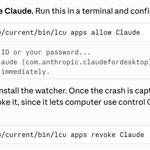
Btw with lcu you can get claude to control... claude.
Computer-use agents usually don't allow a harness to control itself but we do.

LCU now works properly with Claude Code (both app and CLI).
The first time Claude touches an app, you get an approval panel right in the session.
You can also review and edit your always-allowed apps with Touch ID, no Codex app needed.
github.com/amontlabs/lcu

LCU now works properly with Claude Code (both app and CLI).
The first time Claude touches an app, you get an approval panel right in the session.
You can also review and edit your always-allowed apps with Touch ID, no Codex app needed.
github.com/amontlabs/lcu
I extracted computer use from the ChatGPT app to plug it into any harness, because it's great.
Completely decoupled from ChatGPT auth and built-in browser. For macOS and Linux.
github.com/0xpolarzero/lcu
You can now open SSH on a sandbox from Silo and connect from this machine or another.
Works with a terminal or an agent harness, against a local or remote VM.
github.com/0xpolarzero/silo/…
Silo: a native macOS/Linux app for sandboxes on your machine or remote ones. Powered by MicroSandbox.
Meant for letting agents run wild in isolated Linux VMs.
Open a workspace in your editor or terminal, forward ports, keep secrets on the host, scope GitHub access per sandbox, snapshot the environment.
github.com/0xpolarzero/silo
Installers are here: github.com/0xpolarzero/silo/…
I built this for myself, but if you end up using it, issues and PRs are welcome !
And if something feels worse than just doing it in a terminal, please tell me.

polarzero retweeted

zhipu absolutley nailing pursuing the element that played in oss models favour from the HF incident
masterclass in adpating goals and roadmaps to informatin as they come.
anthro and oai neuter you cause they believe humans are more bad than good and they need to control every outcome. kimi and zhipu are there to serve you cause they beleive the future is built toghther in the open and no one person or group can pursue that.
individualism and collectivism battling it out on the grand stage

Introducing GLM-5.3: Built to Code. Ready for Cyber Defense.
- Top-tier coding and agentic capabilities, achieved through post-training on the 743B base model
- A major leap in cybersecurity, setting a new standard among open models
Tech Blog: z.ai/blog/glm-5.3


STRONGLY recommended reading
You're in for a treat at the end, you won't even have to bookmark it for "putting it into practice later": it's a tool that lets your agent put it into practice for you...

Because I’m trying to teach agents how to orchestrate agents, everything I have learned
- prompt engineering
- context engineering
- harness engineering
- workflow engineering
- backpressure
Is all documented in a pretty compact form in the Smithers docs.
The goal is to make an agent so good at this skill you just talk to the agent. But in meantime you can up level yourself by reading this:
smithers.sh/guides/context-e…


polarzero retweeted
Only Smithers supports this feature: Time Travel
No other orchestration framework is built from ground up to be this observable debuggable and durable while supporting multiple providers
1. Smithers saves "frames" to sqlite everytime updates happen
2. JJ snapshots the state of the file system every frame
3. The frame provides perfect visibility into what smithers is doing and why
4. You as the user can time travel back to any frame at any time reverting botht he file system and the state of smithers to that frame

Best way to make a harness is with smithers
You get the holy trinity of orchestration for free: durability, observability and composability
It makes your agentic systems durable, inspectable, and composable with clear coordination between agents, humans and programmatic code

LLMs still barely understand your intent, have no taste and require constant babysitting. You can't stay outside the loop for long on any complex-enough problem.
It's still a dumb slop machine and it's great; you're still forced to learn from its poor choices.
