






Pinned Tweet
Railways in 1845, stocks in 1929, the dot-com boom in 2000. Every big bubble went through the same 5 stages.
I put AI through the same test, using 9 signals from those bubbles.

The biggest IPO in history caused a $900B wipeout on Nasdaq.
By the close:
S&P 500: -2.02%, sixth loss in a row
Dow: -2.19%, first close under 50,000 since June
Nasdaq: -2.25%
VIX: 28.44, near its highest since March
AI stocks fell the most. $NVDA -3.3%, $AMD -7.7%, $CRWV -6.1%, $NBIS -9.4%.
Here's how I read it. Anthropic sold about $107B of stock, counting the private placement. Funds that wanted in had to raise that cash somewhere, and the easiest place was the AI stocks they already owned. ANT itself closing up 17% tells you investors still want AI. They paid for it by selling the old AI winners.
What I'm watching next week: if ANT holds up while the rest keeps falling, this was money moving from old AI stocks into the new one. If ANT starts falling with them, the problem is bigger than one IPO.

45
$ANT down 10% premarket on day two.
Buyers at the $111.50 open are already down ~20%. $83 IPO buyers are still green. With S&P futures -2% and AMD -7%, this looks like the AI selloff hitting the newest and most crowded name first. $83 is the line that matters.

BREAKING: Anthropic stock, $ANT, extends losses to -10% in premarket trading, now down -25% from its post-IPO high.
The stock is now 5% away from its IPO price of $83/share.

3
187
Taiwan's stock market just had its worst week since 1990.
-6.2% today, -17.5% for the week, ~28% below its October 6 record. That's $1.12T of value gone in six weeks.
Korea fell 5.2% today. Samsung -7%, SK hynix -6%.
Two things hit at once.
The AI selloff from Wall Street spread to the companies that actually make the chips. And a new US export rule took effect on Thursday: Chinese chip designers now need a US license to make chips on 16nm or smaller, so TSMC suspended those orders, per Reuters. The FT reports Samsung also paused some China shipments.
The part I'd watch is memory. SK hynix doesn't have a China foundry problem, yet it fell almost as much as Samsung. Meanwhile Nvidia's supply commitments just rose to $390B, mostly multiyear memory contracts, and memory is still one of the tightest parts of the AI supply chain.
That's why $MU at the US open matters to me. If Micron falls as hard as the Korean names, the market is pricing a slowdown in AI spending. If it holds up, Asia was a China-rules selloff that dragged memory along with it.

1
5
175
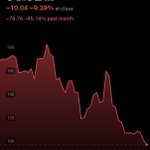
42% that's how mush $NBIS fell in a month.
On Oct 29 it traded around $172. Today it closed at 96$.
Three things happened in between.
Nov 5: Bloomberg reported Microsoft was tightening oversight of some neocloud projects, Nebius included. The stock lost about 15% that day.
Nov 12: Q3 earnings. Revenue was $981M, up 571%, above expectations. It still fell 17%, because 2026 revenue was cut to the low end (about $3B) and the $7B ARR target slipped from December to February.
Today: AI compute names sold off on Anthropic's first trading day, and Nebius dropped another 9%.
The delay part is what I keep coming back to. Most of it comes from one New Jersey site, run by another company for Microsoft. The operator shut down its temporary generators before permanent power was ready, and the schedule reset. Bloomberg reported the site was also fined $1M for running generators without permits. Now only a bit more than half of Microsoft's capacity there is expected by year end, with the rest in Q2 2027.
I don't think demand is the problem. Nebius has $38.7B of contracted revenue it hasn't delivered yet, customers signed $12B+ in new contracts during the quarter, and the company says its own sites are on time or ahead.
My view changes if delays start showing up at sites Nebius runs itself, or if customers stop prepaying for capacity. Until then this looks like a timing problem that the market is pricing as a demand problem.

Nvidia is now cheaper than it was in 2011, back when most of its customers were gamers.
By FactSet's numbers its forward P/E fell to about 11.7x, the lowest since October 2011. The S&P 500 is near 18x. That means the company at the center of the whole AI buildout is priced below the average stock in the index, and that was before Wednesday's drop.
Since October 6, the market has taken about $1.8 trillion off Nvidia. Very little of that is about chips. It's about a CEO who resigned in a scandal, a board investigation that's still open, and an empty chair.
I get why people are scared. Jensen bet the company on CUDA when nobody wanted it, and nobody on the bench has proven they'd make a bet like that. But at this multiple the market is assuming the next CEO wrecks a business that's already shipping Vera Rubin racks to Microsoft, Google and Oracle. I think that's the wrong bet, and the discount starts closing the day the board names someone.

1
3
203
Jane Street reportedly lost $15B in one month this July.
A partner's internal note summed it up as "July was a bad month."
By mid-August the firm had still made over $40B from trading this year.
Las year they made $39.6B. JPMorgan, the biggest bank in the world, made $35.8B. Goldman made $31.1B.
Jane Street is a quant firm. Quants trade with math and code instead of gut feeling. Their models spot tiny price gaps, computers trade them millions of times a day, and the small edges add up to billions.
2026 has been their best year yet. Jane Street did $16.1B in Q1 alone. In Q2, Hudson River Trading made a record $11.4B and Citadel Securities a record $7.3B, both 3 to 4 times what they made a year earlier.
The reason is chaos. The wild swings in AI stocks kept everyone buying and selling, and these firms are in the middle of every one of those trades. Banks also got rules after 2008 that limit risky trading with their own money, so the quant firms took that business.
The $15B came from Jane Street's AI bets, including Leopold Aschenbrenner's Situational Awareness fund. I think the trading side is the safest part of these firms now. The danger is what they do with all the cash it throws off, and July showed that.

6
162
Samsung's chip business made more profit last quarter than all of Nvidia.
Samsung chips: ~$80B operating profit
Nvidia, the whole company: $77.5B
Most people still think of Samsung as the phone company. Last quarter its phone business actually lost money. Almost all of the profit came from memory chips.
Every AI chip Nvidia sells needs memory stacked next to it, and memory is sold out. So the company that made the AI boom possible now has to pay up to the people who make the memory.
$NVDA

2
5
327
Buried in Nvidia's earnings: it has promised to cover up to $105B if OpenAI can't pay for its data center campus in Ohio.
The landlord is SB Energy. The site will host Nvidia chips under 20-year leases to OpenAI. If OpenAI defaults, Nvidia covers the landlord's losses, up to $105B.
Nvidia's total guarantees are now $118B. Its cash and investments are $53.5B.
None of it has kicked in yet. The first phase starts around 2028, Nvidia hasn't paid a dollar, and OpenAI has promised to pay Nvidia back for anything it covers. But that promise only matters if OpenAI is still standing, and that's exactly when Nvidia would need it.
So the world's most valuable chip company is now partly an insurance policy on OpenAI, the same week OpenAI's new model got a cold reception from early testers.

3
100
It's hard to believe but $10,000 in Coca-Cola a year ago is now $13,881
$10,000 in Oracle?
Now $5,231.
Oracle grew revenue 30% and still got cut in half.
2
8
662
Anthropic vs Samsung:
Valuation: ~$1.4T vs under $1T
Quarterly revenue: $17B vs $146B
Quarterly operating profit: a loss vs ~$80B
Price vs yearly revenue: ~17x vs under 2x
Anthropic is about to be worth more than a company that makes 8x its revenue and earns more profit in three months than Anthropic has ever made.
I'm not saying it's overpriced. No company this size has ever grown 12x in a year. But at $1.4T you're paying for years of that growth up front, while Samsung is getting paid right now for the memory Anthropic's models run on.
Just in April the situation was different:

Anthropic IPO valuation: $850B
Samsung valuation: $800B
Anthropic revenue: $30b.
Samsung revenue: $230b.

1
6
141
Nvidia just released their earnings. Here's what you missed:
1. Record revenue of $115.8B, up 103% in a year and almost $8B above their own guide
2. Data center alone made $107.6B
3. Next quarter guided at $130B, but that quarter has an extra week in it
4. Margins drop from 74.9% to 71-72% next quarter. Memory got that expensive
5. Still zero China data center revenue in the forecast
6. Vera Rubin is shipping, which they call the fastest product ramp in Nvidia's history
7. $28.1B returned to shareholders in one quarter
First report since Jensen left. The machine didn't miss a beat.
$NVDA

On May 7, Nvidia got a deal to buy $IREN shares at $70.
Today they're worth less than $16.
The deal was part of a big partnership to build up to 5 gigawatts of AI data centers together. Nvidia got the right to buy up to 30 million new IREN shares at $70 over the next five years, and signed a $3.4B contract to rent GPUs from IREN. Jensen Huang called AI factories "foundational infrastructure for the global economy." The stock jumped more than 20% on the news and a few weeks later hit $70.71.
Six months on, Jensen is gone from Nvidia and IREN keeps falling.
Nvidia hasn't lost anything, because it never had to buy. IREN is the one stuck. It has $20B of signed contracts but still needs about $6B more to build them, and the $2.1B from Nvidia only arrives if the stock climbs back above $70. Every dollar the price falls means IREN has to sell more new shares to raise the rest.


GPT-6.2 is OpenAI's worst launch in a year, and the timing couldn't be worse.
OpenAI had one job this week. Anthropic is about to go public, everyone is comparing the two, and this was the moment to show they're still in the race.
Instead, Dan Shipper's team at Every spent weeks testing it and called it "a disappointing release compared to Fable 5.2." Worse writing than GPT-6. In real coding it keeps quitting before the job is done. That's the one thing you can't afford when people are paying you to build their software.
And OpenAI's answer is a set of charts it made itself, on tests it picked, showing it wins on cost. I'm tired of launch-day benchmarks that fall apart the moment engineers actually use the model.
Honestly, this might be the best thing that happened to Anthropic's IPO all month. The one question buyers had was whether Claude stays ahead. OpenAI just answered it for them.

Anthropic goes public this week, so I went through the numbers in its IPO filing.
Revenue was $17.0B last quarter, 12x the same quarter a year earlier.
The compute bill is the line I keep coming back to. In Q3 revenue grew 47% from the quarter before. Compute and infrastructure costs grew 77%, from $5.6B to $9.9B. That swung the company from a $974M operating profit in Q2 to a $567M loss. Anthropic blames most of it on $5B of short-term compute, which costs more than its long-term deals, plus a $2B non-cash charge.
On top of that, the filing lists about $895B of compute commitments stretching out for years.
Demand is obviously there. What I'll be watching once ANT starts trading is whether revenue can keep outrunning the cost of serving it, now that quarterly growth has slowed from 144% to 47%.

4
340
February 2003. The dot-com crash has wiped out trillions, and Jeff Bezos walks on stage at TED to explain why he's still optimistic.
Everyone was comparing the internet to the Gold Rush. Bezos said the comparison breaks exactly where it matters: "in a gold rush, when it's over, it's over." Within a couple of years every stone in California had been turned.
His better analogy was electricity. The electric industry had its own boom and bust, but the wires stayed in the ground. The light bulb is what wired the world, and the appliances came later.
Twenty-three years later we're having the same argument about AI. Nvidia reports tonight and Anthropic lists this week at a valuation above $1 trillion.
I think Bezos asked the right question: what's left in the ground if prices crash? The data centers, the power deals and the trained models don't disappear, the same way the fiber didn't after 2001. Whether the companies that paid full price for them survive is a separate question, and in 2001 a lot of them didn't.
8
585
Nvidia reports tonight, and the first line I'll read is about memory.
In August its supply commitments jumped from $119B to $279B in a single quarter. In the CFO's own words, that was "primarily related to the procurement of memory." $92B of it is due before this fiscal year ends in January.
Kress also guided gross margin to bottom around 71–72% in Q4, and memory prices were the reason.
For two years everyone building AI paid Nvidia's toll. Now Nvidia is paying one to Micron, SK Hynix and Samsung, and it signed up for that memory after prices had already exploded.
The stock goes in about 34% below its October record. Revenue is guided at $108B, plus or minus 2%, and I expect them to clear it. What I'm watching is whether margins hold that 71–72% floor, because a revenue beat with slipping margins would show who has the pricing power in this buildout now.
$NVDA
5
148
Ten weeks ago Google's threat team said it hadn't seen a fully autonomous AI cyberattack in the wild. Yesterday it said it found one.
On an exposed attacker server they found a framework the operator called "exploit_agent." It watches popular web software around the clock. When a security patch comes out, it compares the code before and after the fix, works out which hole was closed, writes an exploit and runs it against sites that haven't updated yet. Nobody presses a button.
The same server held data already stolen from French media, entertainment and education sites, plus a config file with Russian-language comments calling the setup a "pilot."
Zero-day exploits averaged 8 a month in 2025. In August this year there were 22.
Google hasn't named who ran it, and the report comes bundled with a pitch for Google's own AI security product, so I'd keep that in mind. Still, the timing is what bothers me. Companies used to get days or weeks between a patch and the first attack. If an agent can read the fix and attack the same afternoon, every company that patches late is now the target.

5
136
$NVDA is doomed.
Your thoughts?


2
7
270