

Co-founder @DeriProtocol Personal blog: https://xitter.cf/t.co/qIWwwajOeh
Crypto Nomad @Singapore
Joined February 2011
- Tweets1.1K
- Following163
- Followers2.2K
- Likes375






The world computer with ultimate scalability!

The cryptographic world computer:
vitalik.eth.limo/general/202…
My attempt to express in somewhat concise terms the true meaning of basically everything planned to happen to Ethereum starting from the fork after Hegota. It's really not just a blockchain anymore. It's a hybrid architecture that combines together blockchains and modern cryptography, to enable much more powerful properties.
FOCIL, EIP-8288, Lean consensus, state management, formal verification, advanced mempool improvements (including privacy), and the longer-term specter of obfuscation all mentioned.
LFG💪

⏳ 16 hours left! The Arbitrum @arbitrum × Deri × Upscale @UpscaleTrade Trading Tournament is about to officially kick off!
Here’s how to register:
1⃣Go to deri.io/#/tournament and click Register.
2⃣Click the "Register on Upscale" button
3⃣Click "Sign in" and complete your registration
4⃣Click your pfp to copy your Upscale ID
5⃣Go back to the Tournament page and enter your ID
Everyone who completes 5 trades + $5 in trading fees will receive a $1,000 Upscale prop account 🔥

美国的数学教育到底出什么问题了? 🇺🇸📉
2026年费城国际数学家大会刚刚颁发了菲尔兹奖。
首先是对美国的好消息:4名获奖者里有3位在美国工作,唯一在加拿大工作的 Tsimerman 也马上要入职 @OpenAI 了!🚀
这届获奖者创造了诸多个“第一”:
🥇 王虹:@PKU1898 、巴黎综合理工 (@Polytechnique)、@MIT 历史上的首位菲尔兹奖得主(含并列)!
🥇 邓煜:@PKU1898 和 @MIT 的(并列)首位菲尔兹奖得主!
🥇 Tsimerman:多伦多大学 (@UofT) 乃至全加拿大🇨🇦大学的首位得主!
但很多人没想到的是,John Pardon 其实也是一个“第一”:他是本世纪第一位美国本土出生的菲尔兹奖得主!
如果我们看一下“在美国接受本科教育”的群体:整个21世纪,美国的本科教育其实仅仅培养出了 2.5 个菲尔兹奖:
🎓 John Pardon
🎓 邓煜 (0.5个,本科一半在北大一半在 MIT)
🎓 Manjul Bhargava (2014年得主,@Harvard 本科,来自加拿大的印度裔)
是的,你没有看错!整个21世纪,只有2.5位菲尔兹得主是在美国完成的本科教育,其中只有1位是美国本土出生的。
美国的数学基础教育,到底哪里出了问题?🤔👇
#数学 #菲尔兹奖 #FieldsMedal #教育 #STEM #基础教育


1
464
The ETA of 2030 might be just too conservative, isn't it?
AI-powered development can significantly speed up this process.
Two weeks ago, Ethereum researchers met in Berlin to continue charting the protocol's long-term trajectory, following along discussions with client teams in Svalbard in April.
The updated strawmap is at strawmap.org, and I attached a picture of it to this post.
My own high-level takeaways:
* "Lean Ethereum" is not a single one-shot upgrade, it is a collection of improvements that will come online to the Ethereum network over the course of three or four years. But make no mistake, this IS the third major iteration of Ethereum in the same way that the Merge was the second. Almost every major piece of the protocol will be replaced:
- Verification through recursive STARKs, rather than direct re-execution. Recursive STARKs become an enshrined first-class core component of the protocol
- Replacing everything quantum-vulnerable with quantum-safe alternatives
- Consensus: decoupled available chain and finality, one or two-round finality. Theoretically optimal security properties, simpler than today, and faster than today
- Multidimensional gas
- State: not just tree structure, but what *types* of state are available
- Changes to client architecture
...
At the same time, simplification, cleanup and future-proofing. And this will all be done in a way that minimizes disruption to existing application. We've done this before (the Merge), we can do it again.
* H-star (aka Hegota) is probably Ethereum's last thematically "pre-Lean" fork. Starting from I-star, most of everything we do will have a very strong "Lean" feel to it in one way or another.
* Privacy is no longer an afterthought, it is a first class goal. When designing Frames, the mempool, additions to the state tree, we explicitly ask the question "okay, how do quantum-safe, intermediary-free privacy protocol transactions go through this, and what is the overhead?"
* Formal verification of everything for security.
* FV also makes us much more comfortable with canonicalization (having pieces of the protocol that are directly defined as a piece of bytecode expressed in some language). evm-asm is being written in part to become a canonical proof system for the EVM.
* Quantum safety has shifted up a LOT in priority. This adds a lot of work (eg. finalizing a quantum-safe blobs design has become urgent; this work has already been ongoing for months)
* Probably the single most disruptive part of the plan is the changes to state. There is growing consensus around leaving present-day-style "dynamic state" mostly unchanged, but scaling it only a medium amount, and adding new types of state that are more scalability-friendly (eg. no need for builders to sync/store all of it) but more restrictive, and that will scale a large amount.
eg. possible Ethereum in 2030: 2 TB of present-day-style (dynamic) state, and 100 TB of new-style (scalable but restrictive) state
This "new-style" state would work very well for ERC20s, NFTs, many defi use cases, but not eg. highly "central" objects like Uniswap contracts, or onchain order books, or other complex things (which are crucial for Ethereum but which only take up a small percentage of state)
Hence, it will not be *necessary* to rewrite any apps, but it will be *very cost-effective* to eg. rewrite an ERC20 token into a newer design that uses a new type of UTXO storage that is currently being explored, so that it will have >10x lower txfees.
Design of these new state types (current ideas: keyed nonces, ring buffers, UTXOs, statically accessible state, temp state) is an area where we will need a lot of feedback from application developers (incl. privacy-friendly application developers) and probably several rounds of rethinking and iteration.
* In the context of a much larger total state size, we need to figure out the incentive issues around who stores this state and what motivates them to. Even saying "each node stores 1%" is not good enough - why do they store that 1% and why are they willing to serve it? This is being elevated as a first-class research area.
* Ethereum will need to have a "VM" other than EVM in one form or another - at the very least, we need something like leanISA for recursive STARKs - and the gains are large in exposing it to users so that we support programmable privacy and better scalability. Right now, the most likely contenders are leanISA and RISC-V.
My own ideal is that in this world, we adjust the protocol so that the EVM becomes a high-level-language compiler-level feature, and the protocol only "sees" RISC-V / leanISA directly. But this is still far away.
* Gas limit increases, blob increases and slot time decreases will happen many times over the next ~5 years. We expect a large gas limit increase with Glasterdam. Each step of increased scale or decreased slot time is a matter of getting to the point where it is safe to do it, which comes from a combination of client optimization and protocol changes.
Ethereum is CROPS.
Ethereum is scaling.
Ethereum is reinventing itself.
Onward.

1
1
645

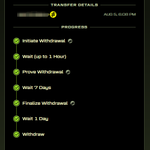
🚨If you still hold assets on one of those "ghost-town" chains like @zksync, @0xPolygon zkEVM, or @MantaNetwork, keep a very close eye on them.
We’ve already seen explorers get discontinued (some even without warning). The uncomfortable truth? You never know when the actual blockchain might be terminated next.
Don't get stuck. Stay vigilant.
3
421
Very interesting point!
DAT has no pressure to sell its token holdings in the short term, which everybody agrees with. However, @0xVeryBigOrange points out that they also have no such pressure in the long term, which I agree with.
What do you think?


3
234
This is a classic prisoner's dilemma scenario: due to competition between companies and nations, it's simply impossible to voluntarily or involuntarily slow down AI progress. Like it or not, we have to contend with a future where significant AI advancements have already occurred.
My response to AI 2027:
vitalik.eth.limo/general/202…
The AI 2027 post is high quality, I encourage people to read it at ai-2027.com/
I argue a misaligned AI will not be able to win nearly as easily as the AI 2027 scenario assumes, because it greatly underrates our ability to protect ourselves, especially given the (pretty magical) technologies that the authors admit will be available in 2029 in their scenario.
3
5
307
Traders, are you ready to trade futures and options on @SUPRA_Labs ?😎

Trade, hedge, and speculate on countless assets.
@DeriProtocol is shipping this on Supra mainnet sooner than you think 👇
Last milestone toward @SUPRA_Labs before going live!
✅The audit for our Supra deployment is done!
We will be live on @SUPRA_Labs' mainnet very soon, stay tuned!
Thanks a lot to @peckshield for their swift and thorough work on the audit 💪
🔖Read the final report: github.com/peckshield/public…

Putting aside the moral issue of the share-for-pardon deal, the way of the crypto community discussing this issue reflects a serious Cry-for-Savior complex.
But crypto was born precisely because there are people who don't believe in saviors! If you all love saviors so much, then you might as well stay in the old world—what's the point of coming to crypto?
Please leave the crypto space for those of us who don't believe in any savior!

4. Sorry to disappoint. The WSJ article got the facts wrong.
More than 20 people have told me they were asked by the WSJ (and another media), "Can you confirm that CZ made some deal for a pardon?"
They probably asked hundreds of people to have 20 people reach out to me. In essence, they tried hard to make a story to report.
Fact: I have had no discussions of a Binance US deal with … well, anyone.
No felon would mind a pardon, especially being the only one in US history who was ever sentenced to prison for a single BSA charge.
Feels like the article is motivated as an attack on the President and crypto, and the residual forces of the "war on crypto" from the last administration are still at work.
I am always happy to make crypto great everywhere, US and the rest of the world.
It’s good to see that even WSJ thinks I should be pardoned. 😆🙏
1
3
222
Let's go #SONIC 🔥
We are live on @SonicLabs! Trade perps, options, and more advanced derivatives at the blazing speed of Sonic today!
$S futures should be coming this week, and stay tuned for more 🔥 updates soon!
Trade now at deri.io!
Time to make Metamask better. Right now it sucks. Being a long-time user&fan, I am now so close to abandoning it. – at Colorado, USA

I'm pleased to announce that Consensys and the SEC have agreed in principle that the securities enforcement case concerning MetaMask should be dismissed. Subject to the approval of the Commission, the SEC will file a stipulation with the court that effectively closes the case. We were committed to fighting this suit until the bitter end but welcome this outcome. No company wants to be the target of agency enforcement, but at the same time, it was our duty and honor to stand up for blockchain software developers in the hour it was most needed, as I’m sure our industry peers who also stood up against regulatory overreach would tell you.
Devs both here at Consensys and across the space are building a better world and deserve to have someone in their corner fighting for their rights. That is why we sued the SEC when it became clear that Ethereum was the next target, a lawsuit that actually caused the SEC to drop their Ethereum investigation. Every legal and policy win might be hard fought, but each is an important step along the path to a better financial system and a better internet.
I am grateful to @MattCorva and our legal team for their exceptional work and the entire Consensys family, whose passion and commitment has never once waivered. We appreciate the SEC’s new leadership and the pro-innovation, pro-investor path they are taking. We will remain deeply engaged with public and private policymakers going forward. Crypto wants the U.S. to address the best interests of consumers and businesses alike, and we are already on our way to making that happen.
Now we can get 100% back to building. 2025 is going to be the best year yet for Ethereum and Consensys. The paradigm shift to a much more decentralized world is accelerating.


Deri fellows, let's vote!
Thank you all for the suggestions. The vote is up! $DERI holders, you can now pick where Deri v4 will be deployed next, between @SonicLabs, @Optimism, @MetisL2, and @0xPolygon.
You have until this Friday, 10 AM UTC: deri.io/#/dipeighteen
