

I own my thoughts and digital assets (assuming I remember them).
Joined March 2021
- Tweets4.9K
- Following3.4K
- Followers663
- Likes13.9K


Tula 🧙🏻♂️ retweeted

We’re bringing Power Perps to Hyperliquid, starting with HYPE².
If HYPE doubles, the HYPE² index quadruples. Options-like payoffs. No strikes. No expiry.
Power Perps bring options flow to Hyperliquid by pooling demand for convexity in one order book.
This work builds on “Power Perpetuals” by @danrobinson,
@_Dave__White_, @andrewjleone and their coauthors.


“Je spaargeld” bij een bank is niet van jou. Je hebt alleen een vordering op dat geld. Vertrouwen in de overheid, welke soms de grootste aandeelhouder, is een gegeven.

Mooi idee, maar zou de burger de overheid nog wel vertrouwen met zijn/haar spaargeld? De regels zijn al vaker tijdens het spel veranderd (rente studieschuld, toeslagenaffaire, greep uit de pensioenpot jaren 80-90).
1
6
72
Proof I was here early.
I just claimed Quantum Early Access Pass #00997 on @QMSNetwork.
What number did you land?
qms.finance/pass/0xTula

6
80
Tula 🧙🏻♂️ retweeted

Zcash is nowhere near quantum resistant.
Even the unreleased tachyon update is still built on an ECC-based proof system.
You were lied about the integrity of the supply and now you are lied about the quantum resistance.


The triffin dilemma in short: The reserve-issuing nation is trapped. It must choose between fueling global growth (which weakens its own currency) or protecting its own currency (which stalls global growth).

The coldcard exploit will make sure the bitcoin community starts working on the quantum threat.

⚡️The real mistake is treating technology as stronger than incentives.
Technology never exists in isolation.
It exists inside systems that fight to preserve themselves.
Bitcoin is no longer a research project.
It is a monetary network securing trillions of dollars in value, embedded in sovereign policy, public companies, ETFs, banks, payment infrastructure, and global capital markets.
That creates an evolutionary force far larger than any individual cryptographic algorithm.
Quantum eventually breaks today’s cryptography.
That part is almost irrelevant.
Today’s cryptography was never supposed to be eternal.
Every cryptographic standard in history has eventually been replaced.
DES disappeared.
SHA-1 disappeared.
RSA has been hardened repeatedly.
TLS evolved.
The internet did not die because its cryptography changed.
It evolved because the incentive to evolve exceeded the cost of staying still.
Bitcoin inherits the same dynamic.
The deeper misunderstanding is believing mathematics alone protects Bitcoin.
Economics protects Bitcoin.
The protocol survives because the people securing it have overwhelming financial incentive to migrate before failure.
Miners.
Exchanges.
Custodians.
ETFs.
Nation-states.
Treasury companies.
Developers.
Every one of them becomes poorer if Bitcoin dies.
Every one of them becomes richer if Bitcoin adapts.
That incentive field is the strongest defensive mechanism the network possesses.
Quantum therefore faces an adaptive organism, not frozen software.
The narrative also reveals something about human psychology.
People consistently overestimate discontinuity and underestimate adaptation.
Civilizations almost never collapse because one invention suddenly appears.
Civilizations reorganize around inventions.
Steam reorganized labor.
Electricity reorganized industry.
The internet reorganized communication.
AI is reorganizing cognition.
Quantum reorganizes computation.
The systems built on those foundations mutate in response.
Bitcoin will be one of them.
The deeper irony is that the same people claiming AI will recursively improve itself somehow assume Bitcoin developers, cryptographers, hardware manufacturers, nation-states, and every institution securing the network simply stop thinking while quantum advances.
That assumption violates every historical pattern.
The strongest systems become the fastest adapters because they have the most to lose.
The real existential threat to Bitcoin has never been quantum.
The real existential threat would be a loss of adaptive capacity.
A protocol that stopped evolving.
A community that became ideologically frozen.
An ecosystem that refused to upgrade.
Bitcoin has repeatedly demonstrated the opposite.
Every crisis has increased its institutional depth.
Every attack has expanded its engineering effort.
Every failure has produced stronger infrastructure.
Quantum is another evolutionary pressure.
The network either adapts or disappears.
The incentive structure overwhelmingly favors adaptation.
The fear comes from imagining a static protocol.
Reality contains a living monetary organism with millions of participants defending their own balance sheets.
That is a much harder target than a cryptographic paper.
The market keeps asking whether quantum can break Bitcoin.
The better question is whether quantum can outrun the combined adaptive intelligence of every actor whose wealth depends on Bitcoin continuing to exist.
That is a far higher bar than most people appreciate.
8
120
Tula 🧙🏻♂️ retweeted

According to Goldman Sachs, we just experienced the WORST momentum sell off ever recorded.
These 10 stocks will make great long term investments:
1. $BE - Bloom Energy (-40%)
Just posted its first billion dollar quarter. Revenue hit $1.065 billion, up 165%, with product revenue up 215% and gross margin expanding to 33.4%. Management raised full year guidance to $3.9-4.2 billion, roughly 100% growth. Fuel cells powering AI data centers is no longer a story, it's a P&L.


Tula 🧙🏻♂️ retweeted

If you trade trend, you'll get a bunch of false starts
If you trade momentum, you'll often buy the top/sell the bottom
If you trade mean reversion, you'll periodically get carried out by an outsized move
And so on for basically every trading system
This is the cost of doing business that's embedded into every market effect you're monetising
Your job is to understand it and manage it
If you try to avoid it entirely you simply won't get paid
There's no perfect system, it's all about managing trade-offs
Go take a look at your setups/playbook or wherever your trading system lives and map its assumptions and failure cases
The stuff you wanna avoid:
1. Mutating your system because the risk feels uncomfy so you get the worst of both worlds e.g. not holding for long trends/outsized moves but still eating the false starts when you're wrong (all the downside, no balls for the upside)
2. Not knowing what the trade-offs are and sizing like a dickhead so when you're wrong it wipes out all your gains e.g. penny collecting on mean reversion with increasing size and then getting fully wiped on the outsized move


I just reserved my Hyperliquid AI trading agent on @senpi_ai. Use my link to skip the line + get $100 free AI credits: waitlist.senpi.ai/?ref=M1984…

2
8
37
Tula 🧙🏻♂️ retweeted

my full conversation today with @cobie
01:04 offering to work at Coinbase for free
06:05 the K-shape crypto thesis
10:33 thoughts on Saylor
14:39 why UpOnly hasn't come back
22:37 the last 10 years of Crypto
44:52 trillion dollar IPOs
57:02 Cobie's legendary buy wall
1:02:57 top 5 Crypto traders of all time
1:21:20 reasons to be optimistic on Crypto
Tula 🧙🏻♂️ retweeted

Crypto-bezitters die aangifte 2025 doen:
Had je een verliesjaar? Dan kun je de forfaitaire box 3-heffing op nul zetten.
Werkelijk rendement was negatief → box 3 crypto = €0.
De meeste mensen vullen blind het forfait in en betalen vrijwillig te veel.
Hoe het werkt:


Tula 🧙🏻♂️ retweeted

1/ I’ve spent most of the last few weeks since the Google, Caltech papers to think about tradable implications around quantum computing and crypto
specifically what happens to the market around q-day

Tula 🧙🏻♂️ retweeted

The real deep state is the Vatican, Rothschild family and Chabad Jews. They use the Freemasons and The Knights of Malta as 'fixers'. The City of London, Wall street and central banks as managers.
Below the deep state is the shadow government which is comprised of the politicians and senior bureaucrats. Those are the shadow government people. They're not the deep state. They are the best of the servant class.
Most of the world leaders are slaves. You are not eligible to be elevated if you're not compromised by blackmail (i.e Jeffery Epstein's role)
They worship the black sun.
Tula 🧙🏻♂️ retweeted

Respectfully Saylor is wrong here on quantum.
Specifically, he is wrong on four claims (I'm only focusing on the technical ones). Let me walk through each one.
Claim 1: The consensus of the cyber security community is that quantum is not a threat for the next 10 years and thus no immediate action is needed.
There is no such consensus. The opposite is true: every major national security and standards body in the world is actively mandating post-quantum migration right now, because the migrations themselves take a decade or more.
NSA CNSA 2.0 requires all new National Security Systems to be quantum-safe before 2035 with most of that work being done in the next 5. NIST published finalized PQC standards (ML-KEM, ML-DSA, SLH-DSA) in August 2024 and released IR 8547 setting a target to deprecate all quantum-vulnerable public-key algorithms after 2030 and disallow completely by 2035. The UK NCSC set migration milestones for 2028, 2031, and 2035.
These are not responses to a distant hypothetical. These are programs with compliance deadlines because the organizations that set them have concluded that starting now is barely early enough.
Historically, it has taken a long time from the moment that a new algorithm is standardized until it is fully integrated into information systems. Past cryptographic migrations confirm this. The SHA-1 deprecation took about 7 years. The AES migration took around 5 years. The TLS 1.3 rollout took 3-5 years despite offering clear performance benefits. NIST has already concluded that PQC migration is fundamentally more complex than any of these precedents.
The timeline argument ignores harvest-now-decrypt-later entirely. Adversaries are collecting encrypted data today for future decryption. The U.S. Federal Reserve published an analysis of this in September 2025, using Bitcoin as a case study. The threat is already active.
Claim 2: When quantum hits, everything upgrades; banks, the internet, defense, Bitcoin.
The internet is already upgrading. 52% of human web traffic on Cloudflare used post-quantum key exchange by December 2025, nearly doubling from 29% at the start of the year. Chrome ships ML-KEM for TLS. Apple enabled PQ TLS in iOS 26. OpenSSH has defaulted to post-quantum key agreement since version 9.0. Signal has post-quantum encryption. AWS and Google Cloud support PQC in their KMS products. Apple added ML-DSA and ML-KEM to CryptoKit as production APIs.
Banks and payment networks are centralized. Visa pushes a firmware update or SWIFT changes a protocol spec. TLS upgrades are invisible to end users (if you use Chrome you use a TLS version that supports post-quantum and you didn't even know). These systems can and will migrate without their customers doing anything.
Bitcoin cannot do this. Bitcoin requires a fork with global decentralized consensus. A PQC signature migration is categorically harder than previous forks: ML-DSA-44 signatures are 2,420 bytes versus 64 bytes for Schnorr, a 38x increase that breaks Bitcoin's existing SegWit weight economics, Script stack limits (520-byte maximum), and transaction propagation assumptions. A single ML-DSA-44 signature plus public key is several times larger than an entire typical single-input P2WPKH spend today. BIP-360 and QBIP exist as (great) proposals. Sadly, neither has an activation timeline.
Enterprise PQC migration is much easier. These are organizations with executive authority to mandate changes, dedicated security teams, and established procurement processes. Bitcoin has none of these. Blockchain governance is structurally slower than centralized governance.
The "everything upgrades together" framing also ignores the permanently exposed key problem. When banks upgrade TLS, old sessions don't matter, they were ephemeral. When Bitcoin upgrades, the ~6.9 million BTC with already-exposed public keys on the immutable ledger are still sitting there. You cannot un-publish a public key from a blockchain. Those coins need to be actively moved by their owners to new quantum-safe addresses. Approximately 1.72 million BTC in P2PK addresses, including Satoshi's estimated 1.1 million BTC, are likely permanently exposed because the private keys are lost.
There is no banking equivalent to this. Banks do not maintain a public, permanent, immutable record of every customer's authentication key going back 17 years.
Claim 3: Digital assets have the most advanced cryptographic security; more than banking, credit cards, stocks, etc
This conflates trustlessness with cryptographic strength. They are not the same property.
Bitcoin uses ECDSA over secp256k1. Your bank's TLS connection uses ECDHE over P-256 or X25519. These are the same class of cryptographic primitive, elliptic curve schemes whose security rests on the hardness of the discrete logarithm problem.
Shors algorithm breaks both identically. Neither is "more advanced" than the other. What differs is what we call the defense-in-depth architecture around that primitive. A credit card tap-to-pay transaction involves: TLS with ephemeral key exchange, an EMV chip with hardware-bound keys in a certified secure element, tokenization so the merchant never sees the real card number, session-based key rotation, fraud detection, transaction reversal capability, and regulatory insurance.
A Bitcoin transaction involves: one ECDSA signature. That is the entire authorization layer. No fraud department, no chargeback, no identity verification layer that can distinguish a legitimate owner from a quantum attacker holding the same derived private key. Once a forged signature is accepted by consensus, the transfer is irreversible.
The systems Saylor describes as less secure are, in fact, already deploying post-quantum protections that Bitcoin has not yet started. They can do this because they are centralized. Bitcoin's decentralization, its core value proposition, is precisely what makes its quantum migration harder, slower, and later than every system he compared it to.
Claim 4: The crypto community will be the first to spot the threat and move.
This assumes a CRQC will be publicly announced. Nation-state adversaries have zero incentive to disclose a quantum capability. The entire intelligence value of a CRQC is that no one knows you have it. You harvest quietly, you decrypt quietly, you exploit quietly.
What would "spotting it" look like on Bitcoin? A quantum attacker does not exploit a bug, bypass a firewall, or compromise a server. They produce valid signatures indistinguishable from the legitimate owner's, because mathematically, they hold the same key. If an attacker begins draining P2PK addresses, each theft is a correctly signed transaction. There is no intrusion detection system for the Bitcoin blockchain. Transactions are valid or they aren't. By the time someone notices a pattern across thousands of UTXOs, the damage is done and irreversible.
And the empirical record directly contradicts the "first to move" claim. The current state of readiness: one BIP with no activation timeline, an ongoing debate about whether to freeze Satoshi's coins, and a quantum-vulnerable exposure surface that is only going up. The exposure is increasing, not decreasing, because address reuse continues to add more and more BTC to the vulnerable set.
Meanwhile, the rest of the internet has already deployed PQC to billions of users without anyone noticing.
Where things actually stand
We maintain the Bitcoin Risq List, an open-source, continuously updated tracker of quantum-vulnerable Bitcoin at the address level. As of block height 936,882 (February 2026): approximately 6.9 million BTC across 13.9 million addresses have exposed public keys.
Solana is 100% quantum-vulnerable as their address structure exposes the full public key. Deloitte's analysis found 65% of Ethereum is in quantum-vulnerable accounts.
The internet started its post-quantum transition in 2022. National security systems have a 2027 compliance mandate. NIST targets deprecating and disallowing all quantum-vulnerable public-key algorithms well before 2035.
The blockchain industry, which directly protects bearer value with the exact cryptographic primitives that a quantum computer breaks, has a BIP and a debate.
The question is not whether quantum is a threat to digital assets. It is whether the industry will begin its migration before the window closes. The gap between the internet's pace of PQC adoption and the blockchain industry's pace is not a gap in awareness. It is a gap in urgency and importantly, the gap is not closed by asserting that the threat doesn't exist.

Michael @Saylor explains the quantum computing debate, the actual risks to Bitcoin, and what protocol upgrades could look like. Watch this clip from our full show👇🏼

Tula 🧙🏻♂️ retweeted

JUNE 2028.
The S&P is down 38% from its highs. Unemployment just printed 10.2%. Private credit is unraveling. Prime mortgages are cracking. AI didn’t disappoint. It exceeded every expectation.
What happened?
citriniresearch.com/p/2028gi…

Tula 🧙🏻♂️ retweeted

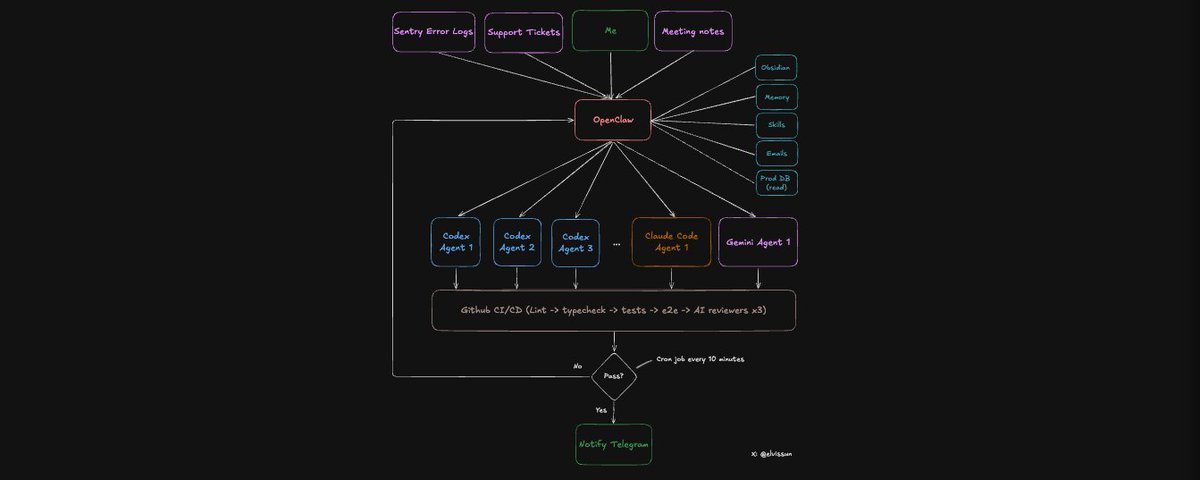
Probably the best video on how to setup openclaw right now

I'm one of the most advanced users of OpenClaw.
OpenClaw + GPT5.3 Codex + Opus 4.6 has been the trifecta that changed everything.
I made a video going over everything I'm doing with these tools.
Learn these tools, stay ahead.
Watch this video right now.
0:00 Intro
1:02 Overview
4:17 Sponsor
5:12 Personal CRM
7:11 Knowledge Base
8:30 Video Idea Pipeline
11:09 Twitter/X Search
12:47 Analytics Tracker
13:33 Data Review
15:34 HubSpot
16:13 Humanizer
16:52 Image/Video Generation
18:22 To-Do List
19:37 Usage Tracker (Saves Money)
20:45 Services
21:25 Automations
22:42 Backup
23:30 Memory
24:06 Building OpenClaw
25:22 Updating Files