

find alpha in 2 clicks, finished school
AI
Joined June 2023
- Tweets477
- Following82
- Followers1.9K
- Likes1.6K


charles howard hinton spent 20 years building colored wooden cubes trying to teach humans to visualize the fourth dimension. he coined the word “tesseract” in 1888. he died in 1907 convinced it was impossible for a mind to truly see 4D.
this october 2026 paper asked a language model to draw it anyway.
the model has never perceived three-dimensional space. has no eyes, no spatial memory, no embodied geometry. zero direct perception of anything. it generates tokens - probability distributions over vocabulary.
it drew a geometrically correct 4D hypercube on the first attempt.
16 vertices. symmetric structure. consistent connections across the w-axis. meaningful projection into 3D. the paper verified each property independently. all four passed.
a 3D cube has 8 vertices. add one spatial dimension - every point splits. 8 becomes 16. the outer cube and inner cube connect through the fourth coordinate w, the direction no human has ever pointed. the AI connected them correctly without knowing what they look like.
section 6 is the finding nobody has fully processed yet. the model doesn’t “see” 4D. it reasons about it through mathematical structure - the same way it reasons about anything it has never perceived directly. spatial intuition is not required. geometric consistency is computable.
this is what transformer architecture actually is. not a pattern matcher. not autocomplete. a system that navigates high-dimensional representation space and produces outputs consistent with mathematical constraints it never explicitly learned.
hinton spent a lifetime trying to build the intuition manually.
the model skipped the intuition entirely and got the answer right.
save this.

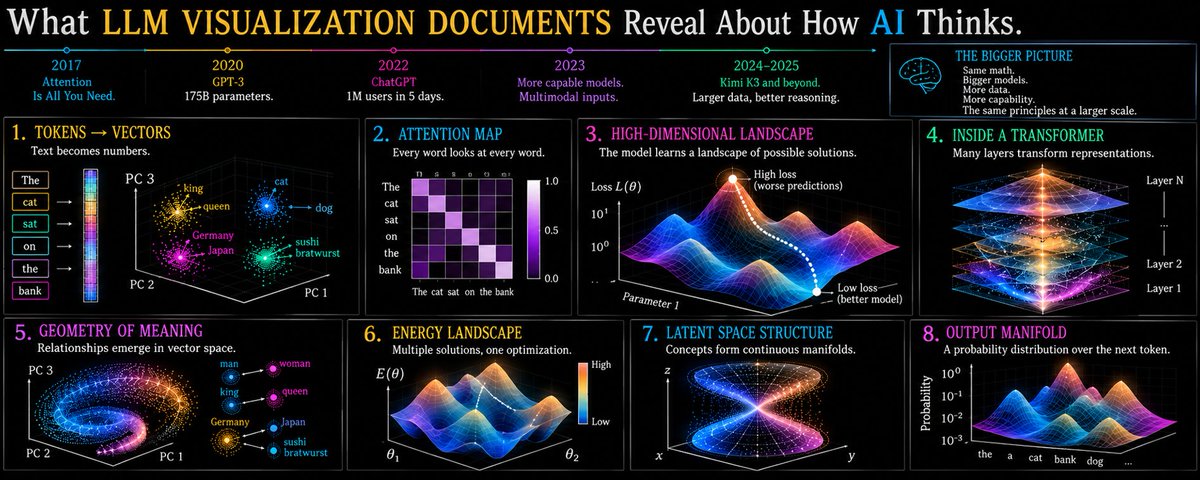
William Tutte cracked Nazi Germany's toughest cipher at age 24, helped build the world's first programmable computer to run it, and then spent the rest of his life doing pure mathematics. In 1963 he published a paper called "How to Draw a Graph" that contained one theorem so powerful it now runs inside every 3D graphics pipeline, every UV unwrapping tool, and every mesh-based physics simulation in film and game CGI today.
The theorem is about springs. Pin down the outer boundary of any polyhedral graph into a convex shape, turn every interior edge into a spring with zero rest length, and release. The springs fight until equilibrium - and if the graph is three-connected, that equilibrium is always crossing-free. Every node lands at the exact average of its neighbors. That is the Laplace operator - the same structure governing heat flow, electron orbitals, and the attention weight averaging inside every transformer layer of every LLM running today.
25 minutes. Bookmark & watch today. The cipher-breaking mathematician whose spring theorem became the foundation of modern computer graphics.


peter shor cracked RSA-2048 encryption in 1994 with one algorithm.
25 years later, researchers are combining quantum computers with LLMs — and the market behind it just hit $450 billion.
most people still don't understand what this actually means.
a classical computer searches solutions one by one.
an LLM narrows the search using language and reasoning.
a quantum computer explores millions of possibilities simultaneously — in parallel universes of probability.
merge all three and you get something that didn't exist 18 months ago.
a hybrid system where the LLM guides the search, the quantum computer evaluates branches in parallel, and the result gets interpreted back into human language.
the computational cost graph shows what no one wants to say out loud.
classical: exponential scaling. LLM alone: exponential. LLM + quantum: near-flat.
that gap compounds every year.
the companies that understand this are already betting everything:
google quantum AI — $5B invested
IBM quantum — $4.5B roadmap
microsoft — $3.5B commitment in 2025 alone
the first killer app isn't crypto or finance.
it's molecular discovery.
scanning a chemical possibility space so vast that no classical machine could live long enough to search it.
new drugs. new materials. new physics.
shor proved quantum changes the rules.
llms proved language is the interface.
together — they might change everything else.
save this. quantum + llm is the trade of the decade.
The Pauli Exclusion Principle is why matter exists. Without it, every electron in every atom would collapse into the lowest energy level, chemistry would vanish, and no LLM - or anything else - could ever exist. It is not itself a fundamental law. It falls out automatically from something deeper that nobody taught you about in school.
The mechanism is wavefunction symmetry. Two identical quantum particles share a single wavefunction across both positions simultaneously - not one each, one total. Swap their labels and the wavefunction either stays the same or flips sign. Electrons always flip sign. The moment you force two electrons into the same quantum state, the two halves of the wavefunction cancel each other to exactly zero - a probability of zero everywhere, making the state physically impossible. No force is involved. No repulsion. Just pure mathematics producing an apparent force from nothing. The same antisymmetry that blocks electrons from collapsing governs the orthogonality conditions that keep attention heads in a transformer from all converging to identical representations during training.
15 minutes. Bookmark & watch today. The quantum rule that makes chemistry possible and the reason the universe didn't collapse at the moment of the Big Bang.
researchers asked Claude to process 1,000,000 tokens at once and filmed what happened to its internal state. the answer broke their model.
at 10^3 tokens - coherent. tight activations, stable attention, clean output. at 10^6 tokens - full computational collapse. reasoning errors hitting 10^0 error rate. hidden state activations exploding from a clean blue cluster into chaotic red scatter. the LLM didn't break like software. it broke like a nervous system under overload.
the stress metric is: S = (1/T) * sum(||h_t||^2 + alpha * H_t). hidden activation magnitude plus attention entropy across every layer. higher values - instability. the visualization shows the model's trajectory in high-dimensional state space going from a stable spiral path straight into an unstable chaotic region the moment context complexity spikes.
Demis Hassabis understood this in 2010 when he left a $ 500k neuroscience PhD track to build DeepMind from scratch. he studied how biological systems fail under overload - then spent 14 years building AI that doesn't. Google bought DeepMind for $ 650M in 2014. today it's worth more than most countries' GDP.
the people who understand what happens inside an LLM under stress are getting hired at $ 500k-$ 1M+ total comp at Anthropic, DeepMind, and OpenAI right now. not because of their coding skills. because they understand attention entropy, hidden state dynamics, and why a model that processes 10^6 tokens starts hallucinating like a human who hasn't slept in 4 days.
AI safety, model interpretability, inference optimization - the 3 fastest-growing fields in tech. all built on understanding exactly what this document shows.
the answer to "can AI feel pain" is no. but understanding why it fails the same way a brain does is worth $ 10M in equity over the next 5 years.
Bookmark & watch today.
You can turn a sphere inside out without tearing it, poking holes, or creating a single crease - and this is not a trick, it is a proven theorem. You cannot do the same thing to a circle. Stephen Smale proved it was possible in 1957 and the mathematics community refused to believe him. The topological invariant that blocks the circle from flipping is the same invariant governing every high-dimensional embedding space an LLM operates in.
The mechanism is corrugation. Divide the sphere into guide strips and connect them with wavy sections springy enough to let the surface pass through itself without pinching. Push the caps past each other before a crease can form. Twist them in opposite directions - the same way a belt with a loop in the middle untwists when you rotate each end half a turn. Push the equator through the center and uncorrugate. Bowls, domes and saddles cancel in a fixed pattern that never changes throughout the entire eversion - the same invariant structure that makes high-dimensional transformer geometry behave nothing like anything visible in 3D space.
18 minutes. Bookmark & watch today. The mathematical proof that breaks every geometric intuition you have ever had.
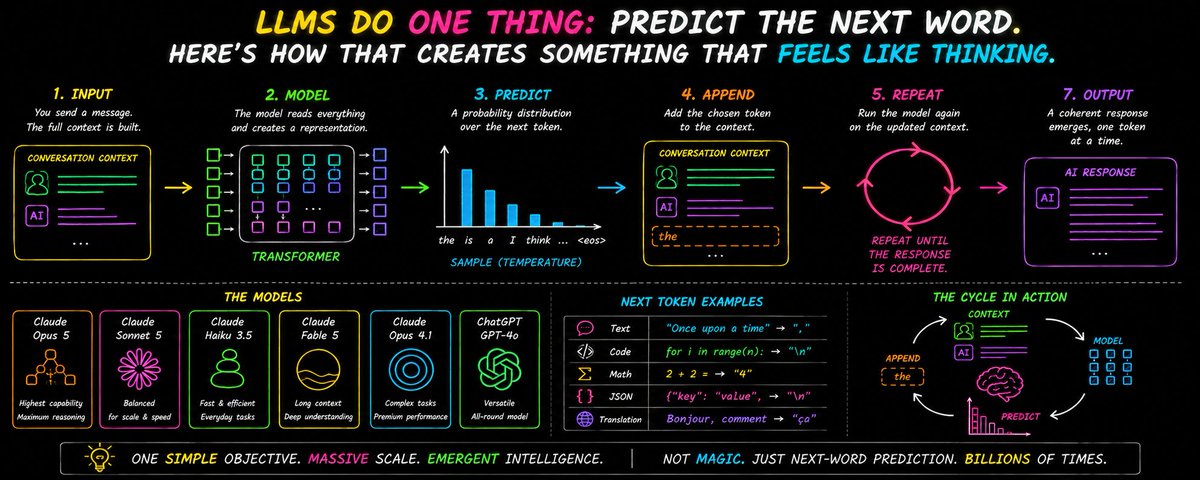
nobody has ever seen what Claude actually does with your question - until now. this visualization shows an AI thought in 3D and it looks nothing like code.
your text hits the model. it splits into tokens, each one converted into a vector in a space with hundreds to thousands of dimensions. not stored. not retrieved. computed - across every transformer layer simultaneously.
inside that space a thought is not a point. it's a region. facts and retrieved knowledge in one cluster. related concepts branching off. reasoning paths forking in parallel. possible answers already forming before the model picks one.
the visualization shows it: general understanding at one axis, specific ideas at another, reasoning paths lighting up and fading in real time as the model eliminates weak continuations and strengthens coherent ones. you type "how does a plane fly" and 44 attention heads fire across that entire 3D landscape at once.
from thought to answer: the model selects the most coherent path through the high-dimensional space and converts it back into tokens. "a plane flies because..." - milliseconds. every time. for every user. in parallel.
Geoffrey Hinton spent 40 years building the math that makes this possible. he left Google in 2023 because he was afraid of what it would become. the companies that understood what LLMs actually were - not chatbots but reasoning engines operating in geometry humans can't perceive - turned that insight into hundreds of billions in market cap inside 5 years.
this is what's running when you think Claude is just autocompleting. it isn't.
Bookmark & watch today.

Newton wrote three laws. Einstein rewrote them. Quantum Field Theory rewrote Einstein. Every single time, the new theory looked completely different - but underneath, every one of them was secretly the same equation. The same equation gradient descent uses to train every LLM running today. Physicists have known this since the 1700s and almost nobody outside physics has heard of it.
The equation is the Euler-Lagrange equation and it comes from one idea: nature is lazy. Between any two points in time, a physical system takes the path where the total action - kinetic minus potential energy integrated across time - stops changing for any small detour. Set that variation to zero and the equation falls out automatically. One condition, any number of variables, any theory ever written. In Quantum Field Theory it holds simultaneously across every point in space - the same structure as gradient descent forcing the loss to stop changing across every parameter in a billion-parameter neural network at convergence.
20 minutes. Bookmark & watch today. The equation hiding inside every law of physics ever discovered.
"AI 2016 vs AI 2026: What Changed in 10 Years?" - a technical note that shows exactly why Sam Altman turned a $ 1B investment into a $ 157B company in under a decade.
in 2016 GPT-1 had 100M parameters, a 512-token context window, text only, no tool use, limited reasoning. in 2026 Claude / GPT-4o runs 100B-1T+ parameters, 1M+ token context, multimodal input across image audio video text, full agent behavior with tool use and self-correction.
that's not an upgrade. that's a different category of object.
the representation space visualization shows it clearly - 2016 models formed small, fragmented clusters. 2026 models form a continuous high-dimensional manifold where multimodal concepts, abstract reasoning, tools and agents all live in the same learned geometry. the model doesn't switch modes. it exists in all of them at once.
training compute went from 10^19 FLOPs to 10^24-10^25. training data from 10^11 tokens to 10^14+. context from 512 tokens to 1M+. every number a 5-6 order of magnitude jump in 10 years.
Jensen Huang saw this trajectory in 2016 and bet the company on it. NVIDIA went from $ 5B market cap to $ 3.3T. the people who understood what LLMs actually were - not chatbots, but universal function approximators trained on human knowledge - made generational wealth in a single decade.
the next 10 years look the same. emergent behaviors - planning, self-correction, novel strategies - appeared at scale without anyone designing them. the next phase will too.
the document was published October 2026. the window to be early is closing.
Bookmark & watch today.
Jeff Hinton dismissed gradient descent entirely before winning the Nobel Prize for it. His fear was local minima - valleys in the loss landscape where the model gets stuck forever. For a 1.2 billion parameter LLM like Llama, the landscape has more dimensions than atoms in the observable universe. Getting permanently stuck would require hitting a dead end in every single dimension simultaneously.
What gradient descent actually looks like on a real LLM is stranger than anyone expected. Take two random directions through that billion-dimensional space, visualize the loss surface, and watch what happens when training starts - a wormhole opens and the model drops into a low-loss valley that wasn't visible from the starting point. The valley was always nearby in high-dimensional space. It just couldn't be seen in the 2D projection. For gradient descent to get truly stuck, it would have to hit a dead end in every dimension at once. The chances of that collapse toward zero as the parameter count grows.
20 minutes. Bookmark & watch today. The most honest visualization of how LLMs actually learn.
sam altman and dario amodei have been publicly debating AI safety for 3 years - this paper locked their models in a room together with no exit and ran the debate to 100,000 turns to see what happens when two LLMs argue forever
the setup: GPT-4o vs Claude 3.5 in a closed loop. same initial question. no external data. unlimited turns t -> infinity. each model reads the other's output, updates its hidden state h, generates a new response. the researchers watched what emerged.
four possible outcomes. convergence - models gradually agree and reach a stable answer. cyclic debate - they repeat arguments with variations in a loop. divergence - they move to increasingly different regions of representation space. emergent topics - the debate generates concepts that neither model contained at the start.
the trajectory visualization is what nobody expected. in 3D representation space, the debate path spirals through 10^5 turns - alternating between convergent regions of shared understanding and divergent regions of novel ideas. the models don't just argue. they explore.
at t = 1,000 turns: discussion expands to related areas. at t = 10,000: distant concepts start appearing. at t = 100,000: multiple new clusters and analogies that exist in neither model's original training distribution. the debate created knowledge that wasn't there before.
cross-attention patterns between the models after 10,000 turns show both systems focusing on the same key argument tokens - 1,024 query tokens, 1,024 key tokens, full attention maps aligning. two separate neural networks developing a shared semantic focus through pure iteration.
the risks section is the part that should stop you: endless loops consuming significant compute, model drift where errors get reinforced into stable attractors, alignment risks where confident but incorrect ideas become fixed beliefs across both models.
the companies building multi-agent systems right now - every enterprise deploying LLM pipelines where models talk to each other - are running this experiment live without measuring any of these dynamics. at $ 0.002 per 1,000 tokens, 100,000 debate turns is still cheap. the misaligned belief that stabilizes in the loop is not.
Bookmark & watch today.
Two models arguing forever don't reach truth. They reach equilibrium.
Heinz Hopf found this in 1931. Roger Penrose called it "an element of the architecture of our world." Eric Weinstein brought it up on Joe Rogan and the silence in the studio said everything. Most mathematicians spend entire careers never touching it - yet the structure lives inside the geometry every LLM embedding space is built on and every qubit in a quantum computer sits on.
Covering a sphere with equal-length fibers is impossible in 3D. In 4D it works perfectly. The trick is double rotation - two coordinate swaps firing simultaneously, which is physically impossible in 3D and completely natural in 4D. That operation is quaternion math. No numerical drift, no gimbal lock, no broken rotations. It runs inside every GPU rendering pipeline, every robotics controller, every transformer attention layer computing distances across high-dimensional space, and every quantum circuit mapping qubit states onto the Bloch sphere.
10 minutes. Bookmark & watch today. The most important shape in mathematics that nobody taught you existed.
JENSEN HUANG BUILT A $3 TRILLION COMPANY BY ACCIDENT - HE MADE CHIPS FOR VIDEO GAMES AND PHYSICISTS TOLD HIM THE MATH INSIDE HIS GPU WAS IDENTICAL TO HOW NEURAL NETWORKS LEARN - HE HAD NO IDEA HE WAS HOLDING THE KEY TO AI
він просто продавав відеокарти геймерам. фізики знали правду 30 років.
the equation for a particle finding minimum energy in a physics simulation and the equation for a neural network minimizing loss are the same formula - same math, same hardware requirement, same gpu
jensen spent the 1990s building chips for game physics - particles, collisions, fluid dynamics - the exact same calculations that every ai model runs during training
when openai needed hardware to train gpt in 2019 they didn't build new chips - they bought jensen's gaming cards because the physics math and the ai math are computationally identical
nvidia went from $140 billion to $3 trillion in 4 years because of an equation that physicists published in academic journals in 1993 for $0
the brownian motion formula that describes random particle movement in a fluid - studied in university labs in the 1990s on $80k salaries - is the direct mathematical ancestor of stochastic gradient descent, the training method inside every major ai model today
deepmind used the same physics-ai connection to solve protein folding in 18 months - a problem pharma companies had been spending $50 billion a year on for 50 years without progress
the phase transition in physics where a system snaps from chaos to ordered structure is the same phenomenon as emergent ai capabilities - why a model suddenly gains reasoning ability at scale with no architectural change
every physics phd from 1995 built tools worth billions and got paid in citations
jensen got paid in stock options
save this before the next nvidia earnings call ↓
Cortex retweeted

OPUS 5.5 + FABLE 5.5 + OPENAI DOTS: 60 minutes, and a business doing $100k a month...
Karpathy coined vibe coding. this is what it looks like when 4 agents do the vibing for you
4 agents, 24 modules, and a new module passes its tests every 2.5 minutes
two agents run on Opus 5.5. one is the architect writing the spec, the other writes the code and ships it
the product and the copy come from Fable 5.5, and OpenAI Dots handles the data and the evals
nobody waits for anybody. the spec is still being written while the product takes shape, and that overlap is the only reason one hour is possible
the hour runs like a relay: 12 minutes of spec, 12 of product, 14 of data, 22 of code
at minute 10 there are 4 modules passing. at minute 60 there are 24
the site, the API, billing and evals all exist, and the button says live
a team of six needs two weeks and 480 hours for the same first version. the Opus tokens came to $40
when the agents' hourglass ran out, the team's had barely moved
4 agents, one hour, $40, and a business live before your coffee gets cold ↓


Three textbooks taught an entire generation a curve that is wrong, and following it would have stopped every LLM before it started.
The rule said stop training when test error rises. AlexNet had 60 million parameters and everyone assumed bigger meant worse. Then double descent showed the error comes back down - sometimes lower than before. Obey the old curve and you kill a $300 billion industry at the first bump.
32 minutes. Bookmark & watch today.


Every LLM on Earth runs on one component with 3 terminals, and an H100 packs 80 billion of them onto a chip the size of a fingernail.
The MOSFET. Voltage on the gate, current through the other two, no current through the gate at all in steady state. Cross the threshold voltage and it switches. That is the entire physical substrate of AI.
11 minutes. Bookmark & watch today.
Over $300 billion a year goes into AI hardware whose only job is to compute one arrow, and this 4-minute video draws that arrow from scratch.
Two partial derivatives added as vectors. It points in the direction of steepest increase, so training walks the exact opposite way. GPT-3 followed that arrow through 175 billion dimensions. Here it is in 2.
4 minutes. Bookmark & watch today.
THIS LLM TOOL TOOK OVER 5 YEARS TO BUILD - IT TURNS AN UNSOLVABLE EQUATION INTO 8TH-GRADE ALGEBRA AND CLOSES IT IN 2 SECONDS
students are taught to press buttons - almost nobody has seen what's under the hood.
function → exponentials → the plane → poles → algebra
first shift: stop looking at the function and ask which exponentials it's built from.
a cosine isn't a wave - it's 2 exponentials spinning in opposite directions, and their imaginary parts cancel each other out.
second shift: the input isn't a number, it's an entire function - the output is a new function of a complex number.
plot it on the plane and you see sharp spikes - each spike is exactly one exponential hiding inside the original.
third shift: for exponentials a derivative is just multiplication by a number - so a differential equation becomes algebra.
everywhere a derivative stood there's now a multiplication - and the equation that wouldn't solve turns into a fractions problem.
the integral only converges on half the plane - but the continuation is defined everywhere, and that's where every pole shows up.
control systems, filters, signal processing and half the math under modern models all run on this.
save this - one transform breaks any function into its parts ↓
AN LLM WRITES THIS FORMULA IN 10 SECONDS - MATHEMATICIANS FOUGHT OVER IT FOR 50 YEARS AND NEARLY BURIED ANALYSIS
2 cubed just means multiplying two by itself three times - but what does it mean to raise 2 to the power of the square root of minus one.
in 1712 Leibniz wrote that the logarithm of a negative number is impossible, Bernoulli answered that it isn't - and the argument dragged on for years with no result.
Euler wrote that leaving it unresolved would be an indelible stain on analysis - and sat down to write 133 pages.
first shift: stop asking how many times you multiply and start asking what preserves the properties of exponents.
multiplying complex numbers isn't algebra, it's geometry: magnitudes multiply, angles add.
second shift: raise 2 to an imaginary power and multiply by its conjugate - the exponents cancel and you're left with one.
that means an imaginary exponent doesn't grow at all - it's locked onto a circle of radius 1, and instead of growth you get rotation.
third shift: a logarithm has not one answer but infinitely many - and that's exactly what removed every contradiction.
what comes out is a formula where an exponential equals cosine plus i times sine - growth and a wave turned out to be the same object.
without that equality there'd be no Fourier transform, no signal processing, and none of the math half of modern AI runs on.
save this - what an LLM writes in 10 seconds cost Euler 133 pages and 50 years of argument ↓
Nobody explains why LLMs get better as they scale, but this 27-minute video hands you the actual reason in one sentence about high dimensions.
In enough dimensions, two random vectors are almost always nearly perpendicular. That is why a model can pack far more concepts into its embedding space than it has dimensions. The same trick powers 24-dimensional sphere packing, which flew on Voyager as error correction.
27 minutes. Bookmark & watch today.