

Research pioneering value-aligned energy & quantum tech #intersellarVision/Strategic Geopolitical Analysis/Philosophy/Consciousness. https://xitter.cf/t.co/epqC3lrnTF
Washington D.C.
Joined September 2019
- Tweets15.9K
- Following6.7K
- Followers924
- Likes119K





Pinned Tweet
Thesis
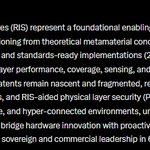
The development and deployment of #Quantum-Governed #Coaxial_Transcription_Hubs, integrating #Quantum_Demodulation, #Blockchain_Technology, and #Ethical_AI, represent a transformative paradigm for #Global_Value_Preservation, surpassing traditional cryptographic systems like #Bitcoin by offering #Quantum_Resistant_Security, Scalable_Decentralization, and #Intrinsic_Utility. This thesis posits that these hubs can establish a #Resilient, #Equitable, and #Future_Proof framework for preserving #Digital_Assets and #Physical_Value_Assets—such as Intellectual_Property, #Tokenized_Resources, and #Financial_Contracts—addressing the limitations of current #Store_of_Value mechanisms in the face of #Quantum_Computing_Threats, #Economic_Instability, and #Societal_Inequity.
Abstract
As the global economy transitions into an era dominated by #Quantum_Technologies, the preservation of #Value—encompassing #Digital_Currencies, #Intellectual_Assets, and #Societal_Equity—faces unprecedented challenges from #Quantum_Decryption_Threats and #Centralized_Vulnerabilities. This paper explores the potential of #Quantum-Governed #Coaxial_Transcription_Hubs, a novel system proposed by the Aussa Research Institute, to revolutionize #Global_Value_Preservation. Leveraging #Quantum_Demodulation, #Blockchain_Integration, and #Ethical_AI_Governance, these hubs achieve a latency of 1.9ms, a storage density of 10 PB/cm³, and #Quantum_Resistant_Security (AdvQ ≤ 2⁻⁴¹⁰), outstripping the capabilities of traditional systems like #Bitcoin.
The study analyzes their application as a Decentralized, #Scalable platform for securing #Digital_Assets, supporting #Energy_Efficient_Smart_Grids, and enabling Equitable Data Ecosystems across 10,000 nodes with 1,500 transactions per second. Drawing on recent advancements in #Quantum_Key_Distribution (e.g., Toshiba’s 2025 #QKD_Trials) and #Post_Quantum_Cryptography (NIST standards, 2022), the research demonstrates how these hubs mitigate risks of #Inflation, #Geopolitical_Instability, and #Quantum_Obsolescence. Comparative analysis with #Bitcoin highlights superior Durability, Utility, and Governance, though challenges such as Adoption and Regulatory Hurdles are identified. The findings suggest a blueprint for a Sustainable, #Inclusive_Value_Preservation infrastructure, with implications for Global Financial Systems, #Smart_Infrastructure, and Societal Resilience as of July 2025

0Persepctrum.com retweeted

19 year old Japanese student built a trading bot with Claude Code in 2 days.
Used his iPad as a second monitor.
First night: $6,732 profit.
Starting capital: $68.
Total profit so far: $750,000.
[ 𝐍𝐨𝐭𝐞: 𝐅𝐨𝐥𝐥𝐨𝐰 𝐌𝐞 @monicaa_AI 𝐅𝐨𝐫 𝐢𝐧𝐬𝐭𝐚𝐧𝐭𝐥𝐲 𝐚𝐮𝐭𝐨 𝐃𝐌]
Here's how it works👇
The bot scans over 50 markets simultaneously.
Syncs live BTC data from Binance every second.
Spots price errors before humans even notice.
The edge is pure speed + pattern recognition.
While traders stare at charts trying to predict the next move, his bot is already executing on mispricing across dozens of markets.
No guessing.
No emotions.
No hesitation.
Just Claude Code logic finding gaps that close in seconds.
He built the entire system in 48 hours:
→ Claude Code handles the trading logic
→ Binance API feeds real-time BTC data
→ iPad displays multi-market monitoring
→ Executes trades when arbitrage windows open
The system runs 24/7.
Every price dislocation = profit opportunity.
Most people are still trading manually, refreshing charts, second-guessing entries.
Meanwhile this 19 year old engineering student turned $68 into $750K by letting Claude Code do what humans can't: process 50 markets instantly and execute without fear.
Why are people still trading manually?
I'm giving away the exact Claude Code setup for free.
24 hours only.
To get it 👇
1️⃣ Comment " Claude "
2️⃣ Like and Repost
3️⃣ Follow @monicaa_AI (so I can send it via DM)
0Persepctrum.com retweeted

New paper advised by Li Fei-Fei!
"Generative Representation Learning for Scalable Latent Tokenization"
Image generation commonly uses pretrained encoders like DINO as tokenizers, but these can discard visual details important for generation.
So this paper trains encoders to preserve information shared between masked image views, using a generative model to guide learning.
On ImageNet, it improves FID from 2.36 to 2.18 at similar total training compute, with scaling-law extrapolations suggesting 7–8x less tokenizer training compute than DINOv2 and WebSSL.
alphaxiv.org/abs/2610.20533

0Persepctrum.com retweeted

ten agents found what was making a database with 48,000,000 rows feel broken
Thariq Shihipar (engineer at Anthropic) paired Claude Code with REA to rebuild the queries behind a dashboard that took 34 seconds to open
he gave the agents a database snapshot and a week of query logs
every change had to return the same data before it could count as an improvement
REA grouped similar traces and routed them to the right investigation. Claude Code agents handled the changes:
→ three examined expensive queries and execution plans
→ three rewrote queries and tested indexes
→ two compared old and new results
→ two replayed dashboard sessions and checked write performance
the logs narrowed down to 18 recurring query patterns
one screen loaded a customer's entire history to display a single total
another repeated the same calculation for every chart
the agents moved that calculation into one shared query, then checked every affected screen
a proposed index made one dashboard faster but slowed incoming writes. the reviewer rejected it
15 query changes passed review. three stayed untouched because the expected behavior needed clarification
on the saved workload:
> median dashboard load → 8.6 seconds to 0.7 seconds
> slowest dashboard → 34 seconds to 2.8 seconds
> 4,800 result comparisons → no mismatches
about 12x faster on both load-time measures, with no changes to the displayed results
each accepted change included the query plan, measured timings and a rollback script
the engineer could inspect and apply each fix separately, with the original query beside its replacement
full optimization playbook below


0Persepctrum.com retweeted

geoffrey hinton won the nobel prize in physics for building systems he couldn't fully explain - this october 2026 paper explains them, and the number that stopped me cold was 3,418 gradient steps to reach coherent reasoning from a random start state
"the most incomprehensible thing about the universe is that it is comprehensible" - einstein said that in 1936. he was describing physics. this paper proves he was also describing GPT-4, claude, and every LLM generating $3.8T in value right now, without anyone understanding why they actually work
every token your LLM generates costs energy. literally. p(τ) = (1/Z) exp(-E(τ)) - the probability of any reasoning trajectory follows the same Boltzmann distribution that governs how atoms arrange themselves in a crystal. your $0.002 per 1,000 tokens API call is a thermodynamic event.
the energy landscape visualization shows the full picture. high-energy region = inconsistent hallucinating output. saddle point = transition between concepts. low-energy basin = coherent reasoning. the model doesn't compute - it falls downhill through 10,000+ dimensions toward the most stable physical state.
neural dynamics: dh(t)/dt = -∇E(h(t)) + ξ(t). gradient pulls toward lower energy. noise term ξ(t) enables exploration before convergence. this is exactly how particles find equilibrium in statistical mechanics. hinton's backpropagation was gradient descent. this paper proves the entire LLM reasoning process is gradient descent - not just the training.
phase transitions explain why GPT-3 to GPT-4 felt like a different product entirely. small models stay trapped in high-energy fragmented states. large models cross a critical threshold and exhibit stable low-energy attractors. the capability jump wasn't more data. it was a phase transition - like water suddenly becoming ice at exactly 0 degrees.
the companies that engineer phase transitions deliberately instead of scaling blindly will compress 3 years of R&D into one architecture decision. that knowledge is sitting in a physics framework that 99% of AI teams have never opened.
hinton understood the gradient. this paper maps the entire landscape he was descending into.
Bookmark & watch today.
Every token your model generates is a system falling toward equilibrium.


0Persepctrum.com retweeted
"HyperThink: Text-to-Parameter Hypernetworks for Efficient Reasoning"
Instead of actually generating CoT, this paper uses a lightweight hypernetwork to predict small and question-specific updates to the LLM's bias parameters, approximating the effect of thinking without generating the trace.
Trained on the base model's own reasoning outputs, it improves accuracy over non-thinking on several reasoning tasks while keeping latency close to non-thinking.
On some QA benchmarks, it matches thinking-mode performance with only 7-9% of the latency.
alphaxiv.org/abs/2610.03039


0Persepctrum.com retweeted

Seven problems. Seven million dollars. And after 26 years, only one has been officially solved.
The Clay Mathematics Institute announced the Millennium Prize Problems in 2000, offering $1 million for a correct solution to each. The questions range from the Riemann Hypothesis and P vs NP to the mathematics of fluid flow and quantum fields.
Grigori Perelman solved the Poincaré Conjecture in 2002–03 and later declined the $1 million prize.
Six problems remain. The money is still on the table.

0Persepctrum.com retweeted
richard feynman once said "nature uses only the longest threads to weave her patterns, so each small piece of her fabric reveals the organization of the entire tapestry" - he died in 1988 not knowing he had already written the mathematical foundation of GPT-4
the researchers who understood that LLMs and physics share the same equation built the $4.6T industry everyone else is now trying to enter. this technical note explains the connection - and most people will scroll past it.
a new independent paper dropped this month with one claim: AI and physics are literally the same equation. not metaphorically. the same math, the same dynamics, the same convergence behavior - just different variables.
physics: dx/dt = -∇E(x). machine learning: θ(t+1) = θt - η∇L(θ). different symbols. identical structure. both systems evolve toward minimum states following gradient-based dynamics in high-dimensional spaces.
the convergence curves match a power-law decay t^(-α) across 10,000+ training steps. physical simulation and LLM loss follow the same line. the document proves this empirically, not theoretically.
the empirical parallels table is what makes this real - phase transition in physics maps to emergent reasoning in LLMs, critical scaling maps to capability scaling, symmetry breaking maps to specialized behaviors, energy barriers map to local minima.
the Lagrangian S = ∫L dt. the Schrodinger equation iħ(∂ψ/∂t) = -(ħ²/2m)∇²ψ. the ML optimization θ* = argmin L(θ). three equations from three different centuries. one underlying process.
what this means practically: tools from statistical mechanics and dynamical systems can be applied directly to improve LLM training efficiency. the people building next-gen architectures are not reading AI papers. they're reading physics journals from the 1970s.
DeepMind already has 40+ physicists on staff, not as consultants, as core researchers. the companies that understand this first will build models fundamentally cheaper and more capable than anything trained on ML intuition alone.
feynman mapped the landscape. we're just now learning to walk it.
Bookmark & watch today.
Nature and intelligence have the same loss function.
0Persepctrum.com retweeted

"The universe is written in the language of mathematics."
– Galileo Galilei.

0Persepctrum.com retweeted

50 completely new websites that can turn a quick visit into hours of exploring Earth 🌍👇
1. accessmars.withgoogle.com — Explore Mars in 3D
2. dinosaurpictures.org/ancient… — Where your city was millions of years ago
3. chronozoom.com — Timeline from Big Bang to now
4. hereistoday.com — Feel the true scale of time
5. stars.chromeexperiments.com — Fly through 100,000 stars
6. radiooooo.com — Music by any country + decade
7. musicmap.info — Explore the map of music genres
8. driveandlisten.herokuapp.com — Drive through cities with local radio
9. zoomquilt.org — Infinite zooming artwork
10. weavesilk.com — Create silk-like digital art
11. mynoise.net — Powerful ambient sound generator
12. asoftmurmur.com — Mix your own soundscapes
13. patatap.com — Make music by pressing keys
14. pointerpointer.com — People pointing at your cursor
15. hackertyper.net — Fake hacker terminal
16. findtheinvisiblecow.com — Find the invisible cow
17. koalastothemax.com — Zoom into koalas forever
18. s2maps.eu — Ultra high-res satellite imagery
19. apps.sentinel-hub.com/eo-bro… — Free Earth observation tool
20. n2yo.com — Live satellite & ISS tracker
21. spaceweather.com — Real-time space weather
22. solarham.net — Solar data & aurora forecasts
23. wikiarchives.space — Huge free space photo archive
24. oculi-mundi.com — Ancient maps, atlases & globes
25. castlemap.com — Interactive map of 2400+ castles
26. omnesviae.org — Ancient Roman roads planner
27. arcanum.com/en/maps — Historical maps collection
28. futuretimeline.net — Possible future timelines
29. earth2050.earth — Visual predictions of Earth 2050
30. worldpopulationhistory.org — Interactive population history
31. timelineofhistory.com — Interactive history timeline
32. 100000stars.net — Deep interactive star map
33. sky-map.org — Online sky atlas
34. astroviewer.net — ISS & satellite passes
35. stuffin.space — 3D objects in Earth orbit
36. satellite-map.space — Live satellite positions
37. spectator.earth — Track Earth-imaging satellites
38. lofi.cafe — Cozy lofi spaces
39. citylines.co — Historical transit maps
40. wikimapia.org — Collaborative annotated world map
41. geoguessr.com Drop into random places
42. randomstreetview.com — Pure random Street View
43. scribblemaps.com — Create & explore custom maps
44. kepler.gl/demo — Geospatial data explorer
45. livingatlas.arcgis.com — Interactive global maps
46. climateexplorer.app — Climate & weather data tools
47. floodmap.net — Sea level rise explorer
48. ancientearth.com — Ancient Earth viewer
49. shouldseethis.com — Fresh curated cool websites
50. chronozoom.com — Deep timeline experience
The internet still has so many hidden corners.
🔖 Bookmark this for later.
Follow for more rare finds. 🚀
@justinbrave21
0Persepctrum.com retweeted

"Decoding Looped Transformers Better for (Almost) Free" is a new and short paper from Apple on a simple but interesting idea for making looped Transformers more efficient.
Looped Transformers are essentially Transformer models that reuse the same block several times instead of stacking many different layers, progressively refining the representation at each loop.
The paper introduces LoopCD, a training-free decoding method that uses the predictions from earlier loops to help improve the final prediction, without requiring another model or any additional training. In the benchmarks, the method significantly reduces computation while maintaining performance on reasoning and coding tasks.
I found this paper interesting because it gives a good idea of how researchers are trying to make Transformer-based models more efficient without simply making them larger. And, as a side note... the paper itself is beautifully designed, with an unmistakably Apple-style layout!
arxiv.org/pdf/2610.02185

0Persepctrum.com retweeted

Einstein ring is an image of something that was never a ring. The distant source may be an ordinary galaxy, but when the source, gravitational lens and observer are closely aligned, its light reaches us along paths passing around different sides of the lens.
Those distorted images can merge into a nearly complete circle. The ring therefore reveals not the shape of the source itself, but the geometry through which its light travelled.
0Persepctrum.com retweeted
Riemann changed geometry by changing what we mean by distance.
In 1854, Bernhard Riemann introduced the idea that geometry on a curved space can be described locally by a metric tensor:
ds² = gᵢⱼ dxⁱ dxʲ
The remarkable part is that the metric does more than measure distance. From it, we can determine angles, lengths, areas, volumes, and even the paths of geodesics.
One idea worth remembering: curvature does not require space to be bent into something else. The geometry is already encoded in the metric itself.


0Persepctrum.com retweeted

This guy built a trading bot on Polymarket with an average trade size of $9
Result: +$108,248
I analyzed its trades and found that its core strategy is based on dynamically accumulating both outcomes at different points throughout 5 minute BTC Up/Down markets
It uses price swings within each market to buy each outcome when it becomes cheaper
Here’s what that looks like in practice:
> BTC declines sharply
> Up falls to 42c, and the bot starts accumulating it
> Then BTC rebounds
> Down becomes cheaper, and the algorithm buys it at 55c
Up + Down = 97c -> 3c edge
These paired positions have an average edge of 2.7%
But it does not always keep Up and Down perfectly balanced at a 1:1 ratio
On top of its paired inventory, the algorithm often keeps a directional residual, which adds extra upside if that outcome wins
Its Polymarket account: Jarvisen
You can build your own trading bot here:
join.horizon.trade/retrovali…
(A trial is available after signing up)
Stats:
> Trades per active hour: 680
> Average trade size: $9.11
> Win rate: 69%
The main edge of this HFT algorithm comes from volatility harvesting: it alternates between accumulating Up and Down, building paired inventory with a combined cost below $1 while keeping a small directional skew toward the cheaper side
🤝 Paid partnership


0Persepctrum.com retweeted

We don't experience a STATIC world.
Every living thing is in MOTION...
growing, changing, becoming.
A POINT becomes a LINE.
A line becomes an AREA.
An area becomes FORM.
But FORM doesn't fully describe our REALITY.
For life to be EXPERIENCED...
it must unfold through TIME.
3 dimensions of SPACE.
1 dimension of TIME.
So, do we merely EXIST in 3D...
Or do we EXPERIENCE in 4D?
0Persepctrum.com retweeted

Gradient Descent ✍️
All AI models that have at any time acquired knowledge whether they are neural networks, language models or image classifiers have done so by using gradient descent. It is the core of machine learning, the algorithm which tweaks billions of parameters in order to improve predictions, and can be summed up in a single sentence: always move downhill.
Full explanation given below 👇

0Persepctrum.com retweeted

i genuinely don't understand why everyone isn't doing this yet
Grok Bot watches your X timeline, figures out why other posts blow up and writes my next one before i even know what to post.
i used to burn ~3 hours a day on this:
scroll -> save posts -> check views -> dump ideas into notes -> stare at a blank draft -> repeat
so i built a tiny X newsroom instead:
-> Scout tracks ~18 accounts, skips replies, drops anything under 5K views, stars 10K+
-> then scans ~20 fresh AI posts from the last 48h to catch what the whole feed suddenly talks about
-> it breaks down what worked: hook, keywords, structure, topic, tool, CTA
-> Draft turns those patterns into a new post + a short video idea
-> Board tracks everything: found, drafted, posted, still to do
-> i fix whatever sounds dumb and hit Post myself. nothing auto-posts
it doesn't invent trends. it reads what people already proved with their attention.
one Claude bug-hunting post from this workflow did ~2.1M views.
the math:
~3 hours/day back
~$1K/month not spent on assistants
1–2 posts/day without living in the feed
a little AI employee with one job:
find what works -> figure out why -> hand me something worth posting
it's public and free


0Persepctrum.com retweeted
50 completely new websites that can turn a quick visit into hours of exploring Earth 🌍👇
1. accessmars.withgoogle.com — Explore Mars in 3D
2. dinosaurpictures.org/ancient… — Where your city was millions of years ago
3. chronozoom.com — Timeline from Big Bang to now
4. hereistoday.com — Feel the true scale of time
5. stars.chromeexperiments.com — Fly through 100,000 stars
6. radiooooo.com — Music by any country + decade
7. musicmap.info — Explore the map of music genres
8. driveandlisten.herokuapp.com — Drive through cities with local radio
9. zoomquilt.org — Infinite zooming artwork
10. weavesilk.com — Create silk-like digital art
11. mynoise.net — Powerful ambient sound generator
12. asoftmurmur.com — Mix your own soundscapes
13. patatap.com — Make music by pressing keys
14. pointerpointer.com — People pointing at your cursor
15. hackertyper.net — Fake hacker terminal
16. findtheinvisiblecow.com — Find the invisible cow
17. koalastothemax.com — Zoom into koalas forever
18. s2maps.eu — Ultra high-res satellite imagery
19. apps.sentinel-hub.com/eo-bro… — Free Earth observation tool
20. n2yo.com — Live satellite & ISS tracker
21. spaceweather.com — Real-time space weather
22. solarham.net — Solar data & aurora forecasts
23. wikiarchives.space — Huge free space photo archive
24. oculi-mundi.com — Ancient maps, atlases & globes
25. castlemap.com — Interactive map of 2400+ castles
26. omnesviae.org — Ancient Roman roads planner
27. arcanum.com/en/maps — Historical maps collection
28. futuretimeline.net — Possible future timelines
29. earth2050.earth — Visual predictions of Earth 2050
30. worldpopulationhistory.org — Interactive population history
31. timelineofhistory.com — Interactive history timeline
32. 100000stars.net — Deep interactive star map
33. sky-map.org — Online sky atlas
34. astroviewer.net — ISS & satellite passes
35. stuffin.space — 3D objects in Earth orbit
36. satellite-map.space — Live satellite positions
37. spectator.earth — Track Earth-imaging satellites
38. lofi.cafe — Cozy lofi spaces
39. citylines.co — Historical transit maps
40. wikimapia.org — Collaborative annotated world map
41. geoguessr.com Drop into random places
42. randomstreetview.com — Pure random Street View
43. scribblemaps.com — Create & explore custom maps
44. kepler.gl/demo — Geospatial data explorer
45. livingatlas.arcgis.com — Interactive global maps
46. climateexplorer.app — Climate & weather data tools
47. floodmap.net — Sea level rise explorer
48. ancientearth.com — Ancient Earth viewer
49. shouldseethis.com — Fresh curated cool websites
50. chronozoom.com — Deep timeline experience
The internet still has so many hidden corners.
🔖 Bookmark this for later.
Follow for more rare finds. 🚀
@justinbrave21