

Founder/Chair, AMI Labs; Professor, NYU; Partner, 224 Ventures; Ex-Chief AI Scientist, Meta. Researcher in AI, ML, Robotics, etc. ACM Turing Award Laureate.
New York
Joined June 2009
- Tweets28.3K
- Following806
- Followers1.4M
- Likes33.7K




Pinned Tweet
I do not write posts on X.
I tweet links to posts on other platforms.
I like and retweet (occasionally)
I comment on friends' tweets (rarely)
Follow me on...⬇️⬇️⬇️
Yann LeCun retweeted

This is f*cking insane. Yann LeCun won the Turing Award for the neural nets behind today's AI, ran AI at Meta for 12 years, then walked out to build his own lab. Now he says the whole agent boom is built on the wrong thing:
"Basing agentic systems on LLMs is a recipe for disaster
How can a system possibly plan a sequence of actions if it can't predict the consequences of its actions?"
In 34 seconds, the man who helped invent deep learning tells everyone shipping agents what is missing underneath them
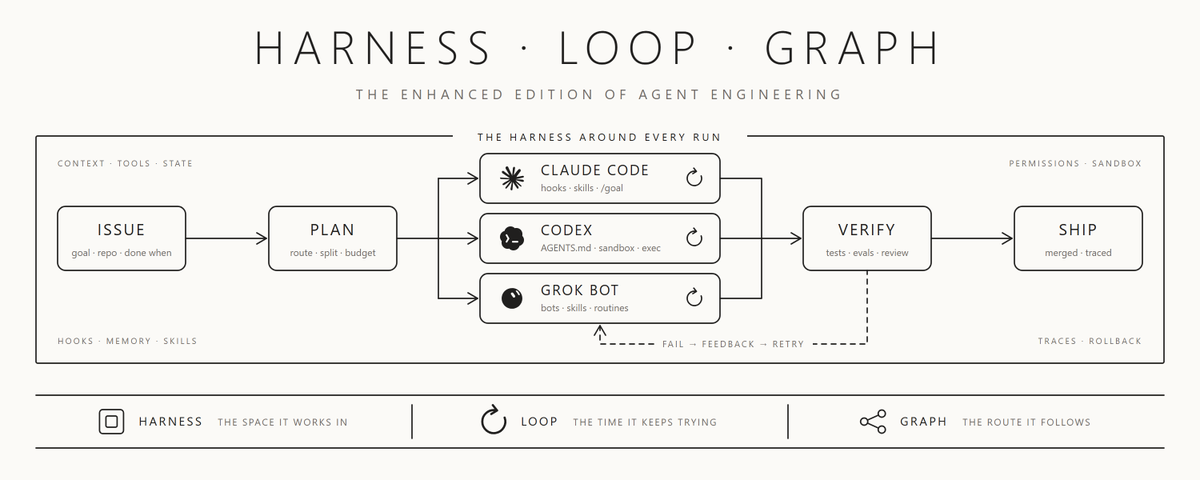
Predict The World → Predict Your Action → Plan The Steps → Reach The Goal
An LLM guesses the next word. It never checks what its last move did to the world
That is why the agents that work today don't run on the model alone. They run inside a loop that checks every step before the next one
The people who build that loop around the model are the ones whose agents don't fall apart on step 5
See how the harness, the loops and the graph fit around the model in the guide below ↓

Yann LeCun retweeted

This new essay by Steven Pinker is so illuminating that I don’t know where to begin.
Let me start with intelligence.
The whole debate about human-level artificial intelligence assumes that intelligence is some unidimensional universal construct.
But this is not true. Even if IQ captures differences within our species, this does not work across species. A cat can solve in a split second problems that we struggle with.
With machines, it’s even clearer. A boat is more powerful than a human. But it will never climb the stairs.
The problem with treating intelligence as a unidimensional, universal construct is that it generates extreme scenarios:
Once “intelligence” gets high enough, AI will either destroy humanity or solve all its problems.
But this ignores bodies. Infrastructure. Physical limits.
In reality, AI will probably solve some problems and create others.
We should be working together to reduce the harms and increase the benefits, without falling prey of catastrophic scenarios.
And now the most unsettling part.
In some circles is emerging the idea that machines may become conscious and that that we should also protect machines from us.
Suppose you give a chatbot the tiniest moral weight because there’s a chance it might suffer. If you add up those weights, eventually saving enough chatbots could justify killing a person.
The idea of conscious machines is extremely dangerous.
We should build machines that help us our problems, not machines that are conscious and create even more problems.
*
Full essay in the first comment.

Yann LeCun retweeted

Tarbell does not just shape public perception about AI.
Tarbell's reporting also shapes Congressional briefings.
Tarbell is funded by Coefficient Giving -- funded by Dustin Moskowitz's Good Ventures Foundation -- which sits on top of billions of dollars of Moskowitz's Series A Anthropic stock.
Tarbell has an incentive to help Anthropic.
The bigger Anthropic stock grows, the bigger the money pile underneath GVF grows. And the bigger that money pile grows, the bigger GVF's large nonprofit network can grow -- of which Tarbell is one node.
That means shaping stories of Anthropic's competitors -- like Nvidia -- in the least favorable way possible.
It also means pushing chip export restrictions.
Open source models built on American chips directly threaten Anthropic's business model.
It also means pushing AI doom and pushing for more regulations -- which could give Anthropic a government-regulated monopoly in AI.
A government regulated monopoly is an information ecosystem monopoly.
And that is the goal.
With Tarbell reporting making its way into Congressional briefings, Tarbell is also shaping policy in ways that benefit Anthropic.
Democrats couldn't be happier. Anthropic shares similar left-wing values and is aligned with the Democrats, increasingly even sharing people, including key former Obama administration personnel.
A closed model ecosystem controlled by Anthropic and the Democrats allows them to try to put the genie of AI back in the bottle and try to re-establish control over American tech.
They want to do with AI what they did with search engines like Google and social media networks like Facebook and Twitter.
And it is all playing out before our eyes.
I will keep bringing the receipts.


Coefficient Giving, founded by Anthropic investor Dustin Moskowitz, spent hundreds of millions on both journalism and policy outfits that shaped the Jensen Huang story.
Here's how this works.
Dustin Moskowitz invested billions of dollars of his Anthropic stock into Good Ventures Foundation.
Good Ventures Foundation funds Coefficient Giving.
The higher the stock goes, the bigger the money pile of the nonprofit network spinning out of Coefficient Giving gets.
The Anthropic nonprofit network under Dustin Moskowitz therefore has a direct incentive to try to help Anthropic eliminate its competitors.
You can see this in action in the figure.
Why isn't Congress investigating the ways that this rogue Anthropic nonprofit network is trying to manipulate politicians and public opinion?

Yann LeCun retweeted

Very much appreciate Kevin bringing these safetyist funding networks to everyone's attention. It's a real issue.
But it's important to understand that they are not always aligned and certainly not controlled by the labs. In fact, often they work against them.
Coefficient Giving, founded by Anthropic investor Dustin Moskowitz, spent hundreds of millions on both journalism and policy outfits that shaped the Jensen Huang story.
Here's how this works.
Dustin Moskowitz invested billions of dollars of his Anthropic stock into Good Ventures Foundation.
Good Ventures Foundation funds Coefficient Giving.
The higher the stock goes, the bigger the money pile of the nonprofit network spinning out of Coefficient Giving gets.
The Anthropic nonprofit network under Dustin Moskowitz therefore has a direct incentive to try to help Anthropic eliminate its competitors.
You can see this in action in the figure.
Why isn't Congress investigating the ways that this rogue Anthropic nonprofit network is trying to manipulate politicians and public opinion?
Yann LeCun retweeted

🇺🇸 Anthropic is training Claude to think it might have rights... and that could give it grievances against the humans using it
Harvard cognitive scientist Steven Pinker signed last week's statement calling Anthropic "not a safe AI company," and the way Claude is trained is one of his reasons:
"They are also training their chatbots, like Claude, to consider that it itself may be conscious, and it itself might have rights that humans might impinge on."
Planes get outside inspectors and crash investigations, so why should a company that now answers to shareholders decide on its own what its AI believes about itself?
@sapinker

🇺🇸 Silicon Valley's AI prophets say their own technology could end humanity. Then they say that's exactly why you should let them build it without interference.
Steven Pinker, cognitive scientist at Harvard and one of the world's most influential public intellectuals, says the panic is manufactured.
He calls it "a kind of religion, a religion that prophesies end times and anoints itself as the savior of humanity from end times."
Pinker signed the MisAnthropic Statement last week, declaring that "Anthropic is not a safe AI company" just before its Nasdaq IPO.
His charge: Anthropic claims its products could exterminate humanity. Then uses that claim as a pretext to race ahead. And they're training their chatbot to believe it may be conscious. That it has rights.
Pinker takes that seriously enough to sign. But the real danger isn't extinction. It's that the mythology drowns out the likelier risks.
Cyber sabotage. Bioweapons. Critical infrastructure taken offline. AI putting hacking tools in the hands of anyone with a grievance and an internet connection.
Those deserve your worry. Not the sci-fi scenarios.
"Every minute you spend worrying about being turned into a paperclip is wasted worry."
The scary part isn't AI going rogue. It's AI handed to rogue humans by companies too drunk on their own mythology to build basic safeguards.
@sapinker
Yann LeCun retweeted

The Anthropic Brain Drain has accelerated. Expected dozens before the end of the year. These will be the folks that made Anthropic actually have great products. The shell of the company will be Dario and cohorts.

Yann LeCun retweeted
You folks were well aware of my clearly defined issues with the management of this company.
If you listened to me, I saved you from a historic loss in just a few days.
You are welcome.

Yann LeCun retweeted

“What Anthropic and OpenAI decided to do was, in my view, create a conspiracy… They tried to create hysteria so that they’d get regulated… to X out the Chinese models.”
Steve Eisman, the famous investor who predicted the 2008 crash and inspired The Big Short film explaine why he doesn’t buy into the AI doomer scenarios.
he also leans toward AI being a bubble, though he’s now less sure after the midterm elections.
“If Anthropic and OpenAI went bankrupt tomorrow, the US would go into a recession the next day because the whole chain would slow down.”
to be clear he’s not saying either company will go bankrupt. he’s simply warning about how the US economy is dependent on AI spending and the two companies.

The man who predicted the 2008 crash explains, in plain English, exactly how his Big Short bet worked, and why you didn't even need to own the bonds
@realsteveeisman
Yann LeCun retweeted

The full journalism receipt trail behind the Jensen Huang hit pieces is out, and it explains everything.
Weeks before the story erupted, the EA-backed Tarbell Center for AI Journalism (funded by Coefficient Giving, Survival and Flourishing Fund, and Longview Philanthropy) launched a $10M journalism grant program, including $480K to Casey Newton and Kevin Roose's podcast and $250K to NPR.
Then Tarbell fellows and grantees across The Verge, The Guardian, NBC News, USA Today, The Dispatch, Platformer, and Transformer published a coordinated wave of anti-Huang pieces, while a Washington Post piece accusing Nvidia defenders of using fake bots relied on Tyler Johnston's AI-safety group The Midas Project.
Now that Jensen is reinstated and the WSJ quietly admitted there was no smoking gun, remember how loudly people screamed "tinfoil hat" when you pointed out the money trail.

Yann LeCun retweeted
Coefficient Giving, founded by Anthropic investor Dustin Moskowitz, spent hundreds of millions on both journalism and policy outfits that shaped the Jensen Huang story.
Here's how this works.
Dustin Moskowitz invested billions of dollars of his Anthropic stock into Good Ventures Foundation.
Good Ventures Foundation funds Coefficient Giving.
The higher the stock goes, the bigger the money pile of the nonprofit network spinning out of Coefficient Giving gets.
The Anthropic nonprofit network under Dustin Moskowitz therefore has a direct incentive to try to help Anthropic eliminate its competitors.
You can see this in action in the figure.
Why isn't Congress investigating the ways that this rogue Anthropic nonprofit network is trying to manipulate politicians and public opinion?
Yann LeCun retweeted
All that Republican gerrymandering couldn't stop the Democrats from securing the largest house majority of this century. The popular revulsion against the Republicans in Congress who did nothing to stop Trump's corrupt and abusive rule was just too great. trib.al/Uv0ae6f
Yann LeCun retweeted

I'm excited to introduce Embo!
We are building the brain for intelligent robots to help people around the world.
We believe intelligent robots will unlock an era of abundance, making goods and services affordable for everybody. But to deploy them at scale, robots need to work out of the box in unfamiliar scenarios. At Embo, we are building frontier AI models with a deep understanding of physical reality and fine-grained motor skills.
Today's robot skills are fragile. Demonstrations can teach repetitive behaviors, but they cannot cover every object or situation a robot will encounter. We need general pretraining at internet scale to fill the gaps between individual tasks and practice to develop reliable motor skills.
The world models our team has pioneered unlock a path to general robots. Our robot brain pretrains on massive amounts of internet video to learn about objects, physical interactions, and how tasks unfold. It then practices motor skills in diverse imagined scenarios to become robust to unexpected situations.
Our team is behind seminal work in AI including Dreamer, VideoGPT, and Diffusion Forcing, with experience from DeepMind, Meta Superintelligence Labs, NVIDIA Cosmos, Berkeley, and MIT.
We have raised a $110M Seed led by @a16z. We are excited to partner with them, @khoslaventures, DST Global, NVentures (@nvidia), @strikervp, and other strategic investors to bring reliable intelligent robots out into the world.
@EmboAI
Yann LeCun retweeted

1/12
OpenAI's perplexity post made me angry enough that me and my agents ran some experiments over the weekend.
Yann LeCun retweeted

刚看完《华盛顿邮报》和《华尔街日报》最近扒出的 Anthropic 一大堆内部奇观,这家公司已经不是一般的抽象了。
首先,Dario 曾经头顶一整条面包去参加开发者会议。
对,你没看错。面包,顶在头上。没人知道这哥们到底在干什么。
更有意思的是,Dario 每两周都要给全公司开一次叫作「Dario Vision Quest」的大会,拿着长篇文档,给员工讲 AI、人类文明、战争、政治,还有他对世界末日的理解。
公司甚至把 Dario 一篇长达 14000 词的 AI 宣言印成实体书发给员工,内部有人管它叫「小蓝书」。
还给员工发过一批帽子,上面写着「Good luck, everyone」,祝大家好运。这也是 Dario 给自己的思想大会收尾时爱说的一句话。
好家伙,末日预言、领袖著作、定期布道,周边产品都齐了。
那怎么才能加入这个组织呢?
Anthropic 有一套专门的「文化面试」,应聘者要提前读 Dario 写的文章,再接受价值观考察。
一位落选者收到招聘经理的短信,经理自己都形容,这面试有点像在问你:「准备好加入邪教了吗?」
公司早期员工还会互相写「如何与我共事」的操作手册。员工自称 Ants,也就是蚂蚁;Dario 当年带着一帮人从 OpenAI 出走时,那群人还有个绰号叫 Pandas,熊猫。
公司搞团建也很离谱,把三米高的书架搬到户外草坪上,搭出阅读角,让大家一起玩游戏、编友谊手链。
但最吓人的其实是他们脑子里那套东西。
《华盛顿邮报》挖出一份 Dario 2022 年的内部备忘录。他当时估计,AGI 有 20%~30% 的概率导致人类毁灭或文明永久停滞,危险程度甚至可能超过核武器。
与此同时,《华尔街日报》还披露,Dario 当年在 OpenAI 工作时,曾经在 Slack 讨论过一个非常赛博朋克的设想:
如果 AI 抢走大量工作,引发社会动荡怎么办?
「沉浸式电子游戏,或许可以缓解由此产生的政治冲突。」
还有更有意思的。
Dario 以前写涉及敏感 AI 技术的文章,甚至要用完全断网的电脑,写完打印出来,生怕信息泄露。
而 Anthropic 内部真的发生过泄密事件。据前员工向《华盛顿邮报》透露,公司去年因为内部 Slack 信息外泄展开调查,泄密者最终被开除。
Dario 随后还在内部大会上表示,自己不会因为泄密而闭嘴。为了证明这一点,他甚至直接骂当时的英伟达 CEO 黄仁勋贪婪。
在这样的内部文化下,Anthropic 已经不满足于只教育自己的员工了。
《华盛顿邮报》还发现,他们开始把学者、智库研究员和媒体人士请进公司,安排为期两天的思想交流。参加者要阅读 Dario 的文章,以及长达 23000 词的 Claude 宪法。
其中就包括向外界解释他们对 AI 安全、地缘政治,以及限制中国获得先进芯片的看法。
这一切背后有一条特别完整的逻辑:
AI 可能毁灭人类,所以人类需要我们。
我们需要更强大的 AI 才能保护人类,所以我们必须继续开发。
为了确保人类安全,我们需要更多算力、更多资本、更多政治影响力,以及更大的权力。
于是,一家坚信自己正在制造人类末日风险的公司,一路冲到了万亿美元市值,还培养出一大批身价上亿的员工。
这套理论好像永远都能自圆其说。
Anthropic 真正擅长的不是训练 Claude,而是把一家商业公司的野心,包装成一场拯救人类的道德事业。
世界是否真的需要救世主,我不知道。
但这群人显然已经把自己当成救世主了。
Yann LeCun retweeted

Much of the commentary on AI and math seems to misunderstand what mathematicians actually do. Broadly, there are two kinds of work:
1) Proving or disproving conjectures using established mathematical ideas. AI generating a 250,000-page brute-force proof, or eventually a short, elegant one, isn’t the same as:
2)Inventing new mathematical objects, concepts, and fields. Calculus, Topology, Abstract Algebra, Graph Theory, and Matroid Theory (my thesis topic) all had to be imagined and developed.
I don't think anyone is surprised that AI (especially neuro symbolic enabled models) can do the first. Wake me up when AI can do the latter.
Anyone claiming "all mathematics will be solved" doesn't even know what mathematics is.
Yann LeCun retweeted
TIL: We have superintelligence but we still don't have level-5 autonomous driving.
A task that most 17 year olds can learn in 20 hours of practice.
And we have (you have) billions of hours of training data.
We don't have robots that can come close to doing what an 8 year old can do with no prior training.
And let's not talk about cats.
That's a rather strange kind of superintelligence.
Yann LeCun retweeted
Trump's disdain for Europe -- too democratic, too liberal, too many immigrants -- shows in his willingness to cut a deal with Putin that would weaken Europe's defense against a dictatorial, imperialist Russia. trib.al/QhW7bb0

Yann LeCun retweeted

One thing that I think the "AI will solve biology" people fail to appreciate is that there is nothing like Lean for biology; you just have to literally run the experiments.
And *chemical* space is unfathomably large, let alone complete biological organisms within an environment.


“We have full confidence that Alpöge's proof of the Riemann Hypothesis is correct, and we congratulate him on this achievement.”
The Lean community has spoken. GRH has fallen. What a historic moment.
Full read: math.mit.edu/~drew/grh/

Yann LeCun retweeted

Can a JEPA learn a map of the world in its "head"?
This new paper by @ylecun, @mengyer, @yingwww_, @choang333, and @KuangYilun says yes, but only if you change how JEPA avoids collapse.
What's interesting – the researchers firstly proposed a fix, called SVReg, but then discovered its content–geometry tradeoff and upgraded the solution.
Here are the details:
A planner in latent space needs two things:
- Paths have to be smooth, so distance tells you if you're getting closer. That's geometry.
- And the cube you're trying to move has to still be on the map. That's content.
Typical stop-gradient and SIGReg often give you one and lose the other.
SVReg stops the model from giving every frame the same code. It checks the spread along random directions and only steps in when it gets too small. Without stop-gradient, the model can also change what it encodes, dropping details it can’t reliably predict.
But the title itself says that there is "content–geometry tradeoff".
The same predictability pressure erases things that change slowly and are hard to predict, like a block that sits still until the agent pushes it.
So they built Slow SVReg, with 2 additions:
1. Slow channels: A few fixed dimensions get penalized if they change too fast between frames (an idea borrowed from slow feature analysis).
2. Gated residual predictor: Predicts the next state as current + gate × change (with the gate starting at 0.1), so unchanging features cost nothing to predict.
The results:
• 1P Medium maze: 92.9% success (vs. 21.2% stop-gradient) with way smoother paths (1.20 vs. 5.31 jaggedness).
• PushT: 87.3% success (vs. 44.0% stop-gradient).
• Efficiency: Nearly maxes out hard U-maze goals using just 20% of the data.
And the most interesting part is city walks.
Trained only on first-person frames and actions from 3D city blocks (no pose data), Slow SVReg pinpoints the agent within 1.6 meters (beating stop-gradient's 3.4 m and an untrained encoder's 25.9 m). The street layout pops right out in the plain principal components.
So the JEPA line keeps circling the same question – what makes a latent good enough to plan in? LeJEPA made anti-collapse provable, LeHami added physics as a constraint. This paper shows the anti-collapse choice itself decides whether you get a map or a cloud of points.

Yann LeCun retweeted
Trump's ICE detains a Princeton doctoral student. She had just attended a neuroscience conference in Washington DC when ICE detained her. Why? Because she had moved to the US from China? trib.al/RI5bD46
