

@TheStudyofWar
Account based inUnited States
About this account
- Account based in
- United States
- Connected via
- Web
Account-level information from X, not a live location or the device used for a specific post.
ISW is a policy research organization focused on U.S. national security. Email: [email protected]. https://xitter.cf/t.co/FO1PVyOnYB
Washington D.C.
Joined September 2009
- Tweets56.9K
- Following3.3K
- Followers1.5M
- Likes18.1K







Pinned Tweet
Statement on ISW Website Service: Following today’s warnings from US cyber authorities about critical PHP vulnerabilities, ISW has taken our website offline while we apply and verify security updates. We’ll restore it once secure. We’ve found no evidence our site was compromised. We will continue to distribute ISW’s daily updates to subscribers as we’re able.
Please continue to follow ISW on social media and subscribe to our e-mails to receive ISW updates while website service is restricted: lp.constantcontactpages.com/…

Institute for the Study of War retweeted

NEW | Houthi and Yemeni government-aligned forces are likely continuing to contest control over Jabal Han, which overlooks western Taiz City.
The Houthis claimed that Houthi forces controlled all of the Jabal Han area on October 20, but an independent Yemeni journalist reported that both Houthi and Yemeni government-aligned forces occupy positions on the mountain.
Neither Houthi nor Yemeni government-aligned forces control Jabal Han’s summit as of October 20, according to the journalist.
Jabal Han is of considerable military value to the Houthis in their campaign to capture Taiz City because it allows observation of the most of the city.
The Houthis could position fighters on Jabal Han to observe Yemeni government-aligned forces' movements and positions in combat areas, along key roadways, and within urban neighborhoods in the vicinity.
Yemeni government-aligned forces also continued to engage Houthi fighters south of Taiz City on October 19 and 20, likely in an effort to break the Houthis' encirclement of government-aligned forces in central Taiz Governorate.
The Houthis likely fired several ballistic missiles targeting Marib City on October 19 as part of a campaign to render Yemeni government-aligned forces unwilling or unable to sustain its counteroffensives in Marib Governorate.

Institute for the Study of War retweeted
MORE: Zelensky has repeatedly, including recently, offered a mutual ceasefire in which both Russia and Ukraine refrain from striking each other’s energy infrastructure, and Russian President Vladimir Putin has rejected each offer thus far.


NEW: Ukrainian President Volodymyr Zelensky continues to reiterate Ukraine’s willingness to engage in a mutual energy strikes moratorium in line with US President Donald Trump’s recent statement regarding a strikes moratorium.
Other Key Takeaways:
Neither Russian nor Ukrainian forces made confirmed advances on September 14.
Ukrainian forces continued their long-range strike campaign against Russian military assets in Krasnodar Krai overnight. Russia launched 102 drones against Ukraine overnight.
Russian forces are heavily relying on drone and glide bomb strikes in the Dobropillya area, likely due to localized Russian personnel shortages following tactical failures to advance in the killzone.
Russian forces continue to employ “human safari” tactics, purposefully hunting civilians in Zaporizhia Oblast. (1/2)


Institute for the Study of War retweeted
NEW: The People’s Republic of China (PRC) is increasingly targeting the family members of those it deems Taiwan “separatists” to coerce them to halt activities that the PRC views as promoting “Taiwanese independence.” The PRC appears to be intensifying its coercion against Taiwanese politician Puma Shen, in particular, possibly to impact his Taipei mayoral campaign. (1/2)
Other Key Takeaway:
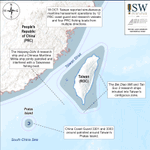
The PRC appears to be intensifying its rhetorical and maritime coercion against the Philippines to reduce the Philippine presence in the South China Sea. The PRC likely seeks to support its own territorial claims and ensure that PRC maritime forces can operate freely in the South China Sea and nearby waters.

MORE: ISW has observed evidence to assess that Russian forces suffered a net loss of 122 square kilometers between September 1, 2026, and October 16, 2026, and seized about 100 square kilometers since January 1, 2026.
Russian Offensive Campaign Assessment, October 30, 2026: Operation Vivaldi and other Ukrainian counteroffensive efforts in the Oleksandrivka and Kupyansk directions in 2026 have enabled Ukraine to contest the operational initiative across the frontline, virtually halting Russian advances. ISW has observed evidence to assess that Russian forces suffered a net loss of 122 square kilometers between September 1, 2026, and October 16, 2026, and seized about 100 square kilometers since January 1, 2026.
Biletskyi reported on October 19 that Operation Vivaldi degraded the Russian 144th Motorized Rifle Division (20th Combined Arms Army [CAA], Moscow Military District [MMD]), which was part of the Russian contingent previously operating from a bridgehead on the right (western) bank of the Zherebets River, to the extent that the division effectively ceased to exist as an organized military force.
Russian forces will have to reconstitute the 144th Motorized Rifle Division for any future offensive operations in the Lyman direction, which will impose further constraints on already costly Russian force generation. Russia has been facing increased combat losses since Summer 2026, with Russian forces losing over 40,000 killed and wounded in several months. Russia’s voluntary recruitment force generation system that relies on contract recruitment has become increasingly costly, and as average contract prices have significantly risen since 2022, to the point that Russian President Vladimir Putin’s is reportedly reluctantly considering ordering another unpopular involuntary reservist call-up. (1/2)


Institute for the Study of War retweeted
Other Key Takeaways ⬇️
Senior Kremlin officials reaffirmed Russian support for Iran and explicitly defined the United States as Russia’s long-term adversary, despite the recent unilateral US concession to Moscow – offering Russia a diesel export waiver.
Former Commander of the Ukrainian 60th Ingulets Separate Mechanized Brigade Major Dmytro Rohozyuk became the acting commander of Ukraine’s 3rd Army Corps (AC) while Brigadier General Andrii Biletskyi continues to command Ukraine’s Center Group of Forces (GoF) in Donetsk’s Fortress Belt.
Russia launched 165 drones against Ukraine overnight.
Ukrainian forces advanced east of Sumy City, and Russian forces advanced south of Orikhiv.


MORE: Ukrainian forces continue to face in-motion speed restrictions to SpaceX’s low-earth orbit satellite communication technology (Starlink and Starshield) that limit Ukraine’s ability to counter Russian piston engine-driven and jet-powered strike drones.
Ukrainian Presidential Advisor on Defense Technologies Serhiy “Flash” Beskrestnov stated on October 19 that the 160 kilometers per hour (around 100 miles per hour) in-motion speed restrictions to Ukraine’s satellite internet service as part of the Starshield package remain in place.
Beskrestnov emphasized that the Starshield in-motion speed restrictions disrupt data transmission to Ukrainian drones used to intercept Russian piston engine-driven Geran drones since the helicopters fly faster than 160 kilometers per hour. Beskrestnov noted that the Starshield speed restrictions limit Ukraine’s jet-powered interceptor drones.
Ukrainian President Volodymyr Zelensky stated on October 19 that Ukraine continues to experience speed restrictions on Starlink and Starshield services in various sectors of the frontline that undermine Ukraine’s frontline logistics, intermediate-range strikes, and counter-drone air defense operations.
Starshield is a more secure, jam-resistant, and military-oriented version of the Starlink satellite network that SpaceX designed for government use, while Starlink serves civilian and commercial purposes. Ukrainian forces do not have access to Starshield or any other Starlink services over Russian territory, as SpaceX has geographically restricted Ukraine’s access to within Ukraine’s international borders.
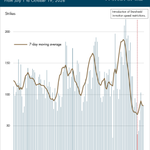
Data from Ukraine’s Unmanned Systems Forces (USF) between July 1, 2026, and October 19, 2026, indicates that the Starshield in-motion speed restriction, which Ukrainian forces first reported on October 14, has significantly degraded Ukraine’s intermediate-range strike campaign targeting primarily Russian logistics across the frontline. ⬇️

Institute for the Study of War retweeted
MORE: Ukrainian forces continue to face in-motion speed restrictions to SpaceX’s low-earth orbit satellite communication technology (Starlink and Starshield) that limit Ukraine’s ability to counter Russian piston engine-driven and jet-powered strike drones.
Ukrainian Presidential Advisor on Defense Technologies Serhiy “Flash” Beskrestnov stated on October 19 that the 160 kilometers per hour (around 100 miles per hour) in-motion speed restrictions to Ukraine’s satellite internet service as part of the Starshield package remain in place.
Beskrestnov emphasized that the Starshield in-motion speed restrictions disrupt data transmission to Ukrainian drones used to intercept Russian piston engine-driven Geran drones since the helicopters fly faster than 160 kilometers per hour. Beskrestnov noted that the Starshield speed restrictions limit Ukraine’s jet-powered interceptor drones.
Ukrainian President Volodymyr Zelensky stated on October 19 that Ukraine continues to experience speed restrictions on Starlink and Starshield services in various sectors of the frontline that undermine Ukraine’s frontline logistics, intermediate-range strikes, and counter-drone air defense operations.
Starshield is a more secure, jam-resistant, and military-oriented version of the Starlink satellite network that SpaceX designed for government use, while Starlink serves civilian and commercial purposes. Ukrainian forces do not have access to Starshield or any other Starlink services over Russian territory, as SpaceX has geographically restricted Ukraine’s access to within Ukraine’s international borders.
Data from Ukraine’s Unmanned Systems Forces (USF) between July 1, 2026, and October 19, 2026, indicates that the Starshield in-motion speed restriction, which Ukrainian forces first reported on October 14, has significantly degraded Ukraine’s intermediate-range strike campaign targeting primarily Russian logistics across the frontline. ⬇️
Russian Offensive Campaign Assessment, October 30, 2026: Operation Vivaldi and other Ukrainian counteroffensive efforts in the Oleksandrivka and Kupyansk directions in 2026 have enabled Ukraine to contest the operational initiative across the frontline, virtually halting Russian advances. ISW has observed evidence to assess that Russian forces suffered a net loss of 122 square kilometers between September 1, 2026, and October 16, 2026, and seized about 100 square kilometers since January 1, 2026.
Biletskyi reported on October 19 that Operation Vivaldi degraded the Russian 144th Motorized Rifle Division (20th Combined Arms Army [CAA], Moscow Military District [MMD]), which was part of the Russian contingent previously operating from a bridgehead on the right (western) bank of the Zherebets River, to the extent that the division effectively ceased to exist as an organized military force.
Russian forces will have to reconstitute the 144th Motorized Rifle Division for any future offensive operations in the Lyman direction, which will impose further constraints on already costly Russian force generation. Russia has been facing increased combat losses since Summer 2026, with Russian forces losing over 40,000 killed and wounded in several months. Russia’s voluntary recruitment force generation system that relies on contract recruitment has become increasingly costly, and as average contract prices have significantly risen since 2022, to the point that Russian President Vladimir Putin’s is reportedly reluctantly considering ordering another unpopular involuntary reservist call-up. (1/2)
Institute for the Study of War retweeted
Iran Update, October 20, 2026: Houthi and Yemeni government-aligned forces are likely continuing to contest control over Jabal Han, which overlooks western Taiz City.
More Key Takeaways:
The Houthis likely fired several ballistic missiles targeting Marib City on October 19 as part of a campaign to render Yemeni government-aligned forces unwilling or unable to sustain their counteroffensives in Marib Governorate. (1/2)


Other Key Takeaways ⬇️
Senior Kremlin officials reaffirmed Russian support for Iran and explicitly defined the United States as Russia’s long-term adversary, despite the recent unilateral US concession to Moscow – offering Russia a diesel export waiver.
Former Commander of the Ukrainian 60th Ingulets Separate Mechanized Brigade Major Dmytro Rohozyuk became the acting commander of Ukraine’s 3rd Army Corps (AC) while Brigadier General Andrii Biletskyi continues to command Ukraine’s Center Group of Forces (GoF) in Donetsk’s Fortress Belt.
Russia launched 165 drones against Ukraine overnight.
Ukrainian forces advanced east of Sumy City, and Russian forces advanced south of Orikhiv.
MORE: Ukrainian forces continue to face in-motion speed restrictions to SpaceX’s low-earth orbit satellite communication technology (Starlink and Starshield) that limit Ukraine’s ability to counter Russian piston engine-driven and jet-powered strike drones.
Ukrainian Presidential Advisor on Defense Technologies Serhiy “Flash” Beskrestnov stated on October 19 that the 160 kilometers per hour (around 100 miles per hour) in-motion speed restrictions to Ukraine’s satellite internet service as part of the Starshield package remain in place.
Beskrestnov emphasized that the Starshield in-motion speed restrictions disrupt data transmission to Ukrainian drones used to intercept Russian piston engine-driven Geran drones since the helicopters fly faster than 160 kilometers per hour. Beskrestnov noted that the Starshield speed restrictions limit Ukraine’s jet-powered interceptor drones.
Ukrainian President Volodymyr Zelensky stated on October 19 that Ukraine continues to experience speed restrictions on Starlink and Starshield services in various sectors of the frontline that undermine Ukraine’s frontline logistics, intermediate-range strikes, and counter-drone air defense operations.
Starshield is a more secure, jam-resistant, and military-oriented version of the Starlink satellite network that SpaceX designed for government use, while Starlink serves civilian and commercial purposes. Ukrainian forces do not have access to Starshield or any other Starlink services over Russian territory, as SpaceX has geographically restricted Ukraine’s access to within Ukraine’s international borders.
Data from Ukraine’s Unmanned Systems Forces (USF) between July 1, 2026, and October 19, 2026, indicates that the Starshield in-motion speed restriction, which Ukrainian forces first reported on October 14, has significantly degraded Ukraine’s intermediate-range strike campaign targeting primarily Russian logistics across the frontline. ⬇️
Russian Offensive Campaign Assessment, October 30, 2026: Operation Vivaldi and other Ukrainian counteroffensive efforts in the Oleksandrivka and Kupyansk directions in 2026 have enabled Ukraine to contest the operational initiative across the frontline, virtually halting Russian advances. ISW has observed evidence to assess that Russian forces suffered a net loss of 122 square kilometers between September 1, 2026, and October 16, 2026, and seized about 100 square kilometers since January 1, 2026.
Biletskyi reported on October 19 that Operation Vivaldi degraded the Russian 144th Motorized Rifle Division (20th Combined Arms Army [CAA], Moscow Military District [MMD]), which was part of the Russian contingent previously operating from a bridgehead on the right (western) bank of the Zherebets River, to the extent that the division effectively ceased to exist as an organized military force.
Russian forces will have to reconstitute the 144th Motorized Rifle Division for any future offensive operations in the Lyman direction, which will impose further constraints on already costly Russian force generation. Russia has been facing increased combat losses since Summer 2026, with Russian forces losing over 40,000 killed and wounded in several months. Russia’s voluntary recruitment force generation system that relies on contract recruitment has become increasingly costly, and as average contract prices have significantly risen since 2022, to the point that Russian President Vladimir Putin’s is reportedly reluctantly considering ordering another unpopular involuntary reservist call-up. (1/2)

Institute for the Study of War retweeted
MORE: Russia’s ongoing long-range strike campaign against Ukrainian energy infrastructure continues to degrade Ukraine’s energy sector and disproportionately harms civilians. Daytime Russian strikes are also inflicting significant civilian casualties. ⬇️
The Ukrainian Air Force reported on October 19 that Russia launched an unspecified number of Iskander-M and S-400 ballistic missiles and Iskander-K cruise missiles and 269 strike (including 59 jet-powered) and decoy drones against Ukraine overnight on October 18 to 19. These strikes follow intense Russian drone strikes during the day on October 18, in which Russian forces launched 463 Shahed and Gerbera-type strike drones, Banderol/Dan-T and Italmas loitering munitions, and Parodiya-type decoy drones — likely in an effort to degrade Ukrainian air defenses in advance of the overnight strikes.
Ukrainian President Volodymyr Zelensky stated on October 19 that Russian forces launched 16 ballistic missiles and over 200 drones (including jet-powered) primarily against Kyiv City and Kyiv Oblast overnight, damaging residential, critical, and transportation infrastructure.
Russian forces also struck 28 substations and other energy infrastructure objects in Vinnytsia, Volyn, Kirovohrad, Kyiv, Mykolaiv, Zhytomyr, Khmelnytskyi, Kharkiv, Ternopil, Odesa, and Rivne oblasts, causing power outages for approximately 550,000 households in 15 oblasts across Ukraine.
Ukrainian Prime Minister Serhiy Koretsky stated on October 17 that Russia has conducted daily strikes against Ukrainian energy infrastructure since mid-July 2026, totaling 2,147 strikes against Ukrainian energy facilities since July 16.
Koretsky stated that Russian forces also struck a park with families in Nova Vodolaha, Kharkiv Oblast, during the day on October 19, killing at least six people, including two children, and injuring at least 14.

NEW: Ukrainian officials continue to report disruptions to US assistance to Ukraine.
Other Key Takeaways:
Devastating Russian drone and missile strikes on the night of October 18 to 19 heavily damaged energy and civilian infrastructure across Ukraine — killing at least four and wounding at least 55.
Daytime Russian strikes are also inflicting significant civilian casualties.
The Kremlin is reportedly pushing for a trilateral meeting between the United States, Russia, and the People’s Republic of China (PRC), likely as part of a dual-pronged effort to present itself as a diplomatic peer while supporting structures that challenge Western-led international organizations.
Recent aggressive Russian military satellite maneuvers are a continuation of Russia’s space policy against third country satellites since at least 2022.
Ukrainian forces recently advanced in the Lyman tactical area, east of Dobropillya, and in western Zaporizhia Oblast.


Institute for the Study of War retweeted
NEW | Ethiopian federal forces are reportedly redeploying southward from towns along the Eritrean border toward the Tigray city belt, including Adwa and Adigrat.
Other Key Takeaways from today's Ethiopia War Security Review:
Tigrayan rebel forces are continuing to attack federal supply lines to central Tigray, although Ethiopian federal forces have simultaneously increased pressure on Tigrayan rebel support zones in the mountainous interior of central Tigray with ground attacks and sustained air and drone strikes.
Ethiopian rebels in the Benishangul-Gumuz and Oromia regions reportedly carried out their first notable attacks against Ethiopian federal forces since joining the Alliance for Survival rebel coalition.
The Tigray People’s Liberation Front warned the Ethiopian federal government against using airports for military purposes and threatened to shoot down Ethiopian Airlines planes carrying suspected military equipment and personnel.
Top Russian and US officials separately underscored their desire to mediate and deescalate tensions between Ethiopia and Eritrea and urged both neighbors to show restraint.


Iran Update, October 20, 2026: Houthi and Yemeni government-aligned forces are likely continuing to contest control over Jabal Han, which overlooks western Taiz City.
More Key Takeaways:
The Houthis likely fired several ballistic missiles targeting Marib City on October 19 as part of a campaign to render Yemeni government-aligned forces unwilling or unable to sustain their counteroffensives in Marib Governorate. (1/2)
Institute for the Study of War retweeted
MORE: Ukraine has regained the operational initiative on most key battlefield directions and has been contesting Russia’s strategic initiative since late 2025, writes @nataliabugayova. ⬇️
Ukraine has slowed Russian battlefield advances to a footpace in 2026 and has grown the already staggering human cost of the Russian advance.
Ukraine has retaken significant territory from Russia in 2026, and at the theater level has nearly zeroed out Russian gains for the year. ISW has observed evidence to assess that Russian forces have only made a net gain of about 100 square kilometers thus far in 2026 thanks to Ukrainian counteroffensives, which have liberated at least 1,046 square kilometers, for example. The daily Russian net rate of advance in 2026 is so far less than a square kilometer per day — literal footpace. Russia’s summer offensive has failed. Russia’s fall offensive is likely to fail as well.
Russian President Vladimir Putin has failed to accomplish any of his stated war aims in Ukraine to date. Putin did not force the Ukrainian government to capitulate, nor did he destroy the Ukrainian military. Russia is nowhere close to taking the rest of the Donetsk region, including the Fortress Belt – one of Putin’s stated war aims.
Ukraine has forced the Kremlin to confront dilemmas inside of Russia that would have been unthinkable not long ago. Ukraine’s deep strike campaign has triggered fuel shortages in Russia, degrading at least 30 percent of its refining capacity, and forced Moscow to choose which infrastructure to protect with air defense assets. Ukrainian advances and strikes are challenging Putin’s promises of Russia’s economic stability, security, and greatness.
Ukraine’s 2026 battlefield progress is not transient or accidental — it is a result of Ukraine’s maturing warfighting capabilities and military transformation that occurred over 2025 and 2026. Ukraine has significantly grown its intermediate-range and deep-strike campaigns, expanded military production, matured operational art concepts, and is increasingly focused on the long-term warfighting strategy. Ukraine is working on its ballistic missile program, which, if successful, will put key Russian defense industrial and military infrastructure at even greater risk.

SPECIAL REPORT: The United States and Europe risk squandering the best opportunity since 2022 to alter Russia’s trajectory toward a longer and larger war. Ukraine currently has the best chance of seizing the strategic initiative against Russia since December 2022, while simultaneously facing the greatest risk to its momentum.
Russia’s ballistic missile and jet-powered drone campaign against Ukraine, alongside its growing kinetic attacks against NATO states, aims to drive Ukraine and its allies into a reactive stance and distract them from seizing a hard-won opportunity to hold the strategic initiative against Russia.
The Kremlin’s offer to supply diesel to global markets is a cognitive warfare effort that aims to disrupt the momentum of the effective pressure campaign against Russia’s energy sector.
The Kremlin is vigilant about Ukraine and its partners holding the initiative and seeks to deter and disrupt it at all costs.
The United States and Europe can either deny the Kremlin’s strategy or risk a greater war with greater escalation risks.


NEW: The People’s Republic of China (PRC) is increasingly targeting the family members of those it deems Taiwan “separatists” to coerce them to halt activities that the PRC views as promoting “Taiwanese independence.” The PRC appears to be intensifying its coercion against Taiwanese politician Puma Shen, in particular, possibly to impact his Taipei mayoral campaign. (1/2)
Other Key Takeaway:
The PRC appears to be intensifying its rhetorical and maritime coercion against the Philippines to reduce the Philippine presence in the South China Sea. The PRC likely seeks to support its own territorial claims and ensure that PRC maritime forces can operate freely in the South China Sea and nearby waters.
2/ China & Taiwan Update, October 20, 2026: isw.pub/ChinaTaiwanUpdate102…