

Crypto Researcher on All Chains | L1, L2, L3 & Coin Expert.. building @Velvet_Capital
enjoy research? ⏎ Highlights
Joined June 2009
- Tweets38.9K
- Following2.1K
- Followers51.1K
- Likes96.2K




Pinned Tweet
When some top chads post their portfolio, some people ask questions "what are they doing, that I'm not doing?"
It's diversification mate!
Many people flock to overpriced crypto assets, overlooking the vast landscape of innovative projects emerging.
While diversification can improve risk-adjusted returns through metrics like the Sharpe ratio, its benefits go deeper.
In a dynamic market like crypto, it's crucial to gain exposure to the diverse applications and other crypto sectors.
Think of returns like a power law distribution. A few investments deliver exceptional results, while many yield lower or negative returns. This is similar to venture capital, where success hinges on identifying a few breakout startups.
Diversification in crypto serves the same purpose, it increases your chances of capturing the "runner" that'll propel your portfolio upwards.
In the last 24h, AI tokens surged +15% outperforming other crypto sector. This is because Nvidia is close to becoming World’s Most Valuable Company.
If you had spread your investment into AI tokens also, your portfolio would've added gains despite this week's bloodbath.
➭ 𝗕𝗲𝘆𝗼𝗻𝗱 𝘁𝗵𝗲 𝗧𝗼𝗽 𝟭𝟬: 𝗔 𝗕𝗿𝗼𝗮𝗱𝗲𝗿 𝗖𝗿𝘆𝗽𝘁𝗼 𝗨𝗻𝗶𝘃𝗲𝗿𝘀𝗲
A portfolio concentrated solely on the top 10 cryptocurrencies by market cap might seem diversified, but it only captures a limited scope.
These are primarily Layer 1 blockchain protocols. While these tokens may appear less risky, they miss the wave of innovation happening across the crypto landscape.
Expanding your portfolio to include the other top crypto sector paints a more dynamic picture. This encompasses:
• AI: $ARKM, $GRT, $BOTTO, $DEAI, $KAI
• RWA: $PENDLE, $OM, $LNDX, $TRADE, $PRCL, $SOIL
• Layer 2: $ARB, $OP, $STRK, $METIS, $MANTA
• DePIN: $OPSEC, $FIL, $AIOZ, $IOTX, $GPU
• GameFi: $PIXEL, $APE, $SAND, $NAKA, $KARRAT, $MYRIA
The crypto market's rapid evolution necessitates an active approach to portfolio management. Diversification isn't simply buying more assets.
It's about taking a long-term view and strategically allocating your investments across different sectors and project sizes to capitalize on diverse potential outcomes.
RWA Market Cap Expected to Reach $16 Trillion in 2030. DYOR and find your best RWA project pick, buy and HODL!
✍️ 𝗖𝗼𝗻𝗰𝗹𝘂𝘀𝗶𝗼𝗻
Think of diversification not as weakening your portfolio, but as giving it more firepower. It increases your chances of capturing the winners while managing risk.
In essence, diversification gives you more opportunities for success, for less.

THEDEFIPLUG retweeted
A stablecoin issuer could launch a cryptographically verifiable reserve dashboard in under 7 days, without building the infrastructure itself.
That’s the business model @primus_labs is introducing through its managed Proof-of-Reserves (PoR) product.
Essentially, turning cryptographic verification into a recurring B2B subscription service.
Primus’s public PoR documentation describes:
➤ Integration targeted at under 7 days
➤ 7 days of free dashboard publishing
➤ A dedicated public reserve dashboard
➤ Monthly subscription pricing after the trial
➤ Managed verification and ongoing maintenance
So instead of a stablecoin issuer having to assemble its own cryptographic reporting infrastructure, Primus offers the reporting workflow as a service.
● What the Issuer Is Actually Buying
Reserve reporting involves more than generating a proof.
An issuer holding assets across onchain protocols and centralized exchanges needs to retrieve financial records, authenticate the information, calculate its backing and publish results that outside parties can independently check.
That also means maintaining the reporting pipeline when exchange interfaces change, verification fails or new reserve sources are added.
Primus packages several of these responsibilities together.
➤ zkTLS authenticates external financial records
➤ Protected computation and proving infrastructure process the relevant reserve information
➤ The dashboard publishes verifiable results
➤ Ongoing maintenance supports repeated reporting
The issuer still has to establish that the records are complete and that the underlying assets genuinely support its liabilities.
Cryptography doesn’t replace financial auditing.
● Why The Customer Keeps Paying
A free publishing period gives an issuer an opportunity to evaluate the reporting product before committing to a recurring subscription.
That’s different from selling a developer SDK and waiting for someone to build an application around it.
The product has a clearer customer journey:
Integration → Dashboard Deployment → Free Publishing → Paid Subscription → Ongoing Reporting
And reserve verification is naturally recurring.
An issuer doesn’t need to prove its backing only once. It needs to keep publishing updated evidence as balances, positions and liabilities change.
That creates a reason to retain the service beyond the initial integration.
● From Task Fees To Recurring Revenue
Primus already has a usage-based verification model where individual proof requests generate task fees.
Managed PoR introduces another potential revenue source.
One business depends heavily on verification volume.
The other can depend on the number of paying institutions, subscription pricing and customer retention.
Consider an illustrative example:
➤ 10 issuers paying $500/month = $60K annual revenue
➤ 25 issuers paying $1,000/month = $300K annual revenue
➤ 50 issuers paying $2,000/month = $1.2M annual revenue
These aren’t Primus’s disclosed prices, contracts or revenue forecasts.
They show why even a relatively small institutional customer base could produce a different revenue profile from low-priced individual verification tasks.
Of course, gross subscription revenue isn’t profit.
Exchange connectivity, proof generation, infrastructure monitoring and customer support all introduce ongoing costs.
● Verification Becomes A Subscription
Primus is turning cryptographic verification into a recurring financial service.
By packaging reserve reporting as a managed subscription, it creates a second potential revenue stream alongside zkTLS fees, built around ongoing institutional demand.

A stablecoin issuer could launch a cryptographically verifiable reserve dashboard in under 7 days, without building the infrastructure itself.
That’s the business model @primus_labs is introducing through its managed Proof-of-Reserves (PoR) product.
Essentially, turning cryptographic verification into a recurring B2B subscription service.
Primus’s public PoR documentation describes:
➤ Integration targeted at under 7 days
➤ 7 days of free dashboard publishing
➤ A dedicated public reserve dashboard
➤ Monthly subscription pricing after the trial
➤ Managed verification and ongoing maintenance
So instead of a stablecoin issuer having to assemble its own cryptographic reporting infrastructure, Primus offers the reporting workflow as a service.
● What the Issuer Is Actually Buying
Reserve reporting involves more than generating a proof.
An issuer holding assets across onchain protocols and centralized exchanges needs to retrieve financial records, authenticate the information, calculate its backing and publish results that outside parties can independently check.
That also means maintaining the reporting pipeline when exchange interfaces change, verification fails or new reserve sources are added.
Primus packages several of these responsibilities together.
➤ zkTLS authenticates external financial records
➤ Protected computation and proving infrastructure process the relevant reserve information
➤ The dashboard publishes verifiable results
➤ Ongoing maintenance supports repeated reporting
The issuer still has to establish that the records are complete and that the underlying assets genuinely support its liabilities.
Cryptography doesn’t replace financial auditing.
● Why The Customer Keeps Paying
A free publishing period gives an issuer an opportunity to evaluate the reporting product before committing to a recurring subscription.
That’s different from selling a developer SDK and waiting for someone to build an application around it.
The product has a clearer customer journey:
Integration → Dashboard Deployment → Free Publishing → Paid Subscription → Ongoing Reporting
And reserve verification is naturally recurring.
An issuer doesn’t need to prove its backing only once. It needs to keep publishing updated evidence as balances, positions and liabilities change.
That creates a reason to retain the service beyond the initial integration.
● From Task Fees To Recurring Revenue
Primus already has a usage-based verification model where individual proof requests generate task fees.
Managed PoR introduces another potential revenue source.
One business depends heavily on verification volume.
The other can depend on the number of paying institutions, subscription pricing and customer retention.
Consider an illustrative example:
➤ 10 issuers paying $500/month = $60K annual revenue
➤ 25 issuers paying $1,000/month = $300K annual revenue
➤ 50 issuers paying $2,000/month = $1.2M annual revenue
These aren’t Primus’s disclosed prices, contracts or revenue forecasts.
They show why even a relatively small institutional customer base could produce a different revenue profile from low-priced individual verification tasks.
Of course, gross subscription revenue isn’t profit.
Exchange connectivity, proof generation, infrastructure monitoring and customer support all introduce ongoing costs.
● Verification Becomes A Subscription
Primus is turning cryptographic verification into a recurring financial service.
By packaging reserve reporting as a managed subscription, it creates a second potential revenue stream alongside zkTLS fees, built around ongoing institutional demand.
THEDEFIPLUG retweeted
550K+ holders, $45B+ in trading volume, and over $1B in AUM.
But the growth behind xStocks tells two different stories.
In September, @xStocksFi reported:
➤ 200K+ holders
➤ $40B+ cumulative volume
By October 28:
➤ 550K+ holders
➤ $45B+ cumulative volume
These are reported milestones, not exact growth figures. Still, the contrast is striking.
Holder adoption is expanding rapidly, but cumulative trading volume hasn’t increased at a comparable pace.
Now Payward has added 200+ UK and European equities, including Germany’s DAX 40, expanding distribution even further.
The question is whether xStocks is attracting active traders or a growing base of investors holding smaller positions.
Wallet counts alone can’t answer that. Neither can cumulative volume.
Monthly active holders, median position sizes and turnover per active wallet would tell us much more.
$45B in cumulative trading volume demonstrates substantial activity.
But the next test for tokenized equities is how much capital stays invested and how frequently those holders return to trade.

550K+ holders, $45B+ in trading volume, and over $1B in AUM.
But the growth behind xStocks tells two different stories.
In September, @xStocksFi reported:
➤ 200K+ holders
➤ $40B+ cumulative volume
By October 28:
➤ 550K+ holders
➤ $45B+ cumulative volume
These are reported milestones, not exact growth figures. Still, the contrast is striking.
Holder adoption is expanding rapidly, but cumulative trading volume hasn’t increased at a comparable pace.
Now Payward has added 200+ UK and European equities, including Germany’s DAX 40, expanding distribution even further.
The question is whether xStocks is attracting active traders or a growing base of investors holding smaller positions.
Wallet counts alone can’t answer that. Neither can cumulative volume.
Monthly active holders, median position sizes and turnover per active wallet would tell us much more.
$45B in cumulative trading volume demonstrates substantial activity.
But the next test for tokenized equities is how much capital stays invested and how frequently those holders return to trade.
THEDEFIPLUG retweeted

The long-awaited @iris_credit mainnet is finally live🫡
For those unfamiliar, IRIS is building a fixed-rate borrowing layer for DeFi, allowing users to access more predictable borrowing costs by coordinating liquidity across existing lending markets.
This is a critical step towards bringing greater certainty to DeFi borrowing imo esp. for users who want to manage their financing costs without constantly worrying about fluctuating rates.
The launch begins with a limited Core Phase, supporting:
🔹 Collateral: cbBTC, wstETH & WBTC
🔹 Borrow USDC: via Aave/Morpho
🔹 Borrow USDT: via Aave/Spark/Morpho
The initial rollout comes w/ predefined limits and a narrower set of supported assets, which the team plans to expand progressively.
What interests me most is the broader opportunity for fixed-rate financing in DeFi.
While variable-rate lending has become a cornerstone of onchain finance, predictable borrowing costs are equally important for longer-term financial planning, leveraged strategies + capital efficiency.
IRIS is tackling this by building on top of existing lending infrastructure rather than trying to replace it.
Ofc, the real test will be how reliably its fixed-rate mechanism performs as liquidity, utilisation + market rates change.
But it's exciting to finally see the protocol move from concept to live deployment.
Keen to see how IRIS develops from here 🤝


1/ IRIS is LIVE on mainnet.
IRIS is a fixed-rate borrowing protocol.
Competitive quotes for any number of days, sourced from DeFi’s deepest liquidity.
Get a quote in seconds :
app.iris.credit/borrow
THEDEFIPLUG retweeted
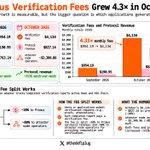
Primus’s onchain verification fees increased more than 4× in October.
And the fee distribution tells a pretty good story about how @primus_labs is monetizing its verification infrastructure.
Here’s how September compared with October:
September 2026
➤ Verification fees: $954.19
➤ Protocol revenue: $190.95
October 2026
➤ Verification fees: $4,134
➤ Protocol revenue: $827.14
That’s approximately 333% growth in monthly fees, with protocol revenue increasing at almost the same rate.
But there’s another detail I find more compelling.
DefiLlama’s fee adapter tracks completed verification reports across Base and HSK Chain.
Each completed report generates fees distributed between two recipients:
➤ Approximately 20% goes to Primus
➤ Approximately 80% goes to attestor node operators
So Primus isn’t capturing the entire verification fee. A larger portion compensates the infrastructure operators responsible for submitting the reports.
This creates a different economic structure from applications that retain nearly all their transaction fees.
The absolute numbers are still small, and the October increase doesn’t automatically establish recurring customer demand.
The missing piece is attribution.
Which applications generated the additional verification activity? Was it concentrated in a single integration, or distributed across multiple applications?
The public fee adapter doesn’t answer those questions on its own.
Still, October gives us a measurable increase in completed verification-fee activity rather than another adoption claim based entirely on partnerships.
And I think that’s the more compelling direction for researching Primus’s business: connecting actual verification usage with the economics of the network processing it.


Privacy is becoming a major crypto infrastructure narrative, but its leading projects are building for different customers.
Confidential DeFi, private execution, AI computation, institutional finance and cross-chain trading require different architectures.
The clearest comparison is what each team has actually deployed.
1. Primus
@primus_labs combines FHE-based confidential computation with zkTLS-authenticated external data.
Its BNB Chain Confidential Vault demonstrates encrypted balances, transfers and yield positions. An integration with Unitas and Brevis supports verification of exchange reserves and financial calculations without exposing every underlying position.
The opportunity is institutional finance that requires both confidentiality and independently verifiable records.
2. Zama
@Zama brings FHE-powered confidential assets to existing DeFi markets.
Its vault expansion connects encrypted positions to Morpho strategies curated by firms including Steakhouse and Flowdesk.
Rather than recreate lending liquidity, Zama adds privacy to established products. The question is how much economic value the encryption layer can capture.
3. Nillion
@Nillion’s Blind Computer targets private AI inference, protected workloads and verifiable computation.
By April 2026, it reported 112K+ users and 1.4M inference requests.
Its opportunity is closer to AI infrastructure and sensitive-data processing than private DeFi.
4. Aztec
@aztecnetwork is developing an Ethereum L2 built around private execution and confidential application state.
Its Alpha Network began processing transactions in March 2026. Building the execution layer provides architectural control, but Aztec must also attract developers, liquidity and sustained application activity.
5. Secret Network
@SecretNetwork has supported TEE-based confidential smart contracts on mainnet since 2020, including private tokens and DeFi applications.
Its newer products extend toward confidential AI and computing. That deployment history is substantial, but current usage is more revealing than longevity.
6. NEAR
@NEARProtocol integrates privacy into cross-chain trading through Confidential Intents, which protects selected transaction details.
Following its July 2026 general-availability launch, NEAR reported confidential mode surpassing 40% of near(.)com volume within weeks.
That figure applies to near.com, not the entire NEAR ecosystem. Still, it shows adoption inside an existing trading workflow.
7. Anoma
@Anoma launched AnomaPay V1 on Ethereum and BNB Chain, enabling supported shielded transfers without moving users to a separate privacy blockchain.
Its intent-based model connects private payments with programmable interactions. The commercial test is recurring transaction activity and integrations.
⸻
These seven projects represent different distribution strategies.
Primus combines confidential financial computation with authenticated external records. Zama brings encryption to existing lending markets. NEAR embeds privacy into trading. Aztec builds a private execution environment. Nillion targets AI workloads. Secret offers an established confidential-contract platform. Anoma extends shielded payments across public chains.
Ranking them solely by cryptography or token performance ignores the customer and business-model differences.
The stronger test is deployment, sustained usage and whether customers repeatedly pay for confidentiality.

THEDEFIPLUG retweeted
The gap between governance-only tokens and tokens with actual fee capture is becoming harder to ignore.
$UNI is a good example.
Since December 2025, @Uniswap has collected protocol fees from v2 and selected v3 pools, converting those fees into UNI burns.
Roughly one-sixth of swap fees goes to the protocol on some enabled pools. It’s not a blanket 17% burn across Uniswap.
@HyperliquidX takes a different approach.
Its Assistance Fund uses protocol revenue to continuously purchase $HYPE, with 99% of eligible trading fees allocated to the mechanism.
Other protocols have their own structures:
➤ @Aave uses DAO revenue for $AAVE buybacks.
➤ @JupiterExchange directs 50% of onchain revenue toward solana:JUPyiwrYJFskUPiHa7hkeR8VUtAeFoSYbKedZNsDvCN purchases.
➤ @Pendle_fi repurchases $PENDLE for active sPENDLE holders.
➤ @CurveFinance distributes fees to veCRV lockers.
➤ @PancakeSwap uses trading fees to buy and burn $CAKE.
The price comparison is revealing.
Over the 90 days ending November 10:
➤ $UNI: +87.28%
➤ solana:JUPyiwrYJFskUPiHa7hkeR8VUtAeFoSYbKedZNsDvCN: +51.17%
➤ $AAVE: +40.32%
➤ $HYPE: +26.54%
➤ $COMP: +22.49%
➤ $MORPHO: +1.79%
➤ $CRV: -3.84%
But the data doesn’t prove that revenue-accruing tokens always outperform.
$COMP appreciated without a direct fee-distribution mechanism. $CRV declined despite distributing fees to locked holders.
@Lido also has a conditional buyback mechanism, although its revenue threshold has prevented regular activation.
My preference is still for protocols where recurring customer payments translate into measurable token demand.
But the percentage of fees captured isn’t enough.
You need to compare actual buyback expenditure against token valuation, circulating supply changes, unlocks and the economics retained by the protocol.
Governance alone can command a premium.
A working fee mechanism gives investors another financial relationship they can measure.
The strongest candidates will be those where that relationship survives changing market conditions.

Primus’s onchain verification fees increased more than 4× in October.
And the fee distribution tells a pretty good story about how @primus_labs is monetizing its verification infrastructure.
Here’s how September compared with October:
September 2026
➤ Verification fees: $954.19
➤ Protocol revenue: $190.95
October 2026
➤ Verification fees: $4,134
➤ Protocol revenue: $827.14
That’s approximately 333% growth in monthly fees, with protocol revenue increasing at almost the same rate.
But there’s another detail I find more compelling.
DefiLlama’s fee adapter tracks completed verification reports across Base and HSK Chain.
Each completed report generates fees distributed between two recipients:
➤ Approximately 20% goes to Primus
➤ Approximately 80% goes to attestor node operators
So Primus isn’t capturing the entire verification fee. A larger portion compensates the infrastructure operators responsible for submitting the reports.
This creates a different economic structure from applications that retain nearly all their transaction fees.
The absolute numbers are still small, and the October increase doesn’t automatically establish recurring customer demand.
The missing piece is attribution.
Which applications generated the additional verification activity? Was it concentrated in a single integration, or distributed across multiple applications?
The public fee adapter doesn’t answer those questions on its own.
Still, October gives us a measurable increase in completed verification-fee activity rather than another adoption claim based entirely on partnerships.
And I think that’s the more compelling direction for researching Primus’s business: connecting actual verification usage with the economics of the network processing it.
Privacy is becoming a major crypto infrastructure narrative, but its leading projects are building for different customers.
Confidential DeFi, private execution, AI computation, institutional finance and cross-chain trading require different architectures.
The clearest comparison is what each team has actually deployed.
1. Primus
@primus_labs combines FHE-based confidential computation with zkTLS-authenticated external data.
Its BNB Chain Confidential Vault demonstrates encrypted balances, transfers and yield positions. An integration with Unitas and Brevis supports verification of exchange reserves and financial calculations without exposing every underlying position.
The opportunity is institutional finance that requires both confidentiality and independently verifiable records.
2. Zama
@Zama brings FHE-powered confidential assets to existing DeFi markets.
Its vault expansion connects encrypted positions to Morpho strategies curated by firms including Steakhouse and Flowdesk.
Rather than recreate lending liquidity, Zama adds privacy to established products. The question is how much economic value the encryption layer can capture.
3. Nillion
@Nillion’s Blind Computer targets private AI inference, protected workloads and verifiable computation.
By April 2026, it reported 112K+ users and 1.4M inference requests.
Its opportunity is closer to AI infrastructure and sensitive-data processing than private DeFi.
4. Aztec
@aztecnetwork is developing an Ethereum L2 built around private execution and confidential application state.
Its Alpha Network began processing transactions in March 2026. Building the execution layer provides architectural control, but Aztec must also attract developers, liquidity and sustained application activity.
5. Secret Network
@SecretNetwork has supported TEE-based confidential smart contracts on mainnet since 2020, including private tokens and DeFi applications.
Its newer products extend toward confidential AI and computing. That deployment history is substantial, but current usage is more revealing than longevity.
6. NEAR
@NEARProtocol integrates privacy into cross-chain trading through Confidential Intents, which protects selected transaction details.
Following its July 2026 general-availability launch, NEAR reported confidential mode surpassing 40% of near(.)com volume within weeks.
That figure applies to near.com, not the entire NEAR ecosystem. Still, it shows adoption inside an existing trading workflow.
7. Anoma
@Anoma launched AnomaPay V1 on Ethereum and BNB Chain, enabling supported shielded transfers without moving users to a separate privacy blockchain.
Its intent-based model connects private payments with programmable interactions. The commercial test is recurring transaction activity and integrations.
⸻
These seven projects represent different distribution strategies.
Primus combines confidential financial computation with authenticated external records. Zama brings encryption to existing lending markets. NEAR embeds privacy into trading. Aztec builds a private execution environment. Nillion targets AI workloads. Secret offers an established confidential-contract platform. Anoma extends shielded payments across public chains.
Ranking them solely by cryptography or token performance ignores the customer and business-model differences.
The stronger test is deployment, sustained usage and whether customers repeatedly pay for confidentiality.
The gap between governance-only tokens and tokens with actual fee capture is becoming harder to ignore.
$UNI is a good example.
Since December 2025, @Uniswap has collected protocol fees from v2 and selected v3 pools, converting those fees into UNI burns.
Roughly one-sixth of swap fees goes to the protocol on some enabled pools. It’s not a blanket 17% burn across Uniswap.
@HyperliquidX takes a different approach.
Its Assistance Fund uses protocol revenue to continuously purchase $HYPE, with 99% of eligible trading fees allocated to the mechanism.
Other protocols have their own structures:
➤ @Aave uses DAO revenue for $AAVE buybacks.
➤ @JupiterExchange directs 50% of onchain revenue toward solana:JUPyiwrYJFskUPiHa7hkeR8VUtAeFoSYbKedZNsDvCN purchases.
➤ @Pendle_fi repurchases $PENDLE for active sPENDLE holders.
➤ @CurveFinance distributes fees to veCRV lockers.
➤ @PancakeSwap uses trading fees to buy and burn $CAKE.
The price comparison is revealing.
Over the 90 days ending November 10:
➤ $UNI: +87.28%
➤ solana:JUPyiwrYJFskUPiHa7hkeR8VUtAeFoSYbKedZNsDvCN: +51.17%
➤ $AAVE: +40.32%
➤ $HYPE: +26.54%
➤ $COMP: +22.49%
➤ $MORPHO: +1.79%
➤ $CRV: -3.84%
But the data doesn’t prove that revenue-accruing tokens always outperform.
$COMP appreciated without a direct fee-distribution mechanism. $CRV declined despite distributing fees to locked holders.
@Lido also has a conditional buyback mechanism, although its revenue threshold has prevented regular activation.
My preference is still for protocols where recurring customer payments translate into measurable token demand.
But the percentage of fees captured isn’t enough.
You need to compare actual buyback expenditure against token valuation, circulating supply changes, unlocks and the economics retained by the protocol.
Governance alone can command a premium.
A working fee mechanism gives investors another financial relationship they can measure.
The strongest candidates will be those where that relationship survives changing market conditions.
THEDEFIPLUG retweeted
Privacy is becoming a major crypto infrastructure narrative, but its leading projects are building for different customers.
Confidential DeFi, private execution, AI computation, institutional finance and cross-chain trading require different architectures.
The clearest comparison is what each team has actually deployed.
1. Primus
@primus_labs combines FHE-based confidential computation with zkTLS-authenticated external data.
Its BNB Chain Confidential Vault demonstrates encrypted balances, transfers and yield positions. An integration with Unitas and Brevis supports verification of exchange reserves and financial calculations without exposing every underlying position.
The opportunity is institutional finance that requires both confidentiality and independently verifiable records.
2. Zama
@Zama brings FHE-powered confidential assets to existing DeFi markets.
Its vault expansion connects encrypted positions to Morpho strategies curated by firms including Steakhouse and Flowdesk.
Rather than recreate lending liquidity, Zama adds privacy to established products. The question is how much economic value the encryption layer can capture.
3. Nillion
@Nillion’s Blind Computer targets private AI inference, protected workloads and verifiable computation.
By April 2026, it reported 112K+ users and 1.4M inference requests.
Its opportunity is closer to AI infrastructure and sensitive-data processing than private DeFi.
4. Aztec
@aztecnetwork is developing an Ethereum L2 built around private execution and confidential application state.
Its Alpha Network began processing transactions in March 2026. Building the execution layer provides architectural control, but Aztec must also attract developers, liquidity and sustained application activity.
5. Secret Network
@SecretNetwork has supported TEE-based confidential smart contracts on mainnet since 2020, including private tokens and DeFi applications.
Its newer products extend toward confidential AI and computing. That deployment history is substantial, but current usage is more revealing than longevity.
6. NEAR
@NEARProtocol integrates privacy into cross-chain trading through Confidential Intents, which protects selected transaction details.
Following its July 2026 general-availability launch, NEAR reported confidential mode surpassing 40% of near(.)com volume within weeks.
That figure applies to near.com, not the entire NEAR ecosystem. Still, it shows adoption inside an existing trading workflow.
7. Anoma
@Anoma launched AnomaPay V1 on Ethereum and BNB Chain, enabling supported shielded transfers without moving users to a separate privacy blockchain.
Its intent-based model connects private payments with programmable interactions. The commercial test is recurring transaction activity and integrations.
⸻
These seven projects represent different distribution strategies.
Primus combines confidential financial computation with authenticated external records. Zama brings encryption to existing lending markets. NEAR embeds privacy into trading. Aztec builds a private execution environment. Nillion targets AI workloads. Secret offers an established confidential-contract platform. Anoma extends shielded payments across public chains.
Ranking them solely by cryptography or token performance ignores the customer and business-model differences.
The stronger test is deployment, sustained usage and whether customers repeatedly pay for confidentiality.
THEDEFIPLUG retweeted
Crypto is on track to generate nearly $100B in blockchain-related revenue in 2026, yet only about 40% is accessible to investors through public stocks or tokens.
And publicly traded companies now capture 16% of that revenue, up from 7% in 2022.
The industry’s business growth and what investors actually own are becoming two different things.
According to 1kxnetwork’s study of 2,600+ protocols and 100+ public companies:
➤ ~$100B projected 2026 revenue, down 28% YoY
➤ 66% from DeFi and financial services
➤ 22% from blockchain infrastructure
➤ 30% connected to institutional and broader-economy activity
➤ 16% captured by publicly traded companies
These categories aren’t all additive. The estimate combines trading fees, reserve earnings, mining and staking rewards, and other income. It’s not $100B of comparable corporate profit.
The ownership structure breaks into four groups.
1. Public financial companies
@coinbase, @RobinhoodApp, @circle, listed miners and asset managers.
Coinbase earns from trading and services. Circle earns primarily from USDC reserve income. Miners receive block rewards and fees.
Investors can buy equity in these companies, but their earnings don’t automatically accrue to BTC, ETH or other tokens used in their businesses.
The growing public-company share means more crypto economics can be accessed through traditional equities.
2. Private crypto businesses
@binance, @Tether, private market makers, payment companies and custodians.
These businesses can generate substantial revenue without offering the public an equity claim.
Holding USDT doesn’t entitle someone to Tether’s reserve profits. Trading on Binance doesn’t provide ownership of its exchange earnings.
So some of crypto’s largest cash-generating operations remain outside the reach of ordinary token investors.
3. Token-based protocols
@HyperliquidX, @SkyEcosystem, @Uniswap and @aave.
This group is more complicated because protocol fees and token-holder benefits are not interchangeable.
Hyperliquid directs eligible fees toward HYPE purchases. Sky has buyback and staking distributions. Other protocols retain revenue for treasuries, liquidity providers or operators, subject to their individual rules.
1kx counted 283 protocols distributing economic value to holders in Q3.
But a token marketed as a governance asset isn’t necessarily a claim on net income. The percentage of fees distributed, buyback execution, emissions and future unlocks determine the actual exposure.
4. Blockchain infrastructure
Bitcoin, @ethereum, @solana and other networks.
Blockchain revenue includes transaction fees and, in the study’s accounting, mining or staking rewards.
But application success doesn’t flow automatically to the base token.
A DEX charging $100M can pay liquidity providers and retain most of its fees, while the blockchain underneath collects a much smaller amount for settlement.
1kx estimates direct transaction fees now account for less than 3% of total measured industry revenue.
That is a major distinction between financial activity happening on a chain and earnings captured by its native asset.
The final comparison is straightforward.
A public-company shareholder owns corporate equity. A private company’s customers own no part of its profits. A protocol-token holder receives only the rights and economics the system actually provides. A native blockchain token has its own issuance and fee model.
That is why the ~$100B headline needs an ownership breakdown.
The industry can generate enormous revenue while many of its most widely held tokens capture only a fraction of it.

Crypto is on track to generate nearly $100B in blockchain-related revenue in 2026, yet only about 40% is accessible to investors through public stocks or tokens.
And publicly traded companies now capture 16% of that revenue, up from 7% in 2022.
The industry’s business growth and what investors actually own are becoming two different things.
According to 1kxnetwork’s study of 2,600+ protocols and 100+ public companies:
➤ ~$100B projected 2026 revenue, down 28% YoY
➤ 66% from DeFi and financial services
➤ 22% from blockchain infrastructure
➤ 30% connected to institutional and broader-economy activity
➤ 16% captured by publicly traded companies
These categories aren’t all additive. The estimate combines trading fees, reserve earnings, mining and staking rewards, and other income. It’s not $100B of comparable corporate profit.
The ownership structure breaks into four groups.
1. Public financial companies
@coinbase, @RobinhoodApp, @circle, listed miners and asset managers.
Coinbase earns from trading and services. Circle earns primarily from USDC reserve income. Miners receive block rewards and fees.
Investors can buy equity in these companies, but their earnings don’t automatically accrue to BTC, ETH or other tokens used in their businesses.
The growing public-company share means more crypto economics can be accessed through traditional equities.
2. Private crypto businesses
@binance, @Tether, private market makers, payment companies and custodians.
These businesses can generate substantial revenue without offering the public an equity claim.
Holding USDT doesn’t entitle someone to Tether’s reserve profits. Trading on Binance doesn’t provide ownership of its exchange earnings.
So some of crypto’s largest cash-generating operations remain outside the reach of ordinary token investors.
3. Token-based protocols
@HyperliquidX, @SkyEcosystem, @Uniswap and @aave.
This group is more complicated because protocol fees and token-holder benefits are not interchangeable.
Hyperliquid directs eligible fees toward HYPE purchases. Sky has buyback and staking distributions. Other protocols retain revenue for treasuries, liquidity providers or operators, subject to their individual rules.
1kx counted 283 protocols distributing economic value to holders in Q3.
But a token marketed as a governance asset isn’t necessarily a claim on net income. The percentage of fees distributed, buyback execution, emissions and future unlocks determine the actual exposure.
4. Blockchain infrastructure
Bitcoin, @ethereum, @solana and other networks.
Blockchain revenue includes transaction fees and, in the study’s accounting, mining or staking rewards.
But application success doesn’t flow automatically to the base token.
A DEX charging $100M can pay liquidity providers and retain most of its fees, while the blockchain underneath collects a much smaller amount for settlement.
1kx estimates direct transaction fees now account for less than 3% of total measured industry revenue.
That is a major distinction between financial activity happening on a chain and earnings captured by its native asset.
The final comparison is straightforward.
A public-company shareholder owns corporate equity. A private company’s customers own no part of its profits. A protocol-token holder receives only the rights and economics the system actually provides. A native blockchain token has its own issuance and fee model.
That is why the ~$100B headline needs an ownership breakdown.
The industry can generate enormous revenue while many of its most widely held tokens capture only a fraction of it.
THEDEFIPLUG retweeted

As of today, $AAVE has ~$30B in deposits and only $12.3B+ active loans.
That is a 41% utilisation rate to be improved.
Fixed-rate lending is still one of the biggest missing pieces in DeFi, and buying @avon_xyz’s fixed-rate markets and order book goes straight at it.
Since we know the intent, the first governance proposal will show who Aave is going after - treasury borrowers or experimenting an idea
(Data: @Token_Logic )


Aave Labs has acquired the team and technology behind @avon_xyz, one of the leading companies working on fixed-rate lending onchain.
The Avon team brings deep protocol engineering and market-structure expertise to Aave Labs as it expands onchain lending for a mainstream audience.

THEDEFIPLUG retweeted

Crypto is hungry for real quantum progress.
I know because QuantumFi posts are printing the strongest mindshare, or at least mine did this quarter.
So here’s everything in one place, featuring 30+ protocols.


Privacy is becoming a major crypto infrastructure narrative, but its leading projects are building for different customers.
Confidential DeFi, private execution, AI computation, institutional finance and cross-chain trading require different architectures.
The clearest comparison is what each team has actually deployed.
1. Primus
@primus_labs combines FHE-based confidential computation with zkTLS-authenticated external data.
Its BNB Chain Confidential Vault demonstrates encrypted balances, transfers and yield positions. An integration with Unitas and Brevis supports verification of exchange reserves and financial calculations without exposing every underlying position.
The opportunity is institutional finance that requires both confidentiality and independently verifiable records.
2. Zama
@Zama brings FHE-powered confidential assets to existing DeFi markets.
Its vault expansion connects encrypted positions to Morpho strategies curated by firms including Steakhouse and Flowdesk.
Rather than recreate lending liquidity, Zama adds privacy to established products. The question is how much economic value the encryption layer can capture.
3. Nillion
@Nillion’s Blind Computer targets private AI inference, protected workloads and verifiable computation.
By April 2026, it reported 112K+ users and 1.4M inference requests.
Its opportunity is closer to AI infrastructure and sensitive-data processing than private DeFi.
4. Aztec
@aztecnetwork is developing an Ethereum L2 built around private execution and confidential application state.
Its Alpha Network began processing transactions in March 2026. Building the execution layer provides architectural control, but Aztec must also attract developers, liquidity and sustained application activity.
5. Secret Network
@SecretNetwork has supported TEE-based confidential smart contracts on mainnet since 2020, including private tokens and DeFi applications.
Its newer products extend toward confidential AI and computing. That deployment history is substantial, but current usage is more revealing than longevity.
6. NEAR
@NEARProtocol integrates privacy into cross-chain trading through Confidential Intents, which protects selected transaction details.
Following its July 2026 general-availability launch, NEAR reported confidential mode surpassing 40% of near(.)com volume within weeks.
That figure applies to near.com, not the entire NEAR ecosystem. Still, it shows adoption inside an existing trading workflow.
7. Anoma
@Anoma launched AnomaPay V1 on Ethereum and BNB Chain, enabling supported shielded transfers without moving users to a separate privacy blockchain.
Its intent-based model connects private payments with programmable interactions. The commercial test is recurring transaction activity and integrations.
⸻
These seven projects represent different distribution strategies.
Primus combines confidential financial computation with authenticated external records. Zama brings encryption to existing lending markets. NEAR embeds privacy into trading. Aztec builds a private execution environment. Nillion targets AI workloads. Secret offers an established confidential-contract platform. Anoma extends shielded payments across public chains.
Ranking them solely by cryptography or token performance ignores the customer and business-model differences.
The stronger test is deployment, sustained usage and whether customers repeatedly pay for confidentiality.
THEDEFIPLUG retweeted
Rain-issued crypto cards processed an estimated $584.2M in October.
That’s a lot of volume for a company most card users probably don’t even know about.
Rain powers several crypto-card products, including:
➤ @ether_fi Cash
➤ @Plasma One
➤ @EthenaPay
These cards compete for users, but share some of the same issuing infrastructure underneath.
So while the crypto-card market looks increasingly fragmented, a lot of the volume is actually concentrated among a few infrastructure providers.
And Rain is becoming one of the biggest.
Worth noting that $584M is attributed card spending across Rain-issued programs, not Rain’s revenue.
The card brands get the users. Rain processes the payments.

THEDEFIPLUG retweeted

If you missed out on recent updates this week, here’s a roundup on what happened this week. ↓
→ Binance got hacked for $6.3B.
→ Binance — Refilled 100% of hacked assets and added a ZK Proof of Reserves.
→ Mercado Bitcoin — Halted deposits and withdrawals after a hack moved over $40M.
→ Chainalysis — Lost customer names and emails to a hacker using agentic AI.
→ BTCPay Server — Urged an update to version 2.4.7 after hot wallet thefts on older versions.
→ Strategy — Bought 811 BTC for $65.5M, lifting holdings to 849,327 $BTC.
→ Iron fish — Is shutting down after an inflation bug let an attacker double-spend.
→ Riot— Cut BTC holdings 79% and signed a $28B, 910 MW lease with an AI lab.
→ Canton — Got Canton Coin labeled a digital commodity by the SEC.
→ CFTC approved perpetual futures trading on individual US stocks.
→ Solana — Became home to a Schroders emerging market bond fund.
→ BitGo — Launched an institutional trading business led by an ex-NYDIG exec.
→ Paragon — Launched power perps on Hyperliquid, starting with $HYPE
→ BitMart — Suffered a minor hack, possibly tied to the Mercado Bitcoin attackers.
→ Trump Media moves $342M in Bitcoin.
→ US oil price fell below $100.
→House Democrats plans to probe Trump family deals.
→ XRPL activates major security fix.
→ Iphones got drained off $4M+ by opening a link in safari - DarkSword, an iOS exploit kit, is hitting unpatched iPhones on versions 18.4–18.7.
→ $ONDO now top tokenization platform, surpassing $4B in TVL.

Rain-issued crypto cards processed an estimated $584.2M in October.
That’s a lot of volume for a company most card users probably don’t even know about.
Rain powers several crypto-card products, including:
➤ @ether_fi Cash
➤ @Plasma One
➤ @EthenaPay
These cards compete for users, but share some of the same issuing infrastructure underneath.
So while the crypto-card market looks increasingly fragmented, a lot of the volume is actually concentrated among a few infrastructure providers.
And Rain is becoming one of the biggest.
Worth noting that $584M is attributed card spending across Rain-issued programs, not Rain’s revenue.
The card brands get the users. Rain processes the payments.
THEDEFIPLUG retweeted
25 U.S. stocks are now available on Solana through @Securitize, but I think the bigger development is how these tokens could eventually become actual shares on a company’s shareholder register.
On November 2, Securitize expanded its tokenized-equity offering from 12 to 25 stocks, adding ExxonMobil, Disney, Salesforce, GameStop, Lockheed Martin and eight others.
● The Ownership Structure
Each Securitize Stock:
➤ Is backed 1:1 by an underlying share held in custody.
➤ Represents a security entitlement under UCC Article 8.
➤ Preserves applicable economic rights, including dividends and voting where provided.
➤ Trades on Solana with USDC settlement.
➤ Has a conditional route to direct ownership if the issuer adopts tokenization.
That last point is the key.
Securitize calls it a Convertible Entitlement Token (CET).
Today, investors hold a security entitlement through regulated brokerage infrastructure, not shares recorded directly on the company’s shareholder register.
But if the underlying company adopts issuer-sponsored tokenization, that entitlement can convert into shares recorded by its transfer agent.
This lets Securitize tokenize entitlements to existing shares without the issuer sponsoring a token today. It doesn’t make tokenholders registered shareholders automatically.
It creates a potential bridge between two forms of ownership.
● How The Models Compare
1. @xStocksFi
xStocks are backed 1:1 by underlying shares but structured as tracker certificates issued by a Jersey entity. They offer economic exposure without direct ownership or voting rights, prioritizing transferability and DeFi composability.
2. @Ondo
Ondo’s international stock tokens track total returns, including reinvested dividends, without granting direct ownership. Separately, its U.S. custodial tokenization model supports shareholder voting through Broadridge.
Ondo is therefore building across multiple legal structures, not just exposure products.
3. @DinariGlobal
Dinari’s dShares are backed 1:1 by securities and preserve dividends, corporate actions and voting where applicable. Holders own tokenized securities backed by custodied shares, not directly registered shares.
4. @Securitize
Securitize combines an existing securities-entitlement structure with a possible conversion into issuer-registered shares.
That’s different from maintaining economic exposure indefinitely through a wrapper.
● Infrastructure And Access
Securitize uses regulated brokerage infrastructure, JumpTrading for market making and Solana for settlement.
Trading extends beyond conventional market hours, with 24/7 availability planned.
The trade-off is access: investors face eligibility and compliance requirements, and tokens aren’t necessarily as permissionlessly transferable as standard crypto assets.
Conversion still requires issuer adoption. None of the 25 underlying companies sponsors these tokens, so direct onchain shareholder ownership remains a future possibility, not today’s reality.
● The Competitive Landscape
The market is developing along two tracks.
One prioritizes liquidity, distribution and DeFi integration. The other focuses on legal ownership, regulated settlement and integration with traditional securities infrastructure.
They may converge, but they aren’t equivalent.
The next milestone isn’t Securitize expanding from 25 to 100 stocks.
It’s the first major issuer enabling tokenized entitlements to convert into directly registered shares.
That would be more consequential than putting another stock ticker onchain: it would connect onchain trading with a company’s official ownership infrastructure.
