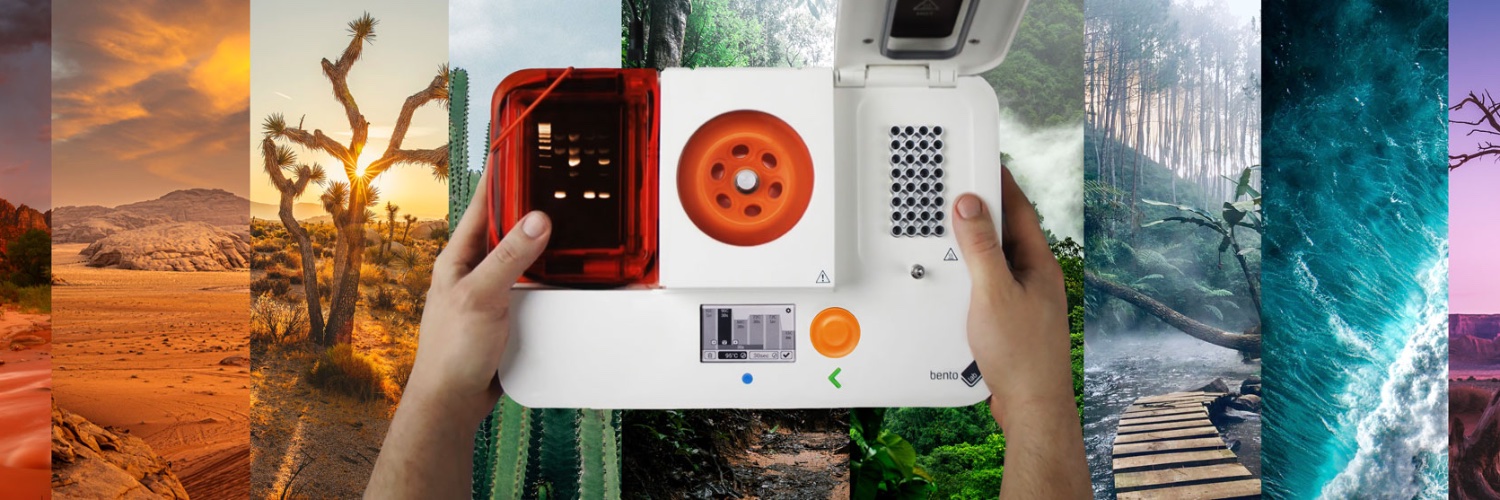

We make Bento Lab = a portable PCR workstation for scientists and educators. Tweets about methods, field sequencing and DNA barcoding
London
Joined October 2013
- Tweets2.8K
- Following2.4K
- Followers8.8K
- Likes4.1K



Pinned Tweet
PCR workstation with laptop-sized footprint? ✅
32-well thermocycler? ✅
8,000 × G centrifuge? ✅
Electrophoresis unit? ✅
Blue light transilluminator? ✅
Spare capacity/fieldwork/teaching/at home? ✅
Affordable and portable✅
Check out Bento Lab here:
bento.bio/product/bento-lab/

🍄 As the autumn mushroom season winds down, here's a fungal discovery worth celebrating!
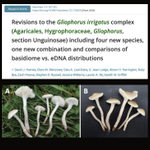
Congratulations to field mycologist and Bento Lab user David Harries, of the Pembrokeshire Fungus Recording Network, Gareth Griffith (@AberMycol) , and citizen scientist collaborators around the world for their paper in MycoKeys describing four new species of fungi.
One of them, Gliophorus alboviscidus, was first collected by David in Pembrokeshire, and Bento Lab was used to amplify the fungal DNA. Combining traditional field mycology with DNA analysis, the researchers were able to distinguish species that might otherwise have been overlooked and ID distinct evolutionary lineages, including North American fungi previously identified as the European species G. irrigatus.
They also explored environmental DNA records, finding evidence that some species may be more widespread than physical observations suggest -- in the case of G. alboviscidus, as far away as China.
We're happy to see David and his fellow researchers making such a valuable contribution to the scientific record, and demonstrating the important role of citizen scientists in documenting fungal diversity.
Read the open-access paper: doi.org/10.3897/mycokeys.127…

Are you experienced in one area of science but suddenly felt like a complete beginner in another?
A zoologist got in touch with us while exploring #eDNA work. They knew the biological questions they wanted to investigate, but had almost no experience with DNA extraction, PCR or molecular biology.
Their question was essentially: Am I getting ahead of myself?
The Lab Mentor’s advice is to start with a simple question and methodology to find out the answer. For eDNA work, a targeted assay asking whether one particular species is present can be a far more approachable introduction than trying to identify everything in an environmental sample.
Has anyone else moved into molecular biology from a completely different field? What did you find hardest at the beginning?
See the full answer to this question and others at: bento.bio/lab-mentor/new-to-…


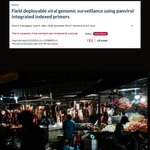
A portable PCR lab, a Nanopore sequencer, a car plug-in fridge-freezer, and a rice cooker… at a live bird market in Cambodia?
This unconventional lab setup might have seemed out of place, but the researchers behind it hope it could represent the future of viral genomic surveillance.
In a new preprint, @E_A_Karlsson and colleagues at @PasteurCambodia, @jcu & beyond, describe how they developed a broad-target viral screening assay and adapted the workflow for use outside a conventional laboratory.
Their field setup included:
✔️ Bento Lab for DNA extraction, PCR and gel electrophoresis
✔️ Oxford Nanopore's #MinION for DNA sequencing
✔️ A laptop for real-time, offline sequence analysis
✔️ An EcoFlow portable power station
✔️ A car plug-in fridge-freezer and CoolBox to keep reagents cold
✔️ A small rice cooker for preparing agarose gels
Working outdoors in temperatures over 32°C and humidity above 60%, the team processed environmental samples collected from poultry cages, drinking water, carcass wash water and air.
Within 6.5 hours of receiving the samples, they had their first viral sequencing results.
While further validation is needed to assess usability, robustness and turnaround time, the work demonstrates how molecular workflows can be taken to the sampling site, reducing reliance on distant laboratory infrastructure.
Congrats to the international team!
We love seeing such resourceful research, and the Methods section is a good read for others who are considering field research in similar climates. And it’s always great to see Bento Lab contributing to the development of more accessible approaches to #OneHealth surveillance.
Read the preprint: doi.org/10.21203/rs.3.rs-115…

👻 A “ghost” band in your negative control gel lane: the molecular biology equivalent of hearing a strange noise downstairs at 2am.
Fortunately, ghoulish goings-on are fairly low on the Lab Mentor’s list, with creepy contamination the more likely explanation.
Check out the full answer for troubleshooting tips: bento.bio/lab-mentor/ghost-b…


You wanted a single band for DNA barcoding. Your PCR had other ideas.
Fortunately, there are some surprisingly low-tech ways to isolate the fragment you actually want, and one of them requires little more than a pipette tip.
Full answer, including the original papers, at bento.bio/lab-mentor/
#LabMentor #labtips #PCR #BandStabPCR


Another marine scientist in the Baja region, Dr. Camila Mac Loughlin combines marine conservation, scientific tourism and hands-on citizen science to bring people closer to the molecular science of the Sea of Cortez.
Her independent initiative, Sequencing Baja, not only shows visitors the ocean, but invites them to help study it by collecting #eDNA samples from the sea.
Back on land, Mac Loughlin brings the filters to her home-based molecular biology setup, where she uses Bento Lab to extract DNA before samples move on to external library preparation and sequencing. The project is designed so that participants can follow the journey from field collection through to biodiversity data, with some samples ultimately contributing to public records in GenBank, as well as building biodiversity inventories.
bento.bio/story/searching-fo…
3
566
People in San Felipe, Mexico were already helping collect #eDNA samples for vaquita conservation.
They wanted to know what happened next.
So @taniavaldiviac brought the molecular lab to them, enabling hands-on experiences with DNA extraction, PCR and gels in a local classroom using Bento Lab.
Learn more about her #citizenscience and #conservation efforts: bento.bio/story/searching-fo…

1
3
372
🚨OPPORTUNITY ALERT: Need a PCR setup for your #eDNA research?
The eDNA Collaborative is offering a new round of microgrants in partnership with Bento Bio.
Successful applicants will receive a Bento Lab Pro to help support sample prep, PCR and gel electrophoresis.
Deadline: 9 October 2026
Apply here: bit.ly/4xXBDWO

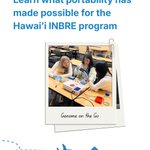
How do you pack a genomics lab for a road trip? The Hawaiʻi INBRE team has it down. They've traveled across Hawaiʻi, the Pacific & the continental US delivering their popular Genome on the Go program.
🦉 See what they've learned: bit.ly/46QppUQ

SPOTTED: A new publication exploring how scientists could carry out bioanalysis in some of the most challenging environments on Earth has included the Bento Lab in its metagenomics workflow.
Aachen University researchers developing the 𝗧𝗥𝗜𝗣𝗟𝗘 𝗔𝘀𝘁𝗿𝗼𝗕𝗶𝗼𝗟𝗮𝗯, a mobile laboratory designed as a test bed for investigating icy ocean worlds, included the Bento Lab for its compact sample-processing capabilities alongside other tools.
The system is being developed for an Antarctic field campaign at Neumayer Station III in 2027, where the team plans to test its performance under representative polar conditions.
Read the paper: frontiersin.org/journals/ast…

3
394
Some summer camps have canoes. HelmCamp has necropsies, microscopes, PCR and parasite DNA.
See what participants encountered on their 10 day journey of discovery at La Selva Research Station in Costa Rica.
bento.bio/story/one-sample-m…

1
364
Thinking of making your genetics lessons more hands on? Get inspired by @oaklandu prof Colin Wu, who packs a whole lot of practical PCR learning into his mobile lab.
Find out more (and steal his set-up!): bento.bio/story/taking-hands…

2
506
We recently caught up with Tunisian researcher & educator @nabilamor, and were delighted to hear how his work has progressed since we first shared his work on the Arabian leopard.
That research has now been published, and he’s already exploring what comes next: faster DNA extraction for field barcoding, airborne #eDNA sampling, and even a low-cost 3D-printed fluorometer.
Read the updated story: bento.bio/story/decoding-the…

👀What if a species is there, but you just can't see it?
At Bosley Reservoir, traditional surveys found no signal crayfish. But when graduate researcher Molly Doyle tested water from the site for #eDNA, her LAMP assay detected traces of crayfish DNA.
Molly developed her assays to work in the field using Bento Lab, with results visible through a simple color change in around 40 minutes.
It makes our day to see molecular biology helping researchers uncover what might otherwise remain hidden.
Read the full story: bento.bio/story/finding-hidd…

We know that a successful practical requires more than choosing a protocol, so we’ve mined the knowledge of our own experts and experienced educators to present an overview of some of the things you should consider when planning your first (or fifth!) hands-on learning session, whether it takes place in a classroom, a community center, or a remote field station.
bento.bio/resources/educator…

...and what to do when you only have one workstation! bento.bio/resources/educator…

1
88
What happens when genomics moves off slides & screens, and into students’ hands?
Dr Wilda Laux is bringing practical molecular biology into schools across New Zealand, helping students experience the science for themselves.
Get inspired (and pick up a few pointers!): bit.ly/4hDYTVk

1
9
1,189
Bringing PCR closer to where questions arise can mean faster answers, greater access, and new possibilities for research, education and conservation.
Bento Bio co-founder Bethan Wolfenden explores how portable molecular biology is changing the science landscape in @Labcompare.
📚bit.ly/4fF8zMB

Interesting look at the use of #eDNA, #citizenscience and #machinelearning in monitoring and assessing marine biodiversity to support managers and policy-makers.

A new #GES4SEAS paper, from past year summer school has been published. It deals with #MachineLearning #eDNA and #CitizenScience for marine monitoring
frontiersin.org/articles/10.…

2
671
An interesting application of the Bento Lab: Forensic entomology! We were excited to see this fabulous feature in @natgeo about Charity & Makhali's fieldwork using the contents of blowfly guts to track parasites, chemical weapons materials, and other wildlife.
nationalgeographic.com/anima…

And here's their latest paper!
Great excerpt: "These insects can act as environmental drones, passively acquiring vast amounts of biological and chemical information that can easily be extracted by investigators."
academic.oup.com/jme/article…

86