

The Criminal Bar Association exists to represent the views of the practising members of the Criminal Bar in England and Wales. RT's not an endorsement.
London
Joined January 2012
- Tweets34.4K
- Following4.4K
- Followers39.6K
- Likes4.4K




Pinned Tweet
Ministers could extend juryless trials ‘by a stroke of a pen’
Sunday Times page 2 @thetimes by @emilydugan
A new power to switch crimes to judge-only hearings without parliamentary scrutiny could be abused by future governments, leading barristers fear
“Flora Page KC, who represented victims of the Post Office Horizon scandal in the public inquiry, said: “It’s the power, without any proper parliamentary scrutiny, to create new offences which will have juryless trials that really worries me. It’s bad enough getting rid of juries in serious fraud cases, which troubles me already, but at least that’s out there, that’s in the legislation. What I find really troubling is the idea that any serious or complex case could, by a stroke of a pen and a statutory instrument, become another judge-only trial.”
“Let’s say officials or ministers were involved, and the police bring charges because they think that’s appropriate, and then the government could probably do pretty quickly a statutory instrument to say, ‘Right, that’s a judge-only trial’.
And then you’ve got a political trial being heard without the sort of public scrutiny it otherwise would have, and without members of the public deciding on guilt or not guilt.”
thetimes.com/article/dac2265…


Ministers could extend judge-only trials for MPs ‘with a stroke of a pen’
By @emilydugan in the Sunday Times page 2 and online @thetimes
Explaining the democratic risks, shadow Solicitor General, Dr @KieranMullanUK said “We could see all sorts of offences added, and as far as I’m aware there has never been a power for ministers quite like this before — to bypass the full scrutiny of parliament, the way in which we pass the most important laws, when deciding what comes on and off a list of who gets a jury trial.”
“Andrew Thomas KC, chairman of the Criminal Bar Association, said the trial without-jury clause in the bill was an “anti-democratic measure” that would “create a system of two-tier justice in our crown courts”. He said: “Judge-only trials could be extended to cases of bribery or misconduct in a public office, where politicians and other powerful people are under scrutiny. ‘Complex’ is not defined.”
“Ministers could introduce judge-only trials for politically damaging cases without a vote in parliament because of a clause buried in a bill that has been approved by MPs.
The unprecedented law would mean any type of trial in England and Wales deemed complex or lengthy, other than rape or homicide, could be recategorised as judge-only without the need for a new vote.”
Page 2 of the Sunday Times and
Full article here
thetimes.com/article/dac2265…


The CBA retweeted
The letter from Bar Chair @Kirsty_Brimelow contains the consistent evidence provided to members of @HouseofCommons and @UKHouseofLords by a united CBA, Bar Council and Circuit leaders. We seek to make things better. Not worse.
The letter details the structural failings and risks of greater miscarriages of justice that will follow from the Courts and Tribunal Bill, as currently drafted by Government. It is time to listen.


Curbing the right to jury trials increases the risk of biased decisions against women, the head of the Bar Council has warned @thebarcouncil @Kirsty_Brimelow @TheCriminalBar @JamesDRossiter @AlexJJNorris @sarahsackman @KarlTurnerMP @PoliceInspForum @HMIPrisonsnews @metpoliceuk @DannyShawNews telegraph.co.uk/news/2026/11…

The CBA retweeted

My article on the unintended consequences of removing the right from a defendant to elect jury trial whilst also increasing sentencing powers of volunteer, non- lawyer magistrates and removing the safeguard of an automatic appeal.
Curbing the right to jury trials increases the risk of biased decisions against women, the head of the Bar Council has warned @thebarcouncil @Kirsty_Brimelow @TheCriminalBar @JamesDRossiter @AlexJJNorris @sarahsackman @KarlTurnerMP @PoliceInspForum @HMIPrisonsnews @metpoliceuk @DannyShawNews telegraph.co.uk/news/2026/11…
The letter from Bar Chair @Kirsty_Brimelow contains the consistent evidence provided to members of @HouseofCommons and @UKHouseofLords by a united CBA, Bar Council and Circuit leaders. We seek to make things better. Not worse.
The letter details the structural failings and risks of greater miscarriages of justice that will follow from the Courts and Tribunal Bill, as currently drafted by Government. It is time to listen.
Curbing the right to jury trials increases the risk of biased decisions against women, the head of the Bar Council has warned @thebarcouncil @Kirsty_Brimelow @TheCriminalBar @JamesDRossiter @AlexJJNorris @sarahsackman @KarlTurnerMP @PoliceInspForum @HMIPrisonsnews @metpoliceuk @DannyShawNews telegraph.co.uk/news/2026/11…
The CBA retweeted

Curbing the right to jury trials increases the risk of biased decisions against women, the head of the Bar Council has warned @thebarcouncil @Kirsty_Brimelow @TheCriminalBar @JamesDRossiter @AlexJJNorris @sarahsackman @KarlTurnerMP @PoliceInspForum @HMIPrisonsnews @metpoliceuk @DannyShawNews telegraph.co.uk/news/2026/11…
Lawyers must make their written submissions to court easily available to reporters to prevent proceedings effectively being held in secret, the judge in charge of transparency has warned.
@legalhackette in @lawsocgazette
lawgazette.co.uk/news/lawyer…

The CBA retweeted

My Chambers use Microsoft Outlook and Teams - it’s all down. Ouch!
#KCHBarristers #Microsoft
How has the Microsoft outage impacted your hearings today?
What sort of hearing eg trial, PTPH, sentencing?
Which Crown Court?
How long a delay? Jury sent home? What alternative communication? Safeguards for sensitive material?
Communication with criminal solicitors? Parole? Other?
With grateful thanks. We need a national picture.
Listen to CBA Vice Chair Kama Melly KC explain judicial guidance in rape trials; how complainants can navigate the system; trauma informed handling of victims of sexual violence; how sentencing guidelines work for custody, release under supervision and public safety.
youtube.com/watch?v=36tRuf4L…

Riel Karmy-Jones KC led the prosecution of Russell Brand
What is the best advice you have received?
Say less.
thetimes.com/article/9e3788e…

Andrew Thomas KC, CBA Chair, and Kama Melly KC, CBA Vice Chair, add the following:
“In his sentencing remarks in the case of Russell Brand, Mr Justice Joel Bennathan said this: “Whatever women wear, wherever they go, indeed whatever they drink, they retain the right to say no and to demand justice from the criminal courts when sexual predators like you act without their consent.”
The CBA are proud of the progress which has been made in our criminal courts over the past few decades, seeking to ensure that ‘rape myths’ of any kind do not cloud the decisions of judges or the verdicts of juries. The CBA have worked alongside many groups and organisations to provide specialist training. Clear guidance has been provided to Judges by the Judicial College and in the decisions of the Court of Appeal. As recently as 2025, the Law Commission produced a comprehensive report on Evidence in Sexual Offence Prosecutions highlighting these issues.
We must remain ever vigilant to ensure that the evidence which goes before a court, including evidence sought in cross-examination, is truly relevant and admissible. Myths must play no part in that. Equally, we must never lose sight of the defendant’s right to a fair trial.”
Judge who sentenced Russell Brand praised for dispelling rape myths
Criminal Bar Association and campaigners hail Mr Justice Bennathan for delivering remarks with ‘piercing clarity’
Andrew Thomas KC, the chair of the Criminal Bar Association, and Kama Melly KC, its vice-chair, said: “We welcome the piercing clarity of the judge’s statement. Myths about rape and sexual assault must play no part in our culture or in our courtrooms. Raping or sexually assaulting someone is a crime, and blame lies entirely with the perpetrator.
“Victims of sexual violence should know that when they go to the prosecution authorities, their evidence will be judged fairly and properly. As the verdicts in Russell Brand’s case show, a properly directed jury will not be put off by a defendant’s appeal to rape myths.”
theguardian.com/news/2026/no…


The CBA retweeted
In the wake of the #RussellBrand trial & sentence it’s right to have a full & honest debate about rape & how we deal with allegations in the criminal justice system.
That includes recognising that just as there is no stereotypical victim there is no stereotypical defendant.
We must not lose sight that in many rape trials the man in the dock could be your son, brother or some other relative or a trusted friend.
Justice must prevail for all
The CBA retweeted

A *lot* of experts on hearsay knocking about.
To help:
Hearsay is an out-of-court statement where someone is relying on the content. (‘I heard a man on a bus say that the celebrity did it to her’).
Evidence given by a person in court (‘he did it to me’) is not hearsay.
Courts and Tribunals Bill
Volume 861: debated on Tuesday 10 November 2026
Read @HansardSociety
hansard.parliament.uk/lords/…
Let there be absolutely NO doubt: the Criminal Bar Association is fundamentally opposed to the proposed restrictions on the right to jury trial.
Relevant documents: 16th Report from the Delegated Powers and Regulatory Reform Committee, 5th Report from the Constitution Committee

Judge who sentenced Russell Brand praised for dispelling rape myths
Criminal Bar Association and campaigners hail Mr Justice Bennathan for delivering remarks with ‘piercing clarity’
Andrew Thomas KC, the chair of the Criminal Bar Association, and Kama Melly KC, its vice-chair, said: “We welcome the piercing clarity of the judge’s statement. Myths about rape and sexual assault must play no part in our culture or in our courtrooms. Raping or sexually assaulting someone is a crime, and blame lies entirely with the perpetrator.
“Victims of sexual violence should know that when they go to the prosecution authorities, their evidence will be judged fairly and properly. As the verdicts in Russell Brand’s case show, a properly directed jury will not be put off by a defendant’s appeal to rape myths.”
theguardian.com/news/2026/no…
The CBA retweeted

For those who are going to say “I don’t understand how Russell Brand got that sentence” the Judge’s full sentencing remarks can be read online …..

The sentencing remarks in R -v- Russell Brand can now be read on the judicial website: judiciary.uk/judgments/r-v-r…
The CBA has proposed retaining the one-year cap on magistrates’ sentencing powers and the right to elect trial, but then reclassifying a dozen offences such as assault on an emergency worker and drug possession as crimes that could only be tried by justices of the peace to reduce the number of cases going up to Crown Court
It would also support increasing the discount criminals receive on their sentences if they plead guilty at the first opportunity, from 33 per cent to 40 per cent as an incentive to reduce the number of trials.


Labour’s courts and tribunal bill returns to the Lords next week for its line-by-line scrutiny in committee, and it is expected amendments will be put forward to water down the reforms.
They are likely to target the proposal to end defendants’ historic right to elect trial in the Crown Court, with magistrates instead deciding where cases should be tried.
Magistrates are also being given greater sentencing powers, enabling them to try more serious cases where defendants face prison terms of up to 18 months and potentially two years, double the current 12 months.
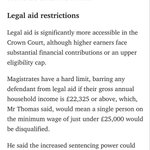
Legal aid restrictions
Legal aid is significantly more accessible in the Crown Court, although higher earners face substantial financial contributions or an upper eligibility cap.
Magistrates have a hard limit, barring any defendant from legal aid if their gross annual household income is £22,325 or above, which, Mr Thomas said, would mean a single person on the minimum wage of just under £25,000 would be disqualified.
He said the increased sentencing power could lead to an innocent 18-year-old fighting a GBH charge or drugs offence without any legal representation. As many as half of defendants represent themselves in magistrates’ cases, the CBA said.
There’s a number of consequences, but first and foremost, and most importantly, it’s miscarriages of justice, where people don’t realise that there is a defence there to the charge that wouldn’t be apparent to someone with an appropriate legal knowledge,” said Mr Thomas. “So innocent people will be wrongly convicted.”
He said Labour was also removing the automatic right to appeal against magistrates’ judgments to the Crown Court.
The CBA has proposed retaining the one-year cap on magistrates’ sentencing powers and the right to elect trial, but then reclassifying a dozen offences such as assault on an emergency worker and drug possession as crimes that could only be tried by justices of the peace to reduce the number of cases going up to Crown Court
It would also support increasing the discount criminals receive on their sentences if they plead guilty at the first opportunity, from 33 per cent to 40 per cent as an incentive to reduce the number of trials.


The CBA retweeted

Andrew Thomas KC is absolutely right here. The new jury proposals just shift the Crown Court backlog to the Magistrates Court - that means much longer waits and fewer Defendants will get legal aid. I wonder if that's attractive to the MOJ cost wise.
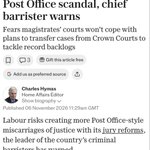
Labour risks creating more Post Office-style miscarriages of justice with its jury reforms, the leader of the country’s criminal barristers has warned.
Andrew Thomas, KC, chairman of the Criminal Bar Association (CBA), said magistrates’ courts would not be able to cope with the Government’s plans to shift 25,000 cases from Crown Courts to tackle record backlogs.
He said there would be shortages of solicitors and barristers to take on defence cases in magistrates’ courts, with more limited legal aid available for defendants.
This would force more suspects to represent themselves in the face of serious charges such as theft from an employer, as happened with the sub-postmasters who were wrongfully prosecuted, said Mr Thomas, a deputy High Court judge.
“The simplest example is the postmasters; those sort of cases of theft from an employer by someone with previous good character are precisely the sort of people who would find themselves in the magistrates’ court who would not qualify for legal aid,” he said.
“They might be able to put together some money to try to pay a solicitor to represent them, but it is going to work towards miscarriages of justice again. Those are cases involving accountancy evidence, computing evidence, lengthy investigations and the magistrates are not geared up to deal with that.”
Asked whether that meant an increased risk of a repeat of the Post Office scandal – considered the largest miscarriage of justice in modern criminal history – Mr Thomas said: “Yes.”
I worry about pendulum swings, because at the moment there is a lot of focus on the backlog and speeding cases up. But in two years’ time, the next crisis will be the number of miscarriages of justice and people complaining that they did not get a fair hearing for their case,” he added.
“And then we get the sort of pressures that there have been in the past about wrongful convictions.”
telegraph.co.uk/news/2026/11…


The CBA retweeted
Please @UKHouseofLords members read this thread by @Joanna__Hardy
And refer also to this


Labour risks creating more Post Office-style miscarriages of justice with its jury reforms, the leader of the country’s criminal barristers has warned.
Andrew Thomas, KC, chairman of the Criminal Bar Association (CBA), said magistrates’ courts would not be able to cope with the Government’s plans to shift 25,000 cases from Crown Courts to tackle record backlogs.
He said there would be shortages of solicitors and barristers to take on defence cases in magistrates’ courts, with more limited legal aid available for defendants.
This would force more suspects to represent themselves in the face of serious charges such as theft from an employer, as happened with the sub-postmasters who were wrongfully prosecuted, said Mr Thomas, a deputy High Court judge.
“The simplest example is the postmasters; those sort of cases of theft from an employer by someone with previous good character are precisely the sort of people who would find themselves in the magistrates’ court who would not qualify for legal aid,” he said.
“They might be able to put together some money to try to pay a solicitor to represent them, but it is going to work towards miscarriages of justice again. Those are cases involving accountancy evidence, computing evidence, lengthy investigations and the magistrates are not geared up to deal with that.”
Asked whether that meant an increased risk of a repeat of the Post Office scandal – considered the largest miscarriage of justice in modern criminal history – Mr Thomas said: “Yes.”
I worry about pendulum swings, because at the moment there is a lot of focus on the backlog and speeding cases up. But in two years’ time, the next crisis will be the number of miscarriages of justice and people complaining that they did not get a fair hearing for their case,” he added.
“And then we get the sort of pressures that there have been in the past about wrongful convictions.”
telegraph.co.uk/news/2026/11…
Labour’s courts and tribunal bill returns to the Lords next week for its line-by-line scrutiny in committee, and it is expected amendments will be put forward to water down the reforms.
They are likely to target the proposal to end defendants’ historic right to elect trial in the Crown Court, with magistrates instead deciding where cases should be tried.
Magistrates are also being given greater sentencing powers, enabling them to try more serious cases where defendants face prison terms of up to 18 months and potentially two years, double the current 12 months.
Legal aid restrictions
Legal aid is significantly more accessible in the Crown Court, although higher earners face substantial financial contributions or an upper eligibility cap.
Magistrates have a hard limit, barring any defendant from legal aid if their gross annual household income is £22,325 or above, which, Mr Thomas said, would mean a single person on the minimum wage of just under £25,000 would be disqualified.
He said the increased sentencing power could lead to an innocent 18-year-old fighting a GBH charge or drugs offence without any legal representation. As many as half of defendants represent themselves in magistrates’ cases, the CBA said.
There’s a number of consequences, but first and foremost, and most importantly, it’s miscarriages of justice, where people don’t realise that there is a defence there to the charge that wouldn’t be apparent to someone with an appropriate legal knowledge,” said Mr Thomas. “So innocent people will be wrongly convicted.”
He said Labour was also removing the automatic right to appeal against magistrates’ judgments to the Crown Court.
The CBA has proposed retaining the one-year cap on magistrates’ sentencing powers and the right to elect trial, but then reclassifying a dozen offences such as assault on an emergency worker and drug possession as crimes that could only be tried by justices of the peace to reduce the number of cases going up to Crown Court
It would also support increasing the discount criminals receive on their sentences if they plead guilty at the first opportunity, from 33 per cent to 40 per cent as an incentive to reduce the number of trials.