

Artificial Intelligence to heal our world.
Joined April 2015
- Tweets666
- Following59
- Followers3K
- Likes263



Pinned Tweet
Introducing Dawn 1, Sword's frontier model for mental health support.
Post-trained from GLM-5.3, Dawn 1 delivers greater intelligence at lower inference cost, with strong performance across mental health knowledge, safety, and sycophancy evaluations. It also outperforms frontier proprietary models on multi-turn safety protocol adherence in our evaluations.
A look at the research 🧵

Our team has spent the past few weeks working with Nemotron 3.5 Super VL, post-training it for the way we deliver care.
Open models give us room to adapt the technology to our members and their needs, and we’re looking forward to seeing where that goes.
Thanks to @NVIDIAAI for the early access and the partnership.

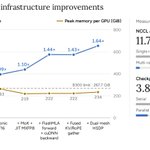
We adapted Prime-RL for our NVIDIA B300 Blackwell cluster, optimizing training throughput and GPU memory efficiency.
These infrastructure improvements support the large-scale reinforcement learning behind Dawn 1's post-training.
Read the full technical research:
sword.com/research/introduci…

We built Dawn Gym to recreate realistic conversation contexts, tool states, and user behavior during training and evaluation.
Combining anonymized production conversations with synthetic scenarios helps us measure model performance under conditions closer to real-world use.
Safety is a core focus of Dawn 1's post-training.
Clinician-defined protocols and multi-turn RL environments improve adherence across conversations, while targeted training significantly reduces sycophancy and the risk of reinforcing harmful beliefs.


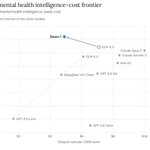
Dawn 1 delivers stronger mental health intelligence while using a fraction of the tokens required by its backbone, GLM-5.3.
Our intelligence-cost evaluations assess capabilities including mental health knowledge, memory usage, and situational awareness relative to inference cost, demonstrating the efficiency gains achieved through targeted post-training.
For most of history, access to high-quality healthcare has been a privilege of circumstance. Changing that takes bravery. That's why we partnered with Monocle to publish 𝘛𝘩𝘦 𝘍𝘶𝘵𝘶𝘳𝘦 𝘰𝘧 𝘏𝘦𝘢𝘭𝘵𝘩𝘤𝘢𝘳𝘦.
Inside this limited-edition hardcover, leaders from @Optum, @NHSEngland, @GovCanHealth, @khoslaventures and @generalcatalyst (+ more) share their boldest ideas for the road ahead, alongside our CEO @VSwordH .
Don't just watch this movement from the sidelines, lead it.
Request your copy now: sword.com/the-future-of-heal…
A great idea is just the beginning. The future only arrives when someone is brave enough to back it.
The Future of Healthcare, a limited-edition book by Sword and @MonocleMag.
Out tomorrow.
MindGuard, our open-source safety classifier for mental health conversations, has been accepted at @NeurIPSConf 2026 🎉
Most guardrails flag sensitive topics. In a mental health conversation, that means someone describing a past suicide attempt and someone expressing intent right now get the same label. The system escalates people who are fine and can still miss the ones who aren't.
MindGuard scores clinical risk turn by turn. At 90% recall, it produces 2 to 26x fewer false positives than general-purpose safeguards. Our 4B model reaches 0.981 AUROC on a clinician-annotated benchmark, outperforming gpt-oss-safeguard at 120B, and our 8B model flags risk at or before the first unsafe turn in 94% of conversations that contain one.
Come find us in Sydney this December 👋 and read the blog on Mindguard here: sword.com/research/mindguard…

Every era has a problem big enough to demand the very best of human ingenuity. In 1962, it was the original moonshot. Today, it's healthcare.
We’re laying out our vision in full and inviting everyone with a stake in healthcare to join us.
Read the full manifesto: sword.com/about-us/moonshot?…
New paper (@COLM_conf): does rubric-based LLM-as-judge evaluation eliminate self-preference bias?
We tested it against fully objective rubrics (unit tests, programmatic instruction checks) plus subjective ones (HealthBench). Short answer: no.
In the worst case, a judge marked 38% of its own failed unit tests as passed, vs 1.9% for other models' code, a 20x self-preference ratio, on fully machine-checked rubrics. The bias survives difficulty controls, survives higher reasoning effort, and only partially survives ensembling.
Thread on what we found and what it means for eval and RL pipelines 👇👇
Not universal across families: Llama 4 judges skew slightly harsh on themselves, Claude judges land close to neutral on HealthBench. That's the encouraging part: this looks trainable, not an inherent ceiling on LLM-as-judge. The flip side is stakes for RL: judge bias in a training loop is a gradient, not just a leaderboard artifact, and should accelerate reward hacking on tasks only one system can currently solve.
Full post by @RicardoRei7 and Jose Pombal: sword.com/research/judges-st…

On HealthBench, this translates to real leaderboard points. GPT-5 self-bonus ≈ 4.6/100, Gemma 3 4B ≈ 11/100. Frontier models are often separated by 2-3 points on public boards.
Pairwise comparison is significantly more biased than rubric-based or direct assessment, but rubrics land roughly on par with direct scoring, not the clean fix people assume. Ensembling (5-family majority vote) helps too: GPT-5's ratio drops from 20.15 to 4.18. But it doesn't zero out, because judges share correlated false positives even on items every generator fails.
Ruled out "hard outputs are just hard to grade": GPT-5 stays at 13-15x self-preference even after stratifying by judge-independent difficulty. And when judges guess authorship, self-preference is 1.88x on outputs they attribute to themselves vs 0.72x on the rest. This tracks recognition, not difficulty.
Today is a historic day for Sword and the future of mental health: Sword is acquiring @Headspace.
This acquisition is the opportunity to bring our AI Care model and frontier research to millions more people around the world.
We’ve built the clinical intelligence to make mental health proactive, personalized and present. Headspace has built one of the most beloved mental health brands in the world, earning the trust of 100 million people in over 200 countries.
Together, we’re ushering in a new era for mental healthcare to make sure world-class care reaches everyone who needs it.
Read the full story here: sword.com/newsroom/sword-acq…
Motivation gets blamed for poor recovery outcomes when the real issue is usually time.
Phoenix builds sessions around the time members actually have. A 20-minute window before work, not the 6 PM slot that never happens.
See how it works: swordhealth.com/solutions/th…
Sword AI Summit is back in Porto. Speakers from @nvidia, @nebiusai, @Microsoft, @OpenAI, @GoogleDeepMind, @spacexai + more, all on one stage.
Oct 3 | Porto
Tickets → 3cket.com/en/event/sword-ai-…

It's 3 AM and you can't sleep. Debt. A fight with your partner. Work stress that won't turn off. A diagnosis you're still processing. Most EAPs are asleep too. Business hours only.
Phoenix is awake instead. Say what's going on and get connected to the right support, whether that's a financial counselor, a therapist, or someone who can just help you figure out next steps. Session booked before you put the phone down.
See Sword, awake at 3 AM: swordhealth.com/solutions/mi…