

Building the infrastructure for humanity's expansion into space
Seattle & Outer Space
Joined February 2021
- Tweets154
- Following65
- Followers4.3K
- Likes7







Pinned Tweet
Otter Pup 2 is now operating as close as 25 meters away from @GilmourSpace's ElaraSat, fully autonomously. This vid contains imagery captured when we were separated by just 33.6 meters.
We’ve demonstrated our ability to safely and precisely operate at very close range, executing intricate maneuvers, gathering detailed imagery, and testing the capabilities we’ll need for docking.
With this progress, Otter Pup 2 has officially completed Characterize, the penultimate phase of its mission. That leaves just one phase left: attempting docking, and a chance to make history.
Thanksgiving travel looks a little different when you're in orbit. Here's a pretty incredible view of @GilmourSpace's ElaraSat, captured by Otter Pup 2 from just 42 meters away.

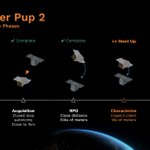
Otter Pup 2 has been making a lot of exciting progress lately, and it’s worth taking a step back to look at where we’re at in the overall mission.
So far, we’ve completed the Long-range Rendezvous, Acquisition, and RPO phases, bringing Otter Pup 2 within 100s of meters of its docking partner, ElaraSat, under closed-loop autonomy.
Next up is the Characterize phase, during which we get within 10s of meters, demonstrating and validating precision maneuvers and gathering another level of detail about ElaraSat as we prepare for final approach and docking attempts.

Two football fields. That’s roughly how close Otter Pup 2 is now regularly operating next to @GilmourSpace’s ElaraSat, fully autonomously. This puts Otter Pup 2 on a very short list of spacecraft in human history.
This video was captured from just 200 meters away as Otter Pup 2 conducted close proximity operations around ElaraSat. Otter Pup 2 is capturing images like these and using them to track and predict the position and orientation of ElaraSat on an ongoing basis.
We’ve gone from thousands of kilometers to hundreds of meters away, continuing to test, iterate and validate our technology along the way. And Otter Pup 2 is not done getting closer, as it continues its mission to make history.
Otter Pup 2 has made it through Acquisition, one of the most challenging phases in its mission! Check out @GilmourSpace’s ElaraSat, our docking partner, from roughly 1 km away.
This is not a flyby. Otter Pup 2 is staying close, making it one of only a small number of free-flying spacecraft in history to operate under control within 1 km of another spacecraft.
With Acquisition complete, Otter Pup 2 is now fully relying on its onboard autonomous relative navigation to stay close to its docking partner. No ground-based navigation needed.
We trust the spacecraft to know where it is, where its partner is, and how to safely stay nearby. That’s the level of autonomy required for safe and scalable rendezvous and docking missions.
Otter made it to space yesterday, and Times Square today! Thanks @Nasdaq for celebrating this milestone with us.

Thanks @SpaceX for the ride. Our first Otter is officially in orbit!
It’s launch day! Tune in to watch our first Otter go to space.
SpaceX:
spacex.com/launches/transpor…
Estimated launch time: 11:32 AM PT
Otter’s deployment time: T+01:03:06

Last week, we celebrated a big milestone: our first Otter going to space! Thanks to everyone who joined us in Seattle to celebrate this moment with us, and all of the partners, supporters and friends who have made this milestone possible.
Check out @SciGuySpace 's writeup on Otter’s journey to space:
arstechnica.com/space/2026/0…

We are proud to announce that our first Otter is going to space! Announced last night at a celebration that brought together hundreds of guests from across the space industry, the launch of our first Otter marks the start of our commercial satellite servicing operations.
This is a big moment for Starfish Space. We’ve spent years developing, iterating, and proving out the key technologies required for affordable, available satellite servicing. Now we’re launching Otters, putting our satellite servicing vehicles to work for customers in orbit.
Otter is scheduled to launch no earlier than October 2026 aboard the Transporter-18 rideshare mission with SpaceX.

Tonight we brought together all of Starfish Space along with hundreds of our supporters, partners, and friends to celebrate a major milestone in our company’s history. More to come soon.

Otter Pup 2 is developing a whole new skill, using its onboard sensors and software to fly close to another spacecraft. Just like any new skill, we learn through practice and iteration.
For Otter Pup 2, that means:
- We build simulations for ground-based testing of what we want to fly on orbit, tuned to match reality and updated with new data from orbit.
- Before flying in orbit, our flight software is tested in simulation to predict how it will work and select target checkpoints.
- We then take our software to orbit and give it checkpoints to aim for, ranging from decreasing separation distance to “go for docking.”
- Maneuvers are executed autonomously, with human operators monitoring and maintaining authority to intervene.
- At multiple points, Otter Pup 2 can autonomously pause, reset back to a checkpoint, or egress before continuing.
- When we’re ready, we go for final approach, closing the distance at centimeter-per-second relative velocities for precise, controlled docking.
This approach allows us to collect meaningful data, rapidly reset and retry with improved algorithms, and make deliberate decisions about when and how to progress.
Right now, Otter Pup 2 is iterating through mission checkpoints every day, all bringing us closer to our docking partner.

Our software has been the focus of the Otter Pup 2 mission to-date as it guides Otter Pup 2 safely and steadfastly towards docking. As we get closer, our docking mechanism, Nautilus, will spring into action.
As we’ve been doing for partners throughout the mission, we’d like to give a shoutout to our partners at @HB_Robotics, a @blueorigin company. The Honeybee team designed and built the protective clamshell for our Nautilus end effector, shielding it from atomic oxygen, micrometeoroids, and other features of the harsh space environment. They also developed Nautilus’ contact absorber, which helps cushion the initial contact between Otter Pup 2 and its client during docking.
These are the kinds of details and collaborations that make complex space missions possible, and we're proud to have Honeybee as a partner on Otter Pup 2.
"As soon as you're able to grab and move a spacecraft, you can do so many other cool things."
That simple idea is driving everything we build at Starfish Space.
In Episode 4 of our video series, meet the technology making Otter Pup 2 possible: CETACEAN for relative navigation, CEPHALOPOD for autonomous guidance and control, and Nautilus, our universal docking mechanism.
The ability for spacecraft to interact unlocks incredible possibilities, from maximizing the value of satellites already in orbit to enabling an entirely new paradigm for the space industry.
Check out Episode 4.
Rapid learning and iteration is what Otter Pup 2 is doing on orbit. Code built today is flying tomorrow.
At Starfish, we built our flight software from the ground up for rapid, safe deployment. Backed by automated testing and expert review, we can patch on-orbit satellites on the fly without sacrificing safety.
The proof? In a typical week, we generate, test, upload, and run multiple software updates to Otter Pup 2, including recent computer vision updates to facilitate relative navigation around @GilmourSpace’s ElaraSat.
Rapid software iteration helps us move faster toward docking and to make history!
Here is an example of how Starfish software simulation prepares us for orbit:
We see you! Otter Pup 2 has acquired @GilmourSpace's ElaraSat.
Acquisition is the moment Otter Pup 2 first detects and begins tracking its client spacecraft using its onboard cameras and computer vision, rather than relying on navigation inputs from the ground.
Here's the view from approximately 6.5 km away, captured during our ongoing relative navigation operations.
This is the first time an Otter Pup mission has reached this milestone and marks a major step forward in our docking mission.

After successfully approaching within 10 km of ElaraSat, Otter Pup 2 has transitioned into relative navigation.
Up to this point, Otter Pup navigated using absolute position information provided from the ground. Now, during the Acquisition phase, it begins navigating based on what it sees - also known as relative navigation. Using Starfish's computer vision software, CETACEAN, Otter Pup detects ElaraSat with its onboard cameras and continuously estimates the client's position and motion relative to itself.
This shift from ground-provided data to onboard sensing is a key step toward autonomous rendezvous and docking. Otter Pup 2 is now making navigation observations and maneuvering decisions using its own observations. This autonomous decision-making will continue all the way through Otter Pup 2’s final approach for a docking attempt.
A few weeks ago we announced the docking partner for our Otter Pup 2 mission, @GilmourSpace's ElaraSat. Otter Pup has now made it through Long-Range Rendezvous (LRR), the first phase of our docking mission sequence.
During LRR, Otter Pup used Starfish's autonomous guidance and navigation software to close the distance from hundreds of kilometers away to hold at 10 km from ElaraSat.
Throughout the approach, the team continued testing, collecting data, and refining software performance in orbit.
Now that we’ve completed the first phase of our docking mission sequence, we’re preparing to transition to relative navigation and take pictures of ElaraSat. Stay tuned!
