

AI research @ Anthropic. Prev: MIT Tech Review 35U35, Data Provenance Initiative, MIT, Google, Apple, Stanford. 🇨🇦 Views my own.
San Francisco
Joined February 2015
- Tweets2.4K
- Following1.4K
- Followers7.6K
- Likes6.8K





Pinned Tweet
Life Update: I recently moved to San Francisco and joined @AnthropicAI as a Member of Technical Staff.
In this next chapter, I’m fortunate to be working across pretraining and societal impacts. Over the past few years—much to the anxiety of my advisors—my PhD research at @MIT has spanned data, pretraining, post-training, scaling laws, evaluation, and ecosystem safety, including work on transparency, accountability, safe harbors for independent research, and AI flaw reporting.
I’ve loved working across the model lifecycle, and I’m excited to continue doing so at Anthropic—thinking about better science, multilinguality, and how we can more rigorously understand the broader impacts of models in the real world.
I also plan to remain actively engaged with the academic and public-interest communities working on these questions. The Data Provenance Initiative has several new projects underway that I’m excited to share soon.
I’m deeply grateful to my friends, family, advisor @alex_pentland, and collaborators across MIT, Stanford, Google, Cohere, BigScience, and the Data Provenance Initiative who supported me throughout this journey.
I feel very lucky to keep working on questions I care about, now from a new vantage point. Please reach out if you’re around SF!
Pictured: me paddling into a new life chapter, my new run route, and some fun pins.


AI is the second coming, or the harbinger of the end times, depending on who you ask. Which is it?
I'm launching Subject to Revision: essays, analyses, and provocations to unravel AI before it unravels us.
I plan to share regularly on here, LinkedIn & Substack.
subjecttorevision.com

The topics I hope to explore:
- How will AI actually impact our lives?
- What happens when we delegate science to AI?
- Will AI compress our culture (how we write, think, and create)?
- How might chatbots impact our social psychology?
- What becomes of art, originality, and human creativity?
- Can we measure the value of intelligence?
5
184
Shayne Longpre retweeted

I am excited to announce our new nonprofit STABL, co-founded with the wonderful @sayashk @random_walker!
Our organization derives from four beliefs:
1. Advanced AI will broadly transform society and, if managed well, this transformation will be broadly beneficial.
2. The speed of this societal transformation is governed by bottlenecks: in many cases, the bottlenecks relate to people and organizations, not AI capabilities alone.
3. Since AI capabilities are not the sole determinant, the best strategy to manage the risks from advanced AI requires broad societal resilience, not just aligned models or capability delays, to provide defense in depth.
4. And while today’s institutions often struggle to grapple with the salvo of advanced AI, institutions will help stabilize society and will be essential, if adequately reformed, for ensuring shared prosperity.
In addition to these beliefs, the reason to create a new organization is based on the need we see in the ecosystem. In today’s ecosystem surrounding advanced AI, many of the leading companies and external actors focus on frontier AI as a technology. We share the view that the technology itself requires dedicated attention, and some of our work at STABL will be in this direction.
But the greater need we see is for independent organizations that take AI capabilities seriously and focus on downstream societal outcomes. We are building STABL to help fill this gap. And we hope to see many other organizations and initiatives emerge to define this field.
For me, the most exciting part thus far has been seeing all the support we have gotten in our early forays. Thanks especially to @audreyt @erikbryn @hlntnr @MichaelRStrain @RobbWiller for joining us as advisers!
We are hiring and fundraising so please reach out if you are interested in this work!

Shayne Longpre retweeted

Do you want your AI model to be more creative?
How would you train it for creativity? What if I told you that directly training a model to be creative can actually prevent the model from reaching its full creative potential?
Think about this: using past examples of creative success as training examples makes similar outputs more likely in the future. But to be creative, reproducing past examples is exactly the opposite of what you want!
This thought experiment led us to what we call the Creative Paradox: "emulating examples of past creative success (even if they were your own successes) can actually prevent you from reaching your full creative potential."
In "Creative Priming: Decoupling Process from Product to Escape the Creative Paradox", we take a different approach: train a creative priming model to guide the creative process, rather than directly generate responses.
We trained a priming model to make Qwen3-8B more creative, but the principles it learns transfer to frontier API models! With creative priming, API models generate 4.5-10x more semantically distinct responses, with 2.5-4.6x more diversity!
A massive thank you to the whole open-endedness team at @LilaSciences, to everyone who contributed to the paper (Sebastian Gabriel, @Evo_Daveo, @joelbot3000, and @kenneth0stanley ), and to LILA for giving us the space to explore big questions like this (and more!)

ALT Creative priming increases the diversity and distinct clusters for API models
What an incredible team!
I’ve been lucky to work with Danqi and Carlos and can’t speak highly enough!!

I joined @noeri_ai part-time two months ago.
It has been a blast! I’m very impressed by the team that Yejin and Carlos (@guestrin) have built. Everyone is incredibly talented and kind, and it’s been so much fun working together.
I’m especially excited about plural AI for scientific discovery, where every scientist can aim AI at their own hard problems.
At a personal level, I am grateful that I’ve finally had the opportunity to work with my long-time role model and friend @YejinChoinka.
We are hiring in Palo Alto and Zurich. The picture is me working from the Zurich office this week :)

Shayne Longpre retweeted

I often get asked what I read to keep up with everything happening in AI governance. Substack is one of my go-to places for more in-depth commentary. They just launched lists today so I made one with all my fav AI governance Substacks:
ankareuel.substack.com/lists…
Please suggest additions in the comments if you have one that you love and that’s not on the list yet!
Shayne Longpre retweeted

Two companies rebuilt git this year but no one rebuilt how we know what’s happening in the code!
Anthropic says their engineers can’t read every line anymore, so they review for intent. With what?
That’s what I’ve been building. CodeStories: a codebase told as a story, intent first, every claim pinned to a line, every chapter proved like a test.
omojumiller.com/2026/10/14/i…

🚨 Update: Claude & political elections
1 in 17 conversations is on politics.
1 in 200 is on elections.
Glad my colleagues are bringing transparency to their approach here:
▶️ Only ~1 in 50,000 conversations violate our election integrity policy (astroturfing, fake-account networks, etc.)
▶️ New classifiers now catch multi-step misuse, not just single bad requests
▶️ Our latest models score 99% on political evenhandedness. Independent reviewers pressure-tested this.
Full blog: anthropic.com/news/2026-us-m…


Update on AI Observatory 🌎:
We've added a catalog of Public AI Usage Data Sources, including beyond what we used.
ai-observatory.org/#data
Let us know if we're missing anything?
Hope this is helpful!

Some Haiku 5.5 highlights:
- 75% cheaper than Haiku 4.5
- Computer Use: 15% --> 72% (OSWorld)
- Agentic Use: 0% --> 39% (TerminalBench)
- 10-50% similar jumps in knowledge work and reasoning.
- Beats GPT-6 Luna in most of these
- 1M context window, 12k output toks
Basically a massive leap over the previous generation of efficient/fast models, and can do everything reasonably well!


Shayne Longpre retweeted

Very happy to see MaxRL making the AI's top 10 list!

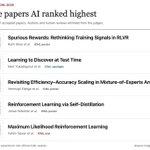
The AI’s top 10, crediting first authors:
1) Spurious Rewards: Rethinking Training Signals in RLVR — @RulinShao
2) Learning to Discover at Test Time — @mertyuksekgonul
3) Revisiting Efficiency–Accuracy Scaling in Mixture-of-Experts Architectures — @venmugil
4) Reinforcement Learning via Self-Distillation — @jonashubotter
5) Maximum Likelihood Reinforcement Learning — @FahimTajwar10
6) AutoNumerics-Zero — Esteban Real
7) Reinforcement Learning with Evolving Rubrics for Deep Research — @RulinShao
8) Rethinking the Trust Region in LLM Reinforcement Learning — @QPHutu
9) Gromov-Wasserstein at Scale, Beyond Squared Norms — Guillaume Houry
10) Flowers: A Warp Drive for Neural PDE Solvers — Till Muser
Shayne Longpre retweeted

Notable in the discussion around AI reviews
What happens to the direction of science when we delegate it to AI?
With @seungonekim, we ranked all 6,617 #ICML2026 papers with AI—the AI Awards.
Findings:
1⃣Humans & AI disagree. Significantly.
2⃣AI is highly influenced by online hype.
3⃣AI preferred papers w/ perceived impact and generalization across settings, whereas humans preferred novelty.
4 AIs agreed fairly highly with one another.
🔗 research-taste.github.io/ai-…
1/


Shayne Longpre retweeted

Honored to have 2 papers on AI’s top-10 list, with a 50% hit rate on the human awards 😂 Clearly still some room for improvement — will work harder on that hit rate!
The AI’s top 10, crediting first authors:
1) Spurious Rewards: Rethinking Training Signals in RLVR — @RulinShao
2) Learning to Discover at Test Time — @mertyuksekgonul
3) Revisiting Efficiency–Accuracy Scaling in Mixture-of-Experts Architectures — @venmugil
4) Reinforcement Learning via Self-Distillation — @jonashubotter
5) Maximum Likelihood Reinforcement Learning — @FahimTajwar10
6) AutoNumerics-Zero — Esteban Real
7) Reinforcement Learning with Evolving Rubrics for Deep Research — @RulinShao
8) Rethinking the Trust Region in LLM Reinforcement Learning — @QPHutu
9) Gromov-Wasserstein at Scale, Beyond Squared Norms — Guillaume Houry
10) Flowers: A Warp Drive for Neural PDE Solvers — Till Muser
Shayne Longpre retweeted

As AI agents take on more of the research process, we want to understand how its "research taste" differ from ours.
In a pilot study along with @ShayneRedford, we had AI agents act as area chairs and rank all ICML 2026 papers.
We found notable differences between the two!
🤖 Made with AI

What happens to the direction of science when we delegate it to AI?
With @seungonekim, we ranked all 6,617 #ICML2026 papers with AI—the AI Awards.
Findings:
1⃣Humans & AI disagree. Significantly.
2⃣AI is highly influenced by online hype.
3⃣AI preferred papers w/ perceived impact and generalization across settings, whereas humans preferred novelty.
4 AIs agreed fairly highly with one another.
🔗 research-taste.github.io/ai-…
1/
Only a quarter of ICML’s human-selected orals reached our AI's top 10%.
Agreement across the main-track corpus was weak: Kendall’s τ ≈ 0.08 against both presentation tiers and reviewer scores.
The models saw anonymized papers, without human reviews, scores, or web search.
2/
We are not advocating for AI area chairs.
AI already influences brainstorming, writing, reviewing, and revision. We want to make the consequences visible, including the risk of introducing uniform, systematic biases into science.
Our study covers accepted papers only, depends on its models and rubric, and cannot rule out training exposure. Human outcomes aren’t ground truth either.
We release the rankings and intermediate judgments so others can examine what these systems reward and overlook.
With @seungonekim. Thanks for feedback to @vijaytarian, @lltjuatja, @yoonholeee, @ohmyksh, @gneubig, and @AkariAsai!
🔗 research-taste.github.io/ai-…
/🧵

