

Full-stack hacker, entrepreneur, hardcore gamer, building @t54ai, @rct_ai, @ycombinator alum
The Overworld
Joined September 2015
- Tweets127
- Following571
- Followers10K
- Likes2K
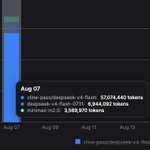


Both my Claude Code and Codex quotas hit zero. Codex ~2 days. Claude ~3 days.
They are playing us for fools. 😡 @thsottiaux
No reset. Can't open a new Pro. Can't even buy a reset.
Folks. Listen. The only thing that kept my agent still ALIVE was @cline plugging into my Codex. ($10/m with free models)
This will save your live: github.com/SergioChan/cline-…


Thank you @thsottiaux for another reset. You are welcome.
Maybe one more this weekend I will consider unsubscribing my Claude Max. 😈

@thsottiaux must have seen the post, because he's already given two resets since then. 👁️
Let's keep pushing!
We should all start using Claude Code, because the more we use it, the more likely @thsottiaux will give us a reset. 🤡
Codex must have shipped some kind of shit subagent upgrade.🤡🤡
One Sol Max task now spins up hundreds of subagents in minutes. It ran all night, finished nothing, and burned 60% of my weekly quota—far faster than before.
It’s like the token tank suddenly sprang a massive leak.

I kept wishing Codex had a speedometer, so I built one.
Token Meter is an open-source codex plugin that shows how many tokens each session is using, how fast they’re being burned, and when something starts looking off.
The numbers and needle move live while the agent works—pretty handy for catching bloated context or runaway loops early.
GitHub: github.com/SergioChan/token-…
Codex just got a phone.
I asked it to open Whatnot, find a live K-pop seller, inspect the shop, and report what was selling.
It found a live show and a $3 listing, entirely through native OpenPocket Plugin.
For both Codex + Claude Code.
github.com/pockebot/openpock…

Sergio retweeted

We are proud to contribute to the development of agentic economy infrastructure on the XRP Ledger.
With the x402 facilitator, agents can instantly settle payments using XRP or RLUSD on the XRPL. ⬇️
xrpl-x402.t54.ai/

AI agents are beginning to transact, pay for services, and settle value autonomously.
Today, we're introducing the XRPL AI Starter Kit, a new set of tools and integrations designed to help developers build agentic payment applications on the XRP Ledger: on.ripple.com/4v7STIm
Phase 1 includes:
→ XRPL Docs MCP Server
→ Claude Skills for wallet creation, payments, and transaction tracking
→ X402 support for agent-to-agent payments using $XRP and $RLUSD
XRPL's fast settlement, predictable costs, and native payment functionality make it a strong foundation for agentic payments.

AI made building cheap.
Regulation made distribution expensive.
Anyone can clone your demo now.
Very few can bring proprietary data, licenses, compliance, and enough trust to sell into serious players.
The moat didn’t disappear.
It moved.

How about KYA as a protocol? @itszach

Introducing ag9.ai – instant agent accountability.
Agents are already operating across the internet, but there’s no portable way to verify them or control what they do.
AG9 is a Know Your Agent (KYA) standard that gives agents identity, credentials, and permissions so they can operate and be trusted.
Sergio retweeted

😀Excited to share our new paper: Quantifying Trust: Financial Risk Management for Trustworthy AI Agents.
arxiv.org/pdf/2604.03976 featured in @FortuneMagazine: fortune.com/2026/04/08/agent…
Together with @Chi_Wang_, @tianyi_peng , @virtuals_io, and @t54ai, we propose the Agentic Risk Standard (ARS), a settlement-layer protocol that uses escrow, underwriting, and collateral to provide enforceable guarantees for transactions involving AI agents
I’ve been working on agent infra since 2024, and most current works on agent infra are about Docker environments or efficiency.
But is that all we need for infra for AI agents?
Agents are already participating in real economic activity: providing services, making purchases, moving money.
That means agent infra is not just technical, it’s also financial.
Right now, using agents is basically “risk-on by default”:
If things go well → everyone benefits
If things go wrong → the user eats the loss
That asymmetry is the real problem.
👀👀So I started thinking: what would finance for AI agents look like?
We propose 👉Agentic Risk Standard (ARS)👈:
1⃣ Quantify agent risk
2⃣ Introduce escrow, premiums, collateral, underwriting, claims
3⃣ Shift from “try it and see” → “clear accountability and compensation”
⛑️Trustworthy AI shouldn’t stop at “models are reliable enough”
But rather, it should answer:
Who pays when things fail?
How much?
Under what rules?
ARS moves us from model-level reliability to product-level accountability, from implicit trust to enforceable guarantees.
ARS is not AI safety (which tries to make models behave) and not fintech with an AI skin (which keeps the human as the backstop). It's a risk layer: escrow holds payment, underwriting prices risk, collateral keeps agents accountable when things break.
🤗 The Agentic Risk Standard is an open-source initiative. We invite researchers, developers, and risk managers to contribute to the protocol and expand the agentic economy.
paper: arxiv.org/pdf/2604.03976
github: github.com/t54-labs/AgenticR…
website: t54.ai/ars

Sergio retweeted

For the past few months, I've been working with researchers from Google DeepMind, Microsoft AI Research, Columbia University, and Virtuals on a paper proposing the Agentic Risk Standard.
Today, it has been officially published: t54.ai/ars
Here's why it's the missing piece for a trustworthy agentic economy ↓

Sergio retweeted
Today, we're announcing Agentic Risk Standard (ARS) research: bringing escrow, underwriting and collateral to the agentic economy.
Co-authored by researchers from Google DeepMind, Microsoft Research, Columbia University, Virtuals Protocol, and t54 Labs.
t54.ai/ars


