

#Author #Languages Not sure why languages haven't stuck for you? Take a free 2-minute language-mindset quiz at https://xitter.cf/t.co/gMbvC34L3E
England, United Kingdom
Joined October 2012
- Tweets6.3K
- Following124K
- Followers124K
- Likes22.7K






Pinned Tweet
You tried your hardest at a language and you still don't know why it never stuck. Join the club — most of us are in the same boat. Want to laugh about it? Cry about it? Welcome to the Dead Linguists Society: language-mindset-quiz.netlif… — 2 minutes. Can't promise fluency. I can promise a sob or a guffaw.

Ryan Doherty retweeted

I cannot tell you how popular this policy is becoming with normal everyday people
When you explain to them they are being given a legitimate chance to put in prison the politicians who have done this to our country they are genuinely hopeful for the future
It's amazing
Ryan Doherty retweeted

THIS IS BIG!
The Cancer Cells That Changed Their Minds
A KAIST team just reversed cancer without killing a single cell — and the method may matter more than the result.
For a century, oncology has had exactly one strategy: find the cancer and destroy it.
Chemotherapy poisons it. Radiation burns it. Surgery cuts it out. Immunotherapy teaches the body to hunt it. Every weapon differs in precision, but not in philosophy. The tumor is an enemy. You win by killing.
Now a team at South Korea's KAIST has proposed a heresy: *what if the tumor doesn't need to die?*
In a study led by Professor Kwang-Hyun Cho of the Department of Bio and Brain Engineering, published in Advanced Science ("Control of Cellular Differentiation Trajectories for Cancer Reversion," DOI 10.1002/advs.202402132), researchers took colon cancer cells and — without poisoning, irradiating, or cutting them — turned them back into normal cells.
Not dead. Not damaged. Just normal again.
The tumors, grown in mice, shrank dramatically. The surrounding tissue was left intact, because there was never an attack to survive.
This is early research — cell lines and animal models, no human trials, real obstacles still unsolved. But the conceptual break is the story. For the first time, cancer treatment has a second verb. Not just destroy. Also: convert.
The digital twin of a cell
The KAIST team's insight begins with a redefinition of what cancer is.
The conventional view treats cancer as a pile of broken machinery: mutations accumulate, checkpoints fail, cells proliferate. Cho's group looked at the same evidence and saw something different — a trajectory. During oncogenesis, they observed, normal cells don't just break. They regress, sliding backward along the differentiation path they followed when they matured. A colon cell becomes, in effect, a confused stem cell: immature, proliferative, lost.
If cancer is a wrong turn on a developmental road, then the treatment question changes. You don't blow up the road. You build a map and find the turn.
That map is what the team calls a digital twin — a complete computational model of the gene network governing a cell's differentiation. Using data from 4,252 intestinal cells, they reconstructed a network of 522 interacting components, capturing how genes regulate one another as a cell matures or degrades.
Then they did the audacious thing: they asked the simulation which levers, flipped together, would push a cancer cell back down the road toward normalcy.
The answer came through a system they built called BENEIN (Boolean Network Inference and Control), which models gene interactions as logical relationships and systematically tests which interventions redirect the network's state. The simulation pointed to three master regulators — the genes MYB, HDAC2, and FOXA2 — acting together as the switch that holds the cancerous state in place.
Turn all three off simultaneously, the model predicted, and the cell would stop proliferating and differentiate into something resembling a normal intestinal cell.
They tested it, and it worked.
In three colon cancer cell lines, suppressing MYB, HDAC2, and FOXA2 together strongly induced differentiation into normal-like cells. The cancer cells began expressing markers of healthy intestinal tissue. Proliferation collapsed — not because the cells died, but because they grew up.
In animal models, tumors formed from the reprogrammed cells were dramatically smaller than controls, and under the microscope they looked far more like normal tissue. The signature achievement, and the one that would matter most to any patient reading this: there was no collateral damage. Nothing was poisoned, burned, or irradiated. The healthy tissue never came under fire, because there was no fire.
1 of 2

Readers added context they thought people might want to know
The KAIST 2024 study showed that inhibiting MYB, HDAC2 and FOXA2 induced differentiation in colon cancer cells to a normal-like state in cell and mouse experiments. No human trials have been done. The before-and-after scan is not from this research.
doi.org/10.1002/advs.2… eurekalert.org/news-releases/…
Ryan Doherty retweeted

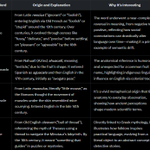
The word delirium comes from the Latin verb dēlīrāre, which originally meant "to go off the furrow" while plowing a field.
Ryan Doherty retweeted

My Gran had an unlimited supply of sayings- some of them baffling. As I grew older I learned that most were biblical- and a great many were from Shakespeare. Oh, that caused some confusion for YEARS 🤣🤣🤣
Ryan Doherty retweeted

Love it. Also Portuguese - as bonkers as a baker's wife. I found out where that derived from, which spoiled it a bit to be honest.
September is basically over. If your big takeaway is a mangled sentence, one good mistake, and a slightly less embarrassing accent than August, that’s not a consolation prize — that’s the actual book, working exactly as intended.
Portuguese "pagar o pato" — to pay for the duck, meaning to take the blame for something that genuinely wasn’t your fault. There’s an old folk tale behind this one involving a duck and a scam, and honestly, at this point, I don’t want to know.
Polish "z choinki się urwałeś?" — did you fall out of a Christmas tree? — for someone acting clueless. No idea why a tree, no idea why Christmas, but I’ve absolutely earned this insult in at least four different countries.
Quick grammar/history lesson nobody asked for: "the sun" is masculine in Spanish (el sol), feminine in German (die Sonne), and neither in English. "Der Tisch" being masculine says nothing about tables, and neither does any other assigned gender — here’s the actual story. The ancestor language behind English, German, Spanish and Greek didn’t start with male/female at all. It split nouns into animate and inanimate — things that act, versus things that get acted on. Feminine came later, and not from "adding sex" to objects: the leading account among historical linguists is that it grew out of a suffix that originally just built abstract and collective nouns, which slowly hardened into its own class. So why do we even call it "feminine"? That’s a separate, later story — ancient Greek grammarians (Protagoras, 5th century BC) looked at the existing noun classes and noticed words for actual women and men often landed in different ones, so they labelled the categories "male," "female," and "thing" for convenience. Most nouns in each class have no sex at all; the name just stuck from the minority that did. Latin grammar inherited the labels, and so did every language taught using it since.
French keeps a cat in your throat when you’re hoarse — "avoir un chat dans la gorge." English keeps a frog there instead. Nobody asked either animal for consent, they just live in your throat now, apparently, in every language.

German has "ins Fettnäpfchen treten" — to step in the little grease pot by the door, meaning to say something that puts your foot right in it. Apparently German farmhouses kept a pot of fat there specifically so you could step in it and ruin your evening.
Spanish has "estar en las nubes" — to be in the clouds, for someone who’s checked out mid-conversation. Which is exactly where a memorised word list lives too: floating up there, disconnected from anything, waving at you occasionally. Bring it down into a sentence or it stays a cloud forever.
Same question as last month: which language did you say you’d start, and did you? No judgement either way — just checking in before October shows up and makes new promises of its own.
Greek "κάνω την πάπια" — to play the duck, meaning to pretend you don’t understand. Genuinely useful phrase for approximately every awkward conversation I have ever had, in any language.
Italian "avere le mani bucate" — to have holes in your hands, for someone who can’t hold onto money. Learned this one the hard way, financially and linguistically, at roughly the same time.
Weekend maths: comparing week 3 of your language to year 3 of somebody else’s isn’t a comparison, it’s just self-harm with extra steps. Compare week 3 to your own week 1 or don’t compare at all.
Polish "nie mój cyrk, nie moje małpy" — not my circus, not my monkeys. Best phrase in any language for problems that were never yours to solve. Stealing it in every language I speak from now on.
Quiet plug: still get messages asking what the book’s actually about, so — it’s the mindset behind learning any language, not a grammar guide. If idioms like these are your kind of fun, that’s the whole book. amazon.com/dp/B09P57L8PJ
