

Asst Professor, Georgetown • Director, CFR China Strategy Initiative • Biden NSC '21-24 • Wrote The Long Game: China's Grand Strategy to Displace American Order
Washington, DC
Joined December 2011
- Tweets9.1K
- Following4K
- Followers39.9K
- Likes12.8K





Rush Doshi retweeted

A father’s worst phone call came on October 18, 2023.
My daughter Christina overdosed on a counterfeit Xanax laced with fentanyl. What followed were 12 days from the trauma center to the ICU to hospice — and her final breath on October 30.
This is our story. Not a statistic. Not a talking point. A family.
Part 1 of a special series on Nation States with Yates. I hope it helps prevent another family from living it.
Listen here:
iheart.com/podcast/1119-nati…
#FentanylCrisis #FentanylAwareness

Rush Doshi retweeted

NEW: Four founders of leading Chinese AI company Z.AI worked on research in a joint project with an institute British intelligence accused of having “very strong ties” to China’s main spy agency
bloomberg.com/news/articles/… with @eastland_maggie
Rush Doshi retweeted

Read this. An advertisement for a new American industrial policy. China will eat our lunch without one.

Chinese export controls now extend beyond refined critical metals to specialized industrial equipment, including tunnel boring machines (TBMs).
TBMs are the most common way of building underground road and rail infrastructure... and they are also increasingly used in mining.
TBMs have been used in underground mine development at several copper, coal and platinum-group-metal operations in the US, Australia, and South America.
Over the past 20 years, Chinese-produced TBMs have grown from ZERO to 60-70% of the global market share, producing approximately 250-300 TBMs per year... approximately half of which are exported. So, we suspect that this news will cause a PANIC in the global TBM market.
We plan to use a TBM at our Santa Cruz copper project in Arizona to develop mine access from the surface. Fortunately for us, the US has its own TBM manufacturer, @Robbins_Co, and earlier this year we purchased a 9.3-metre diameter Robbins TBM for Santa Cruz.
So this news won't disrupt our development plans at @ivanhoeelectric... others may not be as fortunate.
reuters.com/world/asia-pacif…

Rush Doshi retweeted

Chinese export controls now extend beyond refined critical metals to specialized industrial equipment, including tunnel boring machines (TBMs).
TBMs are the most common way of building underground road and rail infrastructure... and they are also increasingly used in mining.
TBMs have been used in underground mine development at several copper, coal and platinum-group-metal operations in the US, Australia, and South America.
Over the past 20 years, Chinese-produced TBMs have grown from ZERO to 60-70% of the global market share, producing approximately 250-300 TBMs per year... approximately half of which are exported. So, we suspect that this news will cause a PANIC in the global TBM market.
We plan to use a TBM at our Santa Cruz copper project in Arizona to develop mine access from the surface. Fortunately for us, the US has its own TBM manufacturer, @Robbins_Co, and earlier this year we purchased a 9.3-metre diameter Robbins TBM for Santa Cruz.
So this news won't disrupt our development plans at @ivanhoeelectric... others may not be as fortunate.
reuters.com/world/asia-pacif…
Exactly this — Beijing isn’t going to indulge our requests for investment with tech transfer, especially when other markets will accept final assembly.

Rush Doshi retweeted

Roughly 95 percent of U.S. ibuprofen imports come from China. Prefer acetaminophen? About 70 percent. @RushDoshi and @OliviaWKosloff join me on @CFR_org Why It Matters podcast to discuss this and oh so much more. podcasts.apple.com/us/podcas…

Rush Doshi retweeted

.@danwwang, author of Breakneck: China’s Quest to Engineer the Future, and research fellow at @HooverInst discussed long-term competition between the U.S. and China with @RushDoshi during the C.V. Starr & Co. Lecture on China. Watch the conversation: bit.ly/4ySkYF7
My take after a few days in the ROK this week is that the Korean government is opposed to SK making this investment in the US.
They’d rather this investment be made in Korea, particularly in certain politically relevant constituencies.

SK Hynix conditions new US factory on more US chip equipment exports to China, sources say reuters.com/world/asia-pacif… But the ROK government does not want SK Hynix to make this US investment, so the US government would be naive to agree to this proposal

Rush Doshi retweeted

Beijing’s biggest coup in recent years is convincing western analysts that it’ll burn down the global economy if liberal democracies take actions that are in their self-interest.
I don’t think China will shut down the global SME industry in response to MATCH. Here’s why:

Rush Doshi retweeted

“I feel like the United States used to be an engineering state—when I’m walking around cities like New York, you know, it really feels like we’re walking through the ruins of a formerly great industrial civilization that our grandparents’ generation built. And so this is where I hope that we can do a little bit more thinking about how do we build better, a little bit more like the Chinese,” says @danwwang, research fellow at the Hoover Institution.
Rush Doshi retweeted

#BloombergNewEconomy Forum is in India for the first time — and we’re bringing you an inside look.
Join us for a special virtual briefing, live from the Forum. @becca_wasser, @lyndsayhoward, @chetnakum, Shantanu Jaiswal of @BloombergNEF and I will be digging into the event's defining debates and exclusive remarks from global leaders — plus previewing new research from Bloomberg Economics and BloombergNEF.
- Wednesday, Oct 14
- Starting at 2:45 PM IST*
- No Terminal subscription required
More information and registration: events.bloombergevents.com/e…
* We will have a broadcast for Europe/US time zones. Stay tuned for details!

An interesting proposal for allied scale in AI

In @ForeignPolicy, @anton_d_leicht and I make the case for compute-for-access deals: allies host data center sites for U.S. labs struggling to build at home, in exchange for guaranteed access to frontier AI. The data centers are the enforcement mechanism—a credible commitment to anchor allies in the U.S. tech stack. (Guest link ⬇️)

Rush Doshi retweeted

America might get to AGI before it manages to reindustrialise. That means there's room for an international version of 'industrial AI', where America makes the tokes and its allies build chips, robots, and missiles.
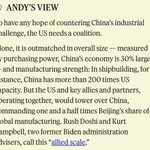
(1) America needs allied factories. The US only accounts for 15% of global manufacturing, China for 32%; but the US+allies have 43%. @RushDoshi argues this should generally motivate 'allied scale', but it's particularly urgent in AI. If a country of geniuses in a datacenter is supposed to cure cancer or beat China, someone still has to manufacture the cures or produce the drones at scale.
(2) American reindustrialisation alone is not enough. The US economy seems afflicted by 'AI Dutch Disease', absorbing all its capital and capacity into more and more AI buildout (also discussed this week by @DKThomp!). Allies that can't build AGI have no better alternative, their economies are less dominated by the build-out, so they're better-suited to scale up manufacturing.
(3) Allies need American models. Proprietary industrial data is valuable. But it's a complement, not a substitute, for frontier AI: it's most valuable for building post-training pipelines on top of powerful general-purpose models. Allowing for US integration is the only way to make use of this data before it becomes obsolete due to synthetic data down the road.
(4) It's still very hard to stabilise this deal. Allies are worried that Americans siphon off all their IP; Americans are worried that their models get commodified. Figuring out a good deal is the most important next step; I suspect it's (a) exclusive joint ventures between allied industrial firms and American labs with (b) proprietary post-training of specialised models that don't leave the premises of the specific JV.
(5) Waiting makes the deal worse. If allies keep dismissing American AI progress, and Americans keep hoping they can go it alone, we all lose out: allies will have to come crawling back and get a much worse deal later on, and America loses out on years of highly productive industrial integration.
Much more in this week's piece: writing.antonleicht.me/p/all…


I’d love economists to take a crack at this theory that the US is experiencing a mini-Dutch Disease effect from AI.
My big-picture thesis about AI economics right now is that while the discussion about AI safety and existential risk is important, AI’s construction is changing the world faster than its capabilities.


Tune in tomorrow for the C.V. Starr annual lecture at CFR featuring the always thoughtful @danwwang!

On October 8 at 11am ET, @danwwang, author of Breakneck: China’s Quest to Engineer the Future, and research fellow at @HooverInst, will discuss long-term competition between the U.S. and China with @RushDoshi during the C.V. Starr & Co. Lecture on China.
cfr.org/event/c-v-starr-co-a…

Rush Doshi retweeted

If anything that position is in line with what Wall Street and corporate America want and regularly lobby for from tariff cuts to reversing export controls to diluting outbound investment restrictions.

The idea that you must choose between peace and reciprocal trade is a false choice.
What is most amusing about this post is that its premise is factually wrong. “Escalate to deescalate” is not the Trump China strategy nor was it Biden’s strategy — it is Europe’s emerging strategy. Are Europeans pursuing a “forever war” with China by protecting themselves from rare earth coercion?
Europe is right to consider new tools. They want reciprocal trade, China is threatening them with rare earth coercion if they pursue industrial policies that resemble China’s own, so they need to deter that threat.
Instead of sensible self-defense, Jake argues, it is better to “address root causes,” whatever that means. But that position effectively suggests Europe and the US must let their industrial bases die and their working people lose their jobs rather than prepare to respond to China’s pressure.
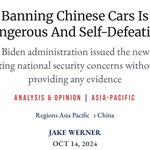
That is a position he has advanced before. See the article below, in which Jake argues restrictions on PRC EVs are “dangerous” — yet another effort to tar sensible protection as pro-war.
But Jake is on an island. Neither Europe nor Japan nor Korea nor Congress nor American organized labor agree with him. And for good reason.
It’s a stretch to call any of those views progressive. Neoliberal sounds about right, though.

Rush Doshi retweeted
I’m genuinely surprised you aren’t aware of these economic threats from China to Europe — threats which have helped reshape German trade policy and which are alluded to in the Merz/Macron letter. Might I suggest you follow this issue more closely before labeling people who do follow it, and propose economic remedies widely shared in allied capitals, as advocates of “forever war” in bed with neocons.
Of course the US and Europe should align on responses to rare earth coercion from China. It’s very odd to suggest that doing so is “forever war.” Even the Europeans want this alignment on trade. Are they Cold Warriors for seeking deterrent tools?
The idea that allies should not align on economic security is very strange. Though it suits Beijing well. The proponents of allied coordination on China trade vastly outnumber those few, like you, who evidently think self-defense is wrong, alliances should be disbanded, and the right and proper course is a kind of noble industrial suicide for the sake of “peace,” which once again is a false choice.
And I think I’ve rendered your views correctly on economic matters. Indeed, the more we engage on this topic the more I find it hard to distinguish your views from old school neoliberalism; they seem clearly on the wrong side of industrial unions and labor on the most important international economic questions of the day.
Rush Doshi retweeted
It’s a very odd stance rooted in several analytical errors:
1) He is basically suggesting that allied coordination on China’s rare earths coercion is a kind of “forever war.”
2) He seems to misunderstand too that no one is actually advocating escalation in this case. They are advocating for the collective deterrent capacity that comes from being able to escalate if needed, and that deterrence is stronger when coordinated.
3) He fails to understand that the US isn’t pursing this strategy. Europe is doing so alone.
Many others have spelled this out, like Victor Cha.

The idea that you must choose between peace and reciprocal trade is a false choice.
What is most amusing about this post is that its premise is factually wrong. “Escalate to deescalate” is not the Trump China strategy nor was it Biden’s strategy — it is Europe’s emerging strategy. Are Europeans pursuing a “forever war” with China by protecting themselves from rare earth coercion?
Europe is right to consider new tools. They want reciprocal trade, China is threatening them with rare earth coercion if they pursue industrial policies that resemble China’s own, so they need to deter that threat.
Instead of sensible self-defense, Jake argues, it is better to “address root causes,” whatever that means. But that position effectively suggests Europe and the US must let their industrial bases die and their working people lose their jobs rather than prepare to respond to China’s pressure.
That is a position he has advanced before. See the article below, in which Jake argues restrictions on PRC EVs are “dangerous” — yet another effort to tar sensible protection as pro-war.
But Jake is on an island. Neither Europe nor Japan nor Korea nor Congress nor American organized labor agree with him. And for good reason.
It’s a stretch to call any of those views progressive. Neoliberal sounds about right, though.
