

A public policy research organization and leadership community working for freedom, equality, and a more perfect union.
Washington, DC
Joined March 2018
- Tweets2.6K
- Following1.1K
- Followers1.3K
- Likes581






Pinned Tweet
SAVE THE DATE
The Rainey Center’s 2026 National Summit is coming to Walt Disney World, December 7–9 2026.
State leaders. Policy experts. Real conversations shaping the future.
Learn more:
raineycenter.org/national-su…

Today a Santa Fe judge ordered Meta to pay New Mexico $25 billion, plus 15% annual interest.
@SarahEHunt01 says the bigger story is the signal it sends. Meta's Los Lunas data centers are one of the few real drivers of private-sector growth in New Mexico, and every site selector in America is watching.
Her new Substack is linked below.
#RaineyCenter #NewMexico #EconomicGrowth

Election policy gets debated in Washington. Elections themselves are run in counties.
In his new Substack, @jaldendaniels looks at a resolution county officials adopted at this summer's National Association of Counties conference, affirming state authority and county administration of elections. The message from counties: federal partnership on things like cybersecurity, election worker safety and funding is welcome, but one-size-fits-all mandates can make elections more fragile, not more secure.
And federalism only works as a principle if it applies no matter which party holds power.
Read "Elections Are Local. Federalism Keeps Them Free." Link below ⬇️
#RaineyCenter #FreeAndFairElections #Federalism

ALT Graphics: 'Elections Are Local. Federalism Keeps Them Free.' by Josh Daniels over the U.S. Capitol, and a Josh Daniels quote: 'Washington debates election policy in slogans. Counties administer it in spreadsheets.'

ALT Graphics: 'Elections Are Local. Federalism Keeps Them Free.' by Josh Daniels over the U.S. Capitol, and a Josh Daniels quote: 'Washington debates election policy in slogans. Counties administer it in spreadsheets.'
Rainey Center retweeted

🧵
Instead of building an economy, my home state is trying to sue its way to a balanced budget, targeting a company that has bet big on NM. Meta is one of the few private-sector growth engines in New Mexico.

Meta ordered to pay $25 billion penalty in New Mexico Cambridge Analytica case cnbc.com/2026/10/21/meta-new…

A ban draws a line at the border. A security standard draws a line around the risk.
This week we've walked through our new policy brief, "Securing the Grid While Growing the Grid." It covers the supply challenge facing America's power grid, why origin alone isn't a safeguard, and how standards that already exist can test every device on what actually matters while the grid keeps growing.
Read the full brief at the link in our bio.
#RaineyCenter #GridSecurity #Energy

By 69% to 19%, voters say how grid equipment is built, tested, and controlled matters more than where it was made, and majorities of both Republicans and Democrats agree.
That's from Rainey Center's September Policy Survey. Asked what a federal standard should require, voters ranked no remote access from outside the U.S. (44%) and testing by independent U.S. labs (41%) at the top. 72% would accept higher costs for stronger standards.
More in our new brief, "Securing the Grid While Growing the Grid," at the link in our bio.
#RaineyCenter #GridSecurity #Energy

Our new brief proposes three questions every grid device should have to answer, foreign or domestic:
Can someone outside the U.S. reach it? Remote functions should be off by default and under the owner's control.
Can its software be verified? That means signed firmware, a list of what's in the software, and owner review of updates.
Does its data stay home? Operational data should stay in the U.S., with vendor access logged and limited.
Each answer can be confirmed by independent testing at accredited U.S. labs, and equipment that fails stays off the grid. Read "Securing the Grid While Growing the Grid" at the link in our bio.
#RaineyCenter #GridSecurity #Energy

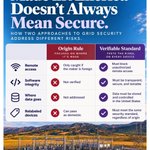
Where a device was made tells you something. It doesn't tell you whether it's safe.
A rule based only on country of origin leaves real gaps. A U.S.-assembled device with an insecure foreign cloud connection passes. Relabeled equipment can pass as domestic. Software integrity and where the data goes aren't tested at all. A verifiable standard closes those gaps by testing every device on the same risks, whatever its origin.
That's the core case in our new brief, "Securing the Grid While Growing the Grid." Read it at the link in our bio.
#RaineyCenter #GridSecurity #Energy

The Rainey Center National Summit brings together the policymakers, thinkers, and leaders shaping where this country goes next. December 7–9, 2026 at Disney's Contemporary Resort. You'll want to be in the room where it happens.
🔗 Link in bio to register
#RaineyCenter #NationalSummit2026
Concern about foreign access to the power grid isn't a partisan issue. In Rainey Center's September Policy Survey, 81% of registered voters said they're concerned a foreign government or company could remotely access or control U.S. grid equipment. Republicans and Democrats were within two points of each other.
That concern is grounded in real events. In 2025, analysts reported finding undocumented cellular radios inside Chinese-made solar inverters. Our new brief, "Securing the Grid While Growing the Grid," looks at what an effective response should actually test for.
Read the full brief at the link in our bio.
#RaineyCenter #GridSecurity #Energy

America's power grid runs on imported parts. More than 90% of the power inverters installed over the past decade, and about 80% of large transformers, came from abroad. At the same time, summer peak demand is projected to grow 24% over the next ten years.
New domestic factories are coming, but most won't reach full production until late this decade. That's the challenge at the center of our new policy brief, "Securing the Grid While Growing the Grid": protecting the grid from foreign risks without stalling the build-out the country needs.
Read the full brief at the link in our bio.
#RaineyCenter #GridSecurity #Energy

The grid has to get more secure and keep growing at the same time. Our new policy brief shows how to do both.
"Securing the Grid While Growing the Grid" makes the case for a security standard that tests every grid device, foreign or domestic, on what actually matters: who can reach it, whether its software can be verified, and where its data goes.
Read it at the link in our bio or below 👇
#RaineyCenter #GridSecurity #Energy


Washington is writing new rules to protect the power grid from foreign-made equipment. The question is how they'll define risk.
Our new policy brief, "Securing the Grid While Growing the Grid," argues that origin is a signal, not a safeguard. The real risks run through code, connections, and control, and those risks are the same whether a device is built abroad or at home.
Voters see it the same way. By 69% to 19%, they say how equipment is built, tested, and controlled matters more than where it was made.
Read the full brief, link below 👇
#RaineyCenter #GridSecurity #Energy
"The good news is, people are still persuadable."
Rainey Center President & CEO @SarahEHunt01 joined @sophiadew on @MTSlive to explain why voters need the facts on AI and data centers, from data privacy and security to America's place in the AI race.
#RaineyCenter #AI #DataPrivacy
Permitting reform is one of the few issues where Republicans and Democrats keep landing in the same place: America has to be able to build. Durable, predictable permitting is what turns plans into projects.
Worth a watch: @SenCapito on @JenningsShow
#RaineyCenter #PermittingReform #EnergyAbundance
AI runs on compute, and compute runs on electricity. Rainey Center President & CEO @SarahEHunt01 joined @sophiadew on @MTSlive to discuss what the AI race with China means for American energy, affordability for consumers, and national security.
#RaineyCenter #AI #Energy
We tested ten approaches lawmakers are proposing on data centers against each other. The leader won 64% of its head-to-head matchups. It recruits major investment while requiring developers to bring their own power, hold public meetings, sign community benefits agreements, hire locally, and power down before homes do.
A one-year statewide pause won 51% of its matchups. Keeping existing tax breaks finished last at 35%.
From our September Policy Survey. Read the full memo at the link in bio or below.
#RaineyCenter #DataCenters #EnergyPolicy
