

Tensors and neural networks in Python with strong hardware acceleration. PyTorch is an open source project at the Linux Foundation. #PyTorchFoundation
Joined September 2016
- Tweets3.8K
- Following98
- Followers517K
- Likes1.1K







Ravi Gupta, Shiksha Patel, and Rishi Madduri (@AMD) will present “Efficient Inference of Masked Diffusion Language Models on AMD XDNA2 NPU” at #PyTorchCon North America 2026.
Their poster presents a power-efficient deployment of LLaDA-8B-Instruct on an AMD NPU. On a Ryzen AI MAX+ 395 APU at sequence length 128, the NPU vendor path ran at 504 ms per forward at 36 W, compared with 843 ms and 110 W for CPU INT4, making it 1.67x faster and 8.9x better on energy.
The poster will also cover the INT4 quantization and graph-partitioning pipeline, the CastAvx fix, and the runtime approach used for single-step prefill on the XDNA2 NPU.
Register for PyTorch Conference North America 2026: hubs.la/Q04v4SL60
Looking for sessions to catch at #PyTorchCon North America 2026? Chris Hoge (@nvidia), co-chair of the PyTorch Ecosystem Working Group, highlights five talks for developers working on open source training and performance.
Hoge will co-present “Ecosystem Working Group: Unlocking Community Impact Through the PyTorch Landscape,” covering what the PyTorch Ecosystem Landscape is, how projects can apply for ecosystem status, and how lifecycle management works for Landscape projects.
He also highlights sessions featuring NVIDIA engineers on hiding expert parallel communication in Mixture-of-Experts training, parameterized dynamic-shaped CUDA graphs, building fused compute-communication kernels with PyTorch Symmetric Memory, and scaling PyTorch data loaders by a factor of 10.
Register for PyTorch Conference North America 2026: hubs.la/Q04v4SL60
How do you deliver full API parity across heterogeneous accelerators with zero additional overhead?
At PyTorch Conference North America 2026, Zesheng Zong (@Huawei), PyTorch Foundation Ambassador and Accelerator Integration Working Group Co-Chair, will share key technical updates on backend integration.
The community is adapting over 600,000 upstream test cases to be generic across all backends, providing a scalable path toward complete API parity. Alongside this effort, Cross-Repository CI Relay connects every PyTorch pull request directly to accelerator repositories, enabling real-time bidirectional testing, early regression detection, and a lower barrier to entry for out-of-tree hardware maintainers.
Join us in San Jose, California next week to see how these foundational updates simplify hardware enablement across the ecosystem: hubs.la/Q04v4SL60
#PyTorchCon @Zesheng_Zong
ExecuTorch is now an official @ZephyrIoT external module, bringing PyTorch model deployment into Zephyr’s firmware build workflow.
Zephyr Project’s walkthrough covers setup and runs quantized MobileNetV2 on an Alif Ensemble E8 DevKit, with the convolutional graph on the Arm Ethos-U55 NPU and input quantization and output dequantization on the Cortex-M55 CPU.
Read more: zephyrproject.org/executorch…

🤠 Hats off to our #PyTorchCon North America diamond sponsors. Connect with the people building the future of machine learning in San Jose, CA on October 20-21. Learn more: bit.ly/3TKs7bi

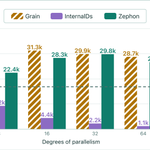
Zephon’s TorchTitan integration preserves identical global batches when training resumes on a different GPU count.
In our latest blog’s 1B-parameter model test, training resumed from a 16-GPU checkpoint on 8, 32, and 64 GPUs, and the SHA-256 hash of every global batch matched the original run.
Zephon tokenizes, packs, shuffles, and mixes data inside the training job, avoiding a preprocessed copy of the corpus.
The data, tokenizer, seed, mixture, context length, and global batch size must stay unchanged when resuming. The lane count must divide evenly across data-parallel replicas, and each optimizer step’s batch must split evenly across lanes. Training losses can still differ because floating-point reduction order depends on GPU count.
✍️ @datologyai @josh_wills @MaxiBoether, Ties Robroek (@datologyai)
Read more: pytorch.org/blog/bringing-el…

Ray All the Way Down: A Heterogeneous, Elastic PyTorch Training Stack at LinkedIn
Join Tommy Li and Tao Huang from @LinkedIn at PyTorch Conference North America 2026 for their lightning talk, Ray All the Way Down, on October 20.
They will share how Ray coordinates CPU preprocessing and GPU training across LinkedIn's distributed pipelines, maintaining high performance, resilient scaling, and flexible data loading for reinforcement learning workflows.
Join the open source AI community in San Jose: hubs.la/Q04v4SL60
#PyTorchCon
PyTorch retweeted

Day-0 support for Muse Spark Open on TokenSpeed.
190 output tokens/s per user on NVIDIA B300 — and that’s without speculative decoding.
Also supported on AMD Instinct MI355X.
👉 github.com/lightseekorg/toke…


Today we’re releasing Muse Spark Open, the most capable US open-weight model to date.
Built for coding and agentic work, it excels at long-horizon tasks, complex software engineering, and multi-step reasoning.
Key Model Specs:
→ 816B total / 42B active parameters
→ 1M token context window
→ Natively multimodal across text, image, video, audio


High 5️⃣ to our #PyTorchCon North America gold sponsors. Top AI pioneers, researchers, and developers are gathering in San Jose, CA on October 20-21. Don't miss your chance to join! Learn more: bit.ly/3TKs7bi

PyTorch retweeted

🎉 Day-0 support for Meta's open-weight Muse Spark Open is
live on vLLM, verified on NVIDIA and AMD GPUs as well as on TPUs!
816B parameters, 42B active per token, a 1M-token image, video and audio inputs, built for long-horizon agentic coding.
We’re excited to have worked with Meta Superintelligence Labs to bring Muse Spark Open to vLLM from day one as the most capable US open-weight model.
✨ 1M context for large, complex codebases
👀 Native image, video, audio & document understanding
⚡ BF16, NVFP4 & MXFP4 support
🚀 DSpark speculative decoding on both CUDA and ROCm
1/6

PyTorch retweeted

At our first #PyTorchMadrid meetup, @SergioPaniego explored TRL + OpenEnv for agent post-training!
Made me think of @goose_oss from @AgenticAIFdn 👀 Open source agent harnesses can also play a role in RL training helping models learn from tool use 💡


🎉 THANK YOU to our #PyTorchCon North America platinum sponsors. Hands on workshops, deep technical talks, and a buzzing community expo land in San Jose, CA on October 20-21. Learn more: bit.ly/3TKs7bi

Today, @Meta is open sourcing the weights for Muse Spark Open, the most capable US open-weights model to date. It’s integrated with the PyTorch ecosystem: it ships with Helion kernels, and TorchTitan can be used to further tune the model.
More in the blog: pytorch.org/blog/muse-spark-…

FIVE. DAYS. 🔥
200+ talks and posters. 400+ speakers. Thousands of open source AI builders. One very energized city.
#PyTorchCon North America lands October 20-21 in San Jose, and there’s still time to get your pass:
bit.ly/4sh3DSw
PyTorch retweeted
1/ 🚀 New on the vLLM blog: Finish RL Training Faster — Bitwise-Consistent, High-Performance, Agent-Driven
Same weights don't guarantee the same policy: inference optimizations can change the logprobs that training recomputes.
We make rollout and training bitwise identical while retaining high-performance inference paths. Here's how 🧵
vllm.ai/blog/2026-10-14-trai…

Arm Cortex-M microcontrollers power everyday devices from wearables to industrial sensors and home appliances. Deploying a PyTorch model to these edge devices no longer requires leaving the PyTorch ecosystem.
Through the ExecuTorch Cortex-M backend, quantized models lower directly to Arm's CMSIS-NN kernels. Because target hardware parameters are known at compile time, operator selection, weight layout, and memory planning are resolved ahead of time, allowing the core runtime to fit in under 20 KiB of flash.
Learn more about this technical milestone, developed in collaboration with @Arm, here: bit.ly/4zu39Mz

PyTorch retweeted

First @PyTorch Madrid meetup! On to many more!
madrid.pytorch.es

At our first #PyTorchMadrid meetup, @SergioPaniego explored TRL + OpenEnv for agent post-training!
Made me think of @goose_oss from @AgenticAIFdn 👀 Open source agent harnesses can also play a role in RL training helping models learn from tool use 💡
PyTorch Conference North America 2026 program committee member Ricardo Aravena (@raravena80) (Nunchux AI) calls #PyTorchCon a great place to connect with the people building the future of machine learning, learn practical ideas from the community, and bring fresh inspiration back to your work.
He’s looking forward to the conversations, new perspectives, and the chance to see what others are creating with PyTorch.
Register for next week’s PyTorch Conference North America 2026: hubs.la/Q04v4SL60