

Ziren: General-Purpose zkVM & Proving Infrastructure
ZK
Joined June 2023
- Tweets4K
- Following586
- Followers42K
- Likes9.9K







Existing BitVM-style bridge designs garble the verifier of a pairing-based proof, and a large enough quantum computer breaks pairings.
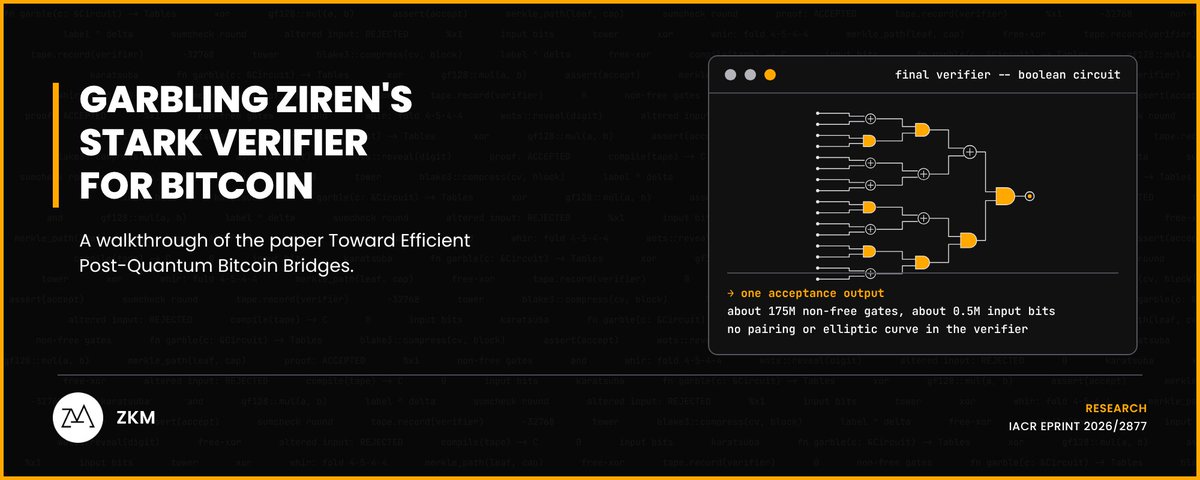
Our walkthrough of eprint.iacr.org/2026/2877 covers another route: garbling Ziren's hash-based STARK verifier directly. Measured on the proof of a real Ethereum block:
- 175.4M non-free gates
- 2.81 GB of garbled tables, about 15.5x smaller than the garbled Groth16 baseline
- 520,832 input bits, about 500x more than Groth16
- 3.93 MvB onchain in a dispute, across 41 standard transactions
Still to build: the proof that the garbling is correct, and the full transaction graph. The bridge's own signatures remain Schnorr.
zkm.io/blog/garbling-zirens-…
What is left before the @MetisL2 Hybrid Rollup's post-quantum proof path ships?
ZKM CTO @sd_eigen and Metis's @Natalia_Ameline and @ElenaCryptoChic explain what a quantum computer puts at risk, what the deadline is, and how Metis makes the switch.

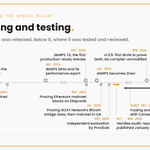
Built through years of engineering and testing.

Announced in 2023. Built through years of engineering and testing.
Powered by @ProjectZKM 's Ziren, Metis Hybrid Rollup brings verifiable execution closer to reality, with a post-quantum proof path under development.
The Hybrid Rollup Devnet is now live. Watch the team explain what comes next. 👇
"Cut trust in third parties down to what you can verify" - this is the purpose of Ziren.
With it, whoever runs the computation returns a proof, and the result is accepted only if it verifies.
Ziren is already running in production on @GOATNetwork and devnet on @MetisL2.

The last few weeks of security incidents look different on the surface. Underneath, they rhyme.
- Binance: ~$6.36B drained, reportedly starting from one engineer's laptop
- Lighter: $10.4M through a single leaked API key
- Polymarket: hit through a third-party provider
- Chainalysis: customer data accessed by an AI-assisted attacker
- FBI warning: AI agent frameworks taking intrusions from first touch to admin access in under 3 hours, and deepfakes beating live KYC checks
Three patterns:
1. Attackers aren't breaking the cryptography. They're going around it: people, laptops, API keys, vendors, front ends.
2. AI collapsed the cost of attacking. Recon, exploit writing and trying again when something fails now run in parallel, 24/7, by people who couldn't do it alone a year ago.
3. The window between a patch shipping and it being exploited is now hours, not weeks.
So yes, the short term may get worse before it gets better. But fear isn't a strategy.
For builders:
- Design as if every key and every laptop will eventually be compromised. Limits, delays and multi-party approval on anything that moves funds
- Cut trust in third parties down to what you can verify
- Put AI on defense: audit, red-team and monitor yourself at the same speed attackers do
- Practice incident response before you need it. The ~$3B frozen after Binance happened because people moved within hours
For everyone:
- Keep most of your assets offline, and only what you need online
- Update quickly. Old versions are the easiest targets
- Assume any urgent message, call or video could be fake, and verify through a second channel
AI is a productivity leap for attackers and defenders alike. The difference will come down to who builds with security as the foundation, not as a patch.
That's the bar we hold ourselves to at @GOATNetwork, @ProjectZKM and @MetisL2.
"We are changing the digital locks before the burglar shows up at the door." - @natalia_ameline
We asked four of the people behind the @MetisL2 Hybrid Rollup what it is, what it means for Metis, and what the hardest problem was to solve.
Now live on devnet.
Teams preparing for quantum shouldn’t each have to work out how to get elliptic curves out of their proofs. For teams proving with Ziren, the work is happening in Ziren itself.
The memory digest has a hash-based replacement on a branch. A draft Keccak-based verifier for Ethereum would replace the BN254 wrapper: zkm.io/blog/the-last-two-cur…
And our new paper measures a hash-based verifier for Bitcoin bridges: eprint.iacr.org/2026/2877


A plain-language read of our new paper, Toward Efficient Post-Quantum Bitcoin Bridges.
Paper: eprint.iacr.org/2026/2877


New paper from researchers at ZKM and @GOATNetwork: "Toward Efficient Post-Quantum Bitcoin Bridges" has been published on the IACR Cryptology ePrint Archive: eprint.iacr.org/2026/2877
BitVM-style bridges check a proof on Bitcoin by garbling its verifier off-chain. Existing designs garble an elliptic-curve verifier, which a quantum adversary breaks. This paper garbles a hash-based one: Ziren’s complete recursive verifier for WHIR-based STARK proofs, compiled to a Boolean circuit over binary-tower arithmetic and Blake3, with no pairing wrapper.
For the proof of Ethereum block 26,206,588, the circuit has about 175M non-free gates and about half a million input bits, which comes to about 2.8 GB of garbled tables. Publishing that input in a dispute with hash-based one-time keys takes just under 4 MvB, in about 40 standard transactions.
The rest of the dispute protocol, including the complete transaction graph, is not built yet, and a bridge built this way would still depend on Bitcoin’s own signatures.

Two elliptic curves stand between a Ziren proof and Ethereum. One carries memory from shard to shard inside the proof. The other wraps the finished proof so that Ethereum can check it cheaply.
Last month, both got public alternatives: a hash chain for the first, measured at 5.4% more proving time on one GPU and 17.6% on four, and an experimental Solidity verifier for the second, which checked a Ziren proof of an Ethereum mainnet block in a single transaction in a local test.
Neither is released yet. Here we set out what each curve does, what replacing it costs, and what we do not yet claim. 🧵

A hash-based proof system rests on the security of its hash, and quantum algorithms weaken a good hash's concrete bounds but are not known to break it.
An elliptic curve is different: on a large enough quantum computer, Shor's algorithm computes discrete logarithms, and every assumption built on them falls at once.
In September we argued that hash-based is not the same as post-quantum: read the security theorem, not the primitive list. By that test, Ziren's path to Ethereum has two exceptions - the memory check inside each proof, and the BN254 wrapper on its release path. This is the work to remove them.
zkm.io/blog/hash-based-is-no…

1
9
4,136
Ziren’s validity proofs are now running on Metis’s devnet, and they can be verified on the EVM two ways:
• Groth16 wrapper: about 233k gas, 260-byte proof
• Direct hash-based verifier: about 13.6M gas, 182 KB proof, in a single transaction and without an elliptic-curve wrapper
The work ahead on the proof side is bringing that second cost down, and replacing the elliptic curve still used for the memory check inside each proof.
→ zkm.io/blog/completing-the-h…

Security has led Ziren’s development because both GOAT’s BitVM3 bridge and Metis’s Hybrid Rollup will rely on its proofs.
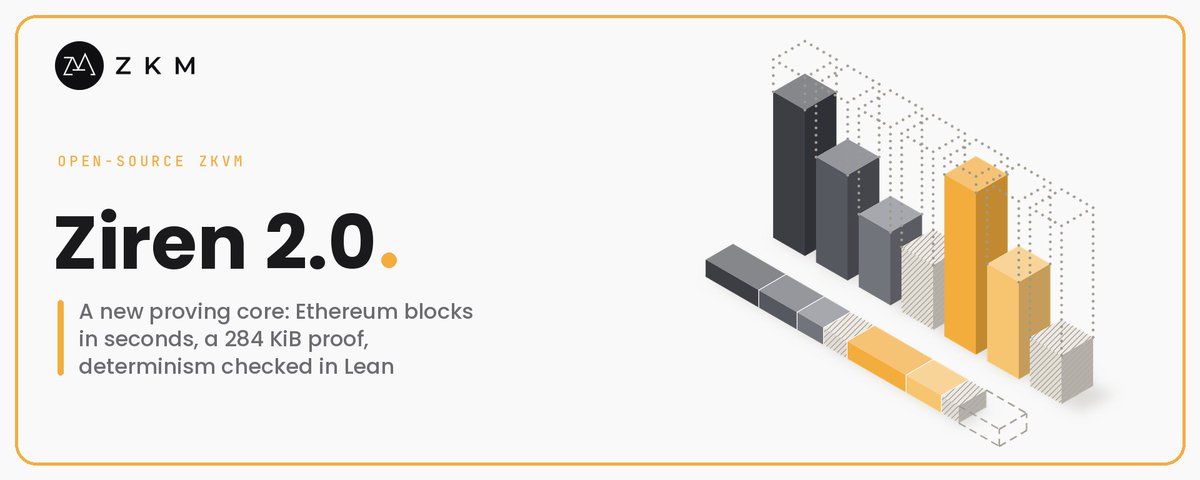
With Ziren 2.0, the speed has caught up, with Ethereum mainnet blocks proved in 8.6 seconds on average.
And the post-quantum work carries to every system that uses Ziren’s proofs: its commitments are hash-based in 2.0, and the work to remove the last two elliptic curves is in progress.
→ github.com/ProjectZKM/Ziren


In 2023, ZKM was formed to build a zkVM that supports Cannon, the Golang MIPS VM behind @MetisL2’s fraud proofs.
Quantum safety has since become a requirement with published NIST end dates, and the Hybrid Rollup is being completed to meet it.
CEO @KevinLiu explains why now is the right time for it to happen:
→ x.com/kevinliu/status/211978…


Ziren 2.0 is what years of security and performance work add up to: the paper, the audits, the Lean proofs, real-time proving of Ethereum blocks.
The next major leap is our post-quantum work: removing the last elliptic curves from the path between a Ziren proof and the chains that check it.
That matters for everything Ziren proves - Bitcoin L2s today, Ethereum L2s next - starting with a major partner we’ve worked with since the beginning.


Ziren 2.0 is here.
The average Ethereum mainnet block proved in 8.6 seconds on @eth_proofs, a 284 KiB proof, verification in 25.5 ms.
More than 100 bits of interactive soundness at every proving stage, the determinism of every chip proved in Lean, and the @ethereumfndn, @ConsensysAudits and @VeridiseInc behind the security reviews.
Start building: github.com/ProjectZKM/Ziren