

Co-Founder and General Partner @MF__xyz prev @aptoslabs @Meta @BCG @BlackRock @ConsenSys @MeridioRE
Joined July 2010
- Tweets8.3K
- Following4.2K
- Followers77.5K
- Likes16.1K








Pinned Tweet
Citadel, is one of the most significant hedge funds, and they just dropped tokenomics …
And it’s not what you would have expected


WHOA-
i need this to go from Austin to Houston...or Santa Fe
youtube.com/watch?v=PX88goI7…


“AI in 2026 is bog-standard beta.”
-Matt Levine
Read this, look at your portfolio, and scratch your head

Mo Shaikh 🇺🇸 retweeted

Austin is on fire. $12.8B in VC funding YTD, blowing past last year's record of $7.5B.
Top 5 Q3 Deals
• @boringcompany: $3B Series D
• @basepowerco: $1B Series D
• @fab2: $500M Series A
• @function: $450M Growth
• @TerraFirma_Inc: $115M Series A
We see you Boston 🤠🚀🦾

Crypto is entering a period where partnerships and acquisitions are becoming increasingly important to finding product-market fit and entering new markets.
Building a blockchain requires significant investment in infrastructure, developers, distribution, and ecosystem development. Each additional market introduces local relationships and regulatory requirements. Combining capabilities with established partners can dramatically improve the economics and speed of execution.
We saw this firsthand with the acquisition of HashPalette in Japan.
HashPalette had built an established blockchain ecosystem around entertainment and digital assets. It also brought relationships with Japanese enterprises and the Osaka-Kansai World Expo.
The acquisition created a path to migrate Palette Chain and its applications onto a larger blockchain. It also introduced a token-exchange mechanism for existing holders.
That combination gave us a stronger position in Japan. HashPalette’s existing ecosystem could benefit from broader infrastructure, distribution, and technical capabilities.
The same pattern is now emerging elsewhere.
Sui Foundation announced a $30 million strategic investment in DATA Network, formerly Story Protocol. DATA will retire its independent blockchain and move its AI data provenance protocol onto Sui.
Its Trace registry has already recorded more than 250 million contributions. Walrus will provide the underlying storage infrastructure, while DATA retains its token and existing governance economics through the migration.
The transaction brings together complementary capabilities. DATA contributes an established application and its users. Sui provides network infrastructure, while Walrus contributes storage designed for large datasets.
Maintaining an independent blockchain carries costs that increase with technical complexity and competition. Protocol teams increasingly have to decide which capabilities are worth owning and which can be acquired through partnerships.
We’re seeing the same logic in traditional financial infrastructure.
Stripe acquired Bridge to expand its stablecoin capabilities. Mastercard acquired BVNK to connect digital assets with established payment networks. LayerZero acquired Stargate through a DAO-approved token exchange.
Each transaction combines assets that could take considerable time to develop independently.
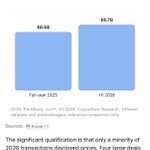
The broader M&A data supports the direction, although the market remains concentrated. Disclosed crypto acquisition value reached approximately $9.7 billion in the first half of 2026, with a small number of large transactions driving most of the total.
I expect more protocol teams to confront these decisions as the market matures.
The most interesting question is where economic value ultimately accrues.
Tokens provide mechanisms for governance, coordination, and economic participation. Their long-term value depends on how those mechanisms connect to genuine demand and durable economic activity.
A protocol with meaningful distribution and a sustainable business model has more strategic options. Others may find stronger economics through partnerships, acquisitions, or migration onto established networks.
The next phase will require teams that understand how to combine equity, tokens, infrastructure, and real businesses.
Many of the legal and economic structures are still developing. Founders will need to understand what they are transferring, what token holders retain, and who controls the resulting network.
We’ve already seen how complicated these arrangements become when technology, ownership, and market access have to work together.
MFV is already guiding several portfolio companies through what we call capability partnerships. I expect more founders to face those decisions as the next generation of protocols begins to consolidate.


Mo Shaikh 🇺🇸 retweeted

Meta is back. Google will be back. Everyone with the right context & data will increasingly compete with the frontier labs. We're rapidly heading towards a world with many competing intelligences. That's great news for consumers, businesses, and society. xitter.cf/ccatalini/status/21075…


always been a great time to be a founder if you know what you’re doing
GP’s always have benefitted from making good investments in the above, if they had the right access
LPS have a waste outsourced decision-making to GPs because they don’t have that specialty in house, likely never will for obvious reasons of scaling asset management



Mo Shaikh 🇺🇸 retweeted
"The invention of the boat reduced the importance of swimming, but enabled the discovery of new lands."
Beautiful analogy from @ylecun about the opportunities and changes with AI, in mathematics and in science more broadly.