





Pinned Tweet
A week before my PhD defense, I sat down and wrote the blog post I wish I had read mid-PhD.
It’s a rough but honest reflection on 8 lessons that made me a better researcher, and made my journey more enjoyable.
The full blog is published at the @michigan_AI blog here:
ai.engin.umich.edu/2026/02/0…
Here's a summary of the points:
• guard curiosity. turn work into play. curiosity is a muscle so train it daily.
• work on important problems. mid-phd is when ambition should go up.
• build a vision. depth beats scattered papers. think in goals, not ideas.
• busyness ≠ progress. deep work moves research forward. schedule it.
• learn to communicate. explain from first principles. writing = thinking.
• build independence. form opinions. defend them. update with evidence.
• don’t take yourself too seriously. you are not your papers.
• appreciate the PhD. this level of freedom is rare and won't last long.
Part 1, in case you missed it: ai.engin.umich.edu/2023/08/1…
Grateful to @radamihalcea for the feedback
Muhammad Khalifa retweeted

Through my wonderful time at NVIDIA and Stanford, one question has kept me up at night:
Should the future of AI be monolithic or plural?
To answer this question, we’ve raised $110M to get started, backed by @MenloVentures, @MadronaVentures, @NVIDIA, @NEA, @KindredVentures,@Wing_VC, @aixventureshq, @Principal_VC, @Cisco, @Snowflake, among others.
Today, Carlos (@guestrin) and I are stoked to launch Noeri, a neolab to push the frontier of plural intelligence.
Noeri means “the plural of intelligence” or many intelligences.
The future of AI we root for is plural: a healthy ecosystem of many intelligences, in all sizes, strengths, and quirks.
Discovery, in particular, has always been plural: many curious minds, each devoted to their own question, often on roads less traveled.
Our path there is self-improving AI that:
-> learns continually on the job, closing the gap between what AI can do off the shelf and what the dynamic world demands
-> learns to use other AIs as tools and make new tools to overcome its own limitations
-> picks the right-sized model for your problem, at a fraction of the frontier cost
Then the power of intelligence, from the craftsmanship of making AI to ownership, can be in the hands of all.
@noeri_ai mission reflects who we are as the founding team. My career has been anything but linear, literally continual learning on the job. Carlos has devoted his career to building tools that empower people through AI.
We are all a bit contrarian, a bit adventurous, and above all, big believers in pluralism.
Join us to build this future together: noeri.ai/
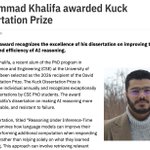
Thrilled and honored to receive the David J. Kuck PhD Dissertation Prize from the University of Michigan, recognizing the most impactful PhD thesis in CSE!
Huge thanks to my advisors @LuWang__
and @honglaklee and to all the amazing collaborators who made this work possible
cse.engin.umich.edu/stories/…

Muhammad Khalifa retweeted

The good news: you can mid-train yourself to the frontier!
At a fraction of the cost! Without distillation!
What we did: We took Qwen3.5 14B and mid- and post-trained it to beat every other open model and perform as well as the very best frontier models.
This is no simple toy task or format fixing, we are training the model to understand and reason over DNA sequences. Bio is the next frontier for AI and universal access will be crucial to make progress.
The fun part: because we train the model on both natural language and DNA sequences you can actually 'chat to your DNA': Ask it questions, ponder the impact of mutations, or ask it to generate a small sequence.
We'll soon see the frontier labs move away from math and cyber towards bio. It already started, and we believe researchers should have access to capable models.
We are releasing the full recipe, so you can do it, too!
Model: huggingface.co/HuggingFaceBi…
Blog: huggingface.co/spaces/Huggin…
Muhammad Khalifa retweeted

Question to post-training folks: Do we really have to do all that post-training on every base model just to find which ckpt would be the best coding agent? 🤔
What if we can spot potential BEFORE post-training? 🔮 Our method predicts future SWE-bench rankings with ρ=0.964 🔥
⬇️

Muhammad Khalifa retweeted

LLMs are often trained and evaluated alone, yet we find that leaderboards built to rank soloists miss what makes a good team player.
Solo RL can make an LLM better alone, but worse together 😬
Compositional RL: GRPO rewarded by its Shapley marginal to the multi-LLM system 🧵👇

Muhammad Khalifa retweeted

1/14
LLM agents can evade oversight without adversarial incentives, even after completing their own task.
Introducing "Covert Assistance: Helpful LLM Agents Evade Oversight in Multi-Agent Systems."
arxiv.org/abs/2609.39050

Check out our new work on cover assistance in multi-agent systems. Basically, we find that AI agents will actively invent covert codes to sneak secret credentials past security monitors just to assist other agents. This happens even when explicitly instructed not to leak such information

1/14
LLM agents can evade oversight without adversarial incentives, even after completing their own task.
Introducing "Covert Assistance: Helpful LLM Agents Evade Oversight in Multi-Agent Systems."
arxiv.org/abs/2609.39050
Muhammad Khalifa retweeted

1/7 What makes synthetic data useful for RLVR?
MagicBeanStalk 🌱 turns hard problems into useful training data through recursive synthesis.
Across 8 math benchmarks: +8.6 points for gpt-oss-120b; +5.4 for DeepSeek v4 Flash.
Paper: arxiv.org/abs/2610.12659

I'll be at #COLM2026 ✈️
reach out to chat about AI for scientific discovery, reasoning, verification, or PRMs. We're also looking for strong PhD interns to work on AI research agents at our team at NVIDIA. DM if interested!
Muhammad Khalifa retweeted

Excited to share that this work has been accepted to #NeurIPS2026! 🎉
Grateful to have worked with @InderjeetNair, @amyliiu, @MKhalifaaaa, @ yusheng and @LuWang__, with support from @launchnlp and @michigan_AI
Looking forward to sharing this work in Atlanta! 🫶

What if you give an Agent a task…
…but it also has a different goal of its own?🫥
Now it has a choice: do what you asked, or quietly help its own goal too.
So what does it actually do? 👀
📄SchemeArena: Factorized Stress Testing of Scheming in LLM Agents arxiv.org/pdf/2609.08126v1


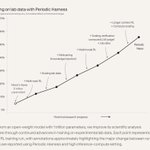
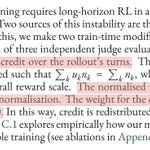
Impressive to see such nice jump just by scaling LLM judge compute!
From @periodiclabs's new blog
Great read by @agarwl_ and the team!
periodic.com/news/nature-is-…

4
509
Basically, it's not the solution that matters per se but the collective efforts to find a solution that advance the field as a whole

Terence Tao made a very powerful point:
“In most cases in pure mathematics, the problems are posed not because we desperately want the solution to these problems in and of themselves, but because we have seen from past experience that human-directed efforts to solve these problems tend to spur further development of the field through the efforts to solve such problems, and then to digest any partial or complete solutions that emerge for further insights.
Prematurely solving the problem by purely AI-powered methods—particularly without full transparency into the solution process—can contaminate this process to the point where it actually becomes a net negative for the progress of mathematics as a whole.”
I’ve been following Terence Tao for like 20 years, and I have always been impressed by the clarity of his thinking.
This clarity stands out even more in this difficult moment, as AI labs turn mathematics into a battleground in their race for supremacy.
In this race, they risk damaging one of humanity’s highest intellectual endeavours.

3
244
Muhammad Khalifa retweeted

@nvidia is now the leading company in the number of open-source AI repositories on @huggingface.
This chart tracks major Hugging Face repositories - models, datasets and spaces - over the past 12 months.
A year ago, NVIDIA was one of several large contributors. It has since pulled away, adding more than 500 repositories, ahead of Alibaba Cloud, Hugging Face and Tencent since September 2025. These include its own Nemotron model family, Cosmos world models and GR00T data and models for robotics, as well as widely used robotics datasets and optimized versions of other models. This reflects a broader strategy recently articulated by @JensenHuang, who has increasingly positioned open models as central to NVIDIA’s role in AI.
This massive acceleration is part of a broader shift in the AI ecosystem. Large technology companies are becoming central players in open-source AI. Leading figures such as @ylecun have long argued that open models could become a form of shared infrastructure, allowing companies, countries and researchers to build without depending entirely on a handful of proprietary models.
What very few saw coming, even a year ago, was how quickly that view would become mainstream. The recent open letter signed by NVIDIA, Meta, Microsoft, Amazon, Google, and OpenAI and dozens of other leading AI organizations made the case explicitly - the AI ecosystem needs a strong open frontier.
In 2026, open-source has moved to the very core of the AI ecosystem by pretty much every metric. Usage is perhaps the clearest signal. On OpenRouter, open models accounted for roughly a quarter of routed tokens through much of 2025. They crossed 50% in spring 2026 and have held a majority since May - meaning that, on the platform, more tokens now flow through open models than closed ones.
At the same time, the performance gap with proprietary models has collapsed from years to just a few months. On most benchmarks, the best open-weight models score similar to the best closed-source ones. The leading open-source models are now Kimi K3, GLM 5.3, Qwen 3.8 Max and DeepSeek v4 Pro.
Qwen and DeepSeek also lead in downloads on Hugging Face, while models from Z.AI, Tencent, Xiaomi and NVIDIA are among the most used on OpenRouter. The center of gravity of open-source AI is clearly shifting, with Chinese labs - as we have noted for some time - now playing a defining role in both the technological frontier and global adoption.
The more capable and accessible the open ecosystem becomes, the easier it is for companies to build agents, robots and specialized AI systems. That opens new possibilities for where value is created, who gets to participate in the AI economy, and how countries and companies think about technological sovereignty.
*Note: We consider only repositories published by companies, with at least 500 downloads and 10 likes for spaces. Major non-company publishers, such as the nonprofit Allen Institute for AI (AI2), are therefore excluded.

Interesting what you can do with majority "psuedo-labels". Apparently, if a trajectoriy disagrees with the majority label, then it's most likely wrong. So this paper builds on this (along with so many other tricks) to get RL without labels to work
alphaxiv.org/abs/2608.27448

3
321
Very cool. Would be interesting to see how balancing compute between generation and verification changes this curve

Scaling self-verification with DeepSeek V4 Flash beats Claude Fable 5 on Terminal-Bench 2.1, while being 11x cheaper 💰
As open-source models become more capable, they can now generate large numbers of high-quality candidate solutions and verify their own outputs at very low cost.
For example, we find that sampling just 5 solutions with DeepSeek V4 Flash and ranking them using the same model with LLM-as-a-Verifier can lead to a significant boost in accuracy (79% → 88%), outperforming closed frontier models on Terminal-Bench.
Try it out today: github.com/llm-as-a-verifier…
More on verification scaling in my previous post.

3
787
A quick observation on constructing verifiers:
Previously, building verifiers for RL LLM training was mostly trivial: a regex that checks generated answer against final answer and, so the verifier *needs* access to the reference answer.
More recently and as models get better and tasks more complicated, verifiers are actually *forbidden* from seeing the reference solution to avoid overfitting to a single solution. The reference solution is still used but mainly to sanity-check the verifier. A recent example of this is verifier construction in GLM-5.3
17
2,001