

Connecting with over 350,000 of @Makerere University Alumni community from across the 10 constituent Colleges #MakerereAlumni
Kampala, Uganda
Joined July 2013
- Tweets1.7K
- Following159
- Followers1.5K
- Likes1.1K



Makerere Advancement Office retweeted

My first time to own a computer was at Makerere university, I joined it so green.
I left Makerere a Medical doctor, writing software and building Startups, also acquired political skills, analytical skills, and much more.
We used to say, Makerere is a hill of endless possibilities and it's true. You can become so much than just acquiring a degree.
Still the more I acquired so much from the University, the deeper I realised how further I would've gone if the university was at the best of its glory like it used to be.
Even after realising how much I never acquired from Makerere due to it's declining potential, there's no place in Uganda or East Africa where I would've been exposed to all the knowledge, the skilling and the resources like I was at Muk.
When we say the university needs to be revamped, don't be deceived that it's supposed to be revamped to national standards, even at it's worst performance, Muk is the greatest University in East Africa. That's why I felt so angry seeing people comparing Makerere to local universities.
Even the university socials celebrated Muk being ranked number one in East Africa for another time in a row!!!! This is an embarrassment. It would've been news if it wasn't.
Nothing Special about Muk!!
I would've said this is one of the dumbest statement I have read this year but it's also important to enlighten those who lack exposure.
1. Makerere has the biggest laboratories in the country in Microbiology, immunology, agriculture, biochemistry, food science, engineering etc that if you're doing research, you would gain so much.
2. Makerere is the only university that receives internet directly from NBI and the only that gets more than 2.4gbps that if I'm doing research and need direct access to super fast internet, Makerere is your go to.
3. The Alumni network, Makerere has an Alumnus in every company in this country. Name it and I will tell you it's alumnus. Not doing cleaning but top office. This goes even beyond Uganda. Also something the university hasn't explored to it's roots.
4. Global Networks, Muk has connections to Microsoft, Google, MIT, Berkeley, KOICA, Bill and Melinda Foundation, IDI, MaRCCI, The Carnegie Corporation of New York, Rockefeller Foundation etc. This is one of the reasons why many lecturers join Muk to tap into this global network. Though end up not doing much of lecturing but if you had so much education, you would realise an affiliation to Muk is enough to propell you to global networks. Many have raised money through this affiliation.
5. Makerere has the highest concentration of brains in this country, that's why many government policies have a citation of professors and lecturers from there.
6. Makerere admissions are only given to the cream of the country. This means, it has the highest concentration of the best students of this country. This even should be a concern because we expect a lot from them.
7. If you want to study Nano technology, Makerere has the only laboratory in Uganda, Muk also extends to being the only place with some of the rarest micro organisms in the banker for research.
8. Makerere has raised so much money in research than all East African universities combined.
Many more.
Muk is so special that when you get to know how special it is, you feel so bad that it's not exploiting it's true potential.
I can talk about all things that make Muk special but will need the whole day.
As an alumnus, I will tell you that walking through the gates of Makerere, you see so much that you get heart broken that it's not utilized to it's fullest.
For example, I started building Startups when I was at the university, Makerere has all this network of alumni, a very special network but cannot build a VC valley to fund Startups straight from dorm rooms. Some will say there's incubation hubs but that's for small universities, Muk has potential to have a fully fledged VC base.

.@Makerere University’s high-level delegation, led by the Chairperson of Council, Dr. @MagaraLorna, visited Ghent University in Belgium to explore new pathways for research, academic exchange and institutional collaboration.
Building on the existing institutional MoU and Staff/Student Exchange Agreement, discussions focused on strengthening health research and medical training, drawing lessons from Ghent University Hospital and its shared biomedical research infrastructure, The CORE, and exploring opportunities for doctoral training and expanding staff and student mobility.
The delegation also engaged Ghent’s Career Centre and Gentrepreneur to exchange ideas on career development, entrepreneurship and employer engagement, while exploring how alumni networks can connect students to mentorship, internships and professional opportunities.
The next frontier for the Ghent–Makerere partnership is to translate these engagements into a joint action plan identifying research areas, institutional leads and funding opportunities; expanding academic exchanges to health sciences, veterinary medicine and engineering; identifying Makerere candidates and Ghent supervisors for the February 2027 sandwich PhD scholarship call; and applying lessons from Ghent to the development of Makerere’s Teaching and Research Hospital and Students Career Services Centre.
These efforts aim to translate the Makerere–Ghent partnership into tangible research outcomes, stronger institutional capacity and expanded opportunities for students and staff.
#MakererePartnerships #GhentUniversity #GlobalPartnerships #ResearchAndInnovation


.@Makerere and @Biocosmosmak (Biocosmos Uganda) are exploring a structured academic partnership to advance research, faculty engagement, and student participation in scientific inquiry grounded in Intelligent Design theory.
Discussions focused on curating academic forums for public debates and knowledge creation, digital learning, and student-led initiatives that encourage critical thinking and evidence-based dialogue.
The proposed collaboration seeks to strengthen local academic leadership while creating space to examine emerging ideas in biology, physics and cosmology.
The next step: The partnership looks forward to translating the MoU into a practical, five-year roadmap for engagement.
#MakererePartnerships #ResearchAndInnovation #AcademicPartnerships


Meet Mr. John Kamya, the longest serving warden of @nkrumahhall, @Makerere.
He had the privilege of serving the land of Osagyefo from 2007 to 2020👏🏾.
Today, we honor his service, his sacrifice, dedication, diligence and integrity.
#NkrumahDay2026
#MakerereAlumni


4
130
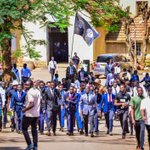
📸Moments from the Nkrumah Day Public Lecture.
It has truly been electric, nostalgic at the #NkrumahDay2026 with all the various @nkrumahhall alumni and residing students.
#MakerereAlumni


Key Reflections from the Nkrumah Day Public Lecture Panel Discussion
💡Mr. @SamsonMKasumba challenged us to examine whether the weaknesses in our education system begin before university and whether inherited ideas of sovereignty constrain Pan-African unity. He ultimately emphasised individual responsibility: strong institutions require responsible citizens, because no system can deliver transformation if people’s behaviour continually undermines it.
💡Prof. Zahara Nampewo, from @MakerereLaw challenged us to rethink the purpose of education. Nkrumah wanted critical thinkers, not graduates who merely regurgitate what they had learnt. Universities may produce degrees, but the real question is whether graduates can transform knowledge into solutions for society. Education is only the beginning; graduates must be willing to engage with real problems, create opportunities and use their knowledge to liberate, create and transform.
She also emphasised the need to connect university education with Uganda’s large informal sector. Whether in economics, law, medicine or agriculture, graduates should see themselves as actors capable of solving problems within their communities—not simply as job seekers waiting for formal employment.
💡Dr. Zaid Sekitto from @MakerereCHUSS brought the historical and Pan-African perspective, reminding us that political independence alone is insufficient. Drawing on Nkrumah and Nyerere, he highlighted the need for economic, intellectual and cultural independence, while challenging contemporary African leaders to confront the colonial structures that remain embedded in our institutions.
He also emphasised that Africa is politically sovereign but remains insufficiently united. Nkrumah’s conviction that “I am African because Africa lives in me” remains a powerful challenge to a generation that must think beyond individual national interests and strengthen continental unity.
💡@PeterCKyajja offered a different but complementary perspective on identity-based associations such as Nkobazambogo. Rather than seeing smaller communities as obstacles to Pan-African unity, he argued that they can become launchpads for learning the power of synergy and collective action.
The path can move from local communities to national cooperation, then to East African and ultimately continental integration. What unites us, he argued, does not necessarily have to be language or identity, but the common problems we face and our shared commitment to improving people’s lives.
💡Rt. Hon. @rodney_adroni reflected on why Nkrumah’s ideas continue to command attention decades after his death. He identified three qualities that contemporary leaders can learn from Nkrumah: foresight, ideological clarity and decisiveness.
Nkrumah anticipated the persistence of neocolonialism and the economic, intellectual and cultural forms of dependence that could survive political independence. For today’s emerging leaders, Rodney argued, ideological clarity is essential to developing and articulating a meaningful vision, while decisiveness is necessary to act on that vision.
He also reminded us that the purpose of studying history is not simply to remember the past, but to understand what prevented the full realisation of Pan-Africanism and use those lessons to reimagine Africa for the present and future.
💎Across the different perspectives, one message stood out:
Nkrumah’s legacy cannot remain a subject of commemoration. It must become a call to action.
The challenge before this generation is to turn education into solutions, knowledge into innovation, sovereignty into self-reliance, diversity into synergy, and individual brilliance into stronger institutions.
The question is no longer simply what Nkrumah envisioned for Africa, but what we are prepared to do with that vision today.
#NkrumahDay2026
#MakerereAlumni


The Keynote Address by Prof. Gerald Karyeijja, Policy Analyst and Head of Quality Assurance, @UMIUganda
Key reflections from the Nkrumah Day Public Lecture at Makerere University.
The keynote was a powerful reflection on what Nkrumah’s vision of African independence demands of our generation.
Transformation is not only about procedures, systems and processes. It is also about character. Strong institutions require people of integrity; economic transformation requires ethical leadership; public trust demands responsible stewardship.
Drawing on Psalm 24, the speaker reminded us that our talents, resources and opportunities are not possessions to exploit, but trusts to manage wisely.
Africa already has the talent and ingenuity to transform itself. Young Africans are building businesses, technologies, advancing science, creating art and developing social innovations. These are not isolated miracles—they are seeds of transformation. Our task is to identify what works, strengthen it, connect it and scale it.
Makerere’s historic contribution to African leadership and scholarship also carries a responsibility: to produce not merely graduates, but problem-solvers committed to Africa’s transformation.
Education, the speaker stressed, must produce more than credentials. The ultimate measure of education is the character it forms and the contribution it inspires. No degree, title or academic credential can match integrity.
In the age of AI, robotics and digital platforms, Africa must also decide whether it will consume the future or create it. Technology must become an opportunity for African ingenuity, ownership and value creation—not another frontier of dependency.
For young people, the message was clear: do not wait for permission to lead. You are not waiting for Africa’s future; you are already building it.
Nkrumah’s generation fought for political freedom. Our generation must deepen economic independence.
We inherit universities—we must make them centres of African innovation.
We inherit resources—we must capture more value from them.
We inherit technology—we must become creators and owners of it.
We inherit institutions—we must strengthen them.
The keynote concluded with five commitments:
Lead with integrity.
Build with confidence.
Decolonize the mind.
Africanize knowledge.
Transform with purpose.
And perhaps the most powerful closing thought:
We should not honour Nkrumah merely by saying, “We remember you.”
We should be able to say:
“We heard you.”
We are decolonizing minds.
We are Africanizing institutions.
We are indigenizing innovation.
We are building the future.
The responsibility is ours.
#NkrumahDay2026
#MakerereAlumni


Today, we not only honour the legacy of the late Osagyefo Kwame Nkrumah, but we also celebrate with all our @makerere, @nkrumah_hall alumni who once resided in the walls of Nkrumah Hall.
A legacy that spans decades! A legacy of power, patriotism, leadership, hardwork and Unity, in Makerere and in the world after University.
To all our alumni from the Osagyefo Land, a happy Nkrumah Day to you all💪🏽!
#MakerereAlumni
#NkrumahDay2026


76
Makerere Advancement Office retweeted
Leadership is not a title that will handed over to you once you are grown, richer or ready, leadership is a personal responsibility handed over to each of us the moment we step into the walls of @nkrumah_hall .
Let us pick a leaf from Kwame Nkrumah and be active participants of change to see the Africa he hoped for. ~ Ssenkabira Joseph, Chairman, @nkrumah_hall
#NkrumahHall2026
#MakerereAlumni


Forward ever, Backward never! This was Kwame Nkrumah’s mantra which the gentlemen of Nkrumah hall stand by! ~ Ssenkabira Joseph, Chairman, @nkrumah_hall
Side note📝 : Nkrumah Hall, a residence for the male students was named after Kwame Nkrumah in the spirit of patriotism. Today we commemorate his legacy at @Makerere with the alumni and current residents of @nkrumah_hall.
#Makererealumni
#NkrumahDay2026


Leadership is not a title that will handed over to you once you are grown, richer or ready, leadership is a personal responsibility handed over to each of us the moment we step into the walls of @nkrumah_hall .
Let us pick a leaf from Kwame Nkrumah and be active participants of change to see the Africa he hoped for. ~ Ssenkabira Joseph, Chairman, @nkrumah_hall
#NkrumahHall2026
#MakerereAlumni
Meet our Panellists for #NkrumahDay2026! 🎙️
Bringing diverse perspectives to the Nkrumah Day Public Lecture:
1. Prof. @SsaliSarah — First Deputy Vice Chancellor (Academic Affairs), @Makerere, and Professor of Gender & Development Studies. Her work spans public policy, social transformation, gender, health systems and identity.
2. Dr. Zaid Sekito — Historian and Lecturer, Department of History, Archaeology & Heritage Studies, Makerere University. His scholarship focuses on history, peace & conflict, terrorism, human rights and youth agency.
3. @PeterCKyajja (ESQ) — President, Baganda Nkobazambogo Students' Association, former Makerere Guild presidential candidate, bringing a youth and student leadership perspective to the conversation.
4. Rt. Hon. @rodney_adroni — Youth leader, former Makerere Guild Prime Minister and Speaker of the 8th National Youth Parliament, with experience in youth engagement and policy advocacy.
Join us as we explore Leadership, self-reliance, and transformation: Reimagining Nkrumah’s Vision for 21st-century African Youth.
📅 8 Oct | 2 PM
📍 Yusuf Lule CTF, Auditorium, Makerere University
#NkrumahDay2026


Meet our Keynote Speaker for #NkrumahDay2026!
Prof. Gerald Kagambirwe Karyeija, a policy analyst and Head of Quality Assurance at the Uganda Management Institute (@UMIUganda), will deliver the keynote address at the Nkrumah Day Public Lecture.
Prof. Gerald Kagambirwe Karyeija is a Ugandan scholar and public administration expert specialising in governance, leadership, public policy, public-sector management and institutional development.
He holds a PhD and a Master's in Philosophy in Public Administration and Organisation Theory from the University of Bergen, Norway and a Bachelor’s degree in Political Science and Public Administration from Makerere University.
He has over 20 years of experience in teaching, research, consultancy and professional training in governance, leadership and public administration. His research interests include leadership, governance, democracy, public policy, corruption, parliamentary studies and local governance.
He has also contributed to government policy development and trained public-sector leaders, including members of Uganda's Cabinet and Parliament. He is a regular commentator on governance and public affairs in the media.

Meet our Chief Guest for #NkrumahDay2026
We will be honoured to welcome Rt. Hon. Dr. C.W.C.B. Kiyonga, Chancellor, @Makerere, Second Deputy Prime Minister and Deputy Leader of Government Business in Parliament.
Dr. Crispus Walter Kiyonga is the fourth non-Head-of-State Chancellor of Makerere University. He is a Ugandan physician, politician and diplomat who has previously served as Uganda’s Ambassador to China and as the Minister of Defence in the Government of Uganda (2006 - 2016).
Before that, he served as Minister without Portfolio in the Office of the President and National Political Commissar (2001 - 2006), Minister of Health (1996 - 2001), Minister of Internal Affairs (1994 - 1996), Minister of Finance (1986 - 1992) and Minister for Cooperatives and Marketing (1986).
He is a gallant alumnus of @Makerere, having graduated with the Bachelor of Medicine and Bachelor of Surgery (MBChB) in 1978. He also holds a Master of Health Science (MHS) with specialisation in Population Dynamics from the Johns Hopkins School of Public Health (2004).
📍 Yusuf Lule CTF | 2 PM


Nkrumah Day is coming to Makerere University! 🇬🇭🇺🇬
Join us for the Nkrumah Day Public Lecture under the theme:
“Leadership, Self-Reliance & Transformation: Reimagining Nkrumah’s Vision for the 21st Century African Youth.”
📅 8 Oct | 2:00 PM
📍 Yusuf Lule CTF
#NkrumahDay2026

Makerere Advancement Office retweeted

Thank you for the warm welcome and wonderful discussion today. Let us stay in touch for further cooperation and academic exchanges.@ProfNawangwe @Makerere
#ウガンダ の名門マケレレ大学を訪問しました。神戸大学、東京大学、千葉大学他の多くの日本の大学と交換留学や交流があります。

Earlier today, VC @ProfNawangwe and Members of Management welcomed H.E. Ambassador TAKAHASHI Misako, Director-General/Assistant Minister for African Affairs, Ministry of Foreign Affairs of Japan (@DGafricaJP) and her delegation to discuss ways of deepening our academic and technical collaboration.
The VC acknowledged and appreciated the long-standing partnership between the University and Japanese institutions; both private and government, and thanked H.E. TAKAHASHI for creating time in her itinerary to visit Makerere.
H.E. TAKAHASHI affirmed that “Japan is deliberately thinking about the sustainable development of Uganda”, as a symbol of their friendship with institutions and the people of Uganda.
She noted that the Tokyo International Conference on African Development (TICAD) where "President Museveni is a long-standing participant” is a vital platform for sharing Japan’s various interests in Africa. She also talked about the Free and Open Indo-Pacific (FIOP) Principle, and Japan’s three pillars for Africa.
“The three pillars of Japanese foreign policy towards Africa include; realising a continent of peace in Africa, creating a virtuous cycle of growth between Japan and Africa, and realising a society where everyone can feel genuine prosperity through empowering young generation for co-creation,” H.E TAKAHASHI noted.
@ProfNawangwe noted that the brief session had brought forth a number important issues for discussion, which will enhance collaborations between Makerere, the Embassy of Japan, and the people of Japan in general.
Some of the key areas highlighted with existing collaborations;
Engineering and Infrastructure
Traffic Management
Health and Veterinary Sciences
Students and staff exchange
Space science
Disaster prevention
Capacity building and volunteers
Library and cultural resources
Makerere currently partners with a number of Japanese Universities including; University of Kobe, University of Tokyo, Kyoto University, Tottori University, among others.
We appreciate the government of Japan for an impactful collaboration over the years as “We Build for the Future”.
Details: news.mak.ac.ug/2026/09/deepe…


Nkrumah Day is coming to Makerere University! 🇬🇭🇺🇬
Join us for the Nkrumah Day Public Lecture under the theme:
“Leadership, Self-Reliance & Transformation: Reimagining Nkrumah’s Vision for the 21st Century African Youth.”
📅 8 Oct | 2:00 PM
📍 Yusuf Lule CTF
#NkrumahDay2026
Happening on 8th October: The Annual Nkrumah Day Public Lecture.
In the spirit of patriotism, @nkrumah_hall residents will celebrate Kwame Nkrumah with a public lecture where we will re-imagine Nkrumah’s vision for today’s African Youth.
🗓️: 8th October 2026
🏢: The Yusuf Lule, CTF 2, Auditorium.
⏰: 2:00pm
