







“The censors of yesterday tried to burn books. The censors of today try to drown us in fake information and lies. Is this the first time in history that we will fight for access to less information as it means more truth?”
@rhodes_trust #techandsociety2026

1
2
136
Jane J Hamilton ✍️ retweeted

Starting to really understand why a core theme of dystopian novels is that nobody reads
Jane J Hamilton ✍️ retweeted

I find articles like this hilarious. They're written as though there's this thing happening that we can't explain.
Look at the data... quiet quitting is particularly pronounced among Gen Z and younger millennials.
Then look at the backdrop to their careers. These people have watched their futures being spent on bailouts, lockdowns and furlough.
Even if you work extremely hard and earn promotions (which is far from guaranteed), wages in the UK are so crap, and the cost of living so high, that the rewards often amount to very little.
The extra pay can be negligible. The extra effort and responsibility are not.
And if you've worked hard, trained and made your way up the greasy corporate pole, there's a good chance you've watched entry-level wages creep ever closer to yours. You might reasonably be asking yourself why you bothered in the first place.
Since the pandemic began, the National Living Wage has increased by nearly 55%. If you're someone with years of experience, training, progression and hard work under your belt, and your wages haven't kept pace, why wouldn't you question the value of all that effort?
The incentive has been inverted.
This is wage compression, and we're now witnessing the second- and third-order effects governments seem so oblivious to. When the financial reward for taking on more responsibility diminishes, so does the incentive to do it.
And this is what's happening. People are moving the dial they actually have control over… how much they give a shit about their job. And I don't blame them.
I think people are also starting to realise that much of the reward for their hard work is swallowed up by the ever-growing, increasingly wasteful blob that is the British state.
It's like having someone sitting on your shoulders, stealing half your food, getting heavier by the day, and repeatedly slapping you around the face as you try to go about your life.

'Quiet quitting' could be hitting the economy - here's why bbc.in/4ijTORZ

“If the emphasis on the Western world is on individual rights and needs, it’s no surprise that so many people struggle in the workplace where a collective effort and an understanding of others is needed.”
@acadofideas #BattleFest

“We are condemning a generation to incapacity rather than capacity.”
A great debate on fixing the Neets crisis at the Battle of Ideas Festival #BattleFest @acadofideas

Jane J Hamilton ✍️ retweeted

Wow. I woke up to an impressive number of upset people who apparently don’t understand how LLMs work and can’t cope well with me pointing it out.
An LLM is a statistical next-token prediction model. That’s how it works. It’s an extraordinarily sophisticated calculator performing math you could theoretically do by hand (if you were sufficiently masochistic).
Math doesn’t know what it’s calculating. Pi doesn’t spend its evenings contemplating the nature of circles, and c doesn’t ponder the relationship between matter and energy.
That doesn’t make the results any less accurate, impressive, or useful.
Between inference requests, an LLM isn’t sitting around thinking. It isn’t reconsidering its answers, wondering whether it made a mistake, contemplating its existence, or questioning whether it’s conscious. Its weights remain fixed (it doesn’t learn), and computation resumes when it receives input.
We know this because we designed these systems. The architectures, mathematics, implementations, and research are extensively documented. You can study them yourself.
Of course, some people immediately lean into comparisons of biological intelligence or philosophical debates over consciousness because that is what they know.
But biological intelligence and artificial neural networks are fundamentally different systems. Similar outputs don’t establish equivalent internal experiences.
I experience consciousness directly. I infer that other humans do too because we share biological structures and processes. We don’t have equivalent evidence for an LLM, and nothing about its known operation gives evidence of conscious experience.
Which brings me back to my original point.
To me, understanding is conscious comprehension. It means being aware of information, recognizing its meaning, and experiencing that comprehension. If I wasn’t conscious I could not understand.
We can perform actions unconsciously. We can produce correct results without knowing why they’re correct. But I distinguish those capabilities from consciously understanding what we’re doing.
An LLM can solve complex problems, explain difficult concepts, and produce remarkably accurate information. I give it full credit for those capabilities.
But producing an answer that we rationalize as understanding isn’t the same as experiencing understanding.
You don’t have to agree with my definitions. We can debate functional understanding versus conscious comprehension all day, but that won’t establish whether an LLM actually experiences anything.
The right debate is this…
Could machines exhibit something different from human consciousness, something measurable, meaningful, and worth studying?
I think so, absolutely!
I’m entirely open to discussing “machine consciousness” in terms of observable, testable computational properties. We built these systems, we can instrument them, examine their internal mechanisms, and investigate what they’re capable of.
That seems far more productive than endlessly arguing over whether a machine experiences life the way humans do.
So here’s my question:
How would you define machine consciousness, and more importantly, how would you measure it?

Jane J Hamilton ✍️ retweeted

One my friends sent this beautiful post explaining Karma. I thought it’s worth sharing 😊

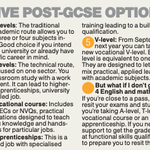
These aren't the most exciting images I've ever posted, but they may be the most useful.
🤞 If you're collecting your GCSE results today, here's all your next options
🧑🏭 If you're an employer, demand for apprenticeships at 16 is on the up. Here's how to help
#GCSEs


2
171
❌ Don’t let anyone else decide your future for you.
Here's my guide to your next steps on A-Level, BTEC and T-Level results day
linkedin.com/feed/update/urn…
#ResultsDay2026 #AlevelResults #ResultsDay

3
308
Jane J Hamilton ✍️ retweeted

This is one of the most famous paintings in the world, and almost no one knows the haunting story of the woman lying in the water...
This is Ophelia, by John Everett Millais, finished in 1852. The scene is from Hamlet, the young woman who loses her mind after the man she loves kills her father, and drowns in a stream while singing and gathering flowers.
Millais caught the instant before she goes under, hands open, lips still parted in song, her gown pulling her down. In the play, her death is almost a throwaway. It happens offstage, and the queen simply reports it afterward:
"There is a willow grows aslant a brook... When down her weedy trophies and herself fell in the weeping brook."
A few more lines, and the story moves on. Millais took that half-second and spent the better part of a year on it.
Every flower in the water is real, painted with the obsessive botanical precision the Pre-Raphaelites were famous for, and almost every one carries a hidden meaning. The pansies floating on her dress stood for love in vain. The violets around her neck meant faithfulness. The daisy near her hand, innocence. The weeping willow leaning over her was the old symbol of forsaken love. And bright against her gown, one red poppy: the flower of sleep and death, which Shakespeare never mentioned, and which Millais added himself. He built the whole tragedy into the foliage, in a language his Victorian viewers could read like text, and which we drift right past today.
To get the water right, Millais did something extraordinary: he painted the river first, outdoors, on the banks of a stream in Surrey, sitting there for five months, recording every leaf and reed. Then, through the following winter, he painted the girl. Her name was Elizabeth Siddal. She was twenty-two, discovered working in a hat shop, and she would become the great tragic figure of this whole story.
To pose as the drowning Ophelia, Siddal lay for hours in a bathtub of water in Millais’s studio, wearing an antique silver gown he had bought for the purpose. It was winter, so he set oil lamps beneath the tub to keep the water warm. One day, absorbed in his work, Millais did not notice that the lamps had gone out. Siddal, the perfect model, said nothing and did not move, and lay there in the freezing water until the session ended. She caught a severe cold that turned to pneumonia.
She recovered, but never fully, and she never posed for Millais again. And here is the detail that turns this painting into something almost unbearable to look at: ten years later Elizabeth Siddal died of an overdose of laudanum, the opium drug that Victorians took by the spoonful. She was thirty-two.
Look again at that single red poppy Millais slipped into the picture, the flower that has always meant both sleep and death, and that opium is made from.
He painted a beautiful young woman playing a girl who drowns. He could not have known he was also depicting her fate.
Some paintings do not stay inside their frames...


Jane J Hamilton ✍️ retweeted

The last match up this big between England and Norway was at Stamford Bridge... in 1066...
We won that one, but lost to France in the final. 960 years of hurt..

Jane J Hamilton ✍️ retweeted

Every person who wants to make a difference at some point has to decide whether they care more about the peoples lives they’re changing or the peoples opinions they’re offending.


👇

My latest in the @FT today. I make four points:
1) Capitalism's great achievement was moving activity out of the household and into the market — turning domestic production into paid specialisation, creating jobs, and making output visible to the national accounts. AI-enabled self-service might quietly reverse that centuries-long trend.
2) When a technology automates tasks within a service, it can trigger a Jevons paradox: the service gets cheaper, demand expands, and employment grows. When it lets people do the work themselves, demand for the service collapses.
3) AI extends this even to the manual trades, the supposed safe haven of the AI age. If a homeowner can ask a chatbot why their boiler keeps losing pressure, heating engineers lose call-outs.
4) When work shifts to the consumer, it vanishes from the economy statisticians measure. Replace a billing department with a chatbot and a firm records lower costs and higher output per worker; the national accounts register a productivity gain. But the hours patients spend decoding their own test results appear nowhere — not in labour statistics, not in GDP. As self-service spreads into professional domains, that blind spot will grow.

125