

Numbers guy in a narrative market. Reading the onchain data behind what’s moving in crypto. Partnerships: https://xitter.cf/t.co/oALD9GzyfL
blockchain
Joined October 2012
- Tweets118K
- Following2.2K
- Followers30.5K
- Likes146K







This is the dream @Visa Crypto Labs is building toward.
In the same interview, @cuysheffield said AI agents are only moving about $50K a week onchain . He called it nothing, and said it hasn’t really grown in six to eight months .
That shows how early this is.
The payment rails work, but trust is a big missing piece. Visa’s answer is to let people verify their agent with a Visa card, so a real person is behind it. That helps a lot, but agents still need real work that people want to pay for .
If builders keep solving trust and real use cases keep showing up, I think that number looks very different in a few years.
Most of what I know about risk, I learned by getting it wrong.
Everyone gets warned about leverage. Most people don't really listen until they get liquidated.
After that, you size smaller, use stops, and care more about staying in the game than winning big.
What was the loss that taught you the most?
My first on-chain lottery is coming to @coinlotto_xyz, and I want to start it by giving back to you guys.
I’m picking 10 people to get a FREE ticket to my lottery, so you get a shot at the prize pool without spending anything.
How to enter:
Connect your wallet here: coinlotto.xyz/?ref=Jeff
Follow @coinlotto_xyz
Join the Telegram: t.me/coinlotto_xyz
Join the Discord: discord.com/invite/coinlotto
Like, repost and drop your EVM wallet in the comments
I’ll pick the 10 winners and send their tickets when the giveaway closes.
5 days to enter.

Stocks just had their best day in over a year and a half and Bitcoin couldn't hold the bounce.
The Nasdaq closed up 6.5% on Monday. Bitcoin popped above $64K, then slid all the way back down, and Bitcoin ETFs still saw about $570M go out the same day.
I honestly thought a day like that would drag crypto up with it.

Seeing this happen on Aave again honestly worries me, and it’s not the first time.
This is supposed to be decentralized. People shouldn’t wake up blocked from the app their money is in with no explanation.
If a wallet has to be blocked, at least tell people why and give them a way to sort it out.
@aave @trmlabs is there any plan to give users a proper way to appeal?


If you slept through the weekend, Bitcoin looks like it barely moved.
In between, it dropped to around $55K and took about $2B of longs with it, then bounced back near $60K and wiped out a few hundred million in shorts on the way up.
The chart looks calm now, which is funny considering what it did to everyone who was trading it.

Anthropic IPO buyers were up 17% at yesterday’s close, and pre-market today that’s already down to single digits.
Anyone who bought the open was down about 13% by the close, and they’re deeper in the red this morning.
SpaceX also popped on its first day in June and was below its IPO price five weeks later, so I wouldn’t read too much into day one.

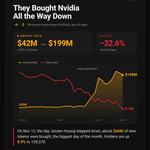
Nvidia had a terrible few weeks and people onchain just kept buying it.
Jensen Huang stepped down and the stock has lost more than a third since its October record.
Over the last 30 days, the amount held in Binance’s Nvidia token went from $42M to $199M.
The token’s price dropped by about a third in that time too, so people were buying more of it while it fell.
Could be the dip buy of the year or a very expensive lesson, either way they didn’t wait for the drama to end.

Your idle USDC is making money every month, just not for you.
Circle earned $189M from USDC reserves in the last 30 days and Tether earned $491M. That’s around 3.3% a year on every dollar sitting in people’s wallets, and the holder gets 0% of it.
Tokenized Treasury funds pay that kind of yield straight to the person holding them. Not every dollar you own needs to sit there, but it’s worth knowing the option exists.

If you’ve ever bought a lottery ticket, you know how it works.
You pay, you wait, and you trust whoever runs the draw.
@coinlotto_xyz is a lottery that runs on the blockchain, and you can check the draw yourself.
Ticket sales, the prize pool, the draw and the payouts are all recorded there for anyone to see, and the winner is picked by Chainlink VRF, a random draw that can’t be tampered with.
The prize money doesn’t sit with a company or the host either. It’s held in the lottery’s smart contract until the winner claims it.
You don’t need to sign up. Just connect your wallet and buy a ticket with crypto.
You can use it in three ways:
- Play: join weekly lotteries, with tickets from 1 USDT
- Launch: start your own lottery for your community in a few minutes, set the ticket price, prize split and draw date, and keep a share of ticket sales as the creator
- Earn: share your link and get half of the platform’s fee on tickets your friends buy
It’s live on Ethereum, BNB Chain and Base, with Robinhood Chain coming soon.
Have a look here:
go.coinlotto.xyz/4t0lE8j
Play for fun, and only with money you can afford to lose.
🤝 Paid partnership

If you’re wondering why Nvidia only moved about 4% after crushing earnings, the answer wasn’t in the report.
The numbers were great. Revenue more than doubled from a year ago to over $115B, and guidance for next quarter came in strong.
But strong numbers from Nvidia were already expected.
What the market is actually trying to price in is what Nvidia looks like without Jensen Huang.
He stepped down last week, and on the earnings call, the board confirmed they have no plans to bring him back. They wouldn’t even take questions about why he left.
Great earnings tell you how a company did last quarter. They can’t tell you who’s running it next year.
That’s why the reaction felt like relief instead of excitement.
A hardware wallet protects you from the exchange.
An exchange protects you from your own mistakes.
Neither protects you from everything.
This year showed it.
Exchanges took the biggest hits. Binance lost around $6.3B last month, the largest crypto theft on record, and Bitget lost around $350M in September.
In both cases, the exchange said it covered the loss in full. Binance users just couldn’t withdraw for a few days while it was sorted out.
Hardware wallets had a different kind of year.
A flaw in how some Coldcard devices created recovery phrases let attackers drain around $116M. Ledger devices sold through one reseller had a hidden chip that sent recovery phrases out, and around $90M was taken.
No refunds have been announced for either.
With an exchange, you’re mostly trusting the company to stay honest and stay afloat. With a hardware wallet, you’re trusting the device, where you bought it, and yourself.
And there are two risks neither one fixes.
The first is your personal details. Exchanges hold your ID and your balance, and hardware wallet companies, through their online stores and delivery partners, have leaked names and home addresses more than once this year. That kind of data is what gets people targeted in real life.
The second is scams. A fake login page can empty an exchange account, and a drainer link or someone asking for your recovery phrase can empty a hardware wallet.
So it comes down to which risk you’d rather carry. For money you trade often, an exchange makes sense. For money you plan to hold for years, a hardware wallet bought directly from the company makes more sense.
Which one would you trust more with your long-term savings?

Both @atoma_fi vaults have made about $33K so far.
One made close to half of it from trading. The other made most of it in points.
That gap is the first thing to understand before you deposit.
- Atoma RWA is the trading vault.
It looks for small price differences on stocks, indices and commodities across exchanges, and sets its trades up so that a move up or down mostly cancels out.
Points come in on top.
That’s why about half of its return is trading gains, earned in USDC.
- Atoma Index is the points vault.
It moves money to whichever exchange is paying the best rewards at the time, and keeps trading for a profit while it’s there.
That’s why close to 80% of what it has made is points from exchanges like Lighter.
So the real question is what you want your return to depend on.
With RWA, it leans on how well the trading goes.
With Index, it leans on what those exchange points end up being worth.
Two things to keep in mind.
Points value is an estimate until those exchanges decide what their points are worth.
And balanced trades still carry risk. Fees between traders can turn against it, an exchange can have problems, and code can break.
You can start either one with about 100 USDC.
Which one fits you better?
app.atoma.fi
🤝 Paid partnership

It’s been a rough few weeks in crypto, but not for everyone.
Some parts of trading took the biggest hit, especially memecoins. Over the last 30 days, Uniswap fees fell 36% and pump fun fees fell 20%.
Funny enough, pump fun actually got about 13% more users. They just spent a lot less.
Stablecoins shrank too, with about $11.8B leaving USDT and USDC.
But a few corners kept growing:
- Predictions: Polymarket volume rose about 17% to $6.1B, with the US midterms helping, so people are still betting on real world events
- Lending: there’s less money in Aave and Morpho than a month ago, but the people who stayed earned more, likely as rates rose and liquidations piled up
- Staking: Lido and Ether.fi fees still rose about 5% to 6%, even with ETH falling
- Stocks onchain: tokenized stocks grew about 8% even with names like Nvidia dropping, and tradeXYZ, where people trade stocks and gold onchain, saw fees rise 57% and users 14%
The way I read it, money didn’t leave crypto evenly.
It pulled back hardest from the most speculative stuff, and held up better where people are getting something they can use: an answer, a return, or access to a stock.
Are you using any of these right now, or are you sitting this one out?

Honestly didn’t expect their perps to reach 500k+ users this quietly
All inside @useTria, settled onchain on @Aptos via @DecibelTrade. one account, no bridging
Numbers worth watching the next few weeks

500,000+ users across 150+ countries can trade fully onchain perps without leaving @useTria.
Every order is matched and settled onchain on Aptos via @DecibelTrade. One self-custodial account, no bridging.
Reach, without rebuilding the rails.