

ISSUES is an award-winning journal published by @ASU and @theNASciences devoted to the best writing on policy related to science, technology, and society.
Washington, DC | Phoenix, AZ
Joined April 2014
- Tweets7.1K
- Following900
- Followers7.8K
- Likes2.9K





Issues in Science and Technology retweeted

Some of the smallest organisms in the ocean play an enormous role in shaping Earth’s climate.
Dive into the mystery of 'marine snow' in The Long Fall, an immersive art installation on view at the NAS Building through Feb 12. Learn more in @ISSUESinST: issues.org/issues-org-long-f…

In this month’s Future Tense Fiction story by @sarenaulibarri, a mysterious man steals proprietary information pertaining to a cure-all therapy. When the detective sent to pursue him realizes that his motives aren’t purely financial, she faces an ethical dilemma.
1
114
In the biomedical world, the cost of true breakthroughs is steep. But so is the price to pay when those breakthroughs remain inaccessible. In response to Ulibarri, bioethicist Josephine Johnston explores the tug-of-war between incentivizing innovation and ensuring accessibility.
1
71
Published in partnership with @imaginationASU, read both pieces here: issues.org/futuretensefictio…
🎨 by Rey Velasquez Sagcal

29
Issues in Science and Technology retweeted
Amid rapid changes in the science policy landscape, Open Editorial Meetings are informal webinars enabling collaborative dialogue in the Issues community. To encourage open discussion, they are not recorded or shared. (You just have to be there.)
Link: luma.com/4ackdg6c

Issues in Science and Technology retweeted
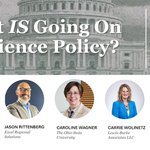
The midterm elections brought about a once-in-a-generation wave of Democrats—and scientists—to the House, Senate, and statehouses. What will this mean for science policy? Join us for this month’s Open Editorial Meeting on November 19.
Register here: luma.com/4ackdg6c

The “miracle machine” of the scientific ecosystem is usually thought of as one where the federal government pushes concerns for profit aside to fund basic research. Advancements such as the internet and GPS are often attributed to this model.
issues.org/small-world-netwo…

1
130
Issues in Science and Technology retweeted

What does a healthy relationship between science and democracy look like? Heather Douglas, Professor of Philosophy at @michiganstateu, joins a national conversation examining the future of U.S. science policy, the role of public accountability, and how research institutions can continue to evolve and serve society (via @ISSUESinST). issues.org/science-nsf-nsb-p…

The midterm elections brought about a once-in-a-generation wave of Democrats—and scientists—to the House, Senate, and statehouses. What will this mean for science policy? Join us for this month’s Open Editorial Meeting on November 19.
Register here: luma.com/4ackdg6c
Amid rapid changes in the science policy landscape, Open Editorial Meetings are informal webinars enabling collaborative dialogue in the Issues community. To encourage open discussion, they are not recorded or shared. (You just have to be there.)
Link: luma.com/4ackdg6c


Issues in Science and Technology retweeted
"For the sake of America's continued technological and economic prosperity, the advancement of the scientific enterprise, and the basic well-being of America's most promising children, the United States needs a national strategy to identify and nurture its own top STEM talent."

In his review of “From the Earth to the Moon: Annotated for Our Spacefaring Age,” the newest edition of Jules Verne’s comic novel accompanied by eight commentary essays, @Operation_Ryan notes that the commentary occupies two distinct camps: astrofuturistic and critical readings.
“For astrofuturists, settling space is the logical next step in achieving humanity’s destiny among the stars,” Faith writes. “Critics, on the other hand, see echoes of a dark colonial past.”
1
1
128
Faith continues, “Neither view can properly enlist Verne’s text, since the novel doesn’t take settlement seriously at all.”
Read the full review here: issues.org/moon-verne-review…
1
45
Some of the most consequential processes shaping Earth’s climate take place at scales we cannot see. “The Long Fall: A Descent Into the Ocean’s Living Memory” by Jiabao Li in collaboration with @ManuPra18599785, Will Tallent, and Michael Bruner makes these processes perceptible.

1
167
The installation asks viewers to consider the ocean not simply as a body of water, but as a living archive in which biological and planetary histories are continually being written.
Link: issues.org/issues-org-long-f…
49
Issues in Science and Technology retweeted

Jules Verne’s From the Earth to the Moon is 160 years old, misreading it, one way or another, for most of that time.
My review of MIT Press’s new annotated edition, in @ISSUESinST:
issues.org/moon-verne-review…
Behind the scenes of the #printprocess at Courier Graphics Corporation where all our magazines are carefully printed. Check out the Fall 2026 ISSUES—and subscribe to the print—here: issues.org/issue/43-1/.
102