

Co-founder/CBO @ZenithFdn | GP Assemble Asia | Ecosystem Fund @CantonNetwork | Venture Partner @RepublicCrypto | Since 2015 🎢
Singapore
Joined January 2018
- Tweets8K
- Following6K
- Followers12.7K
- Likes80.7K




Pinned Tweet
As Canton’s native Ethereum-compatible execution layer, @ZenithFdn offers unmodified EVM (Solidity) and SVM (Rust) virtual blockchains that run atomically within @CantonNetwork’s privacy-preserving infrastructure.
This enables institutions to:
1. Seamlessly deploy to battle-tested Web3 DeFi applications from Canton without bridging to external environments,
2. Utilize ERC tokenization standards (ERC-1400, ERC-3643, DS Protocol, CMTAT, ST Protocol, etc.) and EVM based product/tooking dependencies for their Canton strategies,
3. Migrate Hyperledger Besu stacks with lift and shift code redeployments to compose with the broader Canton ecosystem and external L1s.
All of this happens natively on Canton Mainnet, without economic bridges, code rewrites, or compliance fragmentation.
This is Canton EVM.
This is Zenith.
Zth.

Two years ago, internal teams at Digital Asset thought bringing EVM natively to Canton was technically impossible. Earlier this month, Canton distributed 25,424,478 $CC to Zenith for proving it works end-to-end.
Zenith is a native extension of Canton's consensus into the EVM execution environment, opening @CantonNetwork's institutional rails to Ethereum and Solana developers without rewrites, bridges, or learning a new language from scratch. Canton is where JPMorgan, DTCC, Goldman Sachs, Broadridge, and Visa process $9T+ in monthly settlement volume. We were built to realize Canton's own Polyglot vision, bringing Solidity and Rust developers natively into that infrastructure without asking either side to compromise on what makes them work.
Two milestones complete. Both milestones were independently evaluated by Canton's governance committees, and the external_call() primitive enabling the atomic composability is now merged into Canton's repository.
What comes next: public Testnet arriving soon, the external_call() primitive rolling out to Canton Mainnet with the Canton 3.6 upgrade, and institutional pilots already underway including Zenith's participation in Progmat's JGB working group alongside MUFG, Mizuho, BlackRock Japan, and State Street, targeting Japan's $1.6 trillion JGB repo market.
The wall between DeFi and institutional finance is coming down. Zenith is where developers walk through.
zenith.network/contact-us
Zth.
The Universal Burn CIP is still in draft, but it has important implications.
@bc1pxxx + @ShaulKfir just put out this CIP that unifies Canton MainNet’s economics.
What it is:
Today, Global Synchronizer traffic burns $CC and pays rewards. Dedicated synchronizers mostly sit outside that via license fees. This CIP makes every production synchronizer burn CC at the same list price ($60/MB ≈ $1 per typical ~16.7 KB transaction), extends app/validator rewards to all traffic, and makes dedicated synchronizers fully permissionless.
It adds volume pricing + commitment discounts (backed by staked $CC) so high-throughput, low-value workloads can actually live here.
Hard dollar numbers (not yet approved):
→ Volume curve on dedicated synchronizers: price halves every 10× sustained throughput:
≤1 TPS stays at list (~$1).
10 TPS → 50¢.
100 TPS → 25¢.
1,000 TPS → 12.5¢.
→ Commitment (1yr+, 20% collateral of annual fees): 50% off the volume price. Extra collateral up to 100% of a year’s spend stacks further (toward ~74% off volume price). Loyalty adds up to another 60% after four years.
→ Full stack example: a 10 TPS app drops from 50¢ gross to about 5¢ per transaction. Most of what’s burned is expected to come back as rewards (≥90%), so the net cost is substantially lower.
→ Why the curve exists: a flat $1 everywhere would make 1,000 TPS cost ~$31.5B/year. That prices real payment and trading volume off the network.
Scale implications:
The current split leaves high-volume dedicated capacity economically outside the @CantonNetwork $CC economy. Universal burn turns that into net-new burn. Volume + commitment pricing is what makes sustained institutional throughput (payments, trading, composed RWA flows) viable without forcing everything onto the Global Synchronizer or leaking value as licenses. Collateral commitments lock $CC and make future burn more forecastable. Dedicated capacity becomes additive rather than fragmenting.
One network, one economy. The framework decision is the one that matters first. Numbers follow.
Zth.

Metric just came out of stealth and the timeline is doing what timelines do.
Been watching this one, and know the founder. Hats off @mick_metric 🫡
Active pools that separate pricing from liquidity: a Price Provider sets the bid/ask/reference from oracles (Pyth, Chainlink, custom logic), and the pool holds liquidity in percentage bins around that reference. When the external price moves, the ranges move with it. No more LPs constantly getting picked off because the pool itself is the stale oracle.
That’s the actual problem with almost every AMM for anything that already has a real market. Tokenized stocks, gold, majors, FX. The pool sits wrong until an arb corrects it, LPs fund the correction, spreads widen, and the whole thing becomes a tax on real flow. Metric’s approach is the opposite: quote to reality, keep capital where the market actually is, and let the reference do the heavy lifting. Capital turnover numbers in stealth were absurd for the TVL.
Live on Ethereum, BNB, and Robinhood Chain, and later 👀. Aggregators were already routing to them quietly. Now it’s open: trade, LP, or deploy your own pool. Audited (Zellic, Sherlock). Team has real DeFi LP and protocol experience; one of them just left Uniswap after a few years. Excited to see how this works for DTCC assets.
A few thoughts here:
1. Most “RWA DEXs” still try to force real assets into AMM designs built for tokens that discover their own price. It doesn’t work once size and continuity matter.
2. Separating the price source from the liquidity inventory is the right primitive if you want professional market-making infrastructure to become permissionless.
3. The hard part is the freshness, oracle risk, weekend gaps on equities, and whether LPs actually get compensated for the residual risks (latency, inventory, feed integrity). This design fixes that.
4. If this holds up under real flow on tokenized stocks and majors, it becomes one of the few pieces of spot infrastructure that institutions can actually route through without the usual DeFi tax. That’s rarer than people want to admit.
5. Launch hype and airdrop farming will be loud for a week. The only thing that matters is whether the pools stay tight and capital-efficient once the early volume normalizes like Paper.
Been waiting for this for awhile. The interesting part is whether active pools become the default way anything with a real external price trades onchain. They could be a fundamental piece of market infrastructure moving forward.
Some people are claiming they’re the Morpho of AMMs.
Zth.

Metric is live: metric.xyz
Swap. Provide liquidity. Deploy your own pool.
Now open on Robinhood Chain, @BNBCHAIN and @ethereum.
“I see Zenith as Canton’s first credible entry point for Solidity developers. But it is still a testnet,…”
We appreciate the nod! Respectable post. But if I may…
A handful of testnets have been in prod for several months already with clients. It’s only a marketing choice when to announce things 👀
“…not an active application economy.”
This is the core value proposition of having a single public, permissionless EVM virtual blockchain deployed to Canton. We could have just left it at Zenith Stack deploying EVM subnets for specific businesses, but like you noted, that would not yield Robinhood-esque results.
You’ll be pleasantly surprised. Your post is accurate in its scope, but still only a small fraction of what’s possible with this technology and what we impact we can actually make.
Zenith Stack VBs going live will be the first time the EVM has been baked natively into a non-EVM L1, with true atomicity - not marketing jargon. Brew on the implications. And hey, we can do any VM.
“Zenith could solve the developer-access problem. It does not solve distribution by itself.”
Could? It does.
Can’t solve distribution? Says who?
Unlike the ecosystems of yesteryear:
1. I believe bringing the technology to MainNet is only the starting line of the race.
2. I believe incubator/accelerator/start-up/hackathon driven application level ecosystems are doomed from the jump.
3. I believe only mature, robust, stress-tested and trusted applications matter.
4. I believe asset issuance is nearly worthless without bringing the entire value chain… onchain. Why tokenize if you haven’t found the buyer/lender? I could care less personally who the intermediary technology provider is to connect the two as long as it’s on the Zenith Stack and both parties agree to it.
5. I believe in focusing on PMF not market meta noise. I was steering the company in this direction since mid-2024.
6. I believe RWAs will just be called digital assets. Back to the basics.
7. I believe in 10-20 years global financial markets will be entirely migrated with some, if not all, of the backend onchain. Blockchain will just be a technology, not a trend.
8. I believe we’re in an institutional hype bubble with regards to the deployment phase. It’s fine, but there’s lots of noise and shaking trees.
9. I believe CMC/CoinMarketCap top100 is unlikely to include many Web3-first companies/assets in 10 years.
10. I believe applications should pay for protocol dependencies, not the network. As such, what if it could be amortized by all applications and subnets?
11. I believe you shouldn’t overly hype your launch.
12. I believe in rising tides and finding angles to work with all parties, even “competitors.”
13. I believe there is no winner take all.
14. I believe innovative technology isn’t the core element of a successful business. Just a useful piece of the puzzle.
15. I believe in my team.
Between my co-founder, our head of ecosystem, and myself we have over 35 years of Web3 experience in core architecture, ecosystem growth, governance, advisory, investment, leadership/board seats.
We’re not in Kansas anymore Dorothy.
Zth.


Without Vitalik I fear for the long-term consistency of Ethereum to uphold the same values. Vitalik exemplifies strong opinions loosely held, and is not hypnotized by money or grandeur. If and when another ruling class co-opts the network I am skeptical it can maintain the directional guidance Vitalik has set forth 5-10-15-20 years later.
Look what happened to Siddhartha Gautama’s words. It all turned into fairy tales just decades after.
Look at where some of the other Ethereum co-founders are and how they steered those ships.
Vitalik is not the layman. We all know this. IMO this is how and why Ethereum is where it is now.
On to another matter.
Privacy is not real. Don’t be so easily fooled.
When you’re given option A and B it’s to make you believe you have a say in the matter.
Panopticon. Omnipresence. We’re nearly there. Palantir + Pegasus + Beamforming Feedback Information + Facial Recognition Technology… tip of the iceberg.
"By way of deception you shall engage in war.”
Mossad / Not-Mossad.
Allegory of the cave.
Just being frank.
Smell the roses.
Zth.

Vitalik Buterin: A Sign of Ethereum's Maturity Is That It Can Keep Moving Forward Without My Involvement
Ethereum co-founder Vitalik Buterin @VitalikButerin said in an October 9 interview with Balaji Srinivasan @balajis at the Network State Conference 2026 that constantly being in the spotlight can be draining. On Ethereum's leadership and succession, he said decentralization is not about going from one leader to zero, but from one to many, and Ethereum is beginning to move in that direction.
Vitalik said he looks for whether people across the Foundation and community can keep pushing Ethereum forward and defend values such as security and privacy without his involvement. He added that more people are now stepping up without waiting for him to speak first - a key positive sign in his view.
When you see it you can’t unsee it.
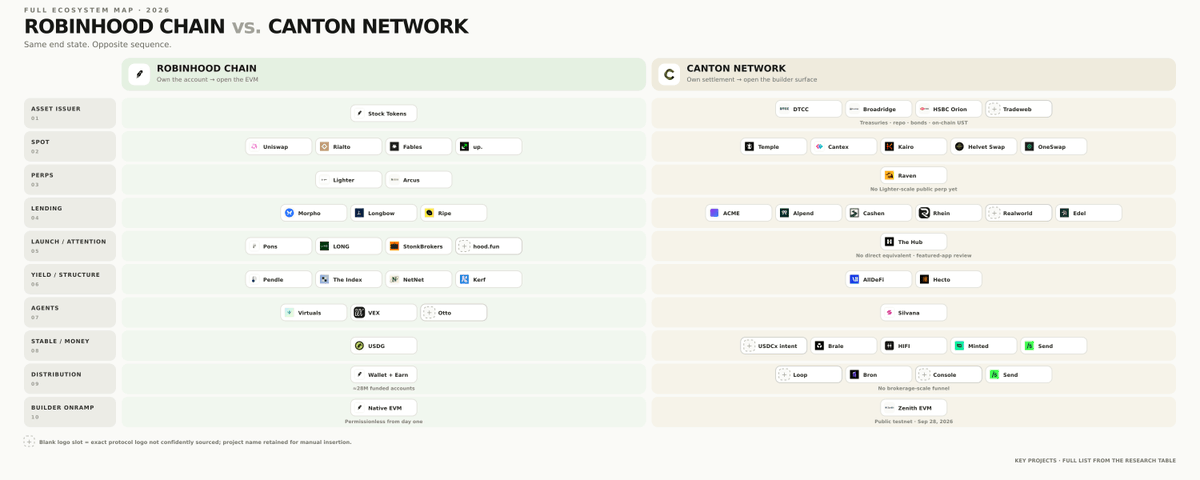
Ethereum <> Zenith <> Canton
Exporting the EVM and ETH.
It’s quite simple really.
Zth.

Canton says its consensus swap had "almost no downtime" and "nobody noticed." Two things worth unpacking: what the downtime actually was, and whether "decentralized network" is the right description. Thread, with on-chain data.
1/ Per Digital Asset's own operator notice, mainnet was topology-frozen for 24 hours (no new parties, validators or package vetting) and transactions paused at the Saturday 13:00 UTC cutover. BitGo kept a maintenance incident open for 25 hours and blocked Canton wallet initializations. The devnet run of the same upgrade hit a bug that pushed mainnet from Aug 8 to Oct 10.
That is a maintenance window. Ethereum has produced a block roughly every 12 seconds since July 2015, through every upgrade, with no halt and no window. For 24/7 settlement, that difference is the product.

Feels like bread crumbs here…
Read between the lines…
Keep thinking…
Yup 🤯
Zth.
Zenith has joined the ERC3643 Association, bringing our experience in interoperability standards and settlement design to the work on compliant tokenization.
@ERC3643Org was originally created in 2018 as the T-REX (Token for Regulated EXchanges) protocol by Tokeny Solutions. ERC-3643 is an open-source token standard for the issuance, management and transfer of permissioned tokens. It enables issuers to enforce compliance requirements, including investor eligibility and transfer restrictions, even on public blockchains. The ERC3643 Association brings together TradFi institutions and blockchain technology providers to advance the adoption of this standard. Its founding members include: Apex Group, @ArchaxEx , @BitstampSupport, @Capgemini, @DLA_Piper, @InvescoUS, @0xPolygon Labs, @TokenySolutions, and others.
This matters because tokenizing a regulated asset is only the beginning. Once issued, these assets need to participate in financial workflows involving settlement, collateral, lending, and trading, often across different applications and environments.
That second step is what Zenith is built for. As the EVM and SVM extension for @CantonNetwork, Zenith allows Solidity applications to interact atomically with Canton-native assets and workflows. This opens a path for applications using Ethereum standards such as ERC-3643 to connect with Canton's institutional financial infrastructure while retaining their established Ethereum tooling.
We look forward to working with the Association and its members as regulated tokens move into production.
More about the ERC3643 Association and its members: erc3643.org/members
Zth.

DAS ASIA: Balancing Privacy vs Transparency in Onchain Finance was a banger. Crowd was nuts.
Eric from Digital Asset @wesarn_real
Keone from Monad @keoneHD
Zach from Grayscale @LowBeta
Myself
Moderated by @robbiek__
TLDR: there’s not one size fits all for privacy. That’s why Zenith provides full optionality on deployment structures:
a. Open public permissionless
b. Open public permissioned
c. Private permissioned isolated
d. Private permissioned multi-party
Q2 pilots for privacy-enabled EVM optionality on public permissionless.
Zth.

Balancing Privacy vs. Transparency in Onchain Finance
with @wesarn_real @heslinkim @keoneHD @LowBeta @robbiek__
DAS Asia 2026 Mainstage
One of my favorite events over the last 2 weeks because I saw friends from the last decade. The original STO cabal showed up and we got to talk old war stories.
It’s good to see friends and partners doing well this many years later with the same or different businesses.
Wishing everyone success in whatever they’re working on now. Having been through the thick of it and the rollercoasters between, we can all empathize with each others’ journeys.
Onwards and upwards.
To the Zenith.
Zth.

Good morning, Singapore.
Opening Bell is open. A room of institutional, RWA and settlement people, seated and talking tokenization before Token2049 kicks off.
Hosted by us with @ZenithFdn and @KaikoData. 📷


Two panels in one day. I’m excited to speak on why stablecoins are becoming the settlement layer for onchain finance. What infrastructure can make that liquidity work at institutional scale?
Zenith.
At the Singapore edition of TokenizeThis 2026, @HeslinKim (@ZenithFdn), @jeremyng777 (@OpenEden_X ), Bhaumik Kotecha (@paxoslabs ), and
@MattWyss (@obligatecom) will discuss stablecoins and liquidity infrastructure.
Moderated by Dan Sun (@Alchemy ).
See you there at 6:30PM on October 6th!
Zth.


Stablecoins are becoming the settlement layer for onchain finance. What infrastructure can make that liquidity work at institutional scale?
At the Singapore edition of TokenizeThis 2026, @HeslinKim (@ZenithFdn), @jeremyng777 (@OpenEden_X ), Bhaumik Kotecha (@paxoslabs ), and
@MattWyss (@obligatecom) will discuss stablecoins and liquidity infrastructure.
Moderated by Dan Sun (@Alchemy ).

On October 6th, I am thankful to also be speaking at Merkle Science Meet: Token2049 Singapore. There’s a stellar crew on this panel:
“Real-World Asset Tokenization: Compliance at the Intersection of TradFi and Blockchain”
Ilya Brovin - CGO at @sumsub
Sheena Lim - CEO at @1Xexchange
Jenna Peterson - COO at @MidnightNtwrk
Arthur Breitman - Co-Founder at @tezos
Heslin Kim - Co-Founder CBO at @ZenithFdn
Yan Ma - Executive Director at @TheSpartanGroup
Moderated by Mark Tang - VP Client Solution at Hydra X.
I’m scheduled to speak from 3:55 – 4:35pm! See you all there.
Zth.

Daily Words of the Buddha for October 05, 2026
Dhammena saṃharitvāna,
uṭṭhānādhigataṃ dhanaṃ,
tappeti annapānena
sammā satte vanibbake.
Listen
With one's wealth collected justly,
won through one's own efforts,
one shares both food and drink
with beings who are in need.
Zth.
Singapore: TOKEN2049 Week
This week in Singapore, I’m on stage five times across the week, catch me at:
- TokenizeThis 2026 by RedStone on October 6: luma.com/sk9weqs5
- Blockworks Digital Asset Summit on October 7: lnkd.in/dA3ceSJ5
- Agentic Finance by More & More on October 8: lnkd.in/d8rNUsVN
- HSC Asset Management Conference Singapore on October 8: lnkd.in/dJRUXZSM
- RWA SUMMIT on October 9 as part of RWA WEEK: luma.com/rwasummit
Come meet the broader team on October 7 (9:00-12:00):
Opening Bell, an institutional breakfast co-hosted with @trex_network and @KaikoData. 10 minutes from Marina Bay Sands and timed to kick off your TOKEN2049 day. Relaxed setting, high-quality conversations, and the right people in the room. Quality breakfast on us.
RSVP: luma.com/ht5jyi8k
Zth.

You know you’ve got a stellar team when they treat you like an F1 car.
I was fading one evening in Seoul so they brought me to @NorbertVadas’s hotel room, and then set a timer for me to sleep for an hour.
Immediately when the alarm went off he blasted some Miranda Lambert and made me down a German instant espresso.
@SuontamaJulia came in, we called my cab, pushed me out the door, and I hit an important founders’ dinner at full speed.
I could hear the F1 tire drills through this whole process like clockwork. A founder is nothing without his colleagues.
Team.
Family.
Pit crew.
Zth.


서울에서 한국 금융기관들과 토큰화의 다음 단계를 논의했습니다.
Zenith co-hosted the Seoul Table, an institutional lunch, alongside @KaikoData, @utila_io and Happyblock during @kbwofficial, bringing together a cross-section of Korea's financial and digital asset ecosystem. Banks, securities firms, asset managers, custodians, legal advisors and infrastructure providers, all navigating the same questions about how tokenization, digital assets and institutional blockchain infrastructure come together at scale in regulated markets.
Korea is not watching this space from the sidelines. With the token securities framework taking effect in February 2027, institutions are preparing now, and multiple tokenization and won stablecoin initiatives are already taking shape. Thank you to Woori Bank, Mirae Asset Securities, Kyobo Life Insurance, Kyobo Securities, Meritz Securities, LS Securities, iM Bank, Shin & Kim, Deloitte Korea, Bithumb and many others for being in the room, alongside ecosystem teams from across the region and beyond.
Being in these conversations, and hosting them, is how Zenith stays close to the decisions that matter. Grateful to our co-hosts and to everyone who made time to join.
Next stop: Singapore.
Zth.


🚨 ZENITH TESTNET IS LIVE 🚨
Short and sweet. If you say you’re going to build it. Build it. Less talk, less marketing fluff, less hype.
Just deliver. If the market needs it. You win.
Keep it simple.
Canton EVM.
Here are the live links:
Get started: docs.zenith.network
Explore: explorer.testnet.zenith.netw…
Blog: zenith.network/resources/blo…
X: x.com/ZenithFdn/status/21045…
LinkedIn: linkedin.com/feed/update/urn…
Zth.
JUST IN: The Zenith EVM Testnet is live and open to the public.
For the first time, 31800+ Ethereum developers can deploy standard Solidity applications that compose atomically with @CantonNetwork - the institutional blockchain where DTCC, JPMorgan, Goldman Sachs, and Visa process $9T+ in monthly settlement volume.
Point your existing tools at the Zenith RPC endpoint and deploy. Your contracts don't change, your tooling doesn't change, and every transaction is finalized through Canton's consensus with deterministic finality in seconds. The external_call() primitive enables atomic composability with Canton-native Daml workflows directly, and the Linked Transactions explorer shows you the full lifecycle of every transaction across both environments in one place.
Zenith is already contributing to two of the most significant tokenization initiatives running on Canton: @The_DTCC 's DTC Digital Assets Solutions Industry Working Group bringing $114 trillion in U.S. securities on-chain, and @progmat_en's Tokenized JGB working group targeting Japan's $1.6 trillion JGB repo market alongside MUFG, Mizuho, and BlackRock Japan.
This is the first public venue where Ethereum's programmability and Canton's institutional rails meet.
Get started: docs.zenith.network
Explore: explorer.testnet.zenith.netw…
Full announcement: zenith.network/resources/blo…
To test atomic cross-environment workflows with the Zenith Gateway, reach out to us directly: [email protected]
Zth.