

Heartflow’s non-invasive AI-driven personalized 3D heart models empower clinicians to detect and manage coronary artery disease. #Heartflow #FFRct #Plaque #CCTA
San Francisco, CA
Joined September 2016
- Tweets3.1K
- Following840
- Followers12.6K
- Likes762




What does successful CT-guided PCI planning look like when imaging and interventional teams work together?
This question is the focus of Episode 13 of @SYSTOLE_live's The Coronary Corner podcast. Drs. @yadersandoval and @esbrilakis are joined by Drs. @RyanMadderMD and Michael Gallagher for a discussion on developing a CT-guided PCI program, including the role of FFRct and how Heartflow PCI Navigator supports procedural planning and training.
Tune in to the full episode here:
YouTube: youtube.com/watch?v=MmQFI3tD…
Spotify: open.spotify.com/episode/7qf…
S/B Heartflow.
#PCIplanning #CTguidedPCI #PCINavigator

🎙️ CT-Guided PCI: The Imager-Interventionalist Partnership
In Episode 13 of The Coronary Corner, @RyanMadderMD & Michael Gallagher discuss how imaging and interventional teams can partner to build a CT-guided PCI program—from FFR-CT to procedural planning with PCI Navigator.
“Don’t stop at stenosis severity—think about physiology, plaque burden, calcium distribution, and lesion length.”
▶️ YouTube: youtube.com/watch?v=MmQFI3tD…
🎧 Spotify: open.spotify.com/episode/7qf…
PCI planning has historically happened during the case. What changes when planning happens before the case starts?
Two new data sets at TCT2026 look at that question.
Join our Lunch Symposium to hear directly from the PIs on what these findings mean for clinical practice.
New data at AHA 2026 explores what AI-enabled plaque analysis means for patient risk and outcomes. Hear from Dr. Campbell Rogers and visit us at Booth #711.
Learn more: lnkd.in/gzaS8TP3
Congratulations to our Q1 2026 CT Quality Award recipients!
This award recognizes institutions in the 90th percentile nationally for CT quality, reflecting their commitment to advancing patient heart health through superior care pathways. We're proud to partner with these teams to help more patients access improved diagnostic pathways and gain a deeper understanding of their cardiovascular health using coronary CTA + Heartflow Analysis.
Learn how this approach supports clinical excellence:
heartflow.com/ccta-advantage…
@advocatehealth @amiradiology @BoulderCHealth @BrowardHealth @ccpdocs @christianacare @CHS_LI @GeisingerHealth @Lee_Health @Memorial_Owosso @MtSinaiQueens @HCAHealthONE @Norton_Health @nyulangone @theprismahealth @ShannonMedical @SimonMedImaging @sdenvercardio @StLukesSTL @uchealth

Two new data sets. Both advancing CT-guided PCI planning. Hear Dr. Campbell Rogers on why TCT 2026 matters this year then see us at Booth #3819.
Visit our website to learn more:
event.heartflow.com/tct2026
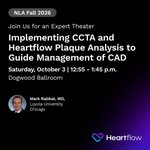
Join us for an Expert Theater with Dr. Mark Rabbat at NLA Fall Clinical Lipid Update 2026 on Saturday, October 3: Implementing CCTA and Heartflow Plaque Analysis to Guide Management of CAD.
We'll explore the clinical need to evolve risk assessment through new tools and emerging evidence, and discuss how Heartflow Plaque Analysis and the DECIDE Registry inform management strategies for patients with CAD.

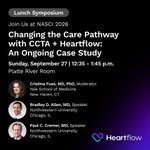
Heading to #NASCI2026? Join us Sunday, September 27, for our lunch symposium, "Changing the Care Pathway with CCTA + Heartflow: An Ongoing Case Study.” Drs. @CsFuss, Bradley Allen, and Paul Cremer will explore how AI-powered coronary CTA is transforming the modern cardiac care pathway. Through real-world cases and registry insights, this symposium will demonstrate practical applications of the Heartflow One platform to sharpen diagnostic precision, implement plaque-guided care, and optimize radiology-cardiology workflows. We hope to see you there!

Heartflow is proud to sponsor the 9th Annual @Heart_SCCT Cardiovascular Disease Prevention Symposium on Saturday, October 10, from 10:10 am–2:50 pm ET.
Join this educational virtual event to understand the evolving landscape of preventive cardiology, novel therapies, and risk assessment tools to reduce cardiovascular risk.
Register now:
scct.org/page/PreventionSymp
#CardiovascularHealth #Prevention #YesCCT

What’s next in cardiovascular prevention?
Join SCCT for a focused session on the 2026 Dyslipidemia Guidelines, lipid-lowering therapy, the role of coronary CTA in asymptomatic individuals & the future of personalized prevention. @RonBlankstein @khurramn1
scct.org/page/PreventionSymp

Mark your calendar! The Heartflow North UK Users' Meeting will take place in Manchester on Wednesday, September 30th.
Cardiologists, radiologists, and imaging specialists from across the region will come together for a day of shared experience, practical insight, and discussion on where cardiovascular care is heading.
Joining the faculty: @JonathonLeipsic, @fairbairn_tim, Alan Bagnall, @doctorradiology, @JWeirMcCall, and @NickCurzen.
The meeting will take place at the Kimpton Clocktower Hotel from 10:00–16:00 BST (registration from 09:00).
Register here, or speak to your Heartflow representative to find out more. eventbrite.co.uk/e/heartflow…

Congratulations to Dr. @YChatzizisis and his team at the @UMiamiHealth on enrolling their first patient in the NAVIGATE-PCI Registry. Heartflow PCI Navigator, the first and only integrated, AI-powered PCI planning tool, can help improve treatment plans with insights to streamline procedures with increased efficiency and clinical confidence. We're proud to be part of this advancement in precision heart care for patients in South Florida.

#UMiami Health System is the first in Florida to use the AI-powered HeartFlow PCI Navigator to help guide heart procedures. bit.ly/4pBF0jC
@UMiamiHealth

Photon-Counting CT is opening new possibilities for cardiac imaging.
In a recent interview with @HCPLiveNews, Dr. @RonBlankstein discussed the technology’s potential, from improved resolution and visualization of calcified lesions to more detailed assessment of CAD.
He also explored our latest data demonstrating consistent results with Heartflow Plaque Analysis across conventional and Photon-Counting CT, including plaque quantification, stenosis grading, and FFRct. Watch the full clip: hcplive.com/view/photon-coun…

Congratulations to Dr. @yadersandoval, Dr. @esbrilakis and their team at @MHIF_Heart on enrolling the first U.S. patient in the OPTIMAL P5 trial. Congratulations as well to Dr. @ColletCarlos and the @crfheart for leading this important research.
At Heartflow, we're proud to support this research and the continued advancement of CT-guided PCI planning with Heartflow PCI Navigator, helping clinicians approach even the most complex cases with greater confidence and precision.

Proud to build on our leadership in advanced coronary imaging and PCI research, enrolling the first US patient in the international OPTIMAL P5 clinical trial—advancing research for people with severely calcified #CAD 🌍️🫀 Led by @yadersandoval, @esbrilakis, and @CCAD_MHIF team!

How reliably can coronary plaque be measured over time?
Our recently released data demonstrated minimal variability between certified analysts and across repeat measurements, with 95% agreement when categorizing patients into total plaque volume-based stages.
Dr. @RonBlankstein joined @HCPLiveNews to discuss the findings and why reproducibility matters for longitudinal disease tracking and assessing treatment response: hcplive.com/view/ai-cpa-plaq…
A CAC score of zero doesn’t always tell the full story. In an interview with @HCPLiveNews , Dr. @RonBlankstein discussed findings from a DECIDE Registry sub-study showing that 50% of symptomatic patients with a CAC score of zero were reclassified into higher-risk categories with total plaque volume-based Heartflow Plaque Staging.
Hear from Dr. Blankstein on how looking beyond calcified plaque to overall plaque burden can help provide a more complete picture of cardiovascular risk: hcplive.com/view/total-plaqu…
Saints Hall of Famer Stan Brock recently joined the @iHeartMedia Seattle Voice podcast with Dr. Eugene Chang of CardioNow to share his experience participating in our GAMEFILM Registry.
Stan opened up about why he wanted to take a closer look at his heart health, and the value of having information you can act on. Dr. Chang added his clinical perspective, discussing how earlier insight into CAD can help inform more personalized care.
Hear their full conversation: iheart.com/podcast/1248-seat…$
#GAMEFILMRegistry #NFLAlumni #GridironGreats

Our Chief Medical Officer, Dr. Campbell Rogers, recently sat down with @IEEEembs to discuss a challenge that has shaped much of his career: finding and understanding CAD earlier so patients can receive more personalized care.
The conversation touched on how far the field has come, the clinical evidence helping drive that progress, and newer advances like Heartflow PCI Navigator and our GAMEFILM Registry for former professional athletes.
Read the full feature: embs.org/pulse/articles/bene…

Late-breaking data presented at #ESC2026 and simultaneously published in @JACCJournals show Heartflow FFRct Analysis reduced unnecessary invasive heart procedures by 44%.
Results from the independent randomized FUSION trial demonstrate how adding Heartflow lesion-specific physiology to CCTA can help resolve diagnostic uncertainty and better inform cath lab referrals.
Learn more: ir.heartflow.com/news-releas…
#FFRct #YesCCT

Detecting narrowing was only half the story. New data at SCCT 2026 showed over 50% of patients with a "zero risk" calcium score have significant non-calcified plaque.
Heartflow Plaque Analysis with Plaque Staging closes that gap for patients like Richard Smith, giving physicians like Dr. Patel a full 3D picture to guide treatment.
Explore more: heartflow.com/patients-cad/p…
#AIinHealthcare #YesCCT #PlaqueAnalysis
Our Chief Medical Officer, Dr. Campbell Rogers, joined Simon Hill on @theproof to talk about something cardiology has worked around for most of its history: treating coronary artery disease without being able to see and measure it.
The conversation covers what a calcium score can and can't tell you, why low-attenuation plaque carries an outsized risk, and how measurement variability and validation of AI-powered plaque analysis tools should shape the interpretation of any single scan.
Worth the listen.
🎧 Episode 426

Can you actually reverse heart disease, or just slow it down? Eighteen months after a scan found soft plaque in my arteries, a follow-up suggested it had shrunk by around forty percent, and I wanted to know whether that result could be trusted.
In this episode, I sit down with interventional cardiologist Dr Campbell Rogers to unpack what modern imaging can really see, why a calcium score of zero is not the all-clear, and whether we should be treating plaque rather than chasing a number.
For the full show notes head to: theproof.com/can-you-reverse…