








The establishment gave @JMilei months. In 2023, 170 Argentine economists signed a letter calling his dollarization plan an illusion, and Ian Bremmer wrote that he expected the economy to collapse in short order—typical Keynesian bullshit, always exactly wrong.
Then monthly inflation fell from 25% in December to nearly 10% by March, and after fifteen straight years of deficits, Argentina ran a primary surplus of 1.4% of GDP in 2025. His party more than doubled its congressional seats in the midterms.
The scoreboard has red ink too. Poverty fell to an eight-year low of 28% in late 2025, then jumped to 32.3% in the first half of 2026. Inflation ran at 33.4% a year, the second-highest in Latin America behind Venezuela, and the IMF cut its 2026 growth forecast from 3.5% to 2.1%.
@saifedean Ammous says the central bank explains the red ink. Milei campaigned on closing it and treated that as an absolute condition, then kept it. Ammous argues that a central bank monopoly on currency and banking licenses guarantees continued peso inflation, and that Ecuador, without its own national currency, cannot inflate even if it wants to.
He says Hoppe was right: Milei should have shut the bank and defaulted. Milei replies that the bank's debts and liabilities need to be cleaned up before it closes, and his proposed charter reform bans the bank from financing the Treasury.
The scorecard splits along the line Ammous draws. Milei cut the deficit and the apocalypse never came. He left the state's money monopoly standing, so the state still decides how many pesos exist.
But hey, Libertarians can cheer the first half and demand the second.
All eyes are on Javi to see how this plays out.

The Inflation King:
Everything you need to know about modern investing can be summed up in the story of one man: Hugo Stinnes, a German industrialist who built the largest private empire in Weimar-era Germany by doing something most people thought was reckless.
He borrowed. Constantly. Aggressively. In marks.
Stinnes came from a coal family in the Ruhr Valley and already ran a solid industrial operation before World War One. When the war ended and Germany began printing marks to pay its reparations debts under the Treaty of Versailles, most citizens watched their savings dissolve in real time. Stinnes drew the opposite conclusion than his neighbors. While German citizens hoarded paper marks in mattresses and savings accounts, Stinnes borrowed enormous quantities of those same marks from German banks, then immediately converted them into real assets: coal mines, steel plants, newspapers, shipping lines, hotels, forests, paper mills. By 1923 his conglomerate, the Stinnes-Konzern, controlled over 1,500 enterprises across Germany, Austria, and beyond. He employed roughly 600,000 people. The inflation that ruined an entire generation of German savers made Hugo Stinnes almost incomprehensibly wealthy.
How did he do it? When a government or central bank expands the money supply, the purchasing power of each existing unit of currency falls. Prices across the economy do not adjust simultaneously. The new money flows into specific assets first, before it filters through to wages and consumer goods, which means whoever holds those assets during the transition captures a windfall. Stinnes borrowed in a currency he correctly identified as dying, bought hard assets whose value was tied to physical reality rather than government decree, and then repaid his loans in marks worth a fraction of what he had borrowed. After the Weimar hyperinflation, the real value of what he owed was virtually nothing. He got the hard assets he bought with loaned marks for free.
Your house today runs the same play, just in slow motion. You take out a mortgage denominated in dollars, a currency the Federal Reserve has expanded by over 40 percent since early 2020. You hold a fixed-rate liability in a debasing currency while the asset itself reprices upward. The bank receives dollars of diminished purchasing power over thirty years. You hold the land and the structure.
The reason property specifically has captured so much of the post-2020 inflation is that new money always travels along the path of least resistance toward collateral-eligible, financeable assets. Residential real estate sits at the center of the credit system. Banks lend against it readily. Institutional buyers treat it as a store of value. When the Fed slashed rates to near zero, and Congress distributed trillions in fiscal transfers, that purchasing power flowed directly into housing markets with predictable results: U.S. median home prices rose from $329,000 in early 2020 to over $420,000 by 2026.
Stinnes died in 1924, before his empire unraveled under poor succession and deflation, but the strategy outlived him. Borrow in the currency they are destroying; hold the asset they cannot print.

France keeps electing governments that promise order while building the exact machinery that produces chaos.
The pattern is old. The 1968 uprising paralyzed Paris because de Gaulle had spent a decade expanding state payrolls, suppressing price signals, and convincing the French that prosperity required a bureaucrat's signature.
By 2005, the banlieues around Paris burned for three weeks. Clichy-sous-Bois, Aulnay-sous-Bois, hundreds of torched cars every night. The state had warehoused North African immigrants in subsidized housing blocks, disconnected from labor markets by minimum wage laws priced above their marginal productivity, and handed them welfare checks just generous enough to eliminate the urgency of assimilation.
That combination guarantees a poverty trap.
Today, with immigration remaining a central tension and pension expenditures consuming 14% of GDP, France runs the same experiment expecting different results.
You pay into a system your entire working life and receive benefits calibrated to political survival rather than actuarial reality. Meanwhile, each new transfer payment handed to recent arrivals without reciprocal labor market access breeds exactly the resentment politicians then exploit.
Open borders and a welfare state cannot coexist. Either migrants enter a free labor market and compete on merit, building genuine stakes in French civil society, or the state subsidizes parallel communities that have no economic reason to integrate. France consistently chooses the latter, then acts surprised at the friction.
Bastiat diagnosed this in 1850. The French state still hasn't read him.

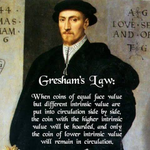
Gresham's Law states that bad money drives out good, and every government that has ever debased its currency has proven this true the hard way.
The mechanism is straightforward. When a sovereign declares that two coins carry equal legal value despite one containing more silver, citizens spend the inferior coin and hoard the superior one. The overvalued bad money circulates. The undervalued good money disappears into mattresses and private vaults. The state creates this distortion through legal tender laws, forcing you to accept both coins at the same face value regardless of actual metal content. Without that legal compulsion, Gresham's Law doesn't operate. Markets simply price the better money higher.
Rome did this with systematic ferocity. The silver denarius, roughly 90% pure under Augustus, fell to under 5% silver by the reign of Gallienus in the 260s AD. Citizens watched the debasement happen and responded rationally: they spent the garbage and saved whatever genuine silver remained.
Gresham's Law is a symptom, not a disease. State monopoly over money is the disease. Remove the legal tender mandate, allow competing currencies, and good money wins on merit. Thomas Gresham identified the phenomenon in 1558 through observation. The cure has been available just as long.

LASIK eye surgery costs roughly $2,100 per eye today. In 1998, it cost $2,200 per eye. Adjusted for inflation, you are paying about 60% less for a procedure that has simultaneously become faster, safer, and more precise. That is what markets do when left alone.
Now compare that to a hearing aid. The FDA classified hearing aids as prescription medical devices for decades, locking you into audiologist appointments before you could buy a $3,000 device that a manufacturer could produce for $300. Or, look at insulin. Heavily regulated, patent-extended, and politically manipulated, a vial of Humalog ran over $330 in 2024 versus roughly $21 in Canada for a biosimilar. Same molecule. Different regulatory environment.
LASIK sits in a peculiar gap. Insurers rarely cover it, which means third-party payment schemes never severed the price signal between provider and patient. You shop, clinics compete, manufacturers race to improve technology. The feedback loop that markets depend on functions exactly as it should.
Regulated medical markets break that loop deliberately. The FDA's approval process costs pharmaceutical companies over $2.6 billion per new drug on average, erecting barriers that protect incumbents and punish smaller competitors who cannot absorb a decade of compliance costs. Patients then pay the premium on the back end.
LASIK is the control in the experiment. The market won.

Central planning produces exactly what Ludwig von Mises titled his 1947 pamphlet: planned chaos.
The mechanism is straightforward. Prices carry the information producers and consumers need to coordinate their decisions across millions of transactions simultaneously. When a government fixes bread prices below market, bakers stop baking or exit the industry. Shortages appear. Planners then fix flour prices to compensate. Now millers face losses. The intervention metastasizes upward through the supply chain until the state controls the entire food system, badly.
Venezuela walked this path in textbook fashion. Hugo Chavez nationalized agriculture, fixed food prices beginning in 2003, and by 2016 Venezuelans lost an average of 19 pounds of body weight from hunger. Central planners cannot rationally allocate resources because no single authority possesses the dispersed, localized, constantly changing knowledge that prices transmit automatically.
Mises called this the calculation problem. Without genuine market prices, socialist planners cannot rationally allocate resources because they have no real signal telling them where resources are most urgently needed. They guess. They mandate. You pay.
This is why every centrally planned economy in history eventually rations goods, generates black markets, and criminalizes voluntary exchange. The black market is simply the real economy refusing to disappear on bureaucratic command. Prices are not a human invention that governments can redesign. They are the emergent language of scarcity itself, and suppressing them does not change the underlying reality, it just makes that reality invisible until the shelves go empty.

Capital gains tax is theft, committed twice against the same dollar.
You earn income. The government takes its cut immediately, in the US its between 22% and 37% depending on your bracket. What remains is yours, after-tax money, already processed through Washington's collection machine. You choose not to spend it. You save it, invest it, buy assets with it. The discipline required to delay consumption is precisely the behavior that funds capital formation across the economy.
Then the asset grows. You sell it. The government appears again, demanding 20% (plus the 3.8% Net Investment Income Tax for higher earners) on the nominal gain, which often includes pure inflation adjustments that represent no real increase in purchasing power whatsoever.
The IRS treats your patience as a second taxable event. The original dollar was already taxed. The "gain" frequently reflects nothing more than the dollar losing value while you held the asset. Murray Rothbard identified this pattern: the state punishes capital accumulation.
Consider a simple case. You invest $50,000 of after-tax earnings in 2016 into an S&P 500 index fund. By 2026, it's worth $115,000. Inflation consumed a meaningful slice of that $65,000 gain. You pay capital gains tax on the full nominal figure regardless.
Capital gains taxation suppresses investment, shrinks the capital pool available for productive enterprise, and forces entrepreneurs to seek financing from a shallower pond. Fewer productive investments get made. Workers carry that cost through lower wages and fewer opportunities. The state expands, while you suffer.

Recessions are supposed to hurt. That pain is the cure, not the disease.
When credit expands beyond real savings, the central bank manufactures a boom that cannot last. Businesses build factories for demand that borrowed money fabricated. Workers take jobs that only exist because interest rates sat artificially low. When the correction arrives, those malinvestments need to liquidate. Wages fall in some sectors, capital shifts, weaker firms close. Painful, yes. Fatal, no.
The depression arrives when government refuses to let the correction finish its work.
Herbert Hoover did this with textbook precision between 1929 and 1932. He signed Smoot-Hawley, raised the top income tax rate from 25% to 63%, pushed wages above market-clearing levels through industry agreements, and expanded federal spending by 50%. Every intervention delayed liquidation. Franklin Roosevelt then deepened and extended those same policies for a decade, keeping unemployment above 14% through 1940 when the private economy, left alone, would have recovered years earlier.
Governments prop up insolvent banks, subsidize failing industries, and inflate prices to prevent the nominal wage adjustments that would restore employment. Each intervention signals investors to wait. Capital sits idle because the rules keep changing. The recovery never gets traction because the government keeps moving the floor.

Criminals in Costa Rica, when they hear the name "Bukele":

This describes South Africa accurately; only we are already 30 years into this. Europe and the US are quickly catching up, though.

Premise:
Incentives drive all human behavior.
The corollary:
How to destroy a country:
A vast social security and support system that serves as a magnet for those who would rather not work.
An open immigration policy that does not screen immigrants to determine their ability and willingness to provide for themselves and their families.
An open immigration policy that does not screen for political and/or religious ideologies that are a threat to the country.
Economic incentives large enough to incentivize immigrants on the state dole to have large numbers of children, but insufficient for educated and economically productive mothers to be able to quit to raise a family.
The declining fertility of the most educated and productive women due to their delay to begin a family as a result of their desire and/or need to advance their careers, among other reasons, to live a life they deem consistent with their educational achievements and/or to repay their student debts.
Amnesty programs that give citizenship and voting power to illegal immigrants without consideration of their economic productivity or their threat to the country due to their religious or political ideologies.
The changing demographics and increased population due to the above factors.
The state responding to protests by increasing social support.
The continued failure to punish and hold accountable violent and looting rioters.
Government managed by a massive and growing unelected bureaucracy.
Government fraud, waste, and abuse contributed to ballooning budgets.
Anti-business legislation that makes it difficult for businesses to compete in a global marketplace being disrupted by AI, including restrictions on firing even poorly performing employees.
Overly burdensome, globally uncompetitive, corporate taxation.
Continuous increases in personal taxes to raise funds to provide for the rapidly growing welfare state.
The substantial majority of the tax burden levied on a small percentage of the population.
A growing percentage of the electorate paying no taxes and receiving welfare.
The introduction or threat of a wealth tax including the taxation of unrealized gains, i.e., taxes on paper wealth.
The flight of the most productive business builders and highest taxpayers to lower tax countries with lesser security concerns.
A growing percentage of the electorate voting for candidates that support increased welfare and laws favorable to, and/or that match the cultural and ideological needs and desires of a growing unproductive immigrant population.
The rapid rise in anti-semitism and inadequate efforts to address this hatred.
Increased borrowing by the state to fund the growing social burden.
Higher sovereign interest rates due to all of the above.
The resulting need to reduce expenditures to make the math work.
Increasingly violent protests that make life less livable for the productive and law abiding citizens leading to their accelerated departure.
And so on…
When immigrants refuse to integrate into the host society's legal, linguistic, and commercial fabric, they create jurisdictional ambiguity. Ambiguity is where transaction costs breed. But that is only part 1 of the problem cascade.
Consider the banlieues ringing Paris, where Sharia-adjacent informal courts settle disputes that French civil law theoretically governs. Two competing legal systems occupying the same geography produce institutional decay. Contracts become unenforceable across community lines. Capital avoids the uncertainty. Citizens pay that cost in stagnant property values and higher insurance premiums. But wait there is more.
Language is infrastructure. A Turkish enclave in Berlin where 40% of residents speak no functional German represents a communication barrier that price signals cannot cross efficiently. Entrepreneurs cannot hire freely across that barrier without absorbing translation overhead. Labor markets fragment. Wages inside the enclave compress because the worker pool cannot compete in the broader market.
Then, the welfare state makes it dramatically worse. State subsidies remove the market pressure that historically forced assimilation. Ellis Island immigrants learned English because the market paid them to. Today the German government pays families in Neukölln to remain monolingual, then wonders why parallel societies calcify across two and three generations.
Non-assimilation creates a property rights problem across cultural barriers. Voluntary immigration into a free society demands adoption of its legal foundations. Anything less transfers real costs onto existing citizens without their consent, and that is simply redistribution without even a passport.
Fast forward 20 years and you end up with this:

History does not merely rhyme; it repeats.

Rome collapsed because Romans stopped enforcing the conditions that made Roman citizenship worth anything. The same is happening to France right now.
The Western Empire's third- and fourth-century emperors, desperate for tax revenue and military manpower, settled entire Gothic and Frankish tribal confederacies inside the limes without demanding assimilation, military oaths, or any meaningful integration into Roman economic life. In 382 AD, Theodosius I settled roughly 100,000 Visigoths in the Balkans under their own chieftains, exempt from Roman law. They owed Rome nothing, and they acted accordingly. By 410, Rome fell.
The Austro-Hungarian Empire ran a version of the same experiment. Vienna absorbed millions of Slavic, Magyar, and Romanian subjects into a single fiscal and administrative unit without establishing coherent property rights or common rule of law across ethnicities. Capital fled the peripheral regions because contract enforcement varied by ethnicity and political connection. The empire spent itself policing internal tensions rather than producing anything.
Open borders can work when you couple them with private property, enforceable contracts, and zero access to a welfare state. Every historical collapse involved governments absorbing populations onto public land, public payroll, or public grain dole. Welfare states and open borders function as a single detonator, not two separate policies.
Open borders + state welfare = disaster
These two things cannot coexist within a society without destroying it.
When millions of low-skill workers flood a labor market simultaneously, wages at the bottom compress. Supply and demand operate exactly as advertised. George Borjas ran the numbers on the 1980 Mariel boatlift: 125,000 Cubans hit Miami in under six months, and wages for native high school dropouts fell measurably. The market eventually adjusts, but "eventually" is cold comfort when your paycheck shrinks this quarter.
The fiscal damage compounds separately from the wage effect. A low-income household in California consumes roughly $30,000 annually in state and federal services, schooling, healthcare, and transfer payments, while paying perhaps $4,000 in taxes. Multiply that gap across millions of arrivals and you have a structural deficit that your children inherit as debt.
Welfare states and open borders cannot coexist indefinitely. The tax-funded magnet subsidizes arrival and rewards dependency. Destroy the welfare state, and mass migration becomes a straightforward story of voluntary exchange, workers seeking employers, capital seeking labor. Keep the welfare state and open the gates, and you are simply voting to transfer wealth from working taxpayers to a federal distribution apparatus.
The hard question is never "should people move freely?" It is who owns the tab when they arrive.


The welfare cliff does not trap poor families by accident.
Congress engineered a benefits system where earning one additional dollar can trigger simultaneous cuts to Medicaid, SNAP, housing vouchers, and childcare subsidies, collapsing your effective income by $5 or more. The government built a cage, and somehow we call it a safety net.
Take a single mother in Houston. She earns $22,000 annually and qualifies for $35,000 in combined federal and state benefits. She gets a raise to $25,000. That $3,000 in new wages costs her $18,000 in benefits. Her employer rewarded her productivity; the state punished her for it. No rational actor climbs that wall.
This is price control, but applied to human ambition. Every welfare threshold functions as a marginal tax rate that would make a Scandinavian bureaucrat jealous, often exceeding 80 or even 100 percent on the next dollar earned. This disincentive is the system's core mechanism.
Dependency concentrates political power. Families tethered to benefit rolls vote to protect those rolls, and the politicians who administer the programs vote to expand them. The cliff self-perpetuates. Free market economists have traced this perverse incentive structure for decades, but the administrative state expands regardless, because a bureaucracy that manages poverty also survives by it.
Genuine exit from poverty requires accumulating capital, building skills, and taking calculated risks. The welfare cliff taxes all three.


The freest banking era in American history also delivered the most stable prices Americans ever experienced, and the federal government had almost nothing to do with it.
Between 1837 and 1863, the United States operated without a central bank after Andrew Jackson killed the Second Bank of the United States. Jackson understood monetary economics better than every Federal Reserve chairman combined, despite his inability to read a balance sheet.
What actually happened? Hundreds of competing state-chartered banks issued their own notes. Suffolk Bank in Boston built a private clearinghouse network that disciplined reckless lenders without a single bureaucrat collecting a salary to do it. Banks that over-issued notes faced redemption pressure from competitors. Imagine that: accountability enforced by markets instead of congressional testimony nobody acts on.
The price level in 1863 sat roughly where it sat in 1837. This represents 26 years of near-zero inflation. The Fed has destroyed over 96% of the dollar's purchasing power since 1913.
Critics called free banking chaotic because bank runs happened. Bank runs also happen under central banking (IndyMac, 2008), except now you get to bail out the gamblers with your tax dollars. The chaos argument collapses the moment you ask who pays for the "stability." You pay. Every year. Through currency depreciation that never appears on any bill the government sends you.
