

The Genetics Society of America is a professional scientific society representing genetics researchers and educators globally.
Bethesda, MD
Joined June 2009
- Tweets23.4K
- Following6.2K
- Followers26.4K
- Likes10.9K




Pinned Tweet
You told us connection matters, and at #Dros27, great conversations are just steps away (10 minutes max from the venue). Grab a meal at @RdgTerminalMkt, stroll to Philadelphia City Hall, or connect over coffee at local favorites.
Philly locals—where should attendees go next?
🪱 Ever wondered why there are fewer bipartite expression systems in #Celegans?
Read the latest from Michael Nonet in #GENETICS, where he describes new techniques to create homozygous reporter-driver lines while using them combinatorially.
🔗 buff.ly/Unely3m

Ready to ace your next scientific job interview? Join FASEB Associate Director of Workforce Development CJ Neely on November 18 for practical strategies to showcase your strengths and make a lasting impression with employers.
🔗 buff.ly/jx3PI1P

How do multiple, seemingly redundant defense mechanisms against transposable elements coexist within a genome? In #GENETICS, Yusuke Nabeka, Hideki Innan address it by integrating the evolutionary dynamics of transposons, piRNAs, and KZFPs into a model.
🔗 buff.ly/CMLgHsx

↔️ Swipe LEFT or RIGHT
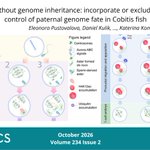
An egg-intrinsic mechanism determines sperm entry and paternal genome exclusion, resulting in either true fertilization or clonal propagation in #cobitis fish.
Find the first in vivo evidence of this in October #GENETICS issue: 🔗 buff.ly/h925zGd

🪰A series of genetic, thermogenetic, and pharmacological experiments establishes the role of AMPK-related kinase snrk in promoting sleep by acting in a subset of wake-promoting cholinergic neurons in #Drosophila.
Learn more in October #GENETICS issue: 🔗 buff.ly/SL6tN5n

🔗 The DRSC Integrative Ortholog Prediction Tool (DIOPT) provides a centralized portal for identifying orthologs among major model organisms.
Major updates made in the 10 DIOPT versions are summarized by @PerrimonLab in the October #GENETICS issue. 🔗 buff.ly/9PiKfjE

New research in the October issue of #GENETICS probes the roles of the nascent polypeptide–associated complex (NAC) and the ribosome-associated Hsp70 system Ssb1/2 in #yeast mitochondrial protein import and proteostasis.
🔗 buff.ly/bKIJKAK

📣 Call for Nominations: The Gruber Genetics Prize recognizes a leading scientist, or up to three scientists, for groundbreaking contributions to genetics research. The prize includes a $500,000 award.
🔗 buff.ly/YrZcKrl
Deadline: December 15, 2026.
@The_Gruber_Fdtn

🧬 Do populations evolve similar traits through the same or different genetic mechanisms?
🐠 A #cavefish study in October #GENETICS issue identifies that repeated evolution comes from reusing a limited subset of genomic regions, affecting many traits.
🔗 buff.ly/ae5YNB1

We’re closing out our #Worm27 speaker series with Asako Sugimoto (Tohoku University).
Her lab investigates the mechanisms and evolution of cell division and chromosome organization.
Join us in Kobe to hear more about her work!
Learn more about #Worm27: buff.ly/mWmNHYX

🪰 Read the featured study in the October #GENETICS issue, which shows how multiple cell-adhesion molecules (CAMs) with opposing roles function synergistically to fine-tune neurite morphogenesis during #Drosophila neural circuit assembly.
🔗 buff.ly/FE7DB0m
📷️ Qi Xiao

Introducing CVaR-OCS, a novel formulation of optimum contribution selection that directly incorporates the joint posterior distribution of estimated breeding values for optimization via Conditional Value at Risk.
Now live in the October #GENETICS issue:🔗 buff.ly/o8rShft

There is still time to apply for the Drosophila Trainee Award! The award provides travel support of up to $1,000 for graduate students and postdoctoral fellows attending #Dros27.
🔗 Apply by October 29: buff.ly/Hq3M0Oc

A #Drosophila genetic screen featured in the October issue of #G3journal shows how Polycomb and Trithorax genes shape the rapidly evolving gene regulatory network responsible for dimorphic abdomen tergite pigmentation.
🔗 buff.ly/3QRlc0U
📷️ Thomas M Williams

Using Bayesian variable selection, QTL mapping, and context-dependent mediation analysis, researchers dissected genetic regulation of immune traits and their contribution to #COVID-19 disease severity in mice🐭.
Now live in the October #GENETICS issue 🔗 buff.ly/QVSTjpc

📣 Attention all educators!
The latest Primers published in #GENETICS in 2026 cover mitochondrial protein cleanup, epigenetic inheritance, neuronal lipids, and QTL mapping. Explore these resources for bringing genetics concepts into the classroom: buff.ly/UKcDiR4

🪰 Discover the latest #Drosophila transcriptome in the October issue of #GENETICS
It provides a high-resolution view of larval transcription under normal and parasitic wasp–infested conditions, highlighting the roles of noncoding RNAs in immunity.
🔗 buff.ly/PBqbEvG

🪰 Copulatory wounds are injuries that arise during mating in insects.
The October #GENETICS issue features a #Drosophila model of copulatory wounds and their healing, offering a system to study sexual conflict in the animal kingdom.🔗 buff.ly/6YNlA89
📷️ Sophie Jalkut

Know an outstanding early career Drosophila neurogenetics researcher? Nominate them for the Hugo Bellen and Catherine Tasnier Drosophila Neurogenetics Lecture for #Dros27! Nominations close October 22. 🔗: buff.ly/WZkKH5B

📖 Want to learn about QTL mapping?
Shizhong Xu's primer unpacks the basics of QTL mapping with the goal of making it accessible to audiences with limited statistical and genetic knowledge.
Read more in October's #GENETICS issue: 🔗 buff.ly/RnpdAyS
