

Co-Author of Superabundance and the Simon Abundance Index. Senior Fellow at the Discovery Institute, Adjunct Scholar @CatoInstitute. Tweets are mine.
superabundance.com
Joined May 2009
- Tweets11K
- Following863
- Followers2.6K
- Likes3.1K





Gale Pooley retweeted

.@Galepooley calculates that "the time price for a blue-collar worker’s Thanksgiving dinner fell 44.4 percent, from 3.22 hours in 1986 to 1.79 hours in 2026."
Read about it here: humanprogress.org/the-second…

How about that? Now ammonia is superabundant, not because we have more atoms, but because we have more knowledge. Nice.

Shrinking ruthenium catalysts boosts ammonia production rate up to 57-fold | The Korea Advanced Institute & Technology, Phys .org
Ammonia is drawing renewed attention as a "magic container" for safely storing and transporting hydrogen, a promising clean energy source of the future, as well as a carbon-free fuel that does not emit greenhouse gases when burned. However, for ammonia to be widely used as a key fuel, improving the efficiency of its production process is essential.
In the Journal of the American Chemical Society, Korean researchers present a new approach that enables ammonia to be produced rapidly and in large quantities while using a much smaller amount of the expensive and scarce precious-metal catalyst.
The team, led by Professor Minkee Choi from the Department of Chemical and Biomolecular Engineering, greatly improved metal-use efficiency by reducing the particle size of ruthenium (Ru) catalysts used for ammonia synthesis.
Ammonia has long been used as a key raw material for fertilizers, but recently it has attracted even greater attention as a critical material in the hydrogen economy. This is because converting gaseous hydrogen into ammonia makes it much easier to store and transport, after which hydrogen can be extracted again when needed or ammonia itself can be used directly as a fuel.
However, conventional ammonia production requires extremely high temperatures and pressures, resulting in high energy consumption.
Ruthenium (Ru), a metal that exhibits excellent performance in ammonia synthesis, is an expensive and scarce precious metal. It is therefore important to achieve high productivity using as little ruthenium as possible.
Smaller particles strengthen the electron effect
The research team found a solution by dividing the precious metal into extremely small particles. In general, when metal particles are made smaller, their surface area increases, naturally creating more sites that can participate in chemical reactions.
The researchers revealed that as the particles become smaller, each individual reaction site itself also becomes significantly more active. The key lies in an "electron promotion effect." To produce ammonia, the strong bond between nitrogen atoms in nitrogen molecules must be broken, and an electron-rich catalyst actively facilitates this process.
The research team further conducted comparative experiments by adding barium oxide (BaO), which helps supply electrons, to ruthenium (Ru) catalysts of different particle sizes.
The results showed that as the particle size decreased, electrons transferred much more effectively from barium oxide (BaO) to the ruthenium (Ru) surface, maximizing the "electron promotion effect." The increased abundance of electrons on the catalyst surface made it easier to break the bonds in nitrogen molecules, greatly accelerating the ammonia synthesis reaction.
Ammonia production rises 57-fold
In particular, a catalyst with a particle size of 1 nanometer (nm) achieved an ammonia synthesis rate per reaction site 4.4 times higher than that of a 10 nm catalyst.
As a result, two effects occurred simultaneously: the number of available reaction sites increased, and the performance of each individual site improved. Consequently, when the same amount of ruthenium (Ru) was used, the overall ammonia production rate increased by as much as 57-fold, dramatically improving production efficiency relative to the amount of precious metal used.
Choi said, "This study identifies a principle for increasing ammonia productivity by using expensive precious metals more efficiently." He added, "Going forward, we will extend this work to develop catalysts that enable ammonia production with lower energy consumption, even at low temperatures and pressures."
Yaejun Baik, a Ph.D. student in the KAIST Department of Chemical and Biomolecular Engineering, led the study as the first author, while Choi participated as the corresponding author.
Read more:
phys.org/news/2026-11-ruthen…

5
194


Look at the time prices of almost everything. Personal abundance is doubling every 20-30 years. Has been for the last 200 years. The poor benefit from innovations the most. Because they now have much more time.

Joe Lonsdale, co-founder of Palantir, on what happened to working class wages the last time productivity shot up:
Joe Kernen: "Everybody's going to get wealthier? Because only the wealthy have been getting wealthier."
Joe Lonsdale: "That's not true. The most important comparison: 1870 to 1900, the Second Industrial Revolution, the last time productivity shot up a lot...
The average working class American was twice as wealthy in real terms within one generation, and that's what happens when productivity goes up. Everyone gets wealthier.
We teach economics very poorly in this country."
@JTLonsdale
xitter.cf/IterIntellectus/status…

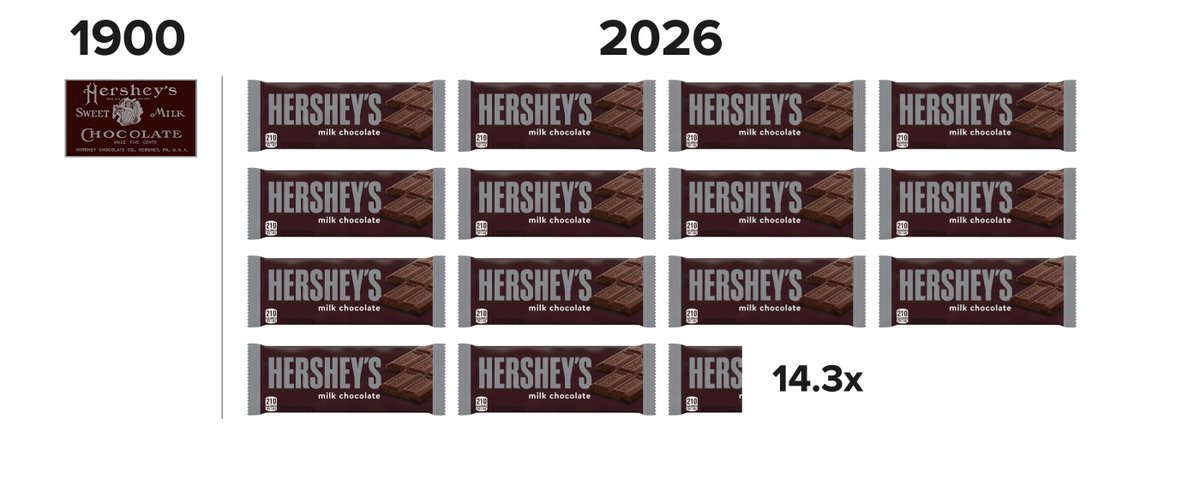
We don’t realize how rich we’re getting because everyone else is getting rich right along with us. We should compare ourselves to our ancestors, not our neighbors. Then you replace envy with gratitude.
Gale Pooley retweeted

From a frustrating laboratory “failure” to inexpensive household necessity, Super Glue demonstrates how new knowledge, not more resources, make the world richer.
cc: @Galepooley
thedailyeconomy.org/article/…

Gale Pooley retweeted

If you don't wake up every day thinking, "What a time to be alive," you're not awake yet.


Get 22,320 tubes of paint today for the time price of one in 1626. Color superabundance. Nice.

New @HumanProgress article by @mariachammond concerning the growing abundance of paint.
humanprogress.org/the-brilli…


I shall try harder.

The First Presidency of The Church of Jesus Christ of Latter-day Saints released their special Christmas message.
President Dallin H. Oaks (@OaksDallinH) shared this invitation as we celebrate Christ's birth this year:
"May we follow the example of Jesus Christ, the 'Prince of Peace,' becoming peacemakers in our hearts, homes, and communities."
Living prophets continue to urge us to be peacemakers. There is no better time to put this guidance into action than during the holiday season.
3
190


Innovators transform waste into value.

When the auto industry was created, gasoline was still just considered a waste byproduct of refining kerosene
Then Henry Ford popularized one of the most consequential innovations in human history
In 2025, the US auto industry earned a combined $6 billion in net income. The oil and gas industry, by contrast, earned $110 billion.
The same thing will happen with AI.
The companies creating the frontier innovation will compete against each other and with open-source models on price, burning hundreds of billions of dollars in the process.
The real winners will be up and down the value chain. They will look obvious in hindsight, but no one is paying attention today.


Probably don't trust electrical engineers to predict the future. Since 1960, global population has increased 177% from 3 billion to 8.3 billion. And personal resource abundance (measured by 37 commodities) has increased by over 500%. Every one percent increase in population corresponded to a 2.83 percent increase in personal resource abundance. Tip of the Hat to Richard Morrison.

Monopoly isn’t capitalism. It’s a zero sum Thanos-type game. Monopoly typically requires government coercion, so it’s really socialism. Capitalism creates lots of new resources and everybody wins.

