

The best in Canadian thought leadership: insights on Canada’s future economy. Subscribe for exclusive content: https://xitter.cf/t.co/L09Df0xTn0
Joined September 2016
- Tweets22.7K
- Following5K
- Followers39.4K
- Likes32.8K







Everyone wants to celebrate Canada’s next global success. Who’s willing to back it before success looks likely?
Founders need capital when their ideas are unproven. They need room to fail, learn and try again. The rewards, if they come, follow years of uncertainty.
Joe Canavan, Principal of Canavan Capital, argues Canada cannot expect world-class companies while discouraging the risk-taking required to build them.
What would make Canada a better place to take that first big bet?
Read his full op-ed on TheFutureEconomy.ca:
thefutureeconomy.ca/op-eds/e…
#Entrepreneurship #CanadianInnovation #StartupCanada #Investment

Canada wants to lead in AI. But we’re already #9 globally for cyber threat activity.
That makes cybersecurity more than an IT problem. As AI scales, so does the speed and sophistication of the threat landscape.
John O’Brien, National Security Officer at Microsoft Canada, argues that cyber resilience could determine how confidently Canadian businesses adopt AI, scale innovation and compete globally.
Can Canada become an AI leader without becoming a cyber-resilience leader too?
Read the full op-ed on TheFutureEconomy.ca:
thefutureeconomy.ca/op-eds/c…
#Cybersecurity #AI #Innovation #Canada #Competitiveness

Cybersecurity training: completed. But has anything changed in how the business makes decisions?
84% of Canadian business leaders surveyed say cybersecurity remains a training “tick-box” rather than being as fully embedded as it could be, according to KPMG’s 2025 survey.
Francois Guay, Founder and CEO of the Canadian Cybersecurity Network, argues that awareness is only the starting point. Businesses need trusted guidance to understand which threats affect their operations, which dependencies leave them exposed and what deserves action.
That knowledge can shape more than protection. It can help leaders choose technologies, meet customer expectations and pursue new markets with greater confidence.
Read Guay’s op-ed for his argument on making trusted guidance more accessible:
thefutureeconomy.ca/op-eds/f…
#Cybersecurity #CanadianBusiness #CyberResilience #Competitiveness

Tariffs don’t just raise costs. They can decide whether a Canadian cleantech company gets to market at all.
In a survey of 100 cleantech SMEs, 71% said US-Canada tariffs have affected them or likely will. Companies are looking for customers beyond the US and choosing Canadian suppliers. But they still need a stronger market for their technologies here at home.
Heather Crochetiere, Interim CEO of Foresight Canada, asks what it will take to turn that pressure into an advantage for Canadian innovators.
Read her op-ed now:
thefutureeconomy.ca/op-eds/n…
#Cleantech #CanadianBusiness #Trade #Commercialization

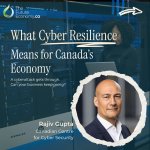
A supplier vulnerability. A stolen password. A convincing phishing email.
Any one can interrupt operations. In a connected economy, the damage can spread well beyond the organization’s first hit.
Rajiv Gupta, Head of the Canadian Centre for Cyber Security, part of the Communications Security Establishment Canada, argues that cyber resilience belongs alongside financial and operational risk on the leadership agenda.
The practical test: can essential services continue during a disruption, and has anyone tested the recovery plan?
Canada’s ability to capitalize on AI and other digital technologies depends on trust in the systems behind them.
Read his op-ed now for what leaders and employees can do to strengthen readiness:
thefutureeconomy.ca/op-eds/c…
#CyberResilience #CyberSecurity #CanadianEconomy #Leadership


Cyber threats are evolving. So is the role cybersecurity plays in Canada’s economy.
For Cyber Awareness Month, our latest Future in Focus explores what stronger digital resilience means for Canadian businesses, institutions and the people responsible for protecting them.
From AI-enabled threats and cyber preparedness to skills, strategy and trusted guidance, we’re bringing together expert perspectives on how Canada can strengthen cybersecurity while supporting innovation and competitiveness.
With insights from ↓
- Rajiv Gupta, Head, Canadian Centre for Cyber Security
- John O’Brien, National Security Officer, Microsoft Canada
- Francois Guay, Founder & CEO, Canadian Cybersecurity Network
Explore our Cyber Awareness Month Future in Focus now:
thefutureeconomy.ca/future-i…
#CyberAwarenessMonth #Cybersecurity #CyberResilience #DigitalSecurity #CanadianBusiness #DigitalEconomy #Canada


Canada wants to move more electricity between provinces. How should it pay for the infrastructure?
One approach is the traditional model: provinces develop infrastructure and recover costs from their own ratepayers.
Another is to treat major interprovincial transmission as national infrastructure, bringing federal funding together with pension and private capital to finance projects whose benefits extend beyond a single province.
Jatin Nathwani, Professor Emeritus at the University of Waterloo, and Barry Appleton, Fellow of the Balsillie School, argue for the latter approach.
Their proposal includes federal green bonds, pension capital and public-private partnerships, with safeguards against foreign control of critical infrastructure.
It raises a bigger question for Canada: when electricity infrastructure serves both provincial customers and national economic objectives, how should the cost be shared?
Read their full argument on TheFutureEconomy.ca:
thefutureeconomy.ca/op-eds/b…
#CanadianEconomy #Electricity #Infrastructure #Energy #Investment

What could $1.7 billion unlock for Canada’s electricity future?
Research from the C.D. Howe Institute suggests that this relatively small amount in seed capital could help drive $92.5 billion in renewable energy investment over a decade.
The bigger question is how Canada finances infrastructure at national scale.
For Jatin Nathwani, Professor Emeritus at the University of Waterloo, and Barry Appleton, Fellow of the Balsillie School, the opportunity is bigger than financing.
They argue that connecting Canada’s provincial electricity systems through an east-west grid could turn the country’s clean power advantage into a national economic asset.
A more connected grid could help provinces trade surplus power, support growing industrial demand and strengthen Canada’s energy resilience.
The question is whether Canada is ready to treat electricity infrastructure as a nation-building project.
Read their full argument on TheFutureEconomy.ca:
thefutureeconomy.ca/op-eds/b…
#CanadianEconomy #Electricity #Infrastructure #CleanEnergy #Investment

As Dr. Rob Annan, President & CEO of Genome Canada, points out in our latest expert interview, the pace of genomic innovation is completely changing what is possible in healthcare. The scientific breakthrough is here, the next challenge is implementation.
To turn this incredible speed into real patient outcomes, Canada must:
- Integrate health data securely to support precise risk assessment and earlier diagnosis.
- Shift from reactive medicine to proactive, personalized care.
- Build strong data governance to ensure public trust remains at the heart of innovation.
The technology to transform patient lives exists, now we need the infrastructure, data sharing, and policy alignment to bring it into standard care.
🎬 Watch the full conversation, also featuring Dr. Jim Woodgett, President & Scientific Director of the Terry Fox Research Institute, and host David Jones, Managing Director of Merck Canada:
thefutureeconomy.ca/intervie…
#Genomics #PrecisionMedicine #HealthcareInnovation #FutureOfLifeSciences #LifeSciences #HealthData #CanadianHealthcare

93%.
A new study by the Council of Canadian Innovators found that, for most Canadian companies that are acquired, control over key business decisions shifts outside the country.
Adam Froman, Founder & CEO of Delvinia, says the question for Canada isn't only whether we can build valuable companies. It’s how much economic capacity we retain when they scale.
Read his full argument on TheFutureEconomy.ca:
thefutureeconomy.ca/op-eds/c…
#CanadianInnovation #TechScaleups #Investment #CanadianEconomy #EconomicGrowth

Canada wants to attract $1 trillion in global investment. Why isn’t that ambition extending to the companies already being built here?
Founders can encounter financing models built around tangible assets, innovation funding that becomes harder to access as they grow, procurement requirements that favour companies already operating at scale, and pressure to look abroad for capital.
Read the new op-ed by Adam Froman, Founder & CEO of Delvina, for a full perspective on what Canada’s investment strategy could mean for its technology founders:
thefutureeconomy.ca/op-eds/c…
#CanadianInnovation #TechScaleups #Investment #CanadianEconomy #EconomicGrowth

What if healthcare isn’t just a cost, but one of the most important investments a country can make?
As Canada faces an aging population alongside growing economic and geopolitical pressures, a healthy, productive population is fundamental to building a resilient society.
In this episode of The Future of Life Sciences Expert Series, presented by Merck Canada, Dr. Jim Woodgett, President and Scientific Director of the Terry Fox Research Institute, David Jones, Managing Director of Merck Canada, and Dr. Rob Annan, President & CEO of Genome Canada, discuss why it may be time to rethink the role of healthcare not simply as a service delivered to individual patients, but as an investment in better outcomes, economic strength and long-term national resilience.
Because when better health strengthens people, communities and the economy, health really is wealth.
Watch Full Episode:
thefutureeconomy.ca/intervie…
#FutureOfLifeSciences #HealthcareInnovation #LifeSciences #HealthSystems #HealthEconomics #CanadianHealthcare
🤖 Made with AI
Canada’s future workforce depends on who has the opportunity to participate in it.
Indigenous youth are already studying, working and building careers across essential sectors. Yet financial pressures, limited access to culturally relevant supports, and gaps between education and employment continue to create barriers.
For Brandon Meawasige, COO of Indspire, addressing those barriers requires action across the economy.
Policymakers can provide predictable, multi-year investment in Indigenous-led scholarships, bursaries and learner supports. Postsecondary institutions can build stronger conditions for belonging and student success. Employers can create paid internships, co-op placements, mentorship and meaningful pathways into careers and leadership.
The opportunity is not simply to help more students graduate. It is to strengthen Canada's talent pipeline, communities and long-term economic resilience.
Read Meawasige’s perspective on TheFutureEconomy.ca:
thefutureeconomy.ca/op-eds/c…
#IndigenousYouth #FutureOfWork #CanadianEconomy #WorkforceDevelopment #Education

Truth and reconciliation are not separate from the question of Canada’s future.
For Stephanie Scott, Executive Director of the National Centre for Truth and Reconciliation, the connection runs through the foundations on which a prosperous society depends: trust, justice and accountability.
Read her perspective on TheFutureEconomy.ca:
thefutureeconomy.ca/op-eds/t…
#TruthAndReconciliation #IndigenousReconciliation #CanadianLeadership #EconomicReconciliation

“When First Nations thrive, all of Canada thrives.”
For Cindy Woodhouse Nepinak, National Chief of the Assembly of First Nations, reconciliation and Canada’s economic future are deeply connected.
First Nations continue to face significant gaps in housing, clean water, schools, healthcare, roads and digital connectivity. The overall infrastructure gap is estimated at $376.1 billion and growing.
Closing it, Woodhouse Nepinak argues, could generate benefits well beyond First Nations communities. She points to $635.3 billion in potential economic output over seven years, alongside gains in GDP, government revenues, productivity, education, health and long-term skills development.
As Canada pursues major projects and looks for ways to strengthen its economy, her argument is that First Nations infrastructure should be understood as part of Canada's broader economic agenda.
On National Day for Truth and Reconciliation, read National Chief Cindy Woodhouse Nepinak’s perspective on building a stronger shared future on TheFutureEconomy.ca:
thefutureeconomy.ca/op-eds/t…
#FirstNations #Reconciliation #CanadianEconomy #Infrastructure #EconomicDevelopment

Can we detect cancer risk before the disease ever develops? 🧬
As populations age and cancer becomes more common, better treatments alone may not be enough. Prevention, and the ability to identify risk earlier, could become an increasingly important part of the equation.
In this episode of The Future of Life Sciences Expert Series, presented by Merck Canada, Dr. Jim Woodgett, President and Scientific Director of the Terry Fox Research Institute, discusses how genomic profiling can help identify inherited mutations that may predispose people to certain cancers.
Leading the conversation, host David Jones, Managing Director of Merck Canada, explores how precision medicine could also help health systems make more effective use of limited resources and create room for the next generation of innovation.
The discussion also features Dr. Rob Annan, President & CEO of Genome Canada, bringing together perspectives on how genomics and precision medicine could shape the future of cancer care.
Watch Full Episode: thefutureeconomy.ca/intervie…
#FutureOfLifeSciences #CancerResearch #Genomics #PrecisionMedicine #CancerPrevention #LifeSciences #HealthcareInnovation
🤖 Made with AI
Canada is making consequential choices about the economy it wants to build, from major infrastructure and supply chains to trade and workforce productivity.
Victoria Pruden, President of the Métis National Council, argues that reconciliation must be part of how those decisions are made.
The Métis Nation is already deeply embedded in Canada’s economy. Métis workers, entrepreneurs and businesses contribute across sectors, including construction and the skilled trades. And the economic opportunity ahead is significant: research cited by Pruden estimates that closing the Métis productivity gap could contribute approximately $13 billion annually to Canada’s GDP.
Realizing that potential means addressing barriers to capital, education and training, while ensuring Métis governments are involved early enough to shape the projects and policies affecting their citizens, lands and futures.
Economic reconciliation, Pruden argues, is about creating the conditions for Métis governments, businesses, workers and communities to participate in Canada’s growth on their own terms.
Read her perspective on TheFutureEconomy.ca: thefutureeconomy.ca/op-eds/r…
#EconomicReconciliation #MétisNation #CanadianEconomy #EconomicDevelopment #Reconciliation

Closing the First Nations infrastructure gap is not only an infrastructure imperative. It represents a significant economic opportunity for Canada.
The gap is estimated at $376.1 billion and growing.
Cindy Woodhouse Nepinak, National Chief of the Assembly of First Nations, writes that closing it has the potential to generate $635.3 billion in economic output over seven years, with every dollar invested contributing $1.82 in economic output.
The projected benefits extend further: an estimated $308.9 billion in GDP over seven years, alongside additional government revenues and longer-term benefits from better education, health, productivity and economic development.
As Canada looks to strengthen its economy and build critical infrastructure, Woodhouse Nepinak argues that investing in First Nations must be part of that strategy.
Read her perspective on TheFutureEconomy.ca: thefutureeconomy.ca/op-eds/t…
#FirstNations #Infrastructure #CanadianEconomy #EconomicGrowth #Reconciliation
