

🚀 Regional Director @BankersLife | 🌍 Int’l Speaker | 🎤 Host: Daily Dose of Leadership | 📘 Author | Forbes Contributor | Helping Leaders Think Bigger
USA/ Los Angeles
Joined June 2009
- Tweets4.2K
- Following3.2K
- Followers2K
- Likes253






“People can rise to your expectations, but they settle into your culture.
When the two conflict, culture wins.”
— Farshad Asl
You can set ambitious goals.
Establish high standards.
Communicate clear expectations.
And challenge your team to achieve more than they thought possible.
But none of those things will create lasting excellence if the culture contradicts them.
Because people don’t just respond to what leaders expect. They adapt to what the organization allows.
If you demand accountability but tolerate excuses, excuses become normal.
If you preach teamwork but reward individual recognition at the expense of others, competition replaces collaboration.
If you speak about integrity but overlook dishonesty when results are strong, people learn that performance matters more than principles.
And if you encourage people to speak up but punish those who challenge you, silence becomes the culture.
Your expectations communicate the standard. Your culture reveals the standard people actually experience.
This is why culture cannot be reduced to motivational speeches, inspirational posters, or a list of values on the wall.
Culture is shaped by everyday leadership decisions.
What you recognize.
What you reward.
What you correct.
What you tolerate.
And what you consistently model.
Over time, those choices teach people what truly matters.
A strong culture does not replace high expectations. It makes those expectations believable, achievable, and sustainable.
As leaders, we must ask ourselves:
Are we reinforcing the behaviors we expect?
Are we holding ourselves to the same standards?
Are we creating an environment where people can grow, contribute, and take responsibility?
Or are we asking people to rise to standards our culture quietly undermines?
You cannot build a high-performance team on a low-accountability culture.
Align your standards.
Align your expectations.
Align your actions.
And build a culture that supports the very excellence you ask people to achieve.
Because expectations may inspire people to rise.
Culture determines what they learn to live.
#Leadership #OrganizationalCulture #LeadershipDevelopment #Accountability #HighPerformanceTeams #Integrity #LeadershipExcellence #FarshadAsl

“Ownership is putting your name on the work before you know the outcome—and standing behind it when there is more to correct than to celebrate.”
— Farshad Asl
Everyone wants to be associated with success.
The recognition.
The results.
The moment when the hard work finally pays off.
But ownership is not something we claim after the outcome is known.
It is a commitment we make before the results arrive.
It means putting our name behind a decision when uncertainty still exists.
Taking responsibility for the standards we establish, the promises we make, and the work we agree to lead.
And when the results fall short?
That is when ownership becomes visible.
Some people begin explaining why the outcome was not their responsibility.
Others distance themselves from the decision, the team, or the work.
But accountable leaders ask a different set of questions:
What did I miss?
What could I have influenced?
What needs to change?
And what am I responsible for doing next?
Ownership is not defending every decision. It is having the integrity to examine it.
It does not mean accepting blame for circumstances beyond our control.
It means refusing to use those circumstances as an excuse to avoid the responsibilities that remain ours.
Sometimes ownership requires admitting a mistake.
Sometimes it means changing direction, rebuilding trust, or making a difficult correction.
And sometimes it means standing beside your team when the results are disappointing, rather than stepping away when they need your leadership most.
Success may reveal what we accomplished.
Setbacks reveal how seriously we take responsibility.
The leaders who earn lasting trust are not those who always get everything right.
They are those who remain accountable when things go wrong and committed to making them better.
Put your name on the work.
Own your part in the outcome.
And when there is more to correct than to celebrate, lead the correction.
#Leadership #Ownership #Accountability #Integrity #Character #LeadershipDevelopment #LeadingByExample #FarshadAsl

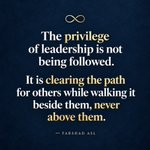
“The privilege of leadership is not being followed.
It is clearing the path for others while walking it beside them, never above them.”
— Farshad Asl
Leadership is not a privilege because people follow you.
It is a privilege because you have the opportunity to make their journey better.
Too often, leadership is measured by authority, recognition, and the number of people who report to us.
But the true measure of leadership is found in what becomes possible for others because we chose to lead.
Did we remove an obstacle or become one?
Did we create opportunities or protect our position?
Did we develop people’s confidence and judgment, or make them dependent on our approval?
Great leaders do not use their position to create distance.
They use it to remove barriers, open doors, and help others discover what they are capable of becoming.
And they understand something equally important:
Leadership does not place us beyond the need to learn, listen, or grow.
We may carry different responsibilities, but we are not above the people we serve.
We remain accountable to the standards we establish.
We stay open to correction.
We share the challenges, recognize the contributions, and celebrate the growth of others without needing the spotlight for ourselves.
Because leadership is not about how high we rise above people.
It is about how many people can rise because we chose to walk beside them.
The greatest privilege of leadership is not having people who follow your path.
It is helping them discover the confidence, capability, and courage to create their own.
Clear the path.
Walk beside them.
Raise leaders who will one day lead beyond you.
#Leadership #ServantLeadership #LeadershipDevelopment #Humility #Integrity #Empowerment #LeadingByExample #FarshadAsl

“AI can shape your choices.
It cannot carry their consequences.
Never surrender the judgment you must answer for.”
— Farshad Asl
Artificial intelligence is changing how we think, work, and make decisions.
It can analyze information in seconds, uncover patterns we might miss, and recommend solutions we may never have considered.
But access to intelligence is not the same as exercising judgment.
AI can shape which options we see, which risks we consider, and which questions we fail to ask.
And when those decisions affect someone’s career, livelihood, trust, or future, the consequences are real.
The recommendation may come from a machine. The responsibility does not.
Leadership requires more than accepting a convincing answer.
It requires the courage to question assumptions, recognize what the data may be missing, and consider the people behind the numbers.
Sometimes, it means rejecting the recommendation altogether.
A faster answer is not always a wiser decision.
The danger is not that AI will make recommendations.
It is that leaders may stop questioning them.
Technology should expand our ability to think, not become an excuse to stop thinking.
Use AI to inform your decisions.
Use your values to guide them.
And never delegate the accountability that belongs to you.
#Leadership #AILeadership #ArtificialIntelligence #Accountability #DecisionMaking #Integrity #HumanJudgment #FarshadAsl

“The first room you lead is not the office.
It is the one where the people who know you best learn what your word is worth.”
— Farshad Asl
Leadership does not begin when someone gives us a title.
It begins much closer to home.
Before our teams experience our leadership, the people closest to us experience our character.
They hear our promises.
They see our priorities.
They feel our presence—or our absence.
And they learn whether our actions give meaning to our words.
At work, we may be recognized for our achievements, decisions, and results.
But at home, the measure is often different.
Did we keep our promise?
Did we make time when it mattered?
Did we listen when someone needed to be heard?
Did we take responsibility when we fell short?
The people closest to us do not need a perfect leader. They need a person whose words and actions can be trusted.
Leadership is not only about inspiring people to follow a vision.
It is about living the values we ask others to embrace.
And when we fall short, as we all do, integrity requires us to acknowledge it, make things right, and do better.
Because credibility is not built through a single promise.
It is earned through the consistency of our choices over time.
Our public achievements may define our reputation.
Our private commitments reveal our character.
The true test of leadership is not only what people say about us in the rooms where we are celebrated.
It is what the people who know us best have experienced through our actions.
Lead with integrity where it matters most.
Start with the people closest to you.
#Leadership #Family #Integrity #Character #Trust #Legacy #PersonalGrowth #FarshadAsl

“Success can rewrite the story of who built it.
Gratitude refuses to let the names disappear.”
— Farshad Asl
Success has a way of changing how the story gets told.
In the beginning, we remember everyone.
The people who believed in us before the results came.
The people who showed up when the work was difficult.
The people who made sacrifices without expecting recognition. The people whose contributions never appeared on a scoreboard.
Then success arrives.
Recognition grows.
The spotlight gets brighter.
And sometimes, without realizing it, we becomes I.
We begin remembering the achievement more clearly than the people who helped make it possible.
That is where gratitude becomes a responsibility, not just a feeling. Gratitude remembers the hands that helped build the dream. It gives credit where credit is due. It recognizes the sacrifices, the encouragement, the loyalty, and the quiet contributions that made the journey possible.
And it reminds us that leadership is not about collecting all the credit.
It is about recognizing the people who helped create the success.
A leader’s integrity is revealed not only by how they achieve success, but by how honestly they share the credit.
So today, think about your own journey.
Who believed in you before others did?
Who stood beside you when things were difficult?
Whose contribution deserves more recognition than it received?
Don’t wait for another milestone to acknowledge them.
Success may put your name in the spotlight.
Gratitude makes sure you remember who helped you get there.
#Leadership #Gratitude #Humility #Recognition #Integrity #Teamwork #ServantLeadership #FarshadAsl

“Forgiveness does not excuse the offense, erase the past, or restore trust.
It refuses to give the offense authority over your next decision.”
— Farshad Asl
Some experiences leave wounds long after the moment has passed.
A betrayal.
A broken promise.
An injustice.
A trust that was violated.
What happened may be beyond our control.
But we can work toward choosing how much influence that experience has over the decisions we make moving forward.
Too often, yesterday’s pain finds its way into today’s choices.
We become suspicious of people who have done nothing wrong.
We avoid opportunities because someone once disappointed us.
We make decisions from resentment rather than from the values we believe in.
Forgiveness does not mean pretending nothing happened.
It does not require reconciliation.
It does not remove accountability.
It does not mean giving someone another opportunity to hurt you.
And it certainly does not require restoring trust that has not been earned.
Forgiveness is the difficult work of separating what happened to us from who we choose to become because of it.
We can remember without seeking revenge.
We can establish boundaries without carrying bitterness into every relationship.
We can hold people accountable without allowing the offense to define our character.
The past deserves to teach us. It does not deserve to govern every decision that follows.
Forgiveness may take time. Healing may take even longer.
But every step toward releasing resentment creates more room for clarity, wisdom, and peace.
Remember the lesson.
Protect your boundaries.
Reclaim your next decision.
#Leadership #Forgiveness #Character #Integrity #Wisdom #PersonalGrowth #EmotionalIntelligence #FarshadAsl

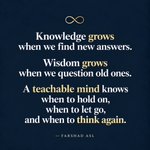
“Knowledge grows when we find new answers.
Wisdom grows when we question old ones.
A teachable mind knows when to hold on, when to let go, and when to think again.”
— Farshad Asl
One of the greatest challenges in leadership is knowing the difference between conviction and certainty.
Experience gives us knowledge.
Knowledge gives us confidence.
But confidence can quietly become resistance when we stop questioning what we believe.
We become attached to the answers that once served us well.
The strategies that produced results.
The lessons that shaped our thinking.
The beliefs that helped us succeed.
And sometimes, without realizing it, we begin protecting those answers instead of learning from new experiences.
What brought us success yesterday may not be what moves us forward tomorrow.
But being teachable does not mean questioning everything or abandoning our principles whenever someone disagrees.
It means developing the judgment to recognize the difference.
Knowing when to stand firm because the evidence and our values support us.
Knowing when to let go because something we once believed is no longer true or useful.
And knowing when to think again because a better question has revealed something we overlooked.
Humility gives us the courage to reconsider.
Wisdom gives us the judgment to discern.
Growth requires both.
The strongest leaders are not those who always have the right answers.
They are those who remain willing to discover better ones without losing sight of what matters.
Ask yourself:
What belief are you defending today that deserves another look?
Never let yesterday’s knowledge become tomorrow’s limitation.
#Leadership #Wisdom #Learning #Humility #GrowthMindset #LeadershipDevelopment #Becoming #FarshadAsl

“Trust is not proven by agreement.
It is revealed when people can disagree freely and the relationship still holds.”
— Farshad Asl
Agreement is easy when everyone sees things the same way.
But the real test of trust often begins when perspectives differ.
In leadership, silence can sometimes look like alignment.
People nod.
Meetings end.
Decisions move forward.
Yet beneath that silence may be questions never asked, concerns never expressed, and ideas that could have made the decision better.
Not because people have nothing to contribute.
But because they are uncertain about the cost of speaking up.
Real trust creates room for honest disagreement without putting the relationship at risk.
It allows someone to say, “I see it differently,” without fear of being dismissed, embarrassed, or punished.
It allows leaders to listen without becoming defensive.
And it allows teams to challenge ideas while remaining committed to one another.
This does not mean every disagreement must change the decision.
It means every person deserves the opportunity to be heard and treated with respect.
Agreement may create alignment.
Disagreement can deepen understanding.
Respect allows trust to endure.
The strongest relationships are not those without differences.
They are those where differences can be expressed, explored, and resolved without sacrificing dignity.
As leaders, we should ask ourselves:
Do our people feel free to challenge our thinking, or have we unintentionally taught them that agreement is safer?
Don’t build a team that simply agrees with you.
Build a team that trusts you enough to tell you the truth.
#Leadership #Trust #LeadershipDevelopment #Communication #Respect #Courage #TeamCulture #FarshadAsl

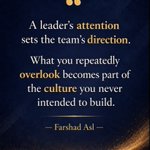
“A leader’s attention sets the team’s direction.
What you repeatedly overlook becomes part of the culture you never intended to build.”
— Farshad Asl
Every leader has a vision for the culture they want to build.
A culture of trust.
Accountability.
Excellence.
Growth.
And respect.
But culture is not shaped by vision alone.
It is shaped by what happens every day, especially in the moments when our actions either reinforce our expectations or contradict them.
The behavior we recognize.
The effort we appreciate.
The standards we reinforce.
The problems we choose not to address.
Our teams notice these patterns.
When we consistently recognize excellence, we communicate what deserves to be repeated.
When we address difficult issues with fairness and courage, we demonstrate that our standards matter.
But when we repeatedly overlook behavior that undermines those standards, silence can begin to look like acceptance.
What we tolerate today can become what we struggle to change tomorrow.
Leadership requires more than knowing what kind of culture we want.
It requires the discipline to give our attention to what matters and the courage to address what does not belong.
Ask yourself:
Are your daily actions reinforcing the culture you want to build, or quietly allowing a different one to take shape?
Your attention communicates your priorities.
Your consistency establishes your standards.
Your choices shape your culture.
Lead intentionally. The culture you build depends on it.
#Leadership #LeadershipDevelopment #Culture #Accountability #Standards #Integrity #TopLeadersGlobal #FarshadAsl

“Resilience is not measured by how quickly you rise after a fall. It is revealed by what you learn, what you leave behind, and how you rise again.”
— Farshad Asl
We live in a world that celebrates the comeback.
How quickly someone recovered.
How soon they returned.
How fast they turned a setback into success.
But some of life’s most meaningful transformations happen long before anyone sees us rise again.
A setback can teach us things success never could.
About our choices.
Our relationships.
Our priorities.
And the strength we didn’t know we had.
But learning is only part of resilience.
Sometimes growth requires leaving something behind.
The resentment that keeps us tied to yesterday.
The fear that makes every new opportunity look like another risk.
The habits and beliefs that no longer serve who we are becoming.
Not everything we experience deserves a place in our future.
And not every comeback needs to look like the life we had before.
Resilience is not about returning unchanged. It is about moving forward with greater wisdom and the courage to begin again.
Take the lesson.
Release what no longer serves you.
Rise with greater purpose.
Because the real measure of a comeback is not how quickly you return.
It is who you become through the journey.
#Resilience #Leadership #PersonalGrowth #Perseverance #Courage #Wisdom #Becoming #FarshadAsl

“Give people direction, and they can follow.
Hold them to standards, and they can perform.
Give them decisions to own and mistakes they can recover from, and they can lead.”
— Farshad Asl
One of the greatest responsibilities of leadership is developing people who can lead without depending on us.
Yet too often, we spend more time giving instructions than developing judgment.
We tell people what to do.
We establish expectations.
We measure performance.
All of that matters.
But following directions is not the same as developing the ability to lead.
Leadership grows when people are trusted with real responsibility.
When they are given decisions to make, not just instructions to follow.
When they are held accountable for their choices, not just their results.
And when they have the opportunity to make recoverable mistakes, reflect, learn, and improve.
Direction creates clarity.
Standards create accountability.
Ownership develops judgment.
Developing leaders does not mean removing standards or abandoning oversight.
It means creating an environment where people can exercise judgment, take responsibility, and grow through experience.
Ask yourself:
Can your people make sound decisions without you?
Can they uphold the standards when you are not present?
Can they develop someone else to do the same?
The goal is not to become the leader everyone depends on. It is to develop leaders others can depend on.
Because the greatest measure of leadership is not how many people follow your direction, but how many develop the judgment to lead beyond it.
#Leadership #LeadershipDevelopment #Empowerment #Accountability #Coaching #Ownership #TopLeadersGlobal #FarshadAsl

“Knowledge creates potential.
Action creates growth.
What limits us is often not what we don’t know, but what we know and still refuse to do.”
— Farshad Asl
We live in a world where knowledge has never been more accessible.
We read.
We study.
We attend seminars.
We seek advice.
We collect information.
Yet knowing more does not always mean becoming more.
Sometimes, the greatest obstacle to growth is not a lack of knowledge.
It is the difficult conversation we keep postponing.
The decision we hesitate to make.
The responsibility we avoid accepting.
The first step we already know we need to take.
We convince ourselves that we need more time, more preparation, or greater certainty.
Sometimes we do.
But there comes a point when learning becomes a comfortable substitute for doing.
Knowledge expands what we understand.
Action expands who we become.
The distance between where we are and where we could be is not always measured by what we still need to learn.
Sometimes it is measured by what we already know but have yet to put into practice.
Growth begins when knowledge stops being something we collect and becomes something we live.
What do you already know you need to do, but keep putting off?
#Leadership #PersonalGrowth #Action #Discipline #Accountability #Mindset #Becoming #FarshadAsl

“The heaviest weight a leader carries is not the mission.
It is the argument that continues after the decision no longer needs one.”
— Farshad Asl
Some decisions deserve more thought.
Others have already been made.
The problem begins when we keep reopening a decision that no longer needs another debate.
We reconsider.
We renegotiate.
We revisit what we already know.
Not because the mission changed, but because commitment became uncomfortable.
There is wisdom in questioning a decision when new information appears. But there is also wisdom in recognizing when the questioning has served its purpose.
At some point, the energy spent debating the decision must become energy invested in carrying it forward.
Clarity makes the decision.
Commitment stops renegotiating it.
Discipline carries it forward.
The mission may be demanding.
Don’t make it heavier by carrying an argument that has already ended.
#Leadership #Commitment #Discipline #DecisionMaking #Focus #PersonalGrowth #FarshadAsl

“Selling is not the art of the close.
It is the fit you confirm and the service that follows.
An honest close starts the relationship.
Service earns the next one.”
— Farshad Asl
Too many salespeople are trained to think the close is the finish line.
It isn’t.
The responsibility begins before the signature by making sure what you offer genuinely fits the person in front of you.
And it continues long after the signature through the service you provide.
A sale without fit may produce a transaction.
A sale without honesty may produce regret.
A sale without service may be the last one you earn.
Great selling is not about convincing someone to say yes.
It is about earning the right yes, serving it well, and becoming worthy of the next opportunity.
Confirm the fit.
Close with integrity.
Serve beyond the sale.
That is how transactions become relationships.
#Leadership #Sales #Integrity #Service #Trust #Relationships #FarshadAsl

“Let faith steady your thoughts.
Let your thoughts shape your next action.
Let that action become the ground where hope grows.”
— Farshad Asl
Faith does not remove uncertainty.
It gives us something steady to stand on while we move through it.
What we allow to settle in our thoughts begins to shape how we respond. And what we repeatedly choose to do gives form to what we say we believe.
Faith steadies the mind.
The mind shapes the action.
Action gives hope somewhere to take root.
Hope is not strengthened by wishing alone. It grows when belief begins to move through us.
Sometimes the next step will be small. Take it anyway.
You do not need to see the entire path to move with faith.
Steady the thought.
Take the action.
Give hope ground to grow.
#Faith #Hope #Action #Mindset #Growth #Purpose #FarshadAsl

“Purpose does not make the work bigger.
It makes the work matter.”
— Farshad Asl
We often associate purpose with something big.
A major mission.
A meaningful title.
A life-changing achievement.
A legacy people will remember.
But purpose is not reserved for the extraordinary.
Purpose changes the way you approach the ordinary.
It changes how you serve one person.
How you lead one conversation.
How you handle one responsibility.
How you do the work no one applauds.
The task may be small. The audience may never see it. The recognition may never come.
But when you know why the work matters, you stop needing the work to look important.
Purpose does not enlarge the task.
It enlarges the meaning behind it.
Do the work with intention. Serve with meaning. Lead with purpose.
#Leadership #Purpose #Meaning #IntentionalLeadership #Service #LeadershipDevelopment #FarshadAsl

“Success has a price.
Excuses are not currency.
Discipline is.”
— Farshad Asl
Everyone wants the outcome.
The growth.
The achievement.
The freedom.
The life on the other side of the goal.
But success has never been free.
It asks for consistency when motivation disappears.
Preparation when no one is watching.
Sacrifice when comfort offers an easier option.
And discipline when excuses sound completely reasonable.
Excuses may explain why something did not happen. They may even be legitimate.
But they still cannot pay the price of the result you want.
Discipline can.
Not once. Not when it is convenient. Repeatedly.
Because eventually, every meaningful goal presents you with the same choice:
Pay the price—or change the goal.
#Leadership #Discipline #Success #NoExcusesMindset #Consistency #PersonalGrowth #FarshadAsl

“Courage is the decision to let conviction speak louder than concern, and commitment stand longer than comfort.”
— Farshad Asl
Courage is often misunderstood.
We think courageous people have less fear, fewer doubts, or greater certainty.
They don’t.
They simply refuse to give concern the final vote.
There will always be reasons to hesitate.
A cost to speaking up.
A risk in taking the step.
A temptation to choose what is comfortable over what matters.
Conviction tells you what you believe.
Courage determines whether you will act on it.
And commitment determines whether you will still be standing when the emotion that started you is gone.
You do not need every concern to disappear before you move.
Let conviction speak louder.
Let commitment stand longer.
#Leadership #Courage #Conviction #Commitment #Discipline #Perseverance #FarshadAsl

AI just crossed an important line. It's no longer answering us — it's acting for us.
Muse. Dots. AI agents. Exciting? Absolutely.
But the bigger question isn't which tech we choose. It's what happens when we delegate responsibility — not just tasks — to AI.
Who's leading whom?
My latest article explores what leaders must get right: farshadasl.substack.com/p/mu…
AI is leverage. People are the purpose. Leadership determines how the leverage is used.