

Short, Sweet & Simplified. #EUMadeSimple 🇪🇺 Your go-to source for understanding the EU 👇 Join us on a journey to demystify the EU
Joined October 2022
- Tweets5.1K
- Following396
- Followers12K
- Likes54.5K





Pinned Tweet
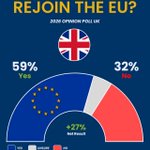
🇬🇧🇪🇺 Should the UK Rejoin the EU? ❓
A recent poll shows a majority of Britons now support rejoining the European Union. 📊
🔹 59% would vote to rejoin the EU
🔹 32% would vote to stay out
➡️ A +27% net support for EU membership
🏛️ By party:
🔹 Greens (Greens/EFA), Labour (S&D), and Lib Dem (Renew) voters show strong support for rejoining
🔹 Conservatives (ECR) and Reform voters remain strongly opposed
⚠️ Important context:
While support for rejoining is clear, polls also show Britons are against rejoining if it means giving up past opt-outs. At the same time, polls show that EU citizens oppose the UK rejoining if those opt-outs are kept, making the path back far more complex.
🤔 Should the UK rejoin the EU? 👇 And should they keep their previous Opt Outs?
#UK #EU #Brexit #RejoinEU #EUMS


🇪🇸 Spain is heading to snap elections! | But how did we get here, and what happens next?
youtube.com/watch?v=s6sUYZzg…
Join us LIVE at 12:00 CET as we break down:
• The current state of Spanish politics
• What led to this moment
• What the election means for Spain 🇪🇸
• And the wider implications for Europe 🇪🇺
🔴 Watch live: youtube.com/watch?v=s6sUYZzg…
🇪🇸 BREAKING: Snap elections called in Spain
Prime Minister Pedro Sánchez has officially called an early general election for 29 November, asking Spaniards to choose the country’s next path forward.
Spain heads back to the polls. 🗳️
🇩🇪 AfD hits 30% as CDU/CSU falls to record low 🇪🇺
The latest poll puts the AfD on 30%, opening a 12 point lead over Chancellor Friedrich Merz’s CDU/CSU, which has fallen to just 18%, its lowest result ever recorded. 📊
🔵 AfD (ESN): 30%
⚫ CDU/CSU (EPP): 18%
🔴 SPD (S&D): 14%
🟢 Greens (Greens/EFA): 14%
🟣 Die Linke (The Left): 10%
🟣 BSW: 4%
🟡 FDP (Renew): 4%
📈 AfD breaks through the “ceiling”
The 30% mark is particularly significant because AfD support was long discussed as having a relatively limited electoral ceiling. That assumption has increasingly broken down: the party won 20.8% in the 2025 federal election.
INSA has recorded the AfD at 30% for the first time, while GMS had already become the first major national pollster to put the party at 30% in September.
📉 At the same time, the CDU/CSU continues to fall. The Union won 29% in the 2025 election, but now sits at only 18% in the INSA poll. Merz’s governing CDU/CSU and SPD together would poll at just 32%, compared with roughly 45% at the last election.
⚠️ The numbers also come amid exceptionally low satisfaction with the government. INSA found 79% dissatisfied with Merz’s performance as Chancellor and 79% dissatisfied with the federal government, while only 15% and 14% respectively said they were satisfied.
Do you think 30% is close to the AfD’s real ceiling, or could it still climb significantly higher? 🇩🇪📊
#AfD #Germany #EU #EUMS

🇱🇻 United List has won Latvia’s parliamentary election in a landslide, securing 42 of the Saeima’s 100 seats and giving Prime Minister Andris Kulbergs a dominant position in negotiations to form the country’s next government.
🔵 United List is a broadly conservative, centre-right alliance focused on national security, more effective government, regional development and economic growth. It is strongly pro-EU, pro-NATO and pro-Ukraine, supports maintaining high defence spending and strengthening NATO’s eastern flank, while also backing greater use of Latvian renewable energy, reducing regional inequalities and giving municipalities a stronger role in development.
📈 The scale of its surge is remarkable. United List won just around 11% in 2022, but has now risen to 35%. Kulbergs only became Prime Minister in May after the previous government collapsed, and his first months in office appear to have significantly strengthened the alliance. His campaign focused heavily on security, continued support for Ukraine, cutting bureaucracy and responding to concerns over the cost of living.
🇷🇺 The other major gains came from Latvia First and Sovereign Power/New Latvians, which finished second and third. Both have taken softer positions towards Russia than Latvia’s traditional governing parties. Sovereign Power has opposed continued aid to Ukraine and higher military spending, while Latvia First combined a conservative-populist platform with criticism of the government’s economic record. Together, the two won almost a quarter of the vote.
🏛️ Despite their gains, they are unlikely to enter government. Kulbergs has ruled out cooperation with Latvia First, while Sovereign Power remains politically isolated. United List is instead expected to look towards parties such as the National Alliance and New Unity, both of which also support Latvia’s strongly pro-Ukraine and pro-NATO foreign policy.
🇪🇺 The result therefore strengthens Latvia’s existing pro-European and Atlanticist direction, while also revealing a growing opposition vote driven by economic frustration and disagreements over the country’s approach to Russia and Ukraine.

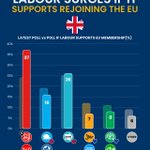
🇬🇧 Labour surges if it backs rejoining the EU 🇪🇺
A recent poll found that Labour support could rise substantially if the party committed to pursuing UK membership of the European Union. Under the hypothetical scenario, Labour reaches 37% of the vote.
That compares with 24% for Labour in the latest YouGov Westminster voting intention poll, a difference of 13 percentage points. In that latest poll, Reform UK narrowly leads Labour by 25% to 24%. YouGov
📊 IF LABOUR SUPPORTS EU MEMBERSHIP (Compared to latest YouGov Poll)
🔴 Labour (S&D) 37% (+13%)
🩵 Reform UK 26% (+1%)
🔵 Conservatives (ECR) 16% (-3%)
🟠 LibDems (Renew) 7% (-5%)
🟢 Greens (Greens/EFA) 8% (-3%)
⚪ Other 6% (-3%)
The YouGov research tested several possible Labour approaches towards Europe, including maintaining closer relations under its existing lines, joining a Customs Union, joining the Single Market and pursuing full EU membership. Of the options tested, EU membership produced the highest Labour vote share. Best for Britain
🗳️ Should Labour eventually campaign for the UK to rejoin the European Union? 🇬🇧🇪🇺

🇪🇺 Europe: A Global Leader in Innovation?
7 of the world’s 12 most innovative countries are European, and 5 are members of the EU, according to WIPO’s 2026 Global Innovation Index. 📊
🌍 Switzerland leads the world, followed by Sweden and the United States. The Netherlands, Finland and Denmark also make the global top 10, while Germany ranks 11th. But major competitors are strongly represented too, with the United States 3rd, South Korea 4th, Singapore 5th, China 10th and Japan 12th.
💡 Europe therefore remains home to many of the world’s leading innovation economies, but the ranking also highlights the scale of the competition. Most EU member states remain outside the very top, while the US and several Asian economies continue to occupy leading positions.
🤔 So is Europe still a global leader in innovation, or is it at risk of falling behind its competitors?

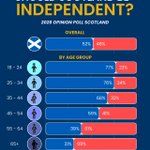
Young Scots Would Vote Yes in an Independence Referendum
A recent poll shows that if a Scottish independence referendum were held, 77% of votes cast by 18–24 year olds would be in favour of independence, while 23% would be against, a +54 point margin for Yes among the youngest age group. 📊
Across Scotland as a whole, 52% of votes would be cast for independence and 48% against it, after excluding those who are undecided.
By age group:
🔹 18–24: 77% Yes
🔹 25–34: 76% Yes
🔹 35–44: 68% Yes
🔹 45–54: 59% Yes
🔹 55–64: 39% Yes
🔹 65+: 31% Yes
📉 The pattern changes sharply with age. A majority of Yes/No votes among every age group under 55 would be cast for independence, while voters aged 55–64 and 65+ would vote predominantly against.
🏴 The poll therefore shows a substantial generational divide on Scottish independence, with younger respondents considerably more likely to vote Yes than older respondents.
A NEW CONSTITUTIONAL MOMENT IN THE UK
This poll comes amid an unprecedented moment in UK politics. For the first time, nationalist parties hold the First Minister position in Scotland, Wales and Northern Ireland. On 14 September, they met in Cardiff and signed a joint agreement asserting the right to self-determination and stated that "the future of our nations belongs in the EU".
🗳️ The debate has since reached Holyrood. On 22 September, the Scottish Parliament voted 84 to 18 for a motion stating that “Scotland is a nation that has a right to decide its own future".
🤔 If a Scottish independence referendum were held today, how would you vote?
#Scotland #ScottishIndependence #IndyRef #IndyRef2 #UK #Polls #EUMS

🇩🇪 Die Linke has won the Berlin state election, becoming the strongest party in the German capital for the first time. The party more than doubled its previous support, while the governing CDU fell sharply from its 2023 result.
🔴 Die Linke (The Left) on 26%
⚫ CDU (EPP) on 19%
🔵 AfD (ESN) on 16%
🌻 Greens (Greens/EFA) on 14%
🌹 SPD (S&D) on 12%
🟣 BSW on 4.7%
🗺️ Unlike a uniform landslide across the capital, the map shows a divided Berlin. Die Linke dominates much of the inner city, while CDU and AfD win numerous constituencies across other parts of the capital.
🏛️ The result ends the CDU–SPD government's majority and puts Die Linke’s Elif Eralp at the centre of coalition negotiations. Both the SPD and Greens have signalled willingness to govern with Die Linke, making a Die Linke–Greens–SPD coalition a likely focus of the talks, although the Greens and SPD have raised conditions concerning antisemitism within parts of the Berlin Left.
🏠 Housing was at the centre of Die Linke’s campaign, with Eralp pushing tighter rent regulation, more social housing and implementation of Berlin’s 2021 referendum on bringing large private housing portfolios into public ownership.
🇩🇪 Berlin was one of two German states voting on the same day, making the results another important test of Germany’s rapidly changing political landscape.

🇩🇪 Germany votes today as AfD surges in two key state elections 🇪🇺
Voters head to the polls today in Berlin and Mecklenburg-Vorpommern, with both races dramatically tighter than at the previous elections. The AfD is competing near the top in both states, while Die Linke has also surged in Berlin. 📊
🏙️ BERLIN
The latest poll puts three parties competing closely for first place:
⚫ CDU (EPP) 19%
🌹 SPD (S&D) 12%
🌻 Greens (Greens/EFA) 14%
🟣 Die Linke (The Left) 21%
🔵 AfD (ESN) 20%
🟡 FDP (Renew) 3%
🟣 BSW 5%
The shift since 2023 is striking, Die Linke previously won 12%, while the AfD received just 9%. Meanwhile, the CDU, which won the 2023 election with 28%, is now fighting to retain first place.
🌊 MECKLENBURG-VORPOMMERN
Here the race is essentially between the governing SPD and AfD:
🌹 SPD (S&D) 37%
🔵 AfD (ESN) 36%
⚫ CDU (EPP) 6%
🟣 Die Linke (The Left) 9%
🌻 Greens (Greens/EFA) 5%
🟣 BSW 4%
That represents a particularly large AfD increase from its 17% result in 2021, while the SPD is close to the 39.6% with which Manuela Schwesig comfortably won the last election.
⚠️ Finishing first does not necessarily mean governing. In Mecklenburg-Vorpommern, an AfD result below a majority would leave it needing coalition support, and current coalition positions leave it with very limited paths to government. SPD-led alternatives therefore remain most likely even if AfD finishes first. In Berlin, current polling instead points toward several possible multi-party coalitions, with AfD likewise outside the combinations currently considered most plausible.
Just two weeks after AfD finished first in Saxony-Anhalt with 43%, another first-place finish in either Berlin or Mecklenburg-Vorpommern would extend a major run of state-level electoral gains for the party.
🗳️ Will the SPD hold Mecklenburg-Vorpommern? Can Die Linke take first place in Berlin? Or will AfD top another German state election, potentially two on the same day? 🇩🇪


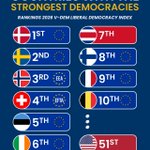
🇪🇺 Europe: The Democratic Superpower?
9 of the world’s 10 strongest democracies are European, and 7are members of the EU, according to V-Dem’s 2026 Liberal Democracy Index. 📊
🌍 But this comes as democracy is weakening across much of the world and throughout parts of Europe. Europe’s unusually strong democratic position could therefore give the EU a much bigger role in defending democracy, both at home and by building closer partnerships with other democratic powers like Canada.
🤝 Could a stronger alliance of democracies become one of the EU’s most important roles in the years ahead?
🎥 Want to learn more about the V-Dem 2026 Report and the role the EU could have in strengthening democracy? Check out the full video on YouTube at EU Made Simple.
youtu.be/kpBo_Ay1d38?is=GgJ0…

EU Made Simple retweeted
🇨🇦🇪🇺 Should Canada Join the EU? ❓
A recent poll shows Canadian support for full EU membership. 📊
🔹 57% of Canadians support Canada becoming a full EU member
🔸 32% oppose, with the rest undecided
📈 Net support: +25
🌍 Beyond membership, support for cooperation is even stronge, 84% of Canadians back strengthening economic and trade ties with the EU.
🤔 Is Canada slowly pivoting toward Europe in a changing global order? 👇
#Canada #EU #Politics #Polling #GlobalEconomy #Trade

🇨🇦 Liberals widen lead as Canada looks closer to Europe 🇪🇺
The latest poll puts Carney’s Liberals on 48%, opening a 17% lead over the Conservatives and widening the gap considerably from the 2025 election. 📊
🔴 Liberals (Renew): 48%
🔵 Conservatives (ECR/EPP): 31%
🟠 NDP (S&D): 11%
🔷 Bloc Québécois (Greens/EFA): 5%
🟢 Greens (Greens/EFA) : 3%
🟣 PPC (PfE): 1%
⚠️ EU political-group equivalents are approximations based on each Canadian party’s ideology, international relationships and similarities with European parties.
🇪🇺 The poll comes as Canada debates a potentially historic deepening of relations with the European Union. Addressing the European Parliament, Carney welcomed Ursula von der Leyen’s proposal to open the door to Canada becoming the EU’s first “associate member,.
⚠️ Canadian Opposition Shares Criticism
Conservative leader Pierre Poilievre has taken a more sceptical position. While supporting free trade and NATO cooperation with Europe, he has warned against any arrangement that could bring EU taxes, EU laws or EU-style open-border policies to Canada.
With the Liberals simultaneously growing their polling lead and pushing for a much closer transatlantic partnership, could Canada’s relationship with Europe become one of the defining political debates of Carney’s government? 🇨🇦🤝🇪🇺

Canadians Overwhelmingly Back Closer Ties With the EU 🇨🇦🇪🇺
A recent poll finds overwhelming support for closer integration between Canada and the European Union, including making it easier to trade, travel, work and study, as well as expanding security cooperation.
Overall, 81% of Canadians support closer integration, compared with just 10% opposed and 9% unsure, giving the pro-integration side a huge +71 point advantage.
This poll becomes more relevant as Canada and the EU enter a potentially significant new phase in their relationship. Prime Minister Mark Carney is due to address the European Parliament today, where he is expected to set out his vision for a “unique alliance” between Canada and Europe.
His speech follows European Commission President Ursula von der Leyen’s State of the Union address, in which she proposed opening the door for Canada to become the EU’s first-ever “associate member”, with deeper cooperation envisioned in areas including defence, technology, energy and economic integration.
With more than four in five Canadians backing closer integration, including majorities among supporters of every major federal party, the poll adds important public-opinion context to the increasingly ambitious discussions taking place.
How close should Canada and the EU ultimately become? What do you think? 👇
#Canada #EuropeanUnion #Polls #EUMS #EU #Europe

Could Canada Become an EU Member State? 🇨🇦🇪🇺
A very recent poll finds that nearly half of Canadians support Canada becoming a member state of the EU. 49% say YES, compared with 30% opposed and 21% unsure, giving the pro-membership side a +19 point advantage. Support has also edged upward from 48% in February and 46% in 2025.
The poll comes at an extraordinary moment in Canada–EU relations. European Commission President Ursula von der Leyen has now publicly proposed opening the door for Canada to become the EU’s first ever “associate member”, as Ottawa and Brussels explore a much deeper strategic relationship. Prime Minister Mark Carney has said Canada is seeking a “unique alliance” with the EU, although his government is not currently seeking full EU membership.
Public opinion appears receptive to that broader shift. The same Abacus survey found 81% support closer integration with the EU, while 80% support deeper strategic cooperation on foreign policy, defence and economic priorities.
The proposed “associate member” status is not full EU membership and would instead focus on much deeper cooperation in areas such as trade, manufacturing, defence, AI, energy and critical minerals. But as Canada and the EU move closer, and polls show substantial support for Canada actually becoming an EU member state, the shift is opening a broader question about how far this relationship could ultimately go.
Could Canada ever become an EU member state? Would you welcome Canada into the EU? Let us know in the comments! 👇
#Canada #EuropeanUnion #Polls #EUMS #EU #Europe

🇸🇪 Right Wing Bloc Loses Majority in Sweden. But Can the Left form a Government?
Sweden’s Right bloc government has lost its parliamentary majority after an extremely close election, opening the door to the return of Magdalena Andersson and the Social Democrats. 🇸🇪
The outgoing government was formed by the Moderates (EPP), Liberals (Renew) and Christian Democrats (EPP), with external support from the Sweden Democrats (ECR). SD had been expected to enter the government if the right retained its majority.
📊 Preliminary results
🌹 S (S&D) on 28.1%
🔵 M (EPP) on 19.9%
🟡 SD (ECR) on 17.6%
🔴 V (The Left) on 8.2%
🟢 C (Renew) on 7.1%
✝️ KD (EPP) on 6.2%
🌻 MP (Greens/EFA) on 6.1%
🔷 L (Renew) on 5.4%
🔴🟢 S–V–C–MP: 176 seats (Majority)
🔵🟡 M–SD–KD–L: 173 seats
The Social Democrats remain Sweden’s largest party, as they have in every parliamentary election for more than a century, but their 28.1% would be their weakest result since 1908.
🔵 A right-wing repeat?
Despite losing by only two seats, another right-wing government now looks highly unlikely. The Centre Party has ruled out cooperation with SD, even if SD remained only an external support party, while SD itself had made clear that it wanted to enter government this time.
🌹 A left-wing government?
The broad S–V–C–MP bloc has a majority with 176 seats, but coalition talks will not be simple.
The Centre Party has expressed skepticism to enter a government with the Left Party, while V has taken a firmer line than in previous elections and is demanding direct participation in government rather than simply supporting another Social Democratic cabinet from outside.
🟩 A Centre alternative?
The Centre Party’s preferred option is a broad centrist coalition excluding both SD and V, with S–C–KD–MP at its core.
But those four parties no longer reach a majority on their own, meaning such an arrangement could require five parties, potentially including the Liberals.
That would be unprecedented in post-war Swedish politics, while the Greens have also expressed clear discomfort with parts of such a coalition’s economic and social programme.
🇸🇪 A majority has changed hands, but forming a government may prove much harder than winning the election.

EU Made Simple retweeted
🇪🇺 Scotland Strongly Supports Undoing Brexit! 🇬🇧
A recent 2026 poll shows 73% of Scots would vote for the UK to rejoin the European Union, while just 27% would vote to remain out, a +46% net rating in favour of undoing Brexit. 📊
➡️ Net Support for EU Membership has nearly doubled over the past decade.
The poll shows a major shift from the 2016 referendum, when 62% of Scotland voted Remain and 38% voted Leave, a +24% net result for staying in the EU, in the referendum that resulted in Brexit.
By party:
🔹 Greens (89%), SNP (88%), Labour (73%), and Lib Dem (70%) voters strongly support rejoining
🔹 Conservative (43%) and Reform (34%) voters continue to oppose EU membership.
👦 Under 35s show the strongest support, with 80% backing UK re-entry into the EU.
🤔 Should the UK rejoin the EU? 🗨️
✨ Fun fact: Europeans would welcome an Independent Scotland into the EU.
🇪🇺 Several 2025 polls show that Europeans would welcome an independent Scotland into the EU if Scotland voted for independence and applied to join.
However, Scotland is still split down the middle on independence, with Yes and No both tied at 50%.
🎂 Age is a big divide:
🔹 Under 45s are strongly pro-independence (over 77% Yes)
🔹 Over 55s lean heavily No, rising to 75% among over-65s
#Scotland #Brexit #RejoinEU #UK #Polls #Politics #Europe #Data

🇩🇪 Saxony-Anhalt Election: AfD wins historic landslide 🇪🇺
The AfD has won the Saxony-Anhalt state election by a huge margin, more than doubling its 20.8% result from 2021 and finishing over 26 points ahead of the CDU. 📊
List Vote Results:
🔵 AfD (ESN) on 45%
⚫ CDU (EPP) on 17%
🌹 SPD (S&D) on 9%
🌻 Greens (Greens/EFA) on 9%
🔴 Die Linke (The Left) on 8%
🟣 BSW on 5%
🗺️ The scale of the AfD victory is visible across the electoral map, with the party dominating municipalities across Saxony-Anhalt and painting the entire state blue.
⚠️ Despite its enormous victory, the AfD is currently projected to fall just short of an outright majority in the Landtag. BSW, however, has narrowly crossed the crucial 5% electoral threshold, potentially becoming decisive in what happens next.
An AfD–BSW arrangement could provide a route to government if the parties were ultimately willing to cooperate. BSW had signalled openness to working with the AfD before the election, although AfD lead candidate Ulrich Siegmund had previously said he wanted to govern alone.
🏛️ If the AfD does enter government, it would mark another historic breakthrough: the party has never before participated in a state or federal government in Germany.
The result is also a devastating defeat for the CDU, which governed Saxony-Anhalt for more than two decades and has seen its support more than halve from 37.1% in 2021.
🇩🇪 The AfD has won the election. Now comes the bigger question: will Germany’s political firewall keep it out of government, or is Saxony-Anhalt about to become the first state governed by the AfD?

🇪🇺 EU Parliament Ideological Composition | A Far-Right Surge? 📊
Since 1979, the political balance of the European Parliament has steadily evolved. This graph shows the % of seats held by each ideological family after every EU election, with the 2026 value based on the latest opinion polls.
(These are ideological groupings, not formal European Parliament groups. Parties that fit these ideological groups have at times sat in different groups, in now-defunct groups, or as non-attached members.)
📈 A historic shift in the making?
For much of the EU’s history, the centre-left Social Democrats and centre-right Christian Democrats shaped the parliamentary majority.
But according to the latest polling, if elections were held today, the Populist Right / Far Right would emerge as the largest ideological bloc in Parliament, marking a potential break from the traditional centre-led dynamic.
🔴 Growth on the radical left as well
The chart also shows a notable increase in Communists/Socialists, signalling movement at both ends of the political spectrum.
🌍 A more fragmented European Parliament
With the centre shrinking and ideological blocs strengthening, EU politics may be entering a new era of competition and realignment.
🤔 Temporary fluctuation, or structural transformation?
Let us know what you think 👇
#EU #EuropeanParliament #Europe #EuropeanUnion #Polls
