

AI time-saver connecting you to people & insights for faster growth
Global
Joined July 2011
- Tweets272
- Following3.1K
- Followers3.7K
- Likes97





Pinned Tweet
📢 Join the AI conversation with two Founders @marcussawyerr Interviewing Duncan Taylor, PhD, on practical tips for AI sales & recruiting; bookmark this one! 🚀 #AI #marketing #sales #recruiting #Founders xitter.cf/i/broadcasts/1BRJjwNXm…
Thinking about "Digital Labor" in staffing? In 2026, the goal isn't just to automate tasks. Here is the 2026 blueprint for where AI agents should be taking over:
1. Top-of-Funnel "Grind" 🔍
Digital Labor: 24/7 autonomous sourcing, skill-adjacency mapping, and personalized outreach.
Human Value: Setting the search strategy and identifying the "X-Factor" in a candidate that data can't see.
2. High-Friction Coordination 📅
Digital Labor: Managing complex, multi-party interview scheduling and automated compliance redacting.
Human Value: Managing the "white-glove" experience and keeping the candidate excited through the process.
3. High-Volume Operations ⚡
Digital Labor: Instant credential verification, 3:00 AM shift-filling, and automated onboarding orchestration.
Human Value: Relationship management and handling complex escalations where empathy is required.
32
The main difference between static and AI signal research is that static research is a snapshot, while AI signal research provides monitored change over time.
That difference matters because timing usually determines whether outreach feels sharp or irrelevant.
In practice, the system is watching for shifts such as new headcount demand, tool adoption, leadership changes, expansion into a new region, or a role that appears for the first time. Then it adds context. Is this normal for the company? Is it new budget, backfill, or a strategic move? Does it create an opening now, or is it just noise?
15
Here's one question that's been floating around on LinkedIn: "How do I stay irreplaceable in an AI landscape?"
Most advice for recruiters tells us to sharpen empathy, learn prompting, and keep a human touch. All fair points, but it doesn't solve the operational mess most agencies are living with.
A recruiter doesn't become more valuable because they can talk fluently about AI on LinkedIn.
They become more valuable when their team can run faster, keep data current, reach the right people sooner, and spend more time in real conversations instead of in browser tabs. The firms pulling ahead are the ones deciding exactly where machines should work and where humans must stay in control.
This is the shift. Start thinking about AI as an agent-based workforce that handles sourcing, verification, enrichment, and admin in the background while your people handle judgment, nuance, and persuasion.
That distinction matters because recruiting has never really had a talent shortage. It has had an attention shortage. Good recruiters lose hours to stale records, fragmented systems, duplicate work, manual follow-ups, and list building that should've been automated years ago.

22
EQ's Enrich allows you to refresh your database, to transform static data into working data.
But is static data really that bad?
In short, yes.
Static databases create fake productivity
It encourages wrong behavior. A recruiter exports prospects, a sales rep buys contacts, someone enriches emails, and then the team starts outreach as if the record itself is the asset.
It isn't. The asset is current context.
Without current context, teams end up doing low-value labor.
Check out EQ.app's Enrich here and see where else your labor could be used👇
eq.community/enrich

21
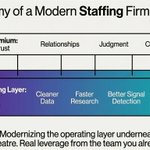
Where does EQ fit in the anatomy of a modern staffing firm?
It serves to leverage AI for well-functioning companies with efficient processes, a balanced service mix, and leaders who understand what AI means for their business.
Staffing is still a people's business.
But the back office is a new battleground where margin gets lost, speed gets slowed, and valuation gets capped when too much of the company still runs on swivel-chair admin.
Looking ahead, the future of staffing is about orchestrating a 'constellation of talent.'
In this new era, AI will not replace the recruiter, instead it will act as an autonomous digital teammate that handles the redundant.

7
Workday. 33x EBITDA multiple.
Motion Recruitment. 13.5x.
Traditional staffing. 2.5x–7.4x.
Same industry. Completely different outcomes.
After 348 M&A deals in 2025, the pattern is clear — buyers aren't paying a premium for revenue volume. They're paying for margin discipline, clean data, and leadership that actually understands where AI is taking this business.
The valuation gap isn't being created in the front office. It's being created in the operating model underneath it.

19
Thomas Schröder, co-founder of Blackwood Capital Group and a seasoned M&A advisor, keeps it practical when it comes to selling.
Get your business buyer-ready by truly understanding your numbers, cleaning up any issues, and giving yourself a couple of months to prepare before going to market.
But don’t try to reinvent your business just to attract buyers.
The better approach is to run a strong, healthy business, because that is what serious buyers are looking for.
29
Not all revenue is created equal — and this chart proves it.
Traditional staffing firms are trading at 0.1x–0.5x revenue.
Specialized, tech-adjacent models? 10x–33x higher multiples.
Same industry. Completely different outcomes.
The difference isn't the front office. It's the operating model underneath it.
After 348 M&A deals in 2025, one thing is clear: buyers aren't paying a premium for volume. They're paying for margin discipline, clean data, and leadership that understands where AI is taking this industry.
Read more: marcussawyerr.substack.com/p…

16
The $10M Question: What Strategic Buyers Actually Look For
AI is changing recruiting fast, but there’s a quieter question most agency owners are starting to ask: what is my business actually worth, and how do I grow that value?
In this episode, Marcus Sawyerr sits down with Thomas Schröder, co-founder of Blackwood Capital Group and a seasoned M&A advisor, to break it all down. With years of experience across Europe, North America, and Asia, Thomas shares what really separates high-value staffing firms from the rest and where many sellers get it wrong.
#AIInRecruiting #AI #Podcast
Listen in here: open.spotify.com/episode/1TK…

27
One of the strange things about recruiting infrastructure:
Most companies spend a lot of money building a database they slowly stop trusting.
People change roles.
Companies restructure.
Emails bounce.
Industry estimates suggest around 30% of B2B contact data decays every year.
(Gartner / SiriusDecisions–style benchmarks often cited across CRM and recruiting data providers.)
So within a year, large parts of a recruiting database are already outdated.
The result is a strange workflow where recruiters end up relying on LinkedIn searches again — essentially rebuilding the same market intelligence over and over.
The real challenge isn’t collecting data.
It’s keeping a living view of the market.
26
One signal worth watching in the AI labor market.
In some AI-exposed sectors, employment growth is slowing.
But wages are still rising.
New analysis from the Federal Reserve Bank of Dallas suggests the difference may come down to experience.
AI can replicate codified knowledge.
But experienced workers still hold tacit knowledge — judgment, context, coordination.
Automation changes tasks.
But expertise still compounds.

Last week at OaklandClaw, a founder said something that stuck:
“We’re not hiring engineers anymore.
We’re hiring people who can manage agents.”
The room laughed.
But nobody really pushed back.
Because once AI starts executing work inside real systems, the hiring question starts to change.
It’s not just:
“Do we hire for this skill?”
It’s also:
“Do we hire for it at all?”
The options increasingly look like:
Full-time → Contract → Freelance → Software → Agents.
LinkedIn estimates 70% of job skills will change by 2030.
Which makes one capability increasingly valuable:
Agility.
Interesting discussion at the first OaklandClaw. More conversations like this ahead.


40
One thing becoming clearer this year:
AI headlines are getting louder.
But the real shift is quieter.
IBM is redesigning entry-level roles around AI oversight.
Enterprise tools are embedding agents directly into workflows.
Infrastructure spend keeps climbing.
The conversation used to be:
“Will AI replace work?”
Now it’s becoming:
“Who owns the systems?”
Because once AI sits inside operations — CRM, ATS, sourcing, workflows — it stops being a tool.
It becomes part of the company.
The next few years won’t just be about better models.
They’ll be about better operators.
42
On a podcast this week, we weren’t debating whether AI will take jobs.
We were debating something else.
110 million hours a day go to scrolling.
At today’s wage levels, that’s over $1T a year in redirected human output.
Meanwhile:
AI is moving into real workflows.
Enterprise budgets are doubling down.
Roles are being redesigned, not removed.
The risk isn’t automation.
It’s distraction.
The next divide won’t be AI vs humans.
It’ll be focused vs distracted.
Community matters.
Distribution matters.
Owning attention matters.
Infrastructure is being built either way.
(Episode dropping soon.)

12
Only Apple’s AI capex went down last quarter.
Amazon +42%
Microsoft +89%
Alphabet +95%
Adoption isn’t slowing.
But here’s the real shift:
The bottleneck isn’t intelligence.
It’s orchestration.
AI without integration creates chaos.
AI with management creates leverage.

38
Last week, we gathered a small group of AI & Talent leaders in LA for an evening of conversation and connection.
We’re genuinely grateful to everyone who took the time to show up, share openly, and engage so thoughtfully. The discussions were honest, practical, and grounded in what it really looks like to integrate AI into day-to-day operations.
It was a reminder that progress in this space doesn’t just happen through tools -- it happens through community, shared insight, and operators learning from one another.
Thank you to everyone who helped make it such a meaningful night. More soon.


33
We’re entering the phase where AI needs management — not experimentation.
3 signals we’re seeing:
Agent infrastructure is arriving
AI is moving from isolated use cases → managed environments.
AI workers need identity + permissions
Microsoft’s Agent ID work reflects a bigger shift: governance.
Fragmentation is the real blocker
Not intelligence.
Not models.
Integration.
The companies moving fastest right now share three traits:
Alive data
Integrated mindset
Defined outcomes
AI without traceability isn’t leverage.
It’s liability.
The winners won’t adopt AI faster.
They’ll manage it better.

1
34
The question I kept hearing at EQ’s LA leaders event last week:
“How do we move from co-pilot → autopilot?”
Because once AI is:
sourcing candidates
enriching data
drafting outreach
triggering workflows
…it stops being a “tool.”
It becomes part of operations.
And operations require ownership.
The last 18 months were about capability.
The next 18 will be about control.
Adoption isn’t the constraint anymore.
Integration is.
The companies pulling ahead aren’t the ones adding more AI tools.
They’re the ones redesigning how work flows around them.
Execution is getting cheaper.
Operational clarity is getting expensive.

1
155
Everyone is talking about AI.
Far fewer are actually building with it.
The gap is getting obvious.
On one side, conversations, panels, predictions.
On the other, teams quietly shipping agents, workflows, and systems that actually do work.
The companies pulling ahead are not the loudest.
They are the ones turning AI into operations.
That shift is already happening in hiring, GTM, and internal tooling.
From experimentation to execution.

1
40
What used to take hours now takes seconds.
What felt impossible now feels inevitable.
Clawdbot is aiming for efficiency and speed, the same goals we aim to achieve.
#Clawdbot #FutureOfWork

82