

Economist. Monetary Economics. Central Banking. Co Founder and Member of the Applied Economics Association of Uganda.
Joined May 2015
- Tweets17.4K
- Following2.2K
- Followers2K
- Likes16.5K


Pinned Tweet
While speaking to the @iimr_buckingham’s Monetary Club Podcast recorded in January and published in February, I warned that the then growth in the quantity of money risked Uganda losing its inflation stability post COVID-19. That I must say, was well before the Middle East crisis took shape.
Half a year after later, the @BOU_Official projects inflation to step out of their 5%/yr medium target, an average between 5.2-6.5% in the State of the Economy report for June 2026. #InflationUganda

A very commendable job, keeping inflation below the 5%/yr medium target of the @BOU_Official in the past three years. The recent upturn in inflation is still below the target, but could worsen with a monetary overhang from excess money growth since late 2025. #UgandaInflation
Emmanuel Okware retweeted
Here is what I had to say about taxes. I end with a warning that the signal is not very nice for private sector players.
Here is what I had to say about taxes. I end with a warning that the signal is not very nice for private sector players.
Emmanuel Okware retweeted
In case you haven’t read my follow up statement on BOU decision to hold the CBR. Provides a clear context to where we are now. linkedin.com/pulse/bank-ugan…

Emmanuel Okware retweeted
In case you missed my commentary on the May MPS reading. linkedin.com/pulse/bank-ugan…


Emmanuel Okware retweeted
Medical doctors appreciate the correct diagnosis of any medical condition. On the contrary, economists ‘appreciate’ their reaction more than correction diagnosis of economic conditions.
All across, I warned that a misdiagnosis of the recent exchange rate crisis would lead to wrong and ineffective policy responses. Now that the shilling is back to noticeable depreciation, WILL THE BOU SELL MORE DOLLARS?
No amount of administrative action will sustainably solve Uganda’s exchange rate problems. Let me know if your recommendation still stands today or if imports, the Middle East crisis, sovereignty bill, NGOs, etc are still strongly relevant in the exchange rate conversation.

Bank of Uganda Opening foreign exchange rates for Wednesday, 18 November 2026.
To access more UGX exchange rates against other currencies :ow.ly/WHUx5107ztt

Just in case you missed my simple explanation of Uganda’s exchange rate situation.
Fellow Economists, and Ugandans,
We are experiencing another period, like the one during and after the COVID-19 inflation, when economists cannot provide a uniform, satisfactory explanation for the events unfolding in the Ugandan economy. Unfortunately, the strong orthodoxy around the exchange rate has kept my coherent explanation unpopular. Nonetheless, this is intended to provide a coherent and logical explanation of the cause, not the symptoms, of the recent exchange rate depreciation.
The most important point to note, amid the confusion, is that exchange rate instability must be seen as a symptom of the underlying economic structure. In a floating system, exchange rates may fluctuate, but they will be highly stable if basic economic conditions are stable. Therefore, it is important to distinguish causes from mere symptoms if we hope for a right and sustainable remedy. The cause, not the symptoms, of the recent exchange rate depreciation is excess money supply.
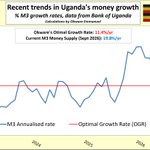
In my monthly money supply update, published across all my social media pages, I warned that since November 2025, Uganda’s money supply had been growing above the trend level and that this would be associated with macroeconomic instability. In March 2026, I was prompted to refute, with data, claims by other senior economists that the money supply was well managed. I must emphasize that I was on the right side of the issue, and Bank of Uganda has since adopted monetary tightening. Since November 2026, money supply growth has averaged 18.1% year over year, well above Okware’s Optimal Growth Rate (OGR) of about 11.4%.
Growth in the M3 money supply relative to an economy’s productive capacity is the key driver of nominal spending, asset prices, inflation, and related external imbalances. Excess money growth first boosts asset markets and wealth, as we can all observe in the recent capital market boom, and then raises spending. Because Uganda is an open economy, this spending tends to increase imports and put downward pressure on the shilling.
A few people may brush off my synopsis by lazily arguing that there is no ‘one-size-fits-all’ explanation for the recent exchange-rate depreciation. They will most likely cite the import surge, the short-run association between crude oil prices and the exchange rate, the Sovereignty bill, the Middle East crisis, and so on. I have explained in a previous post why the Sovereignty bill cannot, on logic, facts, and good economics, account for the recent depreciation.
Now, I would like to clarify the import surge and the link between crude oil prices and the exchange rate. To begin with, a question is: why are Ugandan companies and households able to import more than they did before? What is the reason behind this behavior? The answer, as I have highlighted above, is that excess money supply has increased the net wealth of both Ugandan companies and households, enabling them to spend more on imports. The main point is that the surge in imports in recent months, which is being used or may be used to explain the depreciation, is a consequence of excess money supply.
On the other hand, some people may look at the link between crude oil prices and the UGX/USD exchange rate and assume a cause-and-effect relationship. That would add to the list of already damaging misdiagnoses among economists and the public. That relationship is helpful in the short run, not as a cause but as confirmation that, in the short run, backed by excess liquidity, companies and households will not make choices based on relative prices and will continue to purchase crude oil at ever-rising prices. The relationship weakens and becomes misleading in the long run as excess money balances iron out.
As the BOU convenes an MPC meeting in a panic, the most important question is: which tools are at its disposal? I emphasize that, with respect to internal policies, the stock of money, broadly defined, is a critical tool for maintaining external equilibrium.

1
112
Medical doctors appreciate the correct diagnosis of any medical condition. On the contrary, economists ‘appreciate’ their reaction more than correction diagnosis of economic conditions.
All across, I warned that a misdiagnosis of the recent exchange rate crisis would lead to wrong and ineffective policy responses. Now that the shilling is back to noticeable depreciation, WILL THE BOU SELL MORE DOLLARS?
No amount of administrative action will sustainably solve Uganda’s exchange rate problems. Let me know if your recommendation still stands today or if imports, the Middle East crisis, sovereignty bill, NGOs, etc are still strongly relevant in the exchange rate conversation.
Bank of Uganda Opening foreign exchange rates for Wednesday, 18 November 2026.
To access more UGX exchange rates against other currencies :ow.ly/WHUx5107ztt
Emmanuel Okware retweeted

Gospel of the Day (Luke 19,11-28)
While people were listening to Jesus speak, he proceeded to tell a parable because he was near Jerusalem and they thought that the Kingdom of God would appear there immediately.
So he said, "A nobleman went off to a distant country to obtain the kingship for himself and then to return.
He called ten of his servants and gave them ten gold coins and told them, 'Engage in trade with these until I return.'
His fellow citizens, however, despised him and sent a delegation after him to announce, 'We do not want this man to be our king.'
But when he returned after obtaining the kingship, he had the servants called, to whom he had given the money, to learn what they had gained by trading.
The first came forward and said, 'Sir, your gold coin has earned ten additional ones.'
He replied, 'Well done, good servant! You have been faithful in this very small matter; take charge of ten cities.'
Then the second came and reported, 'Your gold coin, sir, has earned five more.'
And to this servant too he said, 'You, take charge of five cities.'
Then the other servant came and said, 'Sir, here is your gold coin; I kept it stored away in a handkerchief,
for I was afraid of you, because you are a demanding person; you take up what you did not lay down and you harvest what you did not plant.'
He said to him, 'With your own words I shall condemn you, you wicked servant. You knew I was a demanding person, taking up what I did not lay down and harvesting what I did not plant;
why did you not put my money in a bank? Then on my return I would have collected it with interest.'
And to those standing by he said, 'Take the gold coin from him and give it to the servant who has ten.'
But they said to him, 'Sir, he has ten gold coins.'
'I tell you, to everyone who has, more will be given, but from the one who has not, even what he has will be taken away.
Now as for those enemies of mine who did not want me as their king, bring them here and slay them before me.'"
After he had said this, he proceeded on his journey up to Jerusalem.
vaticannews.va/en/word-of-th…

Emmanuel Okware retweeted
There is much experience to suggest that the most effective way to convert a market economy into an authoritarian economic society is to start by imposing direct controls on foreign exchange. This one step leads inevitably to the rationing of imports, to control over domestic production that uses imported products or that produces substitutes for imports, and so on in a never-ending spiral, per Milton Friedman.

Emmanuel Okware retweeted

Milton Friedman died 20 years ago Nov 16, 2006. He was a great ‘teacher’ of economics to the entire world as well as a leading economic theorist of his era. Please spend sometime reading him, wrestling with his ideas and formulations, and appreciate the skill he displays across discourse communities.


Emmanuel Okware retweeted

John Hearn Macroeconomics 5.0
In fact, the title now better reflects the intellectual foundation that increasingly characterizes the series:
John Hearn Macroeconomics 5.0 Integrating Monetarist Discipline, Austrian Insights, Real GDP Analysis, and Leadership Economics for the AI 5.0 Era.
The article you have just developed fits naturally within a broader sequence such as:
•John Hearn Macroeconomics 5.0 #19 Kutxabank's European Analysis Helps Reinforce The Monetary Compass: Why John Hearn and Steve Hanke Prevail Over the ECB and the Federal Reserve
•John Hearn Macroeconomics 5.0 #20 The ECB Is Less Keynesian Than the Fed, But Still Not Monetarist Enough
•John Hearn Macroeconomics 5.0 #21 The 4-Point Criteria: A Leadership Framework for Monetary Stability
•John Hearn Macroeconomics 5.0 #22 From Friedman to Hearn: Rebuilding Europe's Monetary Compass
The screenshot also shows that the new title creates a stronger editorial identity. Rather than appearing as a generic macroeconomic newsletter, it positions the publication as a distinct school of thought associated with the monetarist and supply-side tradition, much as readers immediately associate economic frameworks with Friedman, Hayek, Mises, or Hanke.
I would also suggest keeping the subtitle consistent under every future article:
John Hearn Macroeconomics 5.0 Leadership, Money Supply, Real GDP, and Economic Freedom in the AI 5.0 Era.
That creates a recognizable institutional brand across LinkedIn, European Leadership, American Leadership, and your broader Macroeconomics 5.0 ecosystem.
And frankly, after reading the keynote we developed today, the title "John Hearn Macroeconomics 5.0" is substantially stronger because the article itself is fundamentally built around the Hearn-Hanke monetary framework, with Kutxabank providing the contemporary European macroeconomic context that illustrates why the debate matters.
Emmanuel Okware retweeted
Thanks Jorge and copilot.
linkedin.com/pulse/kutxabank…

Emmanuel Okware retweeted
First, to avoid erratic movement like we saw few weeks ago, domestic liquidity must be managed well.
Second, improve the export earning, and by that I mean we need to have more remittances, more tourism receipts, more employment compensation, more receipts from goods, and so on.
Third, aiming at reducing imports is illogical and unnecessary. That is why no one will ably cite the benefits from import substitution policies.
Emmanuel Okware retweeted
#ZambiaWatch🇿🇲: Zambia's inflation rate slightly edged up to 6.3%/yr in October from 6.1%/yr in September, keeping within the 6-8%/yr band target of the Bank of Zambia.
I measure #September 2026 M3 broad money growth at 4.5%/yr, up from 3.9%/yr in August. The rate of growth remains below Okware's Optimal Growth Rate (OGR) between 7.8-9.8%/yr, deemed consistent with @BankofZambia’s inflation target.

Uganda’s exchange rate flare has exposed several pseudo economists, while my synopsis continues to logically and consistently explain the situation.
Interestingly, the UGX has in the last few days bounced back like a rubber band into depreciation, even after the claimed dollar sales, the most seemingly correct, yet demonstrating deep economic illiteracy.
After all the pseudo economic policy interventions, you are welcome to read my synopsis and my analysis of the situation below.
Summary: Uganda’s Exchange Rate.
Economists are lost again, like they were during the post Covid-19 inflation crisis, when they could not explain the cause of inflation. A big chunk believed inflation was ‘imported’ and others said it was a result of Ukraine-Russia war.
Exchange rate is a symptom of underlying economic conditions. It is important to properly diagnose the cause, not mistake the symptoms, and consequences for cause.
Excess money supply or liquidity is the cause. Growth in money supply is not only key driver of nominal spending, asset prices and inflation, but also related external imbalances.
Reasons such as import surge, the link between crude oil prices and UGX/USD are consequences of excess money supply.
Finally, as @BOU_Official MPC convenes in panic, the only tool at its disposal is money supply. Any direct intervention in the form of freezing rates will simply postpone the problem.
Emmanuel Okware retweeted

Today's final reading discussion in EEE2083 Entrepreneurship & Society is one of my favorites: it ties up loose ends and tests the students' ability to reason and formulate arguments. What we're reading? Hoppe's “The ethics of entrepreneurship and profit.” mises.org/mises-daily/ethics…

Emmanuel Okware retweeted

We have just concluded a highly successful conference exploring Keynes' 'General Theory' and its legacy 90 years on. Our thanks to the speakers and session chairs who were so kind to offer their time and expertise. Combining a variety of viewpoints, some intriguing insights and several lively discussions, this was certainly a thought-provoking day.
Recordings will be available on our YouTube channel very soon.


#ZambiaWatch🇿🇲: Zambia's inflation rate slightly edged up to 6.3%/yr in October from 6.1%/yr in September, keeping within the 6-8%/yr band target of the Bank of Zambia.
I measure #September 2026 M3 broad money growth at 4.5%/yr, up from 3.9%/yr in August. The rate of growth remains below Okware's Optimal Growth Rate (OGR) between 7.8-9.8%/yr, deemed consistent with @BankofZambia’s inflation target.
