A collective set up by teachers to support physics teaching worldwide. Articles, chats & more for all involved in physics teaching. Come & #ChatPhysics with us!

Worldwide
Joined February 2019
Summer Holidays are here. Which can only mean one of 2 things. 1) Teachers discuss plans for new year and help develop resources and teaching tips or 2) CIVIL WAR!!! - fight about current teaching news and developments. Please go ahead and do BOTH and have fun!!
1
1
1
283
Chat Physics retweeted
Today the Nobel Prize in Physics was awarded to a single individual – Francis Halzen – for the 48th time. Not since 1992 was the physics prize unshared by multiple laureates. Discover more statistics about the physics prize: nobelprize.org/prizes/facts/…
21
251
10
880
45,515
Chat Physics retweeted
“Beyond all the other risks, this was what really made the project possible – and that was pure luck.” We got hold of the new physics laureate Francis Halzen right after he learned of his Nobel Prize. In this conversation, he speaks about the hurdles that he and his team had to overcome in the process of creating the neutrino detector on the South Pole – and how one of the crucial discoveries was ’totally unexpected.’ Halzen also talks about how his work on neutrino detection could lead to clues about the universe’s black holes.
26
242
14
1,085
50,345
Chat Physics retweeted
”These neutrinos – we often call them ghost-like messengers – they interact in matter very very rarely, but they carry with them information about their sources where they are produced. By detecting these neutrinos we can learn some things about cosmic sources which otherwise would not be accessible to us.” Immediately after this morning's announcement, Mark Pearce, Chair of the Nobel Committee for Physics explained this year's prize.
27
170
15
665
44,633
A night at NSF–DOE Rubin Observatory✨ Beneath the Milky Way, Rubin shares the scene with the Large and Small Magellanic Clouds and the faint red Cobold Nebula. Over the next decade, Rubin will scan this sky over and over, building an ever-deeper view of the changing Universe🌌
3
44
1
179
2,881
One of the greatest Sci-Fi movies of all time! Still waiting for a political party to propose Cryo-prisons and rehabilitation!
Hace 33 años se estrenaba Demolition Man (1993) Muy criticada en su momento, pero que ha acabado convirtiéndose en película de culto. Sylvester Stallone, Wesley Snipes, Sandra Bullock, explosiones, un futuro distópico y una premisa disparatada Puro cine de los 90. ¿Os gustó?
1
273
“We had to find a way and we did. Looking back, we were the luckiest people in the world; there was no choice but to be pioneers.” —Margaret Hamilton Rest in peace, Margaret. Your trailblazing work leading the development of the on-board flight software for the Apollo spacecraft will forever be remembered. 🫡
135
5,101
238
17,228
249,121
In 1959, Dee O'Hara became the first staff nurse for Project Mercury, NASA's first human spaceflight program. Throughout the Mercury, Gemini, and Apollo programs, she worked closely with NASA astronauts, pioneering the field of space nursing. 📷 O'Hara in 1961
15
35
3
307
15,934
Chat Physics retweeted
Get a sneak peak at the Photoelectric Effect simulation being released soon, and learn more about what makes it so effective. Explore our free quantum sims on the PhET Website 🔗f.mtr.cool/yjlzporth9
1
2
5
531
Chat Physics retweeted
Sunrise, sunset 🏜️ To mark Curiosity’s 5,000th Martian day on the Red Planet, the rover’s team created this postcard. It combines two panoramas, with blue colors representing images taken in the morning, and yellow colors for the images taken at dusk. 1/2
70
657
66
3,968
216,225
Just a piece of NSF–DOE Rubin Observatory's Ocean of Stars 🌊✨ This galaxy is MCG-06-33-009, and the blue knots in its spiral arms show where hot, young stars are forming. Rubin will capture billions of galaxies and enable scientists to study how galaxies grow and change 🌀
2
28
109
3,242
Earth to Roman! 📡 Our team has deployed Roman’s high-data-rate dish antenna. This antenna will be used to send more than a terabyte of science data down from the observatory daily. science.nasa.gov/blogs/roman…
75
704
55
5,831
193,577
Chat Physics retweeted
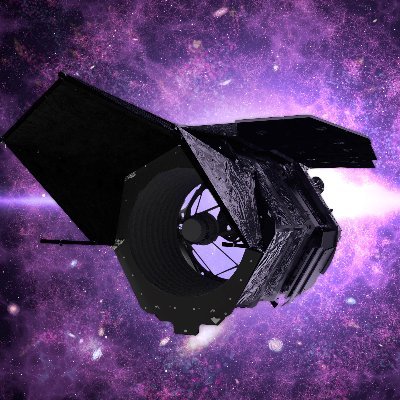
NASA’s Nancy Grace @NASARoman Space Telescope is now in space and beginning the journey to its operating location near the Sun–Earth L2 Lagrange point, roughly 1.5 million kilometres, or just under one million miles, from Earth. Roman launched on August 30, 2026, aboard a @SpaceX Falcon Heavy from Kennedy Space Center, and separated successfully from the rocket about half an hour later. It will spend roughly three months travelling toward L2 while engineers gradually deploy, activate, test and calibrate its systems and instruments. On August 31, the spacecraft completed its first planned mid-course correction, a short engine burn that refined its trajectory toward L2. L2 is one of five Lagrange points produced by the gravitational interaction between the Sun and Earth. They are often described as places where gravitational forces “balance,” although physically the situation is a little more subtle: in the rotating Sun–Earth system, the combined gravitational acceleration of the Sun and Earth allows a spacecraft near L2 to orbit the Sun with the same angular period as Earth despite being farther from the Sun. Roman will therefore not remain motionless at L2. Like the James Webb Space Telescope, it will follow a large halo orbit around the L2 region and will occasionally perform small station-keeping manoeuvres to prevent its orbit from drifting. L1, L2 and L3 are dynamically unstable, while L4 and L5 are stable. For an astronomical observatory, L2 is an extremely useful environment. The Sun, Earth and Moon remain roughly in the same general direction from the spacecraft, making it easier to keep them away from the telescope’s observing direction and to maintain a relatively stable thermal environment. At the same time, Roman remains close enough to Earth for high-rate communications and receives essentially continuous sunlight for electrical power. These advantages are among the reasons JWST also operates around Sun–Earth L2. Once Roman is commissioned, its main strength will be its combination of Hubble-class angular resolution with an enormously larger field of view. Its 300-megapixel Wide Field Instrument will survey large areas of the infrared sky rapidly rather than concentrating primarily on individual targets. Roman is expected to return around 1.4 terabytes of data per day, allowing astronomers to study the distribution and evolution of galaxies across cosmic time on an unprecedented statistical scale. Those surveys are designed to investigate some of cosmology’s central problems, particularly the nature of dark energy, the distribution of dark matter, and the growth of large-scale structure. Roman will also conduct extensive exoplanet studies, including gravitational microlensing surveys capable of detecting planets that are difficult to find with transit or radial-velocity methods. The observatory also carries a Coronagraph Instrument, primarily a technology demonstration, that will suppress starlight sufficiently to directly image and characterize some giant exoplanets. The technologies demonstrated by this instrument are particularly important because more advanced versions could eventually contribute to missions such as the proposed Habitable Worlds Observatory, whose long-term objective includes directly imaging potentially Earth-like planets around nearby stars. Roman’s coronagraph therefore has scientific value of its own, but it is also an important technological step toward much more demanding future observations. Roman’s journey to L2 is consequently not simply a transfer from Earth to a distant fixed point. It is the beginning of an extended commissioning process in which the observatory is being configured and calibrated while travelling toward a carefully controlled orbit around L2. NASA expects the transfer and commissioning phase to take roughly three months, with the first public images anticipated in early 2027. What I find most interesting about Roman is that its real scientific advantage is not simply obtaining sharper or deeper individual images. Hubble and JWST already perform exceptionally well in that regime. Roman changes the scale of the experiment: it combines high-quality space-based imaging with surveys containing enormous numbers of galaxies and stars. For cosmology in particular, that statistical power is what makes it such an important mission.
33
331
18
1,446
31,114
Thank you to all the Physics teachers out there who are about to start the Academic year. Whether it is your first year, or your 30th year, just remember how special you are! “In the beginning there was nothing, which exploded.” – Terry Pratchett
2
2
400
Chat Physics retweeted
Next stop, Mercury. After an eight-year journey, ESA/JAXA's BepiColombo is nearing arrival at its destination. Explore the key milestones, timeline and science behind the mission in our new media kit: esa.int/Science_Exploration/…
27
249
17
1,210
98,591
Chat Physics retweeted
One week to go till publication day!
32
48
3
395
12,778
Chat Physics retweeted
Confirmation from the Examiners Report that the last question on the AQA GCSE Physics Paper 2 Combined Science paper with the typo/error meant all students were awarded all 5 marks for that question regardless of if they attempted it or not.
5
4
1
86
28,617
Think you’ve got what it takes to survey the sky? Control NSF–DOE Rubin Observatory's telescope and try to detect the most objects with our interactive, 60s game: Space Surveyors! 🎮 How many can you catch before the sun rises? Drop your score below👇 spacesurveyors.app
1
7
2
32
1,947
Most asteroids pose no threat, but tracking the ones that could starts with knowing they exist at all. Over the next decade, NSF–DOE Rubin Observatory will reveal millions more, including ~90k near-Earth objects☄️ 🎥: NSF–DOE RubinObs/NOIRLab/SLAC/AURA/R. Proctor
17
67
2,760