

Council on Energy, Environment and Water. Among Asia's top not-for-profit independent policy research institutions, impacting sustainable development at scale.
New Delhi
Joined June 2011
- Tweets17.9K
- Following1.3K
- Followers18.2K
- Likes5K






Pinned Tweet
Delhi's air turns twice each winter, and only the first turn gets the headlines.
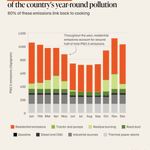
The first PM2.5 peak arrives with the stubble burning season and pushes the weekly average past 250 µg/m³—the 'severe' threshold on India's air quality index. That peak has been the subject of many TV debates. The reason it recurs is duller than the debates. A long-duration paddy variety leaves a farmer about 20 days to clear the field before wheat has to go in. Whether it burns depends on what else is available to them in those 20 days, and at what cost. Our work across Punjab and Haryana has been around these questions and behaviours. A survey of 1,500 farmers across 12 Haryana districts, and another on monitoring burning from space, is out later this week. Both are about where help is still needed.
The second peak follows weeks later: winter biomass burning. Through the coldest weeks, wood, dung cakes, crop waste and whatever else is to hand are burnt for warmth—on construction sites, at guard posts in gated housing colonies, in homes in informal settlements with no affordable alternative. Thousands of small fires rather than one large source, which is what makes it hard to see and harder to govern.
The rest of the year is the relatively cleaner stretch. Through the monsoon, weekly averages fall to around 27 µg/m³, inside the national 24-hour standard of 60, and about a tenth of what the city breathes at its November peak.
Delhi has just had its October: the month everyone photographs, when the saptaparni comes into flower and the whole city smells of it. On this chart and outside our windows, that month is the end of the cleaner stretch, with the line already climbing.
In a jugalbandi, two musicians play different instruments in the same composition. Neither leads, neither follows. This winter we will be talking about both halves of the answer: what a citizen can do, and what the state must. Stay with us.
Check out our work on Clean Air: ceew.in/publications?field_f…

For cleaner air, what happens in the kitchen matters.
Our analysis finds that around 50% of India’s year-round PM₂.₅ emissions come from residential sources, with the majority of these emissions linked to cooking.
The Pradhan Mantri Ujjwala Yojana (PMUY)—the government’s scheme to provide LPG connections to women from low-income households—has helped make a significant dent in household air pollution. In FY2025–26, it helped avert an estimated 834 kilotonnes of primary PM₂.₅ emissions, around 15% of India’s household PM₂.₅ emissions.
Yet many households continue to use solid fuels alongside LPG, particularly when refills are expensive or access is limited.

A new CEEW study, Clean Cooking for Cleaner Air: LPG and Beyond in the Indo-Gangetic Plain, finds that affordability remains a key barrier to sustained LPG use.
🔎 The study proposes:
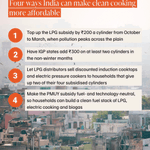
💰 More affordable LPG refills, including a ₹200 winter top-up for PMUY households
🏛️ State-level support for households facing affordability barriers
⚡ Discounted electric cooking devices to support fuel switching
🌱 A fuel- and technology-neutral subsidy to help households build a cleaner fuel stack of LPG, electric cooking and biogas


Cleaner air will require making clean cooking not just available, but affordable and reliable for households across the Indo-Gangetic Plain.
📖 Read CEEW’s ‘Clean Cooking for Cleaner Air: LPG and Beyond in the Indo-Gangetic Plain’: ceew.in/publications/clean-c…
✍️ Rahul Das, Surya Shekhar Auddy, and @Abhishek_Kar_AK

🇮🇳🇩🇰 CEEW hosted a delegation from the Embassy of Denmark in India: @LuquinTorres (Sector Counsellor, Food & Agriculture), Bala Panchanathan (Junior Commercial Advisor) and Lila Hjort (Intern), to explore India-Denmark collaboration on food and agriculture.
Denmark's strengths in agricultural innovation, technology and knowledge transfer can complement India's priorities across:
🐄 Dairy and livestock: animal health, welfare and productivity
🥛 Food safety: stronger regulatory systems, monitoring and institutional cooperation
♻️ Circular bioeconomy: biogas, biofuels and turning agricultural waste into valuable resources
🌱 Future food systems: alternative proteins, resource efficiency and sustainable value chains
As India and Denmark build on their Green Strategic Partnership, research, government, industry and civil society can turn shared knowledge into policy and practice. 🤝
Apoorve Khandelwal, Dr Chandan Jha, Dr Paavani Sachdeva, Palak Khanna, Ruchira Goyal, Bhamini Jain, Astha Chandra, Rishav Thakur, Mridul Khanna


326
❄️ The gas in your air conditioner that keeps your surroundings cold and comfortable is about to change. India is in the process of selecting the alternatives, and some of the options turn into pollutants that never go away.
📢 At Refcold India in Pune, the Council on Energy, Environment and Water (CEEW) launched its new policy brief, ‘Paving India’s Pathway to HFC Phasedown’, during the awards night powered by Copeland.
@BajajPushp, CEEW, co-author, set out the question: as India’s hydrofluorocarbon (HFC) phase-down begins with a freeze in 2028, should it move through hydrofluoroolefins (HFOs), or leapfrog directly to natural refrigerants?
🔍 What the brief finds: some HFOs break down into trifluoroacetic acid (TFA), a per- and polyfluoroalkyl substance (PFAS) that resists natural degradation. Natural refrigerants avoid this, but need careful safety management.
✅ What it recommends:
1️⃣ Choose a pathway that lasts: fixing global warming should not create a new problem.
2️⃣ Judge alternatives on full lifecycle impact: global warming potential alone is not enough.
3️⃣ Build the ecosystem: technical and financial support, workforce training and certification, and standards.
Dr Sheetal Jain, Programme Associate, CEEW, presented ‘Beyond HFOs: Why India should leapfrog to natural refrigerants’ at the session ‘Transition towards clean systems applying natural refrigerants’, part of INDEE³, the Indo-Norwegian project ‘Sustainable Cooling and Heating in India’. In her address she said “Every refrigerant transition is costly. India cannot afford to pay for two: first to HFOs, and then away from them”
🛠️ None of this works without technicians who know how to install and service these systems safely, so skills have to keep pace with the refrigerants transition.
Thank you to Refcold India, Copeland, @ishraehq, Norwegian Environment Agency, INDEE3, SINTEF Ocean, @NTNU, SINTEF Energy Research, @iitmadras, Indian Institute of Science (IISc), @bitspilaniindia, @AEEE_India, Indian Institute of Technology, Kharagpur and International Institute of Refrigeration, Prof Rajagopal Saravanan, Dr. Kristina Widell and Mitsuko Komada for your support.
Dr Sheetal Jain, Dr Pushp Bajaj, Dr Vishwas Chitale
📖 Read CEEW’s ‘Paving India’s Pathway to HFC Phasedown’: ceew.in/publications/hfc-pha…
✍️ Sonal Kumar, Rishabh Shandily and Pushp Bajaj

1
188
🎣 Arnab, Murasu, and now Akvan: India has made significant progress in forecasting cyclones and evacuating people before they strike. But for communities whose homes, farms, boats, livestock and businesses are hit, the crisis doesn’t end when the storm passes.
In @scroll_in, Shreya Wadhawan (Programme Lead) and Vishwas Chitale @vishchi (Fellow) make the case for putting livelihoods at the centre of the next phase of cyclone preparedness—with anticipatory finance and other measures that help people protect what they depend on, before disaster strikes.
Read the full piece 👇
scroll.in/article/1097195/as…

1
246
CEEW retweeted

Join us for inaugural session of NIUA’s #YouVichar2.0 Webinar Series with Ms Kunalika Gautam, Youth Engagement Lead, @CEEWIndia, as she discusses youth participation, leadership & action for sustainable cities.
📅 20 Nov '26 🕐 1–2 pm (IST)
Register: sl1nk.com/6aa407n

Steel and aluminium are the backbone of the energy transition, and at the EU’s border, their carbon footprint now has a price. At @turkiyecop31, Ravi Prasad, Distinguished Fellow, CEEW, joined a side event with @climatestrat, @SEATINIUGANDA and Forum on Trade, Environment & the SDGs (TESS) on how producing countries can turn that shift to their advantage. For India, now the world’s second-largest steel producer, the stakes are high.
🏭 Treat decarbonisation as industrial strategy. Capacity built today should fit tomorrow’s low-carbon pathways, so it doesn’t become a stranded asset.
💰 Keep carbon value at home. Under the EU’s border mechanism, carbon costs already paid domestically can be deducted at the border. A credible domestic carbon price or standard supports decarbonisation and keeps more of that value in the country.
🔁 Count emissions once. Interoperable carbon accounting and mutual recognition of standards would spare exporters, especially smaller firms, from proving the same reductions to every market.
🏛️ Give trade a home in climate talks. Our recent study proposes a Technical Standing Committee, with its mandate agreed at SB66 in 2027.
The countries that come out ahead will treat industrial growth and decarbonisation as a single agenda.
📖 Read "Climate and Trade: Strengthening Cooperation through the UNFCCC" at ceew.in/sites/default/files/…
Ana Paola González Alonso, Herbert Kafeero, Miriam Garcia, Ravi Prasad, Yasmin Ismail, Anthony Dane and Chantal Line Carpentier
#CEEWatCOP31

3
185
🌳 As COP31 enters its second week, the Forest Roadmap faces a crucial test: can we not even decide on forests?
A new CEEW issue brief, Making the Forest Roadmap Work: Forest Finance, Deforestation-Free Trade, and Priorities for COP31, analyses 174 submissions to the COP30 Presidency’s consultation on Forest Roadmap through three lenses: forest finance, trade measures and cross-cutting issues.
🔎 What do the submissions tell us?
💰 Finance remains a major gap: 233 actionable asks call for direct finance for communities, an operational Roadmap, and support for producers meeting new market requirements.
🌍 Delivery needs stronger systems: The Roadmap needs a clear institutional home, budget and reporting mechanism, with stronger representation for forest countries.
🌱 Trade measures bring new challenges: The EU Deforestation Regulation could strengthen demand for deforestation-free supply chains, but compliance costs may fall disproportionately on smaller producers.
For COP31, the study sets out priorities to make the Roadmap operational, improve access to forest finance, support producer-country compliance, and align public and private finance with forest objectives.
The test for the Forest Roadmap is not just ambition-but whether it can create the conditions to deliver it.
📖 Read the issue brief: Making the Forest Roadmap Work: Forest Finance, Deforestation-Free Trade, and Priorities for COP31 at ceew.in/publications/forest-…
✍️ Joy Rajbanshi, Dr. Johns Tiyndel G and @Dr_VaibhavCh

3
275
CEEW retweeted

What stood out from the first week of #COP31?
Our Nonresident Fellow @ShuvaRaha was on the ground in Türkiye, tracking the key discussions shaping the future of climate action and global cooperation.
Watch Shuva's reflections on the first week of COP31 and what the discussions could mean for the road ahead.
@CEEWIndia
#ClimatePolicy #ClimateResilience #Turkiye
Your festive polyester will outlive you.
What On Earth!® is rooting for nature-based materials instead, before 2176’s archaeologists start digging.
More cartoons here: ceew.in/what-on-earth
#WhatOnEarth

2
188
#Opinion | At COP31, India must push for climate finance alongside its interests
In @NavbharatTimes, @pallavi_saice, programme lead at CEEW, writes: For India, the most important issue at COP31 should be securing climate finance. It must advance collective efforts while protecting its own interests.
Read the full op-ed here👇

2
231
In this week’s #CEEWExplains, Nicole Almeida digs into a new CEEW–NRDC study on India’s green jobs to find out where the work is, who’s being left out, and what it will take to get India’s workforce ready for 2030.
Delhi moved from ‘Moderate’ to ‘Very Poor’ within two days in early November, and restrictions have since been put in place under GRAP stage III.
After Diwali, the firecracker contribution fell sharply, yet after the brief dip, the air returned to the ‘Very Poor’ range.
Prarthana Borah, Fellow at CEEW, highlights that in the coming days, vehicular tailpipe emissions and road dust together remain the highest contributors to PM 2.5 pollution in Delhi.
@prarthana_delhi

#Opinion | Expectations from the UN climate conference
In @Lokmat_Samachar, @sumitprd, Senior Programme Lead at CEEW, writes: When warming is breaching its limits, adaptation is not an option but a question of survival.
Climate finance growth slowed to 2.5% in 2025, from 6% in 2024 and 16% in 2023.
Read the full piece:

1
197
#Opinion | India’s climate-tech challenge: Bridging the industry–incubator gap
India has no shortage of climate-tech innovators — or capital. Yet too many promising startups struggle to move beyond pilots and secure the industry partnerships, procurement pathways and market validation needed to scale.
In @htTweets, @GunjanJ3 (Senior Programme Lead, CEEW) and Srivardhini Jha (Professor of Entrepreneurship, IIM Bangalore) argue for a new model of climate-tech incubation, where industry and incubators work together much earlier — from identifying real operational challenges to creating pathways for first deployment and procurement.
The goal is to move beyond the “death by pilots” problem and help climate-tech innovations survive, scale and endure in real markets. Read the full piece 👇
hindustantimes.com/ht-insigh…

1
208
CEEW retweeted

A joint team from the @CEEWIndia and #Google visited #APCNF farmers across Guntur and Eluru districts on October 25–26, 2026, to gain first hand insights into farmers’ agricultural practices, decision making and information needs. Through interactions with farmers at different stages of their #NaturalFarming journey, the team explored their choices between natural and chemical inputs, sources of agricultural advice, the role of community institutions and the potential of digital tools in supporting informed farm decisions. The visit provided valuable perspectives on farmers’ ground realities and highlighted the importance of farmer centric approaches in shaping effective agricultural advisory solutions.
@vijaythallam @AndhraPradeshCM @rajbudithi65
@ap_agriculture @icarindia @FoodPlanetPrize
@FCGulbenkian
#SustainableAgriculture #RegenerativeAgriculture #Agroecology #SoilHealth #HealthySoils #FarmerCentredResearch #AgriculturalResearch #EvidenceBasedResearch #ClimateResilience


CEEW retweeted

Beneath India’s surface lies untapped clean energy.
This technical session looked at the pathways for scaling up geothermal in India, whose resources hold potential for electricity generation, industrial heating and cooling, with @CEEWIndia as Knowledge Partner.
@mnreindia @isolaralliance
#BharatRESummit2026 #geothermal #cleanenergy
CEEW retweeted
A platform for meaningful dialogue, regional perspectives and collaborative action towards advancing India’s renewable energy ambitions.
The State Session on Uttarakhand brought together key stakeholders to exchange insights and explore opportunities for accelerating the state’s clean energy transition.
@mnreindia @isolaralliance @CEEWIndia
#BRESummit2026 #BharatRE2026 #RenewableEnergy #Uttarakhand #CleanEnergy #EnergyTransition