

Risk committee in my head has Zero voting rights.
Joined June 2021
- Tweets20.8K
- Following1.3K
- Followers2.8K
- Likes23.9K







BUNT 🔜 DEVCON 8 🇮🇳 retweeted

Apart from it's novel d(3,3) model, the biggest value proposition of @namidefi lies in its positioning as an all-in-one liquidity + yield coordination layer across chains.
Why so?
Rather than building isolated DeFi products, Nami's Omni Layer connects the entire user journey:
🔸 OmniSwap → Aggregates 16 providers for optimised same-chain + cross-chain execution, alongside MultiSwap.
🔸 OmniDeposit + OmniShift → Simplifies LP creation + migration across chains, allowing capital to follow better yield opportunities w/o the usual bridging + rebalancing complexities.
🔸 OmniGauge → Aggregates liquidity incentives across chains into unified markets, enabling veNAMI holders to vote once across multiple networks.
🔸 Nami Relayer → Automates voting, reward collection + reinvestment strategies.
imo the bigger picture is how these products reinforce one another.
More efficient execution + mobile liquidity enables deeper markets + trading activity → greater fee generation → stronger incentives for veNAMI voters + ogNAMI stakers.
Coupled with d(3,3)'s adaptive emissions, Nami is essentially building a multichain liquidity economy where capital efficiency, user experience + token value accrual are interconnected.
The interesting part isn't any single feature, but how the entire stack could compound adoption + economic activity across the ecosystem.
Worth a read 👇




City of Dreams is calling you 🌆
A little reflection on Mumbai, ambition, and everything that lies beyond our comfort zones. ✨
See you soon, Mumbai! 🇮🇳
@ETHIndiaco @EFDevcon
Hope y’all liked it
@yashascore
@thelearningpill
@0xspicexr
@Eli5defi
@kenodnb
@0xCheeezzyyyy
@tradeguru
@SachinHMx
@satyaki44
@Parthm71
@sakshimiishra

City of Dreams is calling you 🌆
A little reflection on Mumbai, ambition, and everything that lies beyond our comfort zones. ✨
See you soon, Mumbai! 🇮🇳
@ETHIndiaco @EFDevcon
BUNT 🔜 DEVCON 8 🇮🇳 retweeted

When @Starknet said it was preparing for the quantum era, I never thought they would go this hard😳
You know how when your wallet gets compromised, you abandon it and create a new one?
Years of onchain history and reputation, wasted?
StarkNet just launched a wallet that rivals how we react to that.
___________
Is anyone's balls tingling? Cause mine are!
When I first saw the announcement about @Bramble_fi two days ago, I just thought, well it's probably another wallet. But I was wrong.
Bramble is a STRK20 privacy wallet with three major features:
✓ account abstraction
✓ multisig
✓ built-in privacy
But the real magic of this wallet isn't even a feature on this list.
This build by starknet gave me a good chance to look at an idea that had not crosed the boundaries of reasonning for most people:
A wallet security upgrade. xitter.cf/Bramble_fi/status/2112…
On Bramble you don't just swap and store your crypto, you alone have full custody. Of course self-custody sounds boring because Rabby, Metamask and other basic wallets offer the same thing.
However, when you look at it from this angle, it changes how you see Starknet entirely.
In most wallets, your key is your account. If that key ever gets compromised, the only fix is to create a new wallet, and move everything.
On Starknet, you simply upgrade the security by swapping the compromised key, or set up a multisig.
You get to keep the same address and its history.
Bramble is live on mainnet but only as a Chrome extension for now. Download it only from bramble.fi, because fake links are already going around.
To be clear, this is Starknet preparing for quantum threats. Being able to adapt isn't the same as being fully protected, and the migration work is still going on.
I tested it by importing my EVM seedphrase, here's how I did it in tweet 2.


BUNT 🔜 DEVCON 8 🇮🇳 retweeted
On one of RWA-Fi's biggest infrastructure gap:
Demand for 24/7 access to tokenised equities is already evident.
According to @redstone_defi's recent report on tokenised stocks:
🔸~55% of tokenised stock trading occurs outside regular US market hours.
🔸~60-69% of spot volume across @solana, @RobinhoodCrypto , @BNBCHAIN + @base takes place while US equity markets are closed.
🔸 92% of onchain bStocks trading occurs outside US market hours, with activity picking up around the Asian trading day.
These highlights a fundamental demand that TradFi hasn't fully accommodated global investors that want access to US equity exposure w/o being constrained by Wall Street's operating hours.
But there's a catch.
Tokenisation enables 24/7 asset accessibility, not necessarily 24/7 liquidity, price discovery or settlement.
While onchain markets operate continuously, the underlying equities and their associated market infrastructure don't.
When traditional exchanges close, market makers face limited hedging opportunities w/ less reliable price discovery + increased exposure to reopening gaps.
This becomes particularly problematic when tokenised equities are used as DeFi collateral.
Lending protocols must continuously value collateral and execute liquidations, even when the underlying equity markets are closed.
As the report aptly puts it:
“What is the price at 3 AM on Sunday? Who takes the redemption risk?”
These questions highlight two fundamental challenges: reliable pricing + executable liquidity.
Without both, lending protocols may need to impose more conservative LTVs, larger liquidation buffers + tighter collateral requirements.
And this is where I think the next phase of tokenised equity infrastructure needs to evolve.
Beyond making assets tradable 24/7, the industry needs reliable off-hours price discovery, deeper secondary liquidity + settlement mechanisms that can support continuous financial activity.
Making an asset tradable 24/7 is one thing, making it reliable collateral 24/7 is another.



BUNT 🔜 DEVCON 8 🇮🇳 retweeted

Its clear @Pumpfun doesn’t need everyone to like it. It needs traders to keep coming back.
$PUMP has a potential sentiment rerating happening from launchpad to distribution business.
h/t to @DefiLlama for the data


BUNT 🔜 DEVCON 8 🇮🇳 retweeted

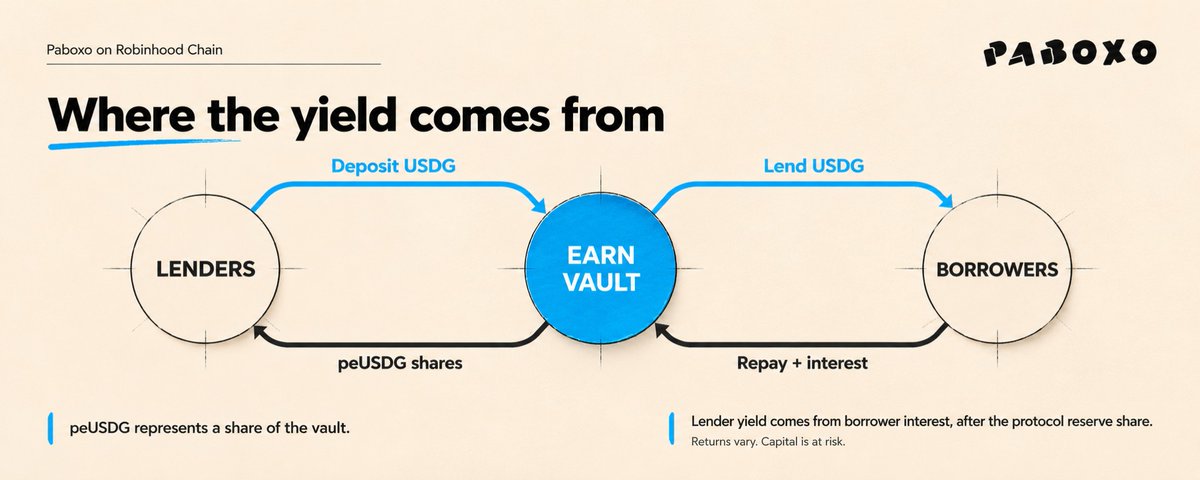
Why did we build @paboxoxyz from scratch?
Because tokenized stocks run on two different clocks.
The blockchain never stops. Stock markets and their price feeds do closing daily, and pausing on weekends and holidays.
That becomes critical when you use a stock token as collateral: a price from before the close doesn’t tell you what you could sell it for right now.
Most DeFi lending was designed for assets that trade 24/7. Tokenized stocks need lending rules that account for these market breaks.
So we built market hours into Paboxo:
- New borrowing and liquidations pause when the relevant stock market is closed.
- Collateral withdrawals against outstanding debt pause too.
- You can still repay or add collateral.
- Price-dependent actions require fresh oracle data.
We want people to borrow against their stocks without having to sell them. That starts with respecting how the underlying market actually works.
Paboxo v0 is now live on Robinhood Chain Mainnet.
This is our first step.


Paboxo is live: app.paboxo.xyz
Deposit USDG. Earn lending yield. Borrow against Stock Tokens.
Now open for deposits on Robinhood Chain.
BUNT 🔜 DEVCON 8 🇮🇳 retweeted
We're talking about trillions in tokenised assets potentially coming onchain over the next few years.
@pendle_fi is already leading the charge in building a fundamental layer for yield markets w/ PTs increasingly serving as the foundation for yield maxxing strategies through looping.
Yet, according to @tokenterminal, only 7.34% ($291M) of the $3.96B in tokenised stocks is currently captured within DeFi.
That leaves a massive opportunity for capital to become more productive as tokenised assets find their way into lending, collateral markets + structured yield strategies.
Asset productivity TVL has been hitting ATHs and imo we're still in the early innings.
The next leg of growth isn't just about bringing more assets onchain, but unlocking what those assets can actually do once they're there.
And that's where primitives like Pendle could become increasingly important.
Pendle 🫡


RWA markets that Pendle runs yield markets for:
1. Tokenized stocks
2. Private equity funds
3. Reinsurance
4. Treasuries
5. Structured credit.
6. AI infrastructure
7. Private credit
8. HELOC
In less than 4 years, Morgan Stanley expects the global tokenized RWA market to reach $3 trillion to $10 trillion.
We're so, so early.
BUNT 🔜 DEVCON 8 🇮🇳 retweeted
Crazy how fast it has been. It's pretty clear now that @aeroxyz will bootstrap liquidity before a larger distribution channel arrives.
And that distribution subsequently will send recurring flow into the already established pools + early liquidity spending will purchase a durable execution advantage.
Remember predictive allocation will rewards and revenue stream concurrently. Bullish on $AERO in the longterm.
h/t to @blockworksres for the data


AGM on the launch of tokenized stocks
"We had our first $100 million day in trading volume on Aerodrome"
"We're not even fully launched. Imagine once it's inside the actual retail app"
BUNT 🔜 DEVCON 8 🇮🇳 retweeted
Interesting breakdown by @Glasscade_xyz on how Ethena's Whitelabel business could become another meaningful value accrual driver for $ENA.
IMO, the bigger opportunity isn't necessarily the fees @ethena collects from partners, but how Whitelabel distribution could amplify $USDe supply + downstream ENA buybacks.
A few takeaways worth highlighting:
1. Dual-channels of value accrual
Ethena earns a share of partner reserve yields (5-15% estimated, 10% base case).
But the more interesting mechanism is how USDe-backed partner supply contributes to USDe circulation, potentially pushing ENA buybacks into higher tiers.
Under the report's assumptions, every $1B of USDe-backed reserves could contribute ~1.5-2x more through tier progression than through direct fees, while USDe remains below $20B.
2. Reserve composition > fee extraction
The report estimates that $2.5B in partner supply generates ~$8.6M annually through direct fees.
Yet just $625M of USDe-backed reserves, if sufficient to push USDe past the $10B threshold, could unlock an additional ~$29M in annual buybacks.
This makes the proportion of USDe in partner reserves arguably more important than maximising Ethena's revenue share.
3. The Ethena flywheel cuts both ways
USDe-backed partner supply can accelerate buybacks, but large redemptions could reverse the effect.
The report models a drop from $10.2B → $9.8B in USDe supply reducing the buyback levy from 10% → 5%, with annual buybacks falling from ~$58M to ~$28M.
A relatively small change in supply could therefore have an outsized impact on ENA buyback flows.
Whitelabel could evolve beyond a standalone revenue stream into a distribution engine for USDe, creating a reinforcing relationship between partner adoption, stablecoin supply + ENA value accrual.
As mentioned in the article, the caveat is that this depends heavily on USDe's share of partner reserves, sustainable demand + the exact implementation of the fee-switch tiers.
The latter is particularly important, as the report's larger estimates assume crossing a threshold reprices the entire revenue base rather than just the incremental portion.
Once again, highly recommend a read & follow👇


BUNT 🔜 DEVCON 8 🇮🇳 retweeted
Most people would value @ethena Whitelabel on the fee Ethena charges partners.
I believe that’s the smaller lever.
At a 10% cut, $1B of USDe backing inside a partner’s reserves earns about $5.7M a year for $ENA buybacks.
When we push that same $1B across one of $USDe’s fee-switch tiers and it’s worth ~$8-11M a year, because crossing a tier reprices all of Ethena’s core revenue and not just the partner’s slice.
So the benefits from every new Whitelabel deal hinges on the amount of reserves in USDe, and then the cut which Ethena takes.

BUNT 🔜 DEVCON 8 🇮🇳 retweeted
Quantum Tier List (2026)
Everyone says their chain is quantum ready but only a few can prove it.
👇 I ranked 34 "quantum" projects including the 28 on @Mars_DeFi's list based on
• quantum safety
• upgradability
• testnet/mainnet
• age + size
• privacy feature
S
.@QRLedger - every wallet has used XMSS feature, a hash-based signature quantum computers can't crack, it has been live since 2018, with multiple audits.
A
.@QuantusNetwork - uses quantum-safe ML-DSA signatures by default, but mainnet only launched this September.
.Abelian - quantum-safe lattice signatures since 2022, but its own custom design haa no public crypto audit.
.@tidecoin - uses Falcon, a quantum-safe signature, on every transaction since 2020, but it's a tiny network.
.@cellframenet wallets use Dilithium, a quantum-safe signature, by default, but adoption is small.
.@QoreChain - every transaction needs a quantum-safe ML-DSA signature, but mainnet only went live in June this year.
.@NeptunePrivacy - spending uses hash-based proofs, but it's a young chain.
.@NEARProtocol - quantum-safe ML-DSA keys are live since Jul 2026, and you can switch your account to them anytime.
.@Algorand - quantum-safe Falcon accounts are live since Aug 2026, and you can move an existing wallet over.
B
.@Starknet - its proofs are quantum-safe, but your wallet keys aren't yet, and the safe wallet is just a demo.
.@solana - an outside team built a quantum-safe vault you can opt into, the chain itself isn't quantum safe.
.@NervosNetwork - an optional quantum-safe lock exists, but you have to move funds into it.
.@trondao - quantum-safe Falcon and ML-DSA keys are being tested on its testnet.
.@tezos - testing quantum-safe ML-DSA accounts on a special testnet.
.@QANplatform - is integrating quantum-safe Dilithium signatures, but still on testnet only.
.@quipnetwork - building earky stage quantum-safe accounts for coins on other chains, still on testnet.
.@Aptos - its quantum-safe SLH-DSA accounts are coded but still waiting for a governance vote to switch it on.
.@SuiNetwork - made its first quantum-safe transaction on a dev network this month, and mainnet is targeted for 2027.
.@Tensorcash - you can create quantum-safe ML-DSA addresses, but it's a small, new network.
.Bitcoin BIP-360, a proposal for quantum-safe addresses, is still a draft
C
.@ethereum - still researching quantum-safe upgrades, most likely years away.
.@zksync - its proofs are quantum-safe, but user accounts aren't.
.@Zcash - plans for quantum-safe signatures, but nothing shipped yet.
.Qoneqt - claims a quantum-safe vault, but can't verify anything yet.
.@injective - said last week it started building toward a quantum future, but no details yet.
.@monad - quantum-safe keys are still on their roadmap.
.@aztecnetwork no quantum plan or anything substantial published yet but Mars included it in his list
.@mindnetwork_xyz - focuses on encryption, not quantum-safe signatures but seems they frame that as quantum
.@NexusMutual - security-focused imo, no quantum plan
.@Qubic - quantum-themed only, maybe to join the hype, but little real quantum-safe tech.
.@GeeqOfficial - only security claims, no quantum details
.AME Chain - claims to be quantum-secure, little public proof
.QuStream - quantum claims, little public detail
Bottom line:
Most of crypto still runs on keys a quantum computer could break. Only one project here clears every bar today and that's @QRLedger.
But there's room for growth and tech like this would take years to perfect👌


Free Crypto Transactions Tier List 2026
Ranked by real cost removed for users, repeatability, accessibility and networks covered.
Bookmark for later ↓↓
1| @OneKeyHQ - free transfers and in-wallet swaps on select tokens on Ethereum, Arbitrum, BNB Chain, Polygon, Base & Tron
➥ Up to 10 free trxns/day on any of the above chains and 1 trxn/day on Tron
2| @TokenPocket_TP - free token transfers on BNB, Polygon, Solana & Tron
➥ BNB; 2/day for USDT & unlimited for USD1, Polygon; 2/day for USDC, Solana; 3 SPL trsf/day (USDC, USDT, BONK, JUP except SOL)
3| OKX @wallet - free transfers on @XLayerOfficial for USDT & USDC only
4| @TrustWallet + @Backpack - free stablecoin transfers on @Plasma
5| @Stable - free USDT P2P transfers on @stablechain
6| @worldnetwork - free trxns on supported tokens @world_chain_ including stablecoins
7| @SuiNetwork - free P2P transfers on Sui
➥ Supported tokens are: USDC, USDsui, SuiUSDe, AUSD, FDUSD, USDB, USDY, with a minimum approx 0.01 token
8| @BitgetWallet - only first USDT transfer on Tron is free, later transfers are discounted
9| @fusewallet - Free sponsored transactions on Solana
➥ Free tier includes 5 trxns/month; further sponsorship requires Fuse+ subscription
10| @Rabby_io - 0% Rabby swap fee across 40+ chains
➥ Other fees like gas, dex fees and bridge fees may still apply.

BUNT 🔜 DEVCON 8 🇮🇳 retweeted

The @pendle_fi team just made funding-rate arbitrage simpler.
The new @boros_fi spread markets reduce the arbitrage setup from 4 legs to 3.
Here's what changed and how it works. 🧵


